

Two liters of displacement, turbocharging, direct fuel injection FSI and all-wheel drive Quattro — this set of ingredients allowed the Ingolstadt manufacturer to create a very attractive offering in the compact premium sedan class.
2005 Audi A4 2.0 TFSI Quattro
© Photo: Stanislav Shustitsky, 5 Koleso
On our roads, where the quality of the surface leaves much to be desired, and for a significant part of the year the asphalt is hidden under a layer of moisture, dirt, reagents or ice, all-wheel drive for a passenger car is an extremely useful thing, even more in demand than in those regions where this car comes from. A properly implemented all-wheel drive scheme can radically change the feel of everyday trips for the better. Audi, being a pioneer in this field, has the right to set the standard for what all-wheel drive should be considered exemplary.
2005 Audi A4 2.0 TFSI Quattro
© Photo: Audi
Under the hood here is a longitudinally mounted two-hundred-horsepower "turbo-four" producing 200 hp. We are dealing with the proprietary permanent Quattro scheme built on a Torsen center differential. Now almost all automakers are somehow developing all-wheel drive systems for regular cars. Electronic clutches and other modern solutions have noticeably progressed, giving the driver decent feedback and good efficiency, but the time-tested classic has not lost its significance either.
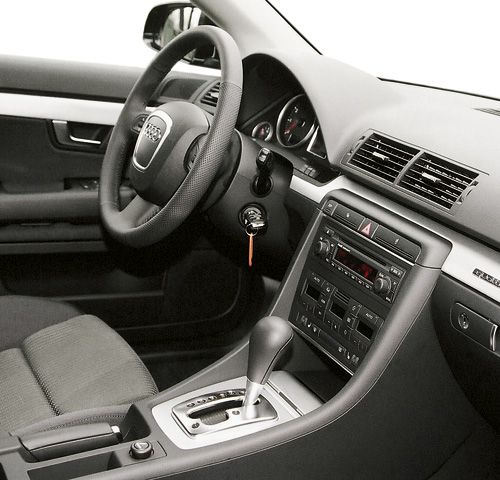
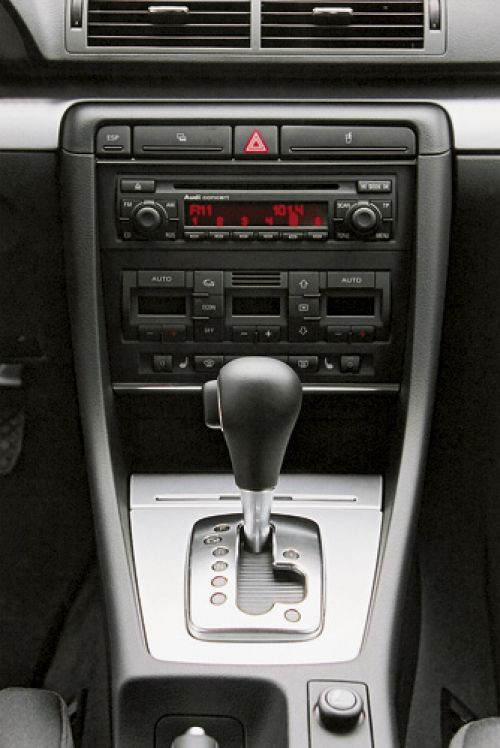
In the design of Audi in recent years, healthy conservatism reigns. The same proportions, the same recognizable profile, the same strict and restrained interior trim. There are few elements and lines, but each of them is flawless and executed with the highest quality. A similar approach is also seen in ergonomics — all time-tested solutions. There is essentially nothing to find fault with.
The soft suspension with increased travel makes it clear that we have a fast but not too sporty prestigious car. Acceleration to 100 km/h in 7.7 seconds and a top speed of 235 km/h allow the Audi A4 2.0 TFSI Quattro on an average highway (that is, of Russian quality) to not yield even to the most charged competitors. And if the weather turns bad, the circle of rivals capable of maintaining its cruising speed becomes very narrow.
The price for comfort is noticeable vertical body pitching — it makes itself known on long transverse irregularities at speeds above 130 km/h. But you should not be afraid of this effect, although it may seem alarming at first. The large rebound travel reserve does not allow the wheels to lose traction with the road, so control always remains reliable, and the energy intensity and compression tuning do not allow the suspension to bottom out. At times it seems that an impact is inevitable, but each time everything goes smoothly, which breeds trust in the car and a calm attitude to surprises of the road surface.
2005 Audi A4 2.0 TFSI Quattro
© Photo: Audi
The chassis as a whole is excellent and provides the signature Audi handling character — not emotional, but precise, linear and imperturbable at any speed. Its only drawback was noticeable vibrations of unsprung masses. However, given the dynamic capabilities of the car, it would hardly have been possible to avoid this without losing comfort.
Powerful brakes and drive shafts on all wheels themselves weigh a lot, and the suspension, remaining soft, is simply unable to dampen their vibrations in the bud.
The smaller the turning radius, the lower the speed and the slipperier the road, the more reluctant the car is to enter a maneuver — however, this is typical of any car. But even on pure ice, understeer does not go beyond acceptable limits: making the car turn is a matter of the driver's ability to properly load the front axle at the turn entry, careful steering and patience.
With increasing speed, the A4 2.0 TFSI Quattro becomes more responsive to steering inputs, and after 80–90 km/h it reacts to barely noticeable movements. At medium speeds, the car obeys both the steering wheel and the throttle perfectly, allowing you to choose any driving style and correct the trajectory at any moment.
2005 Audi A4 2.0 TFSI Quattro
© Photo: Stanislav Shustitsky, 5 Koleso
During measured driving, almost nothing is heard in the cabin, only around 100 km/h aerodynamic noises begin to dominate. If you press the gas pedal properly, the engine emits a quiet, noble sound, audible both inside and outside. For active driving, you can select the sport mode of the automatic, switch to manual shifting, or stay in standard Drive.
Overall, the car leaves a very pleasant impression — primarily due to the integrity of its character and the well-balanced combination of all qualities. The two-liter turbo engine perfectly suited the not-heavy "four." The Audi A4 2.0 TFSI Quattro has no problems with weight distribution and front suspension endurance inherent in V6 versions. At the same time, 200 hp is quite enough so that permanent all-wheel drive on any surface does not feel like extra weight. An indirect confirmation of the chassis's success is the fact that it is precisely such cars that the Quattro driving school uses, which we will talk about next.
The Audi A4 2.0 TFSI Quattro is a precise tool in control and a quality thing in sensations; a symbol of prosperity and sense of proportion, strength and elegance. A serious car.
Technical specifications of Audi A4 2.0 TFSI Quattro
Body – sedan
Curb weight, kg – 1535
Gross weight, kg – 2085
Dimensions, mm:
- length – 4586
- width – 1772
- height – 1427
Wheelbase, mm – 2648
Trunk volume, l – 460
Maximum speed, km/h – 235
Acceleration time to 100 km/h, s – 7.7
Reference fuel consumption, l/100 km:
- urban cycle – 13.1
- suburban – 7.2
- combined – 9.4
Engine:
- type – petrol, inline, 4-cyl., with direct injection, turbocharging with charge air cooling, DOHC
- displacement, cm3 – 1984
- power, hp at rpm – 200/6000
- torque, Nm at rpm – 280/1800–5000
Transmission – 6-speed automatic, tiptronic
Drive – permanent all-wheel drive quattro®
Price, $ – from 48,127
Advantages and disadvantages
+ Quality, comfort, handling, dynamics, all-wheel drive.
– Vibrations of unsprung masses.