
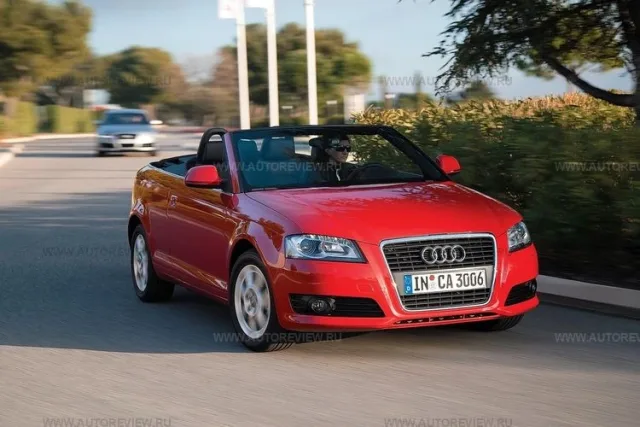
I stand before a row of convertibles and catch myself thinking: maybe we shouldn't laugh at women who choose a car solely by color? Here's the Audi A3 Cabriolet. Technical details? Later. Right now, I desperately need to start getting acquainted with the red car. Or take the white one? No, stop—only the red one. But I won't take the gray one, even if there were a dozen cylinders under the hood.
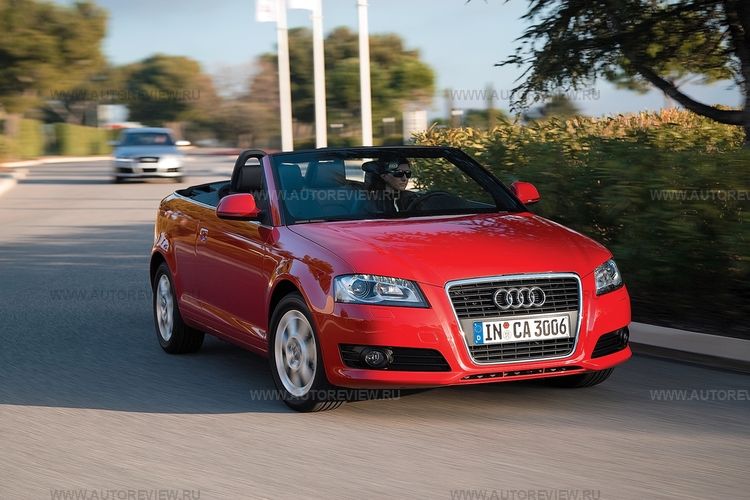
And another question: why, in a palette of fifteen shades for the new convertible, are there as many as three—these are variations of gray? Don't the Germans, not to mention the British (and it's they who buy the lion's share of open-top cars in Europe), burn with the desire to add some yellow or orange to life? But such colors simply aren't on the list. There are three blues, green, beige, and black. True, there's something to console oneself with: the interior can be ordered dark, light, or red—the latter, to my taste, is the most striking. Plus three colors of fabric roof—black, blue, and again red. Multiply all this—you get 135 combinations.
So, before me is a red Audi A3 Cabriolet. The base model is already five years old—by automotive standards, a respectable age, but the convertible looks surprisingly modern. The sculpted front bumper with an integrated radiator grille—here it's called single-frame—like on the latest sporty Audis. The headlights are of a familiar shape, but inside hides an intrigue: a pair of wavy partitions and a garland of daytime running LEDs. The rear lights are also outlined with LED tubes, so even at night it's immediately clear: this isn't just an Audi, but specifically an A3 Cabriolet.
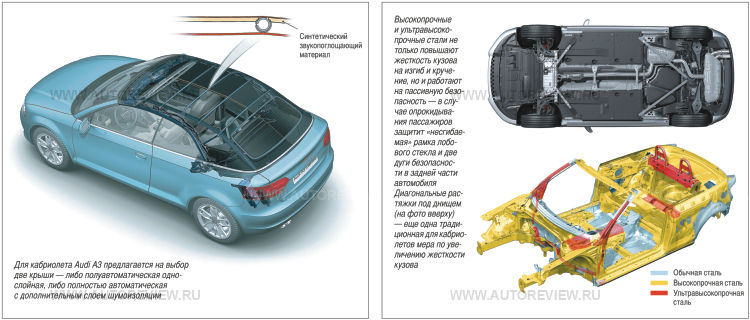
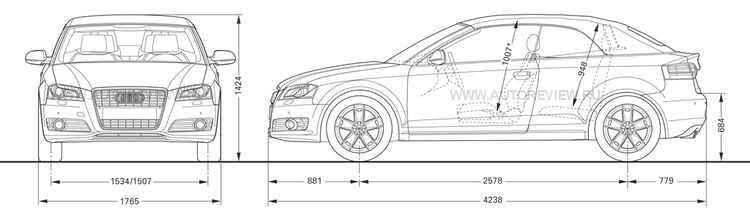
The profile turned out expressive. Unlike most convertibles, which are built on the basis of sedans or coupes, this one is made from a hatchback, so the fabric "skullcap" seems shifted back. In length, the convertible is only 2.4 cm longer than the three-door A3, but almost five centimeters shorter than the five-door Sportback. A compact and taut silhouette! And at the same time—four full seats and a trunk of 260 liters. True, it's not too spacious, and the opening is a bit narrow, but the rear seat backs fold down in parts, opening a wide rectangular window into the cabin. It can fit not only a snowboard, as in the recent BMW 1 Series convertible (see AR No. 3, 2008), but also a folding bicycle. Moreover, the trunk volume doesn't depend on the roof position—it retracts into a separate compartment, and two hydraulic cylinders deftly handle it in a record nine seconds. The top closes in eleven—also a record for convertibles with fully automatic drive. Even a short stop at a traffic light is enough. Or you can not stop at all—just reduce speed to 30 km/h. I checked: it works. Although the Z-shaped metal frame seemed to me a mechanism both precise and rather fragile.
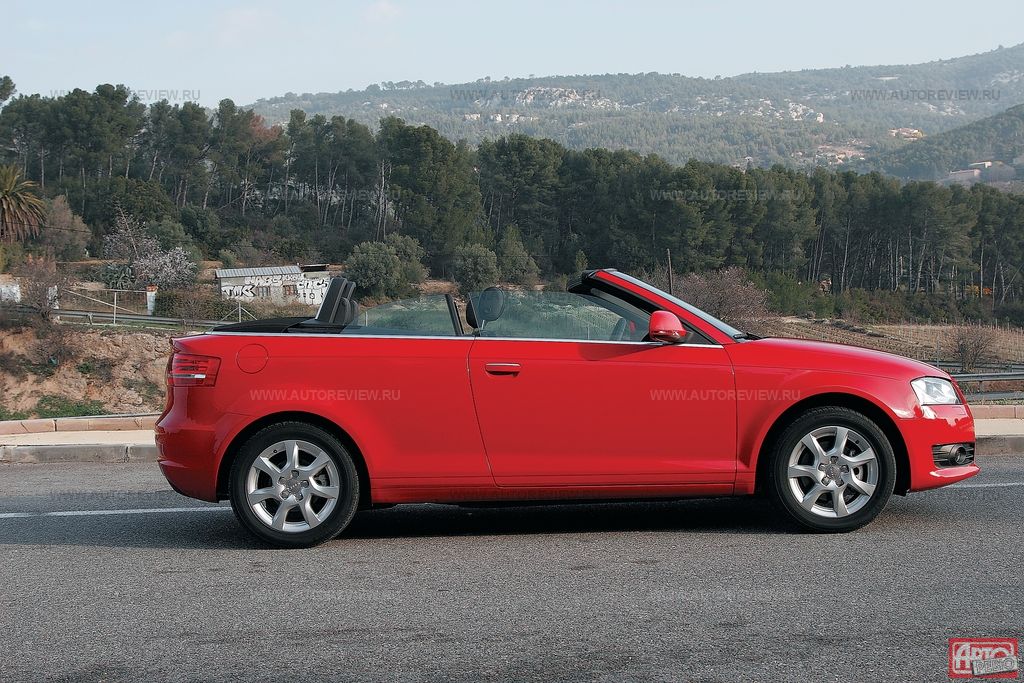
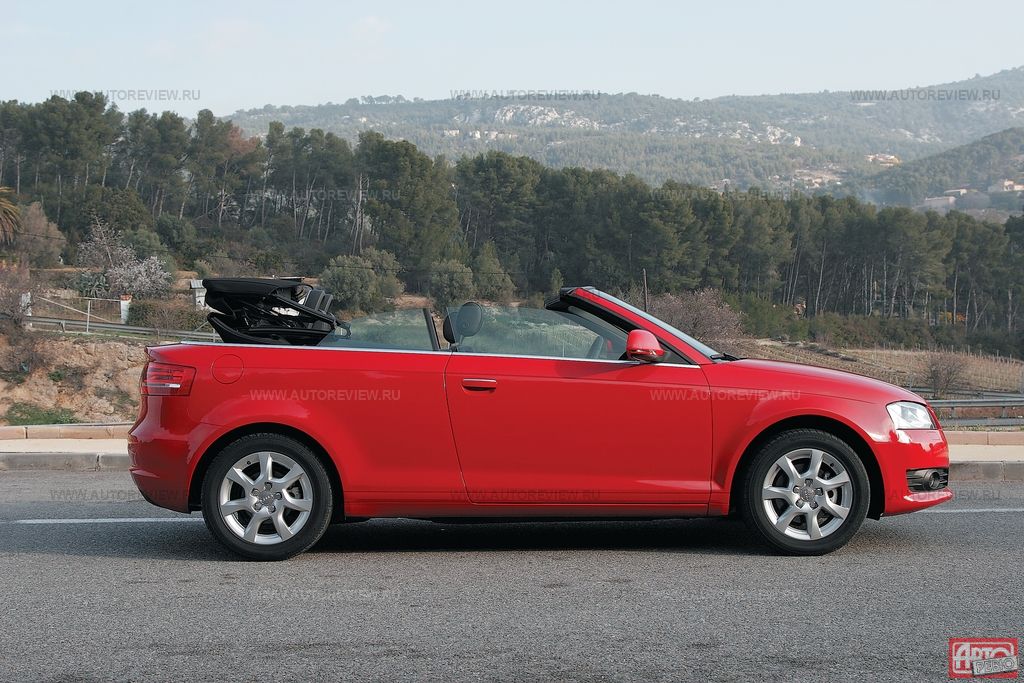
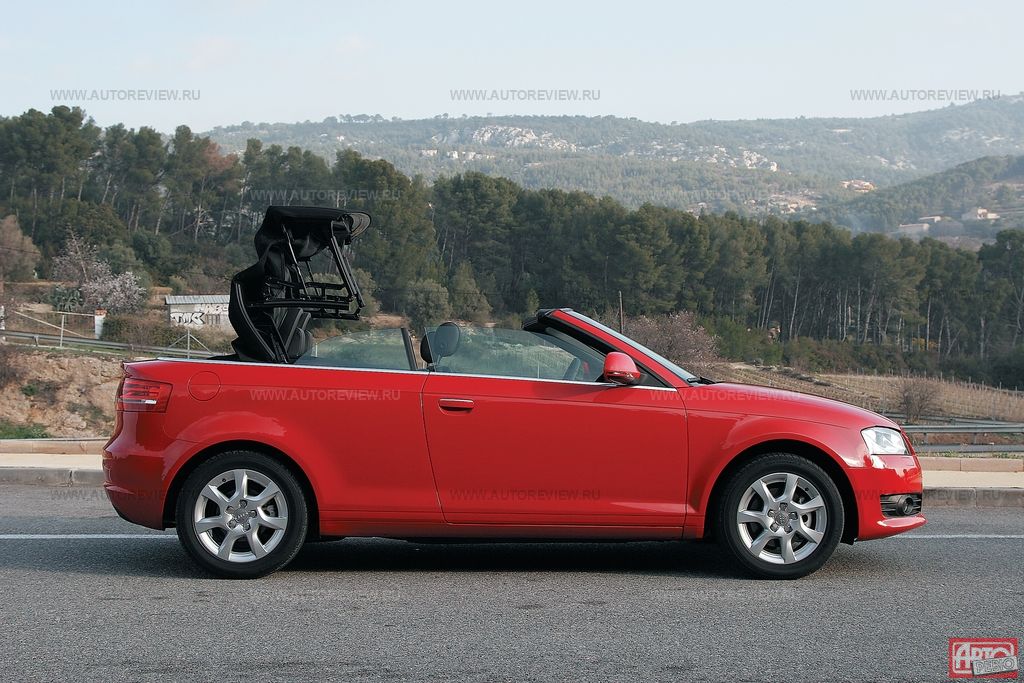
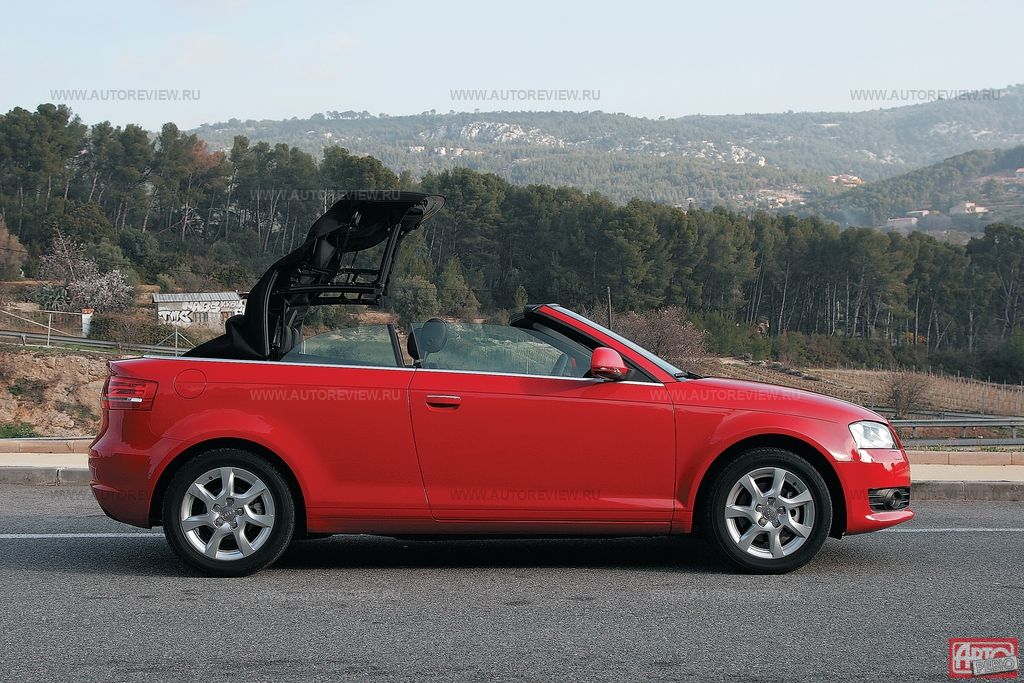
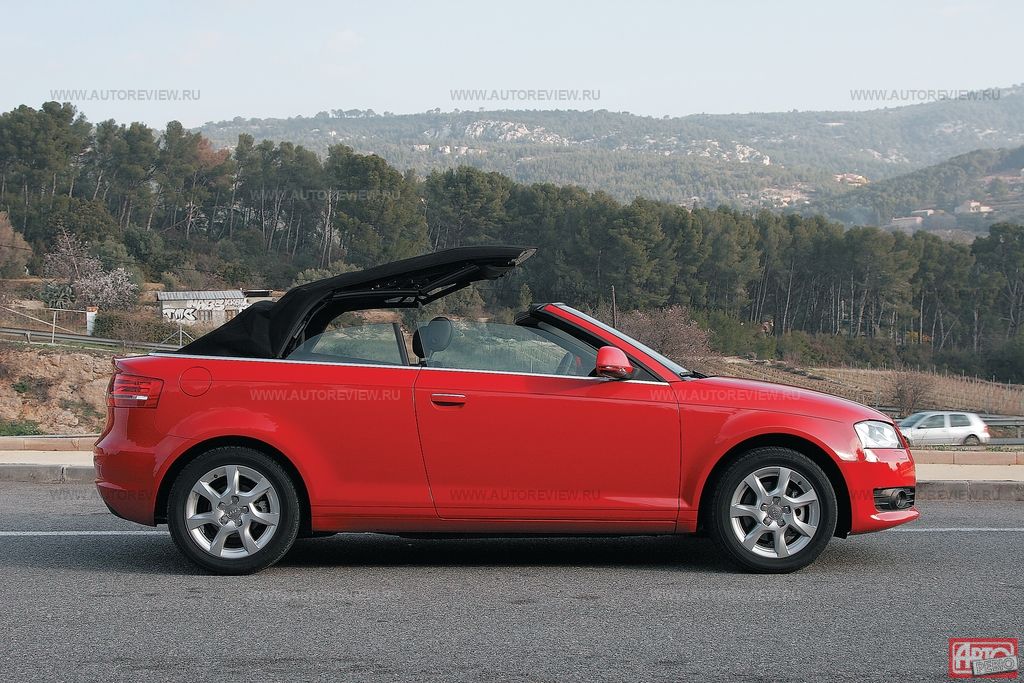
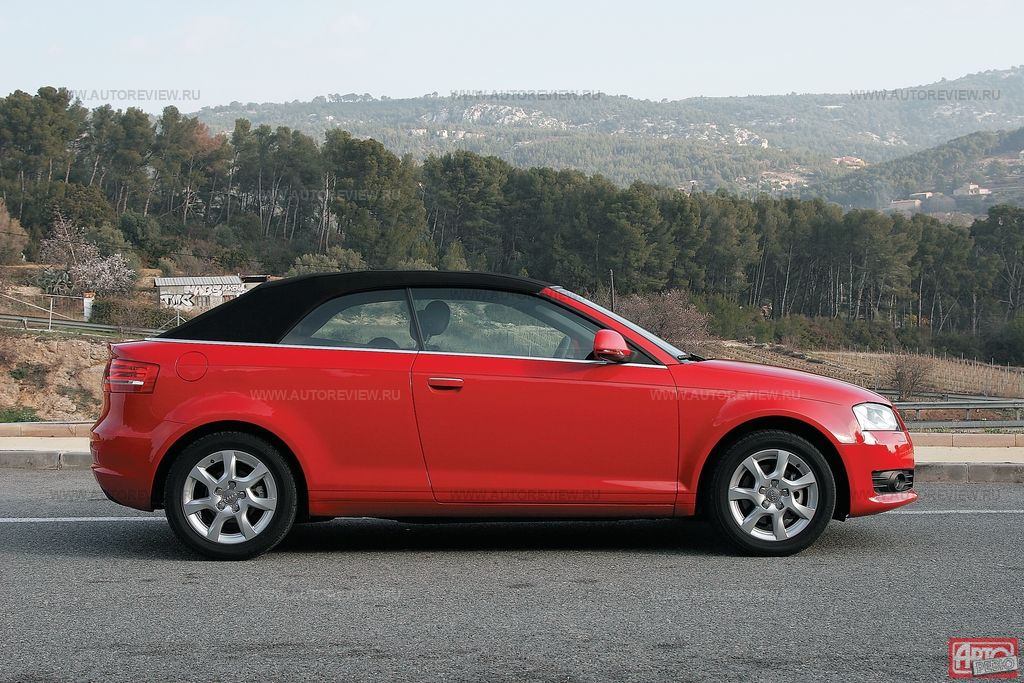
The roof opens in nine seconds, closes in eleven. Both operations are available at speeds up to 30 km/h
Under the hood of the red car turned out to be a new 160-horsepower turbo engine 1.8 TFSI. Great, I'll also get acquainted with the engine that has been installed on both the Passat and the Octavia since this year.
The engine is good: responsive, with a smooth characteristic, without a hint of "turbo lag." And where would it come from, if the maximum 250 Nm is available already from 1500 rpm! But at the start, the uninformative clutch pedal interferes. No, a convertible, and even with such a layout—red or white!—must definitely have an automatic transmission. I'll tell you about it later, when I switch to the white car.
By these "feathers" of the rear taillights, the Audi A3 Cabriolet is easy to recognize at night. In the base configuration, the headlights are halogen—and the LEDs in them are located along the lower edge. And "xenon" (in the photo) is easy to recognize by the upper location of the "eyelashes"
What a pleasure it is to leisurely cruise with the top down along the embankments of the French Riviera! Light steering, well-thought-out "convertible aerodynamics." Up to 90 km/h, the wind hardly bothers you. And if you put a light screen behind the front seat backs, the comfortable speed rises another 30–40 km/h. Oh, if only now... But, having driven away thoughts of coffee with a beautiful stranger, I head into the mountains.
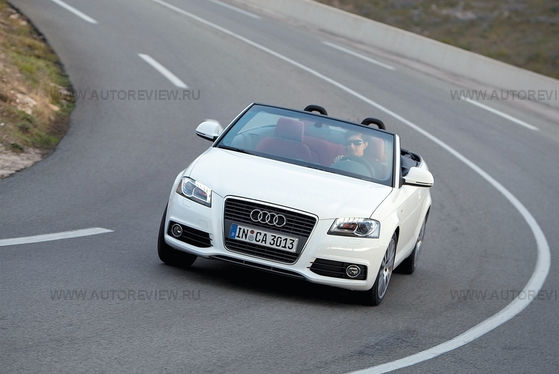
A series of turns, third-second-third-second... The convertible clearly traces the trajectory, only slightly slipping outward with the front wheels. The tires squeak, but the stability system doesn't intervene—it "understands" that everything is under control: for the convertible, freer, as they say at Audi, more sporty ESP settings were chosen. Thanks also to those who tuned the electric power steering: the connection with the road and the car is impeccable. And, of course, thanks to the body engineers who redesigned the entire load-bearing frame. Moreover, the body was made not of aluminum, but mainly of high-strength and ultra-high-strength steels. The convertible became heavier by 120 kg compared to the hatchback, but the torsional rigidity decreased by only 25%. On the mountain road, I didn't feel these percentages—even in extreme modes, the open A3 doesn't creak with upholstery or annoy with stepwise reactions. One of the best front-wheel-drive platforms hasn't been spoiled!
In a car with a manual transmission, hints about rational gear selection are displayed—in this case, Audi recommends shifting from fourth to sixth (bottom line on the display). As an option—a multimedia system with navigation and a music player for music recorded on compact flash drives (the slots for connecting them are located under the front panel)
If the red car had "base" tires 205/55 R16, then the white one already has 225/40 R18. Plus a sport suspension with a lowered by 15 mm ground clearance. Now on the serpentine, you can really "light up"! It's just a pity that not only lateral but also vertical accelerations have increased, which noticeably worsened comfort, especially on small bumps. Perhaps 18-inch wheels are overkill... But the longitudinal accelerations have also increased! The 2.0 TFSI engine together with the robotic DSG gearbox—that's exactly what's needed! The white convertible accelerates very easily, responds sensitively to the pedal, and doesn't "dull" at all when shifting "down."
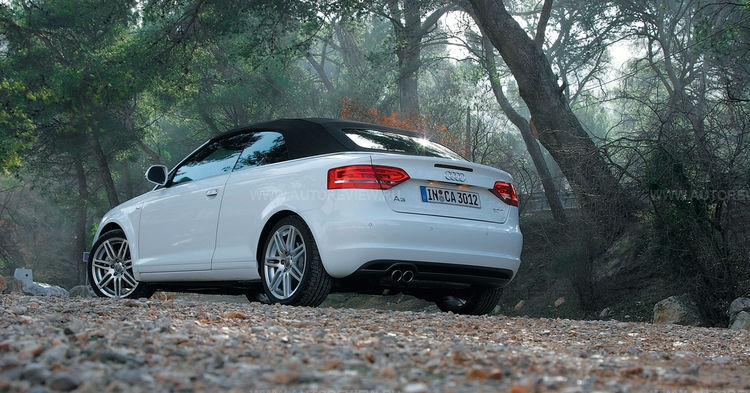
It seems that the main demand in Russia will be precisely for convertibles with the most powerful engines and in maximum configurations. For comparison: of the 23 Audi TT roadsters sold here last year, 16 were top-end, with 3.2 V6 engines. The price of such a car starts from 2 million 102 thousand rubles, which is equivalent to approximately 58,500 euros. The new Audi A3 Cabriolet, apparently, will be much more affordable. The base version with a 1.6-liter engine (102 hp) and manual transmission is estimated at about 26 thousand euros, but even a bright red color is unlikely to save this modification. Much more attractive looks the version with the 1.8 TFSI turbo engine and DSG robot, even if for 32 thousand euros. But the most interesting is the two-liter version with the same gearbox, which will already cost about 38 thousand euros. These cars will appear at dealers live just in time for the start of the season—in April, and by March 8, you can give a lady not the keys, but at least a signed contract. True, if there's no white or red car in stock, perhaps it makes sense to wait for the appearance of a competitor—the BMW 1 Series convertible—and then compare them face to face. We, by the way, will definitely do this, even if both specimens are of a boring gray color.
| Specifications | |||
| Parameters | Vehicle | ||
| Audi A3 Cabriolet | |||
| Modification | 1.8 TFSI | 2.0 TFSI | 1.9 TDI |
| Body type | convertible | convertible | convertible |
| Number of seats | 4 | 4 | 4 |
| Trunk volume, l | 260/674* | 260/674* | 260/674* |
| Curb weight, kg | 1425 | 1485 | 1425 |
| Gross weight, kg | 1925 | 1985 | 1925 |
| Engine | petrol, with direct fuel injection and turbocharging | petrol, with direct fuel injection and turbocharging | diesel, with turbocharging |
| Location | front, transverse | front, transverse | front, transverse |
| Number and arrangement of cylinders | 4, in-line | 4, in-line | 4, in-line |
| Displacement, cm³ | 1798 | 1984 | 1896 |
| Cylinder bore / piston stroke, mm | 82.5/84.1 | 82.5/92.8 | 79.5/95.5 |
| Compression ratio | 9.6:1 | 10.5:1 | 18.5:1 |
| Number of valves | 16 | 16 | 8 |
| Max. power, hp/kW/rpm | 160/118/5000—6200 | 200/147/5100—6000 | 105/77/4000 |
| Max. torque, Nm/rpm | 250/1500—4200 | 280/1800—5000 | 250/1900 |
| Gearbox | manual, 6-speed | automated manual, 6-speed | manual, 5-speed |
| Drive | front-wheel drive | front-wheel drive | front-wheel drive |
| Front suspension | independent, spring, McPherson | independent, spring, McPherson | independent, spring, McPherson |
| Rear suspension | independent, spring, multi-link | independent, spring, multi-link | independent, spring, multi-link |
| Front brakes | disc, ventilated | disc, ventilated | disc, ventilated |
| Rear brakes | disc | disc | disc |
| Tires | 205/55 R16 | 225/45 R17 | 205/55 R16 |
| Maximum speed, km/h | 218 | 231 | 185 |
| Acceleration time 0—100 km/h, s | 8.3 | 7.3 | 12.3 |
| Fuel consumption, l/100 km | |||
| urban cycle | 10.0 | 10.3 | 6.4 |
| extra-urban cycle | 5.7 | 6.1 | 4.3 |
| combined cycle | 7.3 | 7.6 | 5.1 |
| Fuel tank capacity, l | 55 | 55 | 55 |
| Fuel | AI-95 | AI-95 | diesel fuel |
| * With rear seat backs folded | |||