
When the speedometer is almost touching the two hundred kilometers per hour mark, and under the wheels instead of asphalt there is slush, it becomes truly unsettling. But I still keep pressing the gas. The traction control system is working at its limit, but during gear changes the car still noticeably veers to the side. Okay, enough — the straight road is ending, and ahead I need to brake. The dose of adrenaline has been obtained.
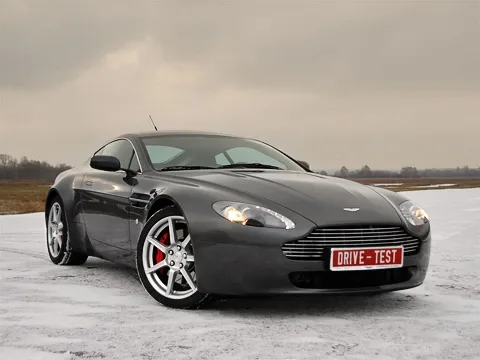
Wait, what the hell is snow doing here? This is an Aston Martin V8 Vantage — a true supercar with a classic layout and a serious pedigree. What is it doing on a winter road? Logically, its place is in a warm garage until summer. But some hold a different opinion: “If Ferraris are exclusively summer cars, then Astons are all-season; you can drive them in winter too.” Well, let's test that claim.
Officially, you can only buy an Aston Martin in Russia recently. The price for the V8 Vantage coupe with a manual gearbox starts at 147 thousand euros. So, this is, if you will, the most accessible car in the Aston Martin lineup. Although the word “accessible” hardly fits a car that is assembled by hand.
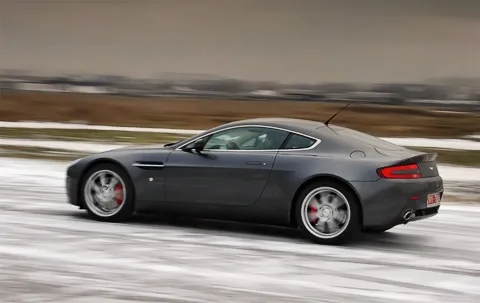
The V8 Vantage is a quite modern car. It is assembled at a well-equipped factory in Gaydon, UK. Each Aston Martin takes about two hundred man-hours. And if something breaks, there is someone to complain to — the name of the master who assembled the specific car is engraved on a plate under the hood. Too bad there's no phone number.
At the base of the car is the same VH (Vertical Horizontal) platform as the DB9: a light and very rigid aluminum frame, with double wishbones front and rear. The 4.3-liter V8 with an aluminum block and dry sump is made in Cologne — since 2005, that's where engines for Aston Martin are produced. The gearbox is moved to the rear and combined with the final drive. Thanks to this, the weight distribution is almost perfect — 51/49.
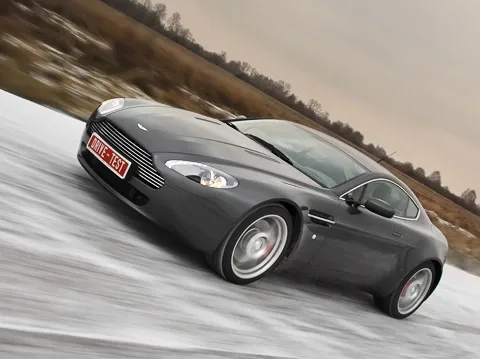
Summer tires are not the best choice for high-speed driving on snow.
The equipment is also serious: four airbags, electric seat adjustments, a good audio system, and navigation (it will soon work in Russia). In general, everything we are used to in executive sedans. Moreover, you can come to a dealer with a piece of fabric and ask to paint the car in that color. They will paint it. You can even bring two samples — to match the interior leather to the body color. For them, it's not a problem.
Inside the Aston Martin, of course, there is no cheap plastic — only leather, wood, and metal. Almost none: the light control and window lift block is clearly borrowed from Volvo. This, however, is a legacy from Ford. Now Aston Martin is under the management of Prodrive and David Richards. And it seems this is serious and for the long term.
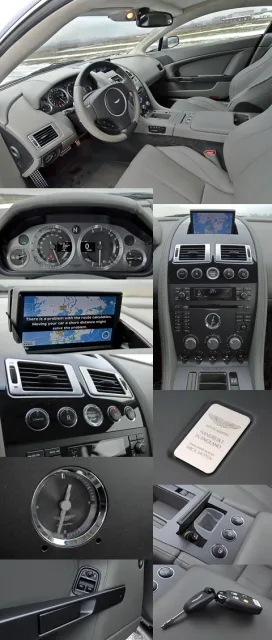
Ergonomics are fine — the seats have large adjustment ranges, and the steering wheel adjusts for height and reach. But getting in and out of a low car is not very convenient. However, for a supercar, that's normal.
Self-tapping screw heads stick out from the sills, and the leather lies unevenly in places. But all these flaws are easily forgiven, because you can see that the Aston is a thing made by hand. Handmade! And it doesn't matter that the company produces 7.5 thousand cars a year — it still makes them by hand and with soul. And, of course, with humor. When our V8 Vantage's odometer showed “666 km,” the on-board computer screen immediately displayed a warning about an engine malfunction and a demand to urgently go to service. I called the service in bewilderment: “What happened?!” They answered: “Relax, it's subtle English humor.” And a kilometer later, all the alarming messages disappeared.
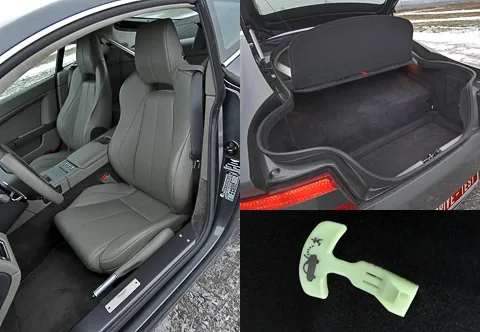
In these seats, a person of almost any build can sit comfortably. At the same time, lateral support is in order. And the trunk, by the way, is not that tiny — judging by the handle inside, you could even stuff a person into its 300 liters.
So, under the wheels is freshly fallen snow, and the tires (apparently for more extreme) are summer. The speedometer and tachometer needles, rotating in opposite directions, spread out like wings — let's fly! But first, you need to release the handbrake. And doing that, by the way, is not so simple. First, it is located to the left of the driver, and second, it works in a tricky way. If you pull it up, when releasing, it just lies down, as if it should be. And to release the parking brake, you first need to lift the lever, press the button, then pull it up all the way, and only then release. I followed all these instructions exactly, but my personal record is releasing it on the third try.
Even on snow and hardened sport tires, the Aston accelerates and brakes quite decently. The engine revs confidently rise, and the restrained grumble of the motor turns into a loud roar. And when asphalt appears under the wheels, it becomes really good — even at speeds well over a hundred, the car “shoots” as if the devil himself is chasing it. However, what else to expect from a 380-horsepower 4.3-liter V8? Only this.
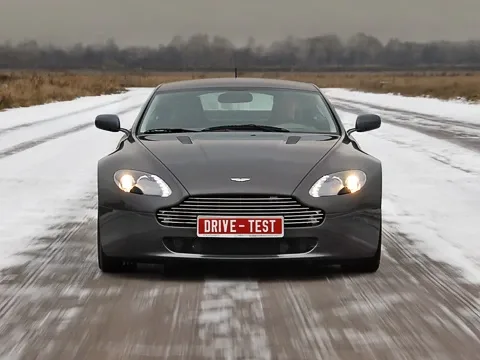
Oh, how much we would give for there to be no snow that day.
The real revelation was something else. When I was told that the Aston has a robotic Sportshift gearbox, I was initially upset. Marketers from various companies have come up with a bunch of advantages for such gearboxes — they say they accelerate faster than “mechanics” and consume less fuel. And in general, it's fashionable. They just forgot to say that “robots” either jerk wildly during shifts or “dull.” Or first “dull” and then jerk. But it turned out that everything is not so bad and it works quite decently. During calm driving, the gearbox shifts almost imperceptibly, and during active driving, it jerks not as much as one might expect. A regular “automatic” would be only slightly softer.
But ahead, the asphalt of the straight rises, forming a relief similar to a “speed bump.” And I'm going about a hundred and fifty… I brake, but to no avail — on snow, you'll only shed a couple of tens of “km/h,” and they won't play a role. Before the bump, I release the brake, press the gas — and the car flies over the unevenness. Something thumped from behind — most likely, the Nikon lying in the trunk, which I carelessly threw there without a case. But the suspension, unlike the camera, didn't give even a hint of bottoming out. Very composed and energy-intensive, it swallowed the unevenness without even noticing it. Excellent!
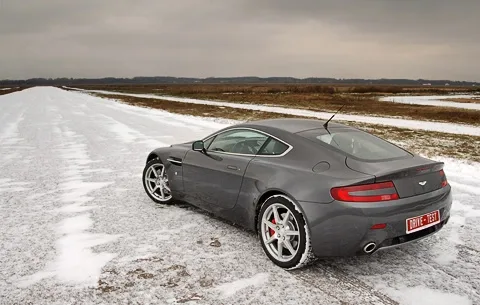
At the same time, many would envy the ride smoothness. After all, the Aston Martin V8 Vantage has a light but wildly rigid body and a low center of gravity. This means the engineers didn't have to fight body roll by “tightening” the suspension. There simply is none, and the Aston handles damn well.
But, of course, there is no hint of feeling like you're in some grand tourer. Yes, while you smoothly press the gas and don't rev the engine, the Vantage rides quite softly and quietly. But it's still not a pleasure yacht, but a wild beast that quietly creeps towards roads where you can really have a blast. And as soon as you press the gas, it instantly pounces on them.
Instant reactions to the accelerator pedal, a very responsive and precise steering wheel, indescribably informative brakes — I'm sure on dry asphalt the Aston will be divine. But it's also great on snow — the chassis is amazingly balanced! I press the button to disable the stability control system and hold it for 7 seconds: now all electronics are off. Only me and 380 horsepower on the rear wheels remain. And after that, I easily guide the car into a snowy corner. I know nothing will happen. The speed is chosen normally, and if you don't provoke the car, it won't even think of deviating from the trajectory. And if there is a slight excess, the Vantage won't jump into the ditch without warning — it will gentlemanly smoothly go into understeer or oversteer, which are easy to catch. However, the V8 Vantage readily gives in to outright provocation and immediately stands sideways. So it's better to fool around with the stability control system on — while you go through a corner in a fan, pressing the accelerator, it understands that you're just playing around and doesn't interfere. But as soon as something goes completely wrong, or you sharply release the gas pedal (or even press the brake), the system immediately stabilizes the car. Good, you've played enough.
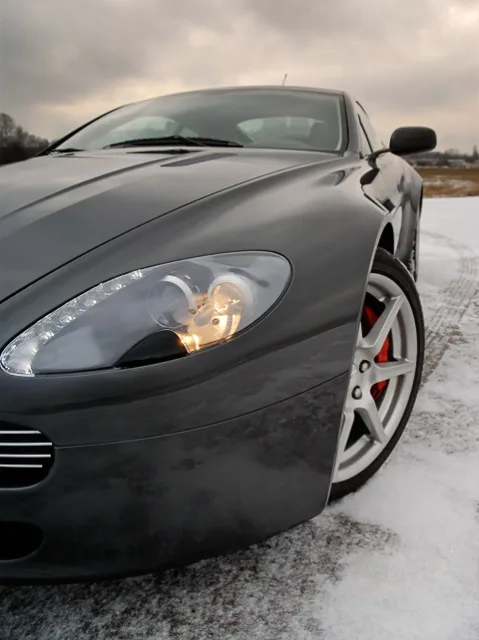
LED parking lights — a nod to Audi!
I drove on frozen asphalt and snow for more than an hour, but I was scared only when I accelerated to completely indecent speeds. And still I kept pressing the gas, confident in the car. Otherwise, there is nothing scary about winter driving an Aston Martin — it behaves very predictably, and the suspension and even ground clearance allow you not to worry too much about the roads. And if you fit the Vantage with winter tires, everything will be even better. And although I would have much more pleasure driving this car in summer, winter driving an Aston is also a rare thrill.
Technical specifications
History
The name Vantage has been used by Aston Martin for quite a long time — that's how the British traditionally called the fastest versions of their cars. However, as a standalone model, the V8 Vantage appeared only in 1977. It was a two-door coupe with a boosted 5.3-liter engine from the Lagonda, capable of accelerating to 274 km/h. Production continued until 1990.
In 1992, the Virage model, which had debuted four years earlier, received a powerful modification that was again given the name Vantage. Under the hood was a 5.3-liter engine with two mechanical superchargers, producing 550 hp and 746 Nm. With such output, the car reached 300 km/h, and acceleration to 100 km/h took just 4.7 seconds. In 1998, an even more radical version, the V600 with a 600-horsepower unit, appeared. A total of 280 such Vantages were built, with the last one rolling off the assembly line in 2000.
The concept of the future successor to the V8 Vantage was shown in 2003 at the Detroit auto show, and the production version was presented two years later at the Geneva Motor Show.
The V8 Vantage became the most compact and affordable car in the brand's lineup. It is produced in two body styles — coupe and roadster, and for each, a more powerful N400 modification is available.
The new Aston Martin production facility in Gaydon, where the DB9 and V8 Vantage are assembled. The plant uses advanced technologies, but almost all operations are performed by hand. The company's head office is also located in the same building.
And here, engines for Aston Martin are born. The plant in Cologne was opened on October 28, 2004. It is equipped with the latest technology and meets the strict environmental standards of ISO 14001. Engines for all models are produced right here. Production occupies a separate building on the premises of the Ford Niehl Engine Plant, and the staff numbers about a hundred specialists. Each engine is overseen from start to finish by a single master — subsequently, his name will appear on a plate under the hood. In total, about thirty people are involved in assembling one engine.