
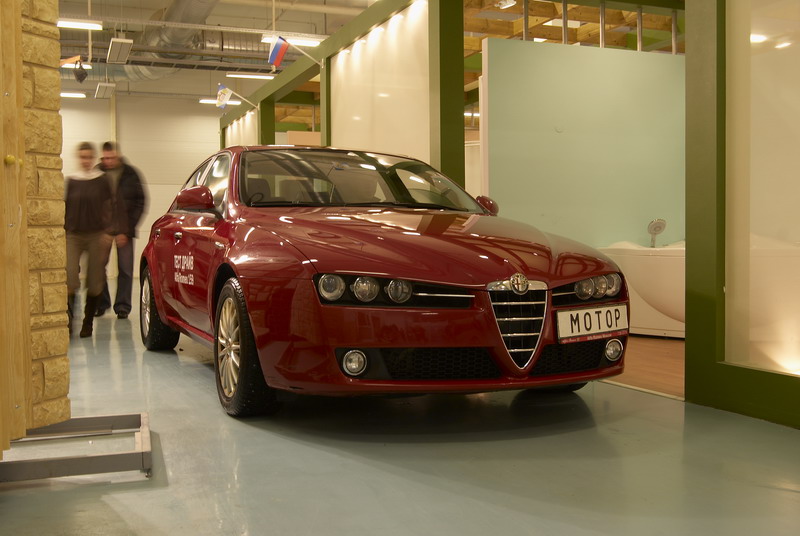
 The Alfa Romeo 159 appeared during the period when the company was led by German Karl-Heinz Kalbfell, who previously worked as vice president at BMW. It seems this is why the model turned out so precise, well-thought-out, and even somewhat German-rational. The Alfa Romeo 159 appeared during the period when the company was led by German Karl-Heinz Kalbfell, who previously worked as vice president at BMW. It seems this is why the model turned out so precise, well-thought-out, and even somewhat German-rational.But Kalbfell has already left FIAT. After Alfa Romeo, he moved to Maserati, and then completely parted ways with the concern. The German is gone, but his legacy remains, with which the brand will have to live in the coming years. The platform of the 159 is used not only in the new Brera and Spider but also sets the direction for the development of the entire brand. This model is the next stage in the evolution of mid-size Alfas. If you line them up by seniority, you get a chain: 156, 155, 75, Giulietta... Each of them embodied its era in the company's history. Now a new page has been turned — the car has made a serious step forward compared to its predecessor. Take at least the dimensions: compared to the 156, the new model has lengthened by 220 mm, become wider by 85 mm, and the wheelbase has grown by 105 mm. |
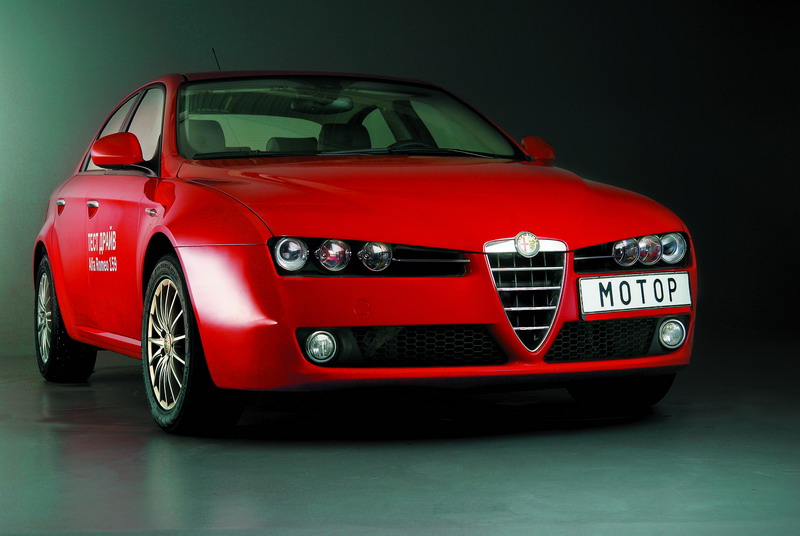
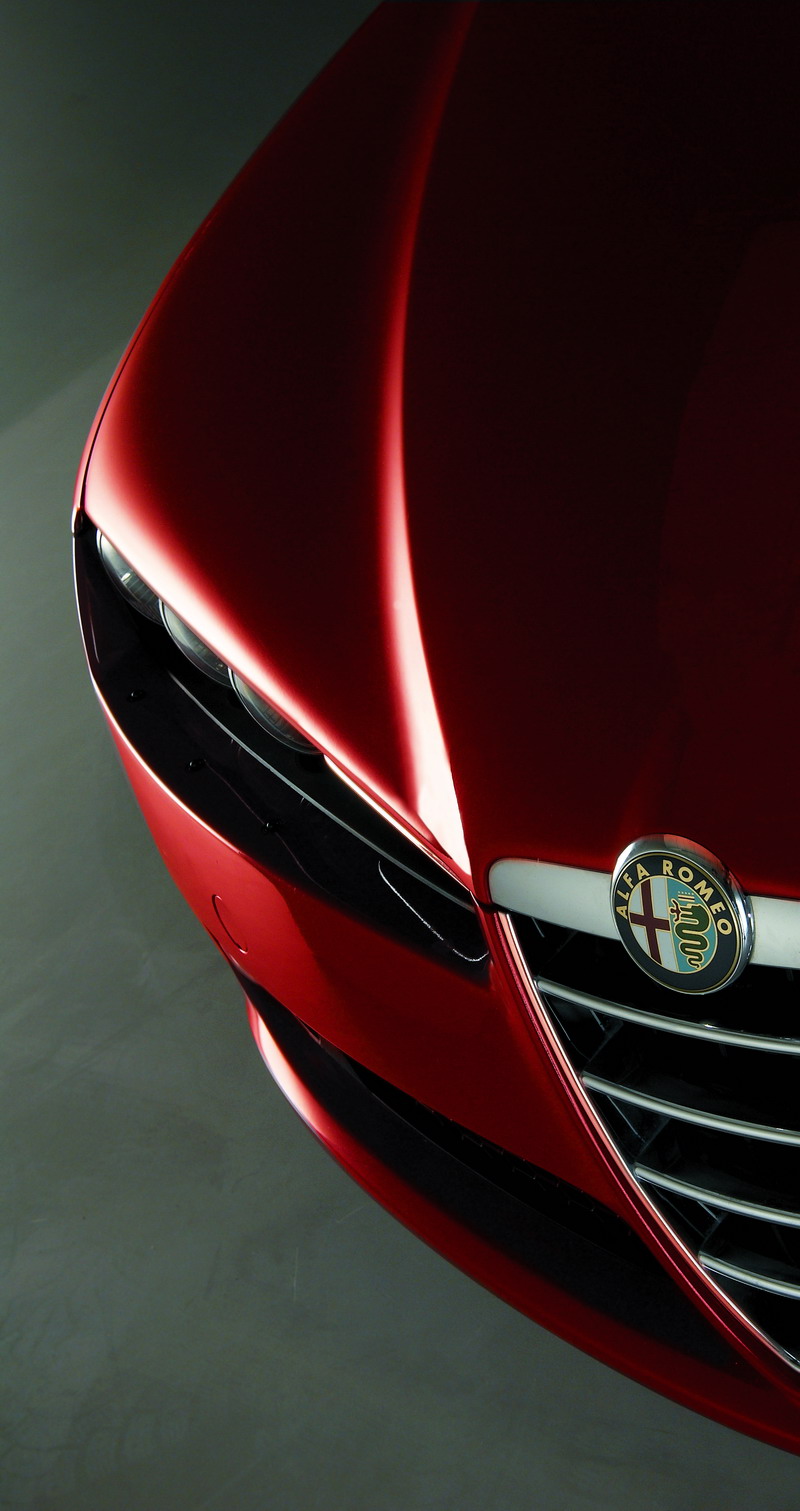
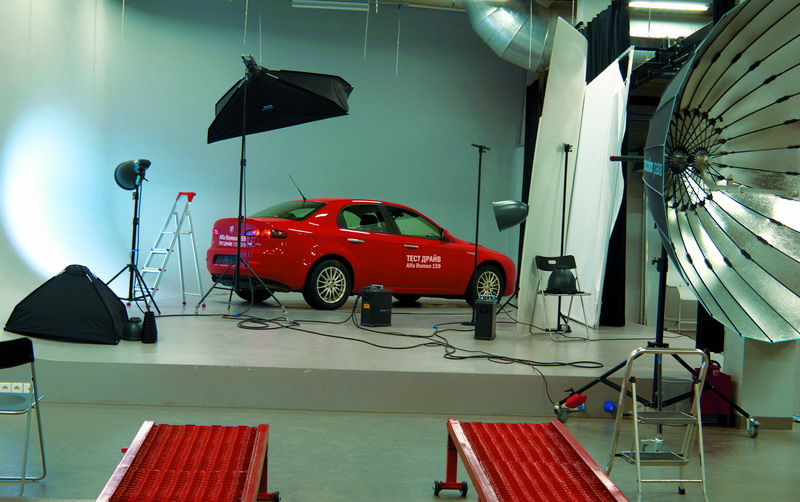 But in design, the 159 clearly echoes the 156. The front part even references the angular 155. The exterior is one of the model's main strengths. The longer you look at it, the more it draws you in. Without exaggeration, today it is the most attractive car not only in its class but across the entire market. Moreover, the 159 belongs to that rare breed of cars whose beauty photographs cannot convey. You need to see it in person! But in design, the 159 clearly echoes the 156. The front part even references the angular 155. The exterior is one of the model's main strengths. The longer you look at it, the more it draws you in. Without exaggeration, today it is the most attractive car not only in its class but across the entire market. Moreover, the 159 belongs to that rare breed of cars whose beauty photographs cannot convey. You need to see it in person!I was lucky: I could admire this creation of the Guigaro studio all day while the car was being shot in the pavilion. They set up lights, emphasized edges, removed glare from surfaces. And I just watched and couldn't get enough. A true sculpture, the embodiment of athleticism and elegance! This bella Alfa stirs and excites the blood! Although with the design of Alfas, everything was fine before. The same 156 looked great. And the 155 too. And what a silhouette the last rear-wheel-drive model — the 75 — had! But in the brand's history, it often happened that the appearance was supported only by driving qualities and engines. And many other important things the Italians left in the background. For example, the interior. |
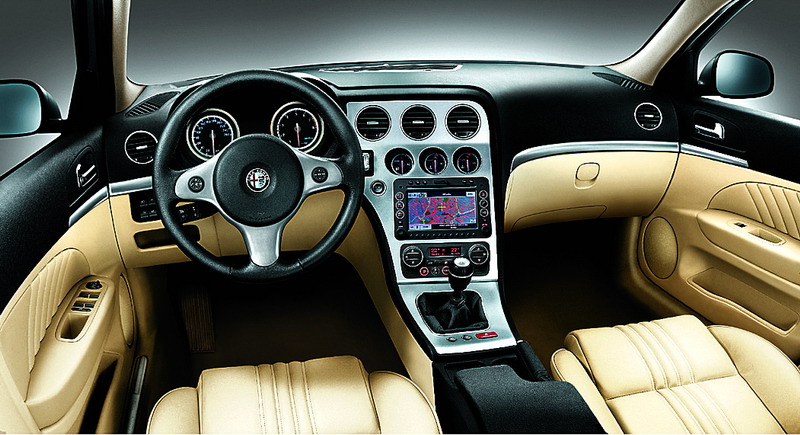 Special charm, racing spirit — that's wonderful. But there were also obvious problems: build quality, materials, ergonomics. The 156 made a step forward, whose cabin hasn't aged even now. However, if you look more closely, touch it — details start to surface: somewhere they didn't tighten, somewhere they saved on plastic, here it creaks, there it rattles. Special charm, racing spirit — that's wonderful. But there were also obvious problems: build quality, materials, ergonomics. The 156 made a step forward, whose cabin hasn't aged even now. However, if you look more closely, touch it — details start to surface: somewhere they didn't tighten, somewhere they saved on plastic, here it creaks, there it rattles.And here again, it's worth remembering Karl-Heinz Kalbfell, who managed to instill in Alfa Romeo the signature Bavarian quality. The interior of the 159 surprised primarily not with style (although with that too), but with the impeccable execution of every little detail. The front panel is made of expensive, resilient plastic, the doors have leather inserts with neat parallel stitching (the same technique was on the 147). The buttons on the central console press with a calibrated force. No extraneous sounds, creaks, or rattles. I found a comfortable seating position almost immediately. True, I had to fiddle with the levers (electric adjustments are only available for an extra charge). The instruments are perfectly readable, all controls are at hand. However, the Italians still couldn't resist originality — the buttons for disabling the parking sensors and opening the trunk are placed on the overhead console. |
 In the center, there are three deep wells in a row with sensors for coolant temperature, oil, and fuel level. The labels Aqua, Olio, Benzina instantly create an "Italian" mood. The instruments are strongly turned toward the driver — the passenger won't see their readings. The seats are quite soft, lateral support is felt only in the back and lower back area. The cushion is almost flat. However, it doesn't cause discomfort. In the center, there are three deep wells in a row with sensors for coolant temperature, oil, and fuel level. The labels Aqua, Olio, Benzina instantly create an "Italian" mood. The instruments are strongly turned toward the driver — the passenger won't see their readings. The seats are quite soft, lateral support is felt only in the back and lower back area. The cushion is almost flat. However, it doesn't cause discomfort.Despite the wheelbase growing by more than 10 cm, there isn't much free space in the back. The 159 clearly doesn't reach the VW Passat here. And the trunk isn't a record holder either: the opening is a bit small, and the loading height is a bit high. Alfa Romeo traditionally treats some practical things with disdain. I insert the stylish key into the slot and press the start button. The engine comes to life under the hood silently. The needles on the five dials, which were standing strictly vertical, begin a synchronized movement. |
| You can feel that the creators worked especially carefully on noise and vibration insulation. The street is not heard at all, and the engine makes itself known only after 4000 rpm. Old Alfas would be surprised by this. On the 156, the acoustic accompaniment was much more pronounced. Although the engines on the 156 were completely different. I already told about the old twin spark, which appeared in the early 90s, using the 147 as an example. The V6 is even older. The cabin without serious sound insulation carefully delivered the singing of these units to the ears. Now their time has passed. The new engines have stepped far forward. For example, the 2.2-liter unit pleased with traction at mid-range revs. It, of course, doesn't rev as cheerfully as the twin spark, but it provides the car with decent dynamics. I doubt I'll be wrong if I say that the 159 with this engine is one of the fastest among 4-cylinder models in the D class. And the fact that the engine no longer needs to be constantly revved to the red zone is a clear plus for reliability. Owners of the 156 TS, who spent considerable sums on repairs due to timing belt breakage, will understand me. |
| Yes, the engines have become different, but in terms of specific power output, they still outperform competitors. For example, the weakest of the engines with a displacement of 1.9 liters produces 160 hp. An excellent result. The 159 moves surprisingly smoothly. Combined with excellent sound insulation, this creates the feeling that you are being carried by an expensive executive sedan. But the smoothness of the ride did not harm handling. Even in the base version, the Alfa confirms its status as a driver's car. In terms of driving behavior, the 159 differs slightly from its predecessor, but if you want to drive as fast as possible, it will gladly play along. At the front — the same double-wishbone suspension as on the 156. At the rear — a new multi-link design. The suspension is comfortable but not loose. In corners, body roll is minimal, there is no pitching at all, and at speed, a bad road seems to smooth out. |
 The new Alfa is more tolerant of road surface quality than the old ones. It doesn't shake your soul out, but at the same time, it allows a lot. The steering wheel is filled with adequate feedback, no "dips" at the center. Less than 2.5 turns from lock to lock. The new Alfa is more tolerant of road surface quality than the old ones. It doesn't shake your soul out, but at the same time, it allows a lot. The steering wheel is filled with adequate feedback, no "dips" at the center. Less than 2.5 turns from lock to lock.The pedals are at the same level. The clutch is understandable, the brake is elastic and gives clear commands to the grippy, powerful mechanisms. The accelerator is a bit thoughtful only at the very beginning of its travel. As revs rise, the response to pressing becomes precise. And for dessert — the gearshift mechanism. A small lever with a comfortable knob glides flawlessly through the positions, engagements are pleasantly elastic. The gear ratios are chosen wisely — not stretched and not too short, the golden mean. So, is it a German Alfa? Yes, partly. But this is exactly what these cars have been missing for so long — attention to detail and quality in everything. At the same time, the Alfa has remained an Alfa — it is beautiful and drives magnificently! |
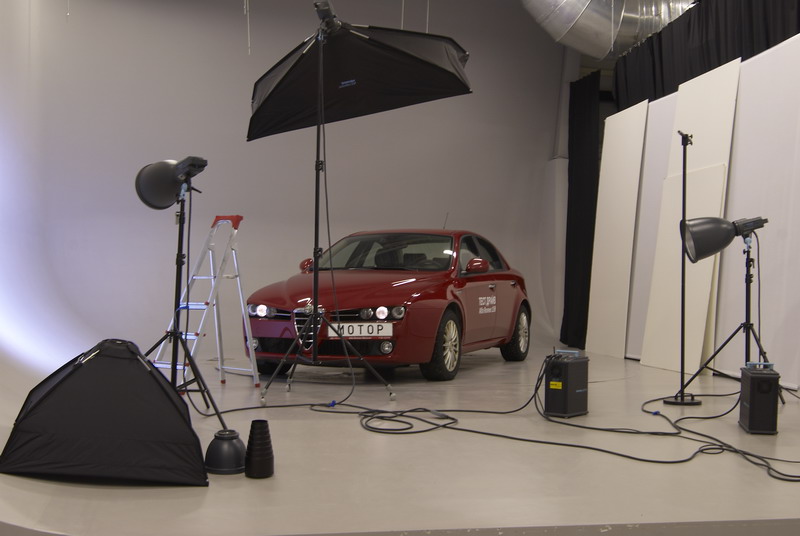 A beautiful car needs to be photographed beautifully. The studio where the photo shoot took place is located in one of the pavilions of a large shopping center. And you can only get to it through the shopping aisles. We drove, carefully maneuvering around stunned shoppers. A beautiful car needs to be photographed beautifully. The studio where the photo shoot took place is located in one of the pavilions of a large shopping center. And you can only get to it through the shopping aisles. We drove, carefully maneuvering around stunned shoppers.As it turned out, the 159 is also quite a maneuverable car. The technical specifications confirm this: the turning radius is just over 11 m — an excellent indicator for a front-wheel-drive car. The only thing that hindered in particularly tight "turns" was the wide fenders. For example, the "body" has already passed, but the rear arch doesn't fit. You have to start the maneuver all over again... Both the sedan and the station wagon Alfa Romeo 159 are offered with three engines: 1.9 L (160 hp), 2.2 L (185 hp), and 3.2 L (260 hp). The most powerful version is only with all-wheel drive. There are two trim levels — Medium and High. The first includes ABS with Brake Assist and EBD, HBA emergency braking assist system, VDC dynamic stability control system, front and window airbags, CD receiver with 8 speakers, onboard computer, Alfatex fabric upholstery, leather trim on the steering wheel and gear knob, bi-xenon headlights, light sensor, steel R16 wheels. The High trim adds dual-zone climate control, cruise control, audio controls on the steering wheel, alloy R16 wheels. The list of available additional options is truly impressive. For example, you can order front seats with electric drive and memory function for ?570, a Bose audio system for ?680, a multimedia center for ?1580, as well as front and rear parking sensors for ?400. In addition, the manufacturer offers several packages of additional equipment. The starting price for the model is ?31,300. For this money, the buyer gets a sedan in the Medium trim with a 1.9-liter engine and a manual gearbox. Modifications with a 2.2-liter engine are available exclusively in the High version, and their price ranges from ?32,500 to ?44,300. The station wagon, depending on the chosen engine and trim, will cost from ?32,300 to ?47,200. |
Alpha of the automotive industry
With this car, the Alfa Romeo brand pins its hopes on a bright future. But I also have a personal interest in the 159. As it happens, I've often come across Alfas in my life: the 159 model is already the eighth one.
Test drive photos
Comments
No comments yet. Say the first word.