Once I had an Alfa Romeo 33 at my disposal. According to the registration document, under the hood was a 1.7-liter unit producing 107 hp. This car allowed me to feel like a troublemaker in city traffic and accelerate to almost 200 km/h on the highway. Imagine my astonishment when, during a major overhaul, it turned out that there was actually a modest flat-four — 1.4 liters with only 90 hp. It was then that I realized the phrase "Cuore Sportivo" is not just a marketing slogan.
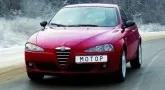
And now I've had the chance to test the current representative of the compact Alfa family — the 147 model. Under its hood is a two-liter unit with 150 horsepower and a modern robotic transmission Selespeed. I wonder how the Italian "sporting spirit" is embodied in a modern guise?
Fresh Alfa Romeos on domestic roads are a rarity. For instance, in the entire 2005, only 68 such cars were sold in Russia, and that's the total across four models: 147, 156, 166, and GTV/Spider. Due to such modest figures, as well as problems in the European market, the FIAT concern halted Alfa Romeo deliveries to our country at the end of 2005. However, the demand for stylish Italians hasn't disappeared — now the brand is represented by Major Auto, and the first swallow is the Alfa 147.
It's worth recalling that this model debuted at the Turin Motor Show in 2000, and a year later was awarded the title "Car of the Year 2001." Recently, the car underwent a facelift. The exterior changes are meant to bring the aging 147 closer to the company's flagship — the Brera model. The headlights have gained a new shape: each has three reflectors under a transparent plastic cover. The hood with the grille, front fenders, and bumper with enlarged air intakes have also become different.
The taillights have grown slightly, and a chrome molding has appeared on the trunk lid. Our test hatchback in Alfa Rosso color sat on expressive 17-inch wheels with the telling name Super Sport and invariably attracted the glances of passersby.
The interior is done in the signature Alfa Romeo style: first of all, the round ventilation deflectors at the edges of the front panel catch the eye. The tachometer and speedometer are spread to different sides, with the onboard computer screen and fuel and coolant temperature gauges between them. The instrument needles point vertically downward — a nod to the 1920s. The front panel is trimmed with high-quality soft plastic with faux leather. The seats themselves are upholstered in genuine leather, with matching inserts on the doors, adorned with neat parallel stitching. Inside is beautiful and cozy. True, in some places there are panels of hard glossy plastic, but they don't spoil the overall impression. In terms of space, the car doesn't set records: four people of average height will fit comfortably.
The three-spoke multifunction steering wheel is wrapped in perforated leather, has anatomical contours in the grip zones, and the cross-section is perfectly chosen. Directly behind the steering wheel are paddle shifters. The robotic "manual" Selespeed works on a simple principle: push the "joystick" on the tunnel away from you — and the number 1 lights up on the panel. Release the brake, press the gas — the clutch engages automatically, and the car moves off. Moreover, the more actively you press the accelerator from the start, the sharper the clutch engages. Thrill-seekers can easily launch with an impressive wheelspin.
In motion, the gearbox performed excellently. During intense acceleration, it instantly, with a slight jolt, shifts gears, evoking associations with the Maserati Quattroporte we had in the fall. Downshifts are executed with precise rev-matching. And if you calmly cruise in the automatic City mode, Selespeed smoothly and without noticeable pauses shifts through the gears.
It's worth mentioning that the two-liter Twin Spark with 150 hp is used almost without modifications in Formula Rus cars. Isn't that a recognition of its racing merits? This engine is well known to all brand fans — it was installed on all company models since the early 90s: 145/146, 155, 164, GTV/Spyder, 156, 166. Although its era is nearing its end, calling Twin Spark an old-timer doesn't come to mind. It delivers a steady torque plateau from 2000 rpm, and after 3500 rpm a metallic note appears in the voice, and a confident surge begins that holds almost until the redline. When the tachometer needle heads into the red zone, the engine sound tempts you to keep revving it to the limiter. Moreover, it not only sings beautifully but also provides exhilarating acceleration — with such a unit, you feel confident both in the city and on the highway.
The steering with 2.3 turns from lock to lock is another testament that Cuore Sportivo lives in this car. It's a pity that our car was shod with not-at-all-Italian Nokian Hakkapeliitta 5 tires, and under the wheels was not the hot asphalt of a serpentine but the dirty slush of Moscow streets. The front suspension with double wishbones effectively counteracts changes in wheel alignment angles under lateral forces. The car behaves eagerly, provoking fast cornering — the limit will be understeer. The rear suspension with MacPherson struts and two transverse and one longitudinal arm creates a slight steering effect, holding the car on the arc to the last. However, an experienced driver can easily provoke a slide and enjoy the well-calibrated behavior in a drift. True, for this it's better to choose a smooth surface: the short-travel suspension of the Alfa 147 reacts painfully to strong impacts — large potholes cause the elastic elements to work to full rebound. But body roll is minimal. At the same time, the ride can't be called purely sporty: for example, driving over standard rubber speed bumps demonstrates a quite comfortable level of stiffness. Overall, even on low-profile 17-inch tires, the car doesn't annoy with excessive shaking or sharp impacts. A compromise! The brakes performed excellently (and what else would you expect?).
Practicality is not the main virtue of beauties, but the Alfa 147 can handle household tasks. The trunk volume of 1042 liters is achieved by folding the rear seatbacks (in a 60/40 ratio) and allows transporting fairly bulky items like a washing machine.
It's unlikely that after the start of official sales, queues will form for the Alfa Romeo 147. The model is not new, and soon it will be replaced by the 149. But while the replacement is only in plans, the Alfa 147 is a sure way to stand out from the crowd. It will surely be used by those who value style with nearly a century of history and a sporting character tempered by participation in racing series.
The Italian hatchback is available in both three- and five-door bodies. You can also choose an engine (1.6 L or 2.0 L) and transmission type (five-speed manual or automatic Selespeed with steering wheel controls).
Standard equipment includes front, side, and window airbags, ABS with EBD system, fire prevention system FPS, dual-zone climate control, onboard computer, audio system with CD receiver, leather steering wheel and gear knob, Alfatex fabric seat upholstery, front seats with manual adjustment and heating, power-adjustable and heated side mirrors, front electric windows, alloy wheels R15, central locking, and immobilizer.
Options include alloy wheels R17 (€238), electric sunroof (€586), rear parking sensors (€206), audio system with subwoofer (€656), xenon headlights (€822), sport leather seats (€2008), and much more.
The most affordable option will cost €22,100: a three-door hatchback in base trim with a 1.6 L engine (120 hp) and manual transmission. The two-liter version (150 hp) costs €23,700. The modification with a 2.0 L engine and automatic transmission is priced at €25,000. For five-door versions, the dealer asks €500 more.
Alfa Romeo holds a series of six races, the European Alfa Challenge Alfa 147 GTA Cup, on Alfa Romeo 147 cars, in which both professionals and amateurs participate.
In the next season of the world touring car championship WTCC, Alfa Romeo will compete as a factory team in 147 model cars with a diesel engine.
History of compact front-wheel-drive Alfa Romeos
Alfasud (1972–1983). This was the first front-wheel-drive Alfa model, which opened the market for inexpensive small cars for the brand. Assembly was organized in southern Italy, in Pomigliano d'Arco near Naples, which is why the car was popularly nicknamed the "Southern Alfa." The design was worked on by Austrian engineer Rudolf Hruska, and the appearance was created by Giorgetto Giugiaro himself. Under the hood was a 4-cylinder flat engine with a displacement of 1.2 L and 63 hp, and top versions were equipped with disc brakes. Over the years of production, many modifications appeared: a more powerful Ti with 68 hp (1973), a three-door cargo-passenger Giardinetta with folding rear seats (1975), the sporty "three-door" Sprint (1975), and finally, hatchbacks with three and five doors (1980).
Model 33 (1983–1994). The new model retained the platform and engines from the Alfasud, but the body was thoroughly reworked, focusing on the Giulietta. In 1984, all-wheel drive and the Giardinetta station wagon appeared, later renamed Sportwagon. In 1986, the lineup was supplemented with a three-cylinder VM Motori diesel with a displacement of 1.8 L and 72 hp. Three years later, the 1.7 L engine received electronically controlled fuel injection. In 1990, a serious facelift occurred, bringing the appearance in line with the style of the flagship Alfa 164, and for top versions — the all-wheel-drive Permanent 4 and front-wheel-drive QV — a 16-valve flat engine with 137 hp was offered. The hot versions were dubbed "Ferrari for the poor" for their bright sporting character.
Arna (1984–1987). Every car manufacturer goes through crises that give birth to "strange" models. Alfa Romeo was no exception. Finding itself in a difficult financial situation, the company agreed with Nissan on the joint production of the budget Arna. The Japanese supplied the body with the rear suspension (taken from the Cherry), while the engine and transmission were made by Alfa — from the Alfasud. The bodies were shipped from Japan in containers, and the cars were assembled at a new plant near Pomigliano d'Arco. The public did not accept such an oddity from Alfa Romeo, and the car became the biggest failure in the brand's history.
145/146 (1995–2000). These are the first Alfa models created at the Centro Stile Alfa Romeo under the direction of Walter De Silva. The three-door hatchback 145 was designed by Chris Bangle, who was just starting out at the time, and the 146 was the five-door version. Both were built on the FIAT Brava/Bravo platform. Initially, they were equipped with flat engines from the Alfa 33, but from 1997 they switched to the new Twin Spark line. The most powerful versions were considered the Ti for the 146 and the QV for the 145 — both with a 150 hp engine.