
Practice: ticket #7
Answers are checked instantly. The hint — a rules excerpt — is under the question.
-
Question #1 At what distance from operational vehicles must drivers of ordinary vehicles move?
Topic: General provisions
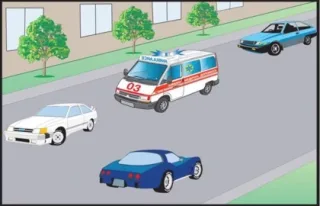
Answer help
safe distance — the distance to the vehicle moving ahead in the same lane which, in the event of its sudden braking or stopping, will allow the driver of the vehicle moving behind to avoid a collision without performing any maneuver; -
Question #2 The driver and passenger of a vehicle equipped with seat belts must be fastened:
Topic: Duties and rights of drivers of mechanical vehicles
Answer help
2.3. To ensure road safety, the driver is obliged to:
c) on vehicles equipped with passive safety devices (head restraints, seat belts), use them and not carry passengers not wearing seat belts -
Question #3 What information is contained in this road sign with a plate?
Topic: Road signs (Appendix 1)
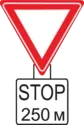
Answer help
2.2. “No stopping without stopping”. It is prohibited to pass without stopping before marking 1.12 (stop line), and if it is absent — before the sign. -
Question #4 Behind which of these road signs is it allowed to move at a speed lower than indicated on them?
Topic: Road signs (Appendix 1)
Answer help
5.30. “Recommended speed”. The zone of action of the sign extends to the nearest intersection.
3.31. “Maximum speed limit zone”. It is prohibited in the zone (populated area, microdistrict, recreation area, etc.) to move at a speed exceeding that indicated on the sign. -
Question #5 Do the requirements of these plates differ?
Topic: Road signs (Appendix 1)
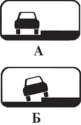
Answer help
7.6.1.—7.6.5. “Method of placing a vehicle in a parking lot”. They indicate: 7.6.1 — all vehicles must be parked on the roadway along the sidewalk,
7.6.2—7.6.5 — the method of placing passenger cars and motorcycles in a parking lot near the sidewalk and using it. In populated areas where parking is allowed on the left side of the street, plates 7.6.1—7.6.5 with a mirror image of the symbols may be used. -
Question #6 In which directions is movement allowed?
Topic: Road markings (Appendix 2)
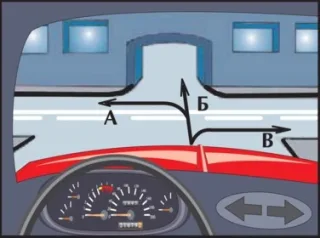
Answer help
1.11. — separates traffic flows of opposite or same directions on sections of roads where lane changing is allowed only from one lane; marks places intended for turning around, entering and exiting parking areas, etc., where traffic is allowed only in one direction;
Line 1.11 may be crossed only from the side of its broken part, and from the side of the solid part — only upon completion of overtaking or avoiding an obstacle. -
Question #7 Is parking of vehicles allowed on the road section behind this road sign?
Topic: Road signs (Appendix 1)
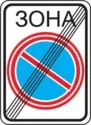
Answer help
3.39. “End of restricted parking zone”. -
Question #8 The baton is used:
Topic: Traffic regulation
Answer help
8.8. Traffic controller signals. Traffic controller signals are the positions of his body, as well as hand gestures, including with a baton or a disk with a red reflector,
having the following meanings:
a) arms extended to the sides, lowered, or the right arm bent in front of the chest: from the left and right sides — tram movement is allowed straight, trackless vehicles — straight and to the right; pedestrians are allowed to cross the roadway behind the back and in front of the chest of the traffic controller; from the chest and back side — movement of all vehicles and pedestrians is prohibited;
b) right arm extended forward: from the left side — tram movement is allowed to the left, trackless vehicles — in all directions; pedestrians are allowed to cross the roadway behind the back of the traffic controller; from the chest side — all vehicles are allowed to move only to the right; from the right side and back — movement of all vehicles is prohibited; pedestrians are allowed to cross the roadway behind the back of the traffic controller;
c) arm raised up: movement of all vehicles and pedestrians is prohibited in all directions. The baton is used only by employees of the State Automobile Inspectorate units and the military road safety inspection. To attract the attention of road users, a signal given by a whistle is used. The traffic controller may give other signals understandable to drivers and pedestrians.
8.9. The requirement to stop a vehicle is given by a police officer:
a) with a baton or hand pointing to that vehicle;
b) using a flashing beacon of blue and red or only red color and (or) a special sound signal;
c) using a loudspeaker device;
d) using a special display that indicates the requirement to stop the vehicle. The driver must stop the vehicle in the place indicated to him, in compliance with the stopping rules. -
Question #9 In which case do the traffic rules not require giving a warning signal?
Topic: Warning signals
Answer help
9.2. The driver must give signals with turn indicators of the corresponding direction:
a) before starting to move and stopping;
b) before changing lanes, turning or making a U-turn. -
Question #10 Before starting to change lanes, you must make sure:
Topic: Starting movement and changing its direction
Answer help
10.1. Before starting to move, changing lanes, and any change in the direction of movement, the driver must make sure that it will be safe and will not create obstacles or danger to other road users. -
Question #11 Is it allowed to drive on tram tracks when crossing an intersection?
Topic: Position of vehicles on the road
Answer help
11.8. On a tram track of the same direction, located at the same level as the roadway for trackless vehicles, movement is allowed provided that it is not prohibited by road signs or road markings, as well as during overtaking, avoiding, when the width of the roadway is insufficient to perform the avoidance without entering the tram track.
At an intersection, it is allowed to enter the tram track of the same direction in the same cases, but provided that there are no road signs 5.16—5.19 before the intersection.
Turning left or making a U-turn must be performed from the tram track of the same direction, located at the same level as the roadway for trackless vehicles,
if a different traffic order is not provided by road signs 5.16, 5.18 or marking 1.18.
In all cases, obstacles to tram movement must not be created. -
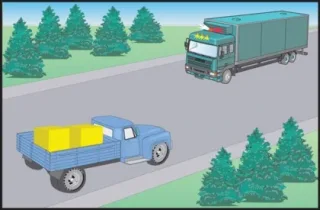
Question #12 What is the maximum speed allowed for a truck on ordinary roads outside built-up areas?
Topic: Speed of movement
Answer help
12.6. Outside populated areas on all roads and on roads passing through populated areas, marked with sign 5.47, movement is allowed at a speed:
e) other vehicles: on a highway marked with road sign 5.1 – no more than 130 km/h, on a highway with separate roadways, -
Question #13 Are vehicles allowed to serve citizens or objects located in a pedestrian zone?
Topic: Movement in residential and pedestrian zones
Answer help
26.3. Entry into a pedestrian zone is allowed only for vehicles serving citizens and enterprises located in the specified zone, as well as vehicles belonging to citizens who live or work in this zone, or cars (motorized wheelchairs) marked with the identification sign “Disabled”, driven by disabled drivers. If there are other entrances to objects located on this territory, drivers must use only them. -
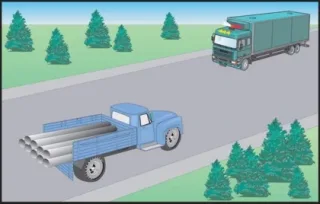
Question #14 Transportation is carried out according to special rules if the load protrudes beyond the rear dimension of the vehicle by more than:
Topic: Transportation of cargo
Answer help
22.5. According to special rules, road transportation of dangerous goods, movement of vehicles and their combinations is carried out if at least one of their dimensions exceeds 2.6 m in width, 4 m in height from the road surface (for container carriers on routes established by Ukravtodor and the State Automobile Inspectorate – 4.35 m), 22 m in length (for route vehicles – 25 m), actual mass over 38 t (on routes established by Ukravtodor and the State Automobile Inspectorate – up to 40 t; for container carriers – over 44 t, on routes established for them – 46 t), load on a single axle – 11 t (for buses, trolleybuses – 11.5 t), twin axles – 16 t, triple axles – 22 t (for container carriers, load on a single axle – 11 t,
twin axles – 18 t, triple axles – 24 t) or if the load protrudes beyond the rear dimension of the vehicle by more than 2 m.
Axles should be considered twin or triple if the distance between them (adjacent) does not exceed 2.5 m.
32.1. The following are agreed with the State Automobile Inspectorate bodies:
c) conditions and order of movement of columns consisting of more than 5 mechanical vehicles; -
Question #15 What should the driver of a non-rail vehicle do in case of a forced stop on tram tracks and the impossibility of removing it?
Topic: Stopping and parking
Answer help
15.9. Stopping is prohibited:
b) on tram tracks (except for cases specified in paragraph 15.8 of these Rules); -
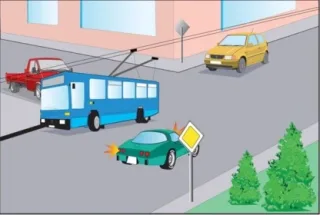
Question #16 What should a driver do if there is a traffic jam at an intersection where he has the right of way?
Topic: Passing intersections
Answer help
16.4. It is prohibited to enter any intersection, including when the traffic light signal permits movement, if a traffic jam has formed that will force the driver to stop at the intersection, which will create an obstacle for the movement of other vehicles and pedestrians. -
Question #17 Is it allowed to enter the lane marked with this road sign when making a right turn?
Topic: Advantages of route vehicles
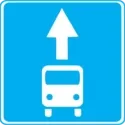
Answer help
17.2. A driver who turns right on a road with a lane for route vehicles, separated by a broken line of road marking, may make the turn from this lane. In such places, it is also allowed to enter it when entering the road and for boarding or alighting passengers at the right edge of the roadway. -
Question #18 Under which of the listed conditions is the operation of vehicles prohibited? Give a complete answer.
Topic: Technical condition of vehicles and their equipment
Answer help
31.4.5. Wheels and tires:
d) on one axle of the vehicle, diagonal tires are installed together with radial, studded and unstudded, frost-resistant and non-frost-resistant, tires of different
31.4.7. Other structural elements:
d) the locks of the body or cab doors, the latches of the sides of the cargo platform, the latches of the necks of tanks and fuel tanks, the adjustment mechanism provided by the design do not work -
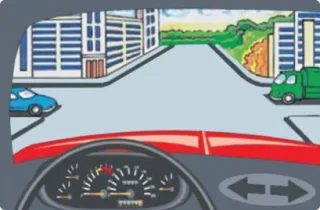
Question #19 The last to pass the intersection will be:
Topic: Passing intersections
Answer help
16.12. At an intersection of equivalent roads, the driver of a trackless vehicle must give way to vehicles approaching from the right.
Tram drivers must also be guided by this rule among themselves.
At any uncontrolled intersection, a tram, regardless of the direction of its further movement, has an advantage over trackless vehicles approaching it on an equivalent road. -
Question #20 At a railway crossing, the general alarm signal is a series of sound signals of a vehicle, consisting of:
Topic: Movement through railway crossings
Answer help
20.9. The signal to stop a train (locomotive, railcar) is a circular movement of the hand (in daylight — with a piece of bright fabric or any clearly visible object, in the dark and in conditions of insufficient visibility — with a torch or lantern). The general alarm signal is a series of sound signals of the vehicle, consisting of one long and three short signals.