
Photo by Lenta.ru and Ilya Shabalin
Expedition
How handy the full-size shovel we brought along turned out to be! Without it, we definitely wouldn't have been able to free the stuck "UAZik". The Patriot was thoroughly trapped: its front end wedged against a fallen tree, it spun its wheels and dug itself in up to the axles in the waterlogged soil of the flooded road. Pulling it out right away didn't work — the "Def", trying to tow with a steady pull, nearly got stuck itself, and there simply wasn't room for a sharp jerk. The jack also let us down — it instantly sank into the soft ground. Even the hand winch gave up: the cable snapped. All that was left was to dig.
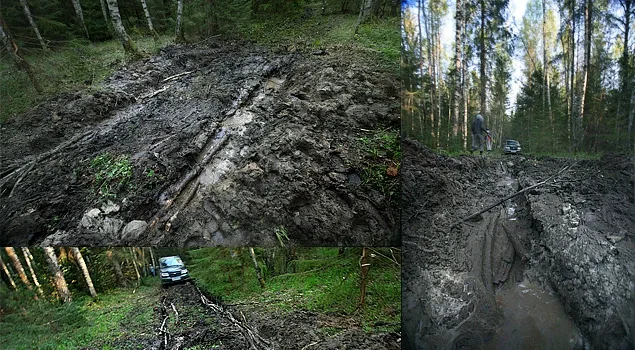 |
Two hours later, a huge pit gaped around the "Patriot" — we dug around the vehicle, freed the wheels, and cleared the track. During that time, the "Defender" managed to pack down a more or less solid "path" and got ready for towing again. We hook up the strap, engage reverse on the "UAZik" — the wheels spin freely in the air — the "Def" tightens the cable… Useless. The Defender spun in place, rapidly digging itself into the ground. We move it onto solid ground and pull up almost right next to the "UAZik".
Desperately churning all four wheels, the Defender slowly accelerates, a jerk… Hurray! The "Patriot" moved a meter and a half. Another jerk — and the "UAZik" struggles out onto solid ground from the pit, which is quickly filling with water from an underground stream. Phew… Time to head home.
Participants
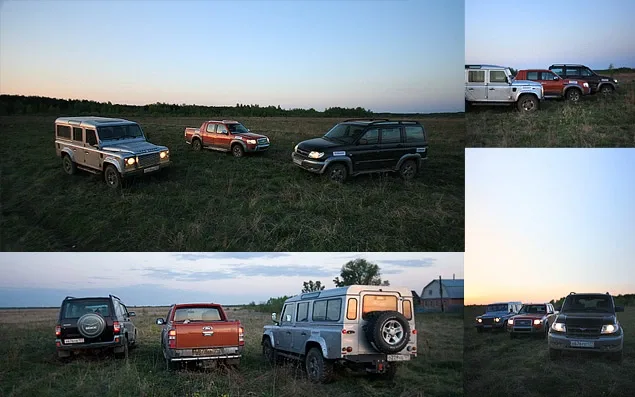
We prepared thoroughly for this test. We wanted everything to be real! An interesting route, serious off-road, and proper vehicles. Which ones? We decided to take one "real" SUV from Russia, Europe, and America.
We quickly chose our "representative" — the UAZ Patriot. Big, modern, and, judging by reviews, an excellent off-roader. With Europe, it's also clear — who else but Land Rover knows how to make proper SUVs, and if it's LR, then only the Defender. Or, simply, the "Def". But with the "Americans", there was a problem…
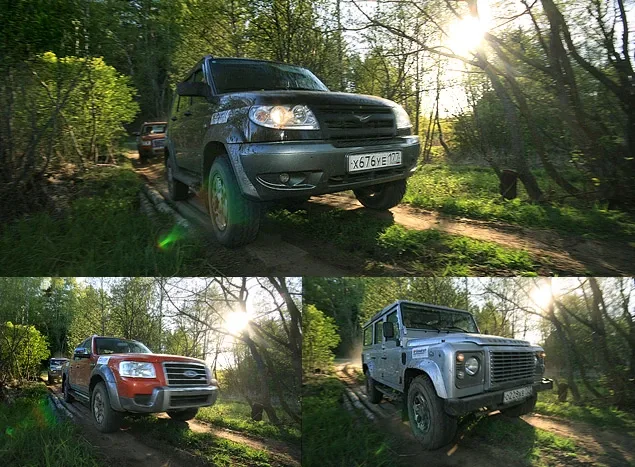 |
First, we looked for the "American UAZik" Jeep Wrangler — didn't find one. We almost agreed on a Hummer H3, but it was broken a week before the trip. Ford Explorer — it doesn't meet our requirements. Are we really going to have to cancel everything? Or maybe take a "Japanese"? Some kind of pickup, for example…
A pickup! Exactly! Ford Ranger! So what if it's assembled in Asia — the brand is American. And its four-wheel drive is "honest" — with lockers and a "low range". And the spacious bed — you couldn't ask for better for an "expedition" into the Tver forests!
With the participants decided and a rough route mapped out — through the southeast of the Tver region — all that was left was to pick the gear.
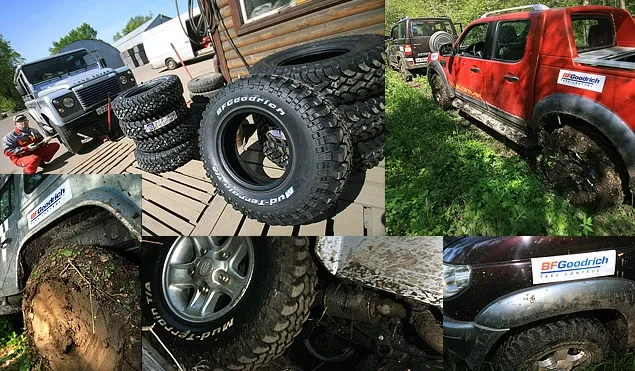 |
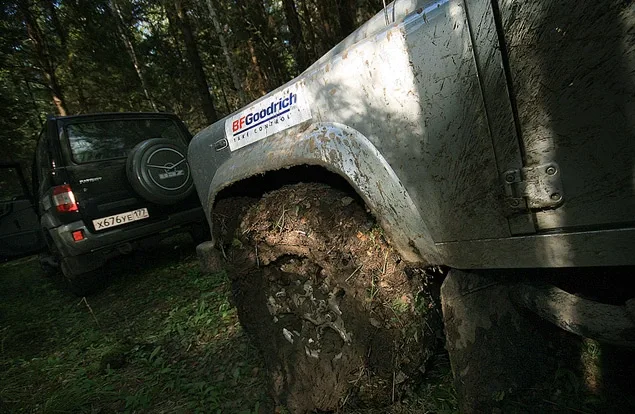
First, tires. We immediately decided to fit our SUVs with identical BFGoodrich Mud Terrain tires, in the sizes recommended by the manufacturers. First, to put all vehicles on equal footing, so we wouldn't have to make allowances for "road" tires. And second, driving on civilian rubber into forests that haven't dried out after the snowmelt is pure suicide. You can't just run to the neighboring village for a tractor there.
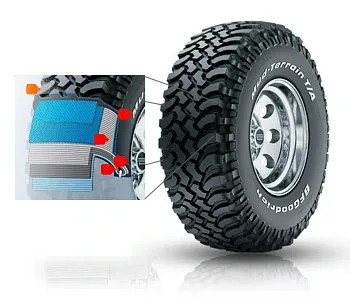 BFGoodrich Mud Terrain
Why did we settle on BFGoodrich Mud Terrain T/A? The main criterion — they're quite affordable for many owners of serious SUVs (just over six thousand rubles per wheel). That's why Mud Terrain is arguably the most popular off-road tire in Russia, along with their "civilian" version, All Terrain.
Given the upcoming route through the Tver forests and swamps, we needed true "mud" tires — with a well-developed self-cleaning tread, strong side lugs, durable and reliable. BFGoodrich Mud Terrain fit our requirements perfectly — they have an aggressive tread and a three-ply carcass, making them resistant to punctures and able to withstand prolonged driving even at very low (down to 0.5 atm) pressure. The only thing, according to rumors, that "Mud Terrains" fear is side cuts from sharp branches and rocks. Well, we had to watch carefully where we were going. Our overall impression of these tires can be summed up in one word — "delight"! SUVs fitted with Mud Terrain are true off-road monsters. They pulled themselves out of seemingly completely "hopeless" places. The main thing is that the vehicle doesn't bottom out, and that there's no clay under the wheels, which instantly clogs even such an "aggressive" tread. In all other cases, the tires let us "fight" to the last, gripping any patches of solid ground and grinding rocks and branches on abandoned forest roads into dust. The description of BFGoodrich Mud Terrain tires says they're designed for drivers who spend 80 percent of their time off paved roads and only 20 percent on asphalt. The thing is, on asphalt, these tires are subjected to too much stress and wear out quickly. Honestly, we didn't notice anything like that — our LR Defender 110 drove on the "Goodrich" tires around the city for another month and a half after the test, but we found no significant wear. So these tires are quite suitable for everyday use — for a couple of seasons, as we see it, they'll definitely last. Driving on "Mud Terrains" in the city turned out to be even pleasant — they're noticeably softer than the stock tires, so after installing them, all three SUVs became more comfortable, and they stopped noticing small bumps altogether. The downside — vague steering response and increased noise at high speeds. Of course, you can buy "cooler" off-road tires — ProComp, Interco, and so on. But those are wheels for true off-road enthusiasts. They're noticeably more expensive and often not as versatile as BFGoodrich Mud Terrain. |
After consulting with friends who are off-roaders, for navigation through the Tver forests, we put together the following setup — a laptop (with an adapter to power it from the vehicle's electrical system), an external GPS receiver, and the Oziexplorer program with a set of topographic maps of the area. As it turned out, this setup works excellently.
We bought the essential "off-road" equipment: a Hi-Lift Jack (T-Max 60"), a polyamide eight-ton cable with two "shackles" (those iron things used to hook onto tow points), and a nine-ton strap (a very strong and useful item). We got several pairs of swamp boots (the kind that go up to the waist), an inexpensive hand winch (just to have one), borrowed a chainsaw from friends (what would we do without it???), found and booked a cottage in some village, stocked up on food, filled fuel cans with "reserve" fuel, invited friends (we're not going to push our SUVs out by ourselves), and off we went…
Day One
According to the plan, we were supposed to cover 80-100 kilometers a day and return to "base". And not on public roads, but on abandoned ones, which on topographic maps were marked either with the thinnest line or even a dotted line. That is, along old dirt roads, through fields and forests. Naive!
 |
At first, things went well — we briskly covered a 10-kilometer stretch of rather mediocre asphalt road, turned onto a country lane, passed through a village, and headed along a barely visible trail toward a dense forest. In our hearts, each of us anticipated some new, special sensations from the upcoming trip through uncharted places…
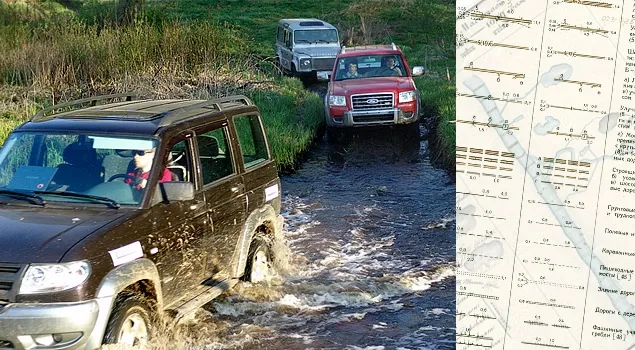
We didn't go around the puddles we encountered — we flew through them at speed, having engaged four-wheel drive on all vehicles in advance. Just in case. True, there was no reason for concern — all three vehicles passed through the black muck easily and effortlessly.
The first serious obstacle awaited us at the forest entrance: a very large puddle with flooded approach and exit. We put on our boots and went to measure its depth — only 25-30 centimeters. However, the puddle turned out to be nasty — the water had soaked deep into the ground, and the boots suspiciously easily sank into the muck up to the ankle.
This spot could only be bypassed on one side, via a fairly high hillock with a sharp crest at the top. We decided to first try to go around on dry ground, and if that didn't work, we'd ford the puddle. We sent the Ranger first — it climbed up easily, but at the very top it lacked momentum (and ground clearance), and it sat down on its belly and sills right on the crest. We pushed it out with four of us — in a couple of minutes, we rocked it and shoved it down. Who's next?
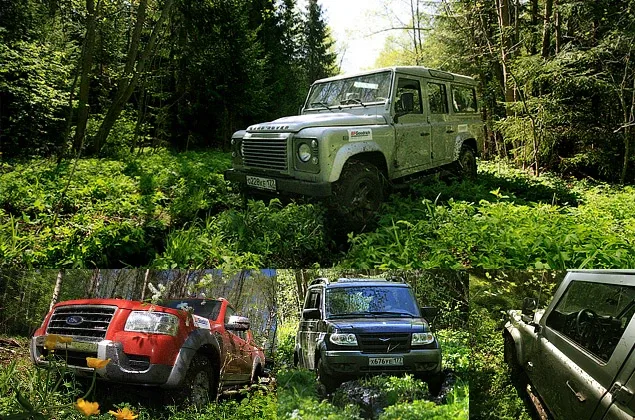 |
The next target was a UAZ, but we no longer felt like taking a detour — there was a great puddle ahead, and for some reason we were hesitant. We decided — let's get muddy! Especially since there were vehicles in front and behind that could pull us out if needed. The Patriot cleared this obstacle so easily that we felt embarrassed by our own indecision. The Def, bringing up the rear, didn't even notice the puddle — what a turn of events... And we were worried.
Then the real fun began. Deep in the forest, the ground hadn't dried out yet and was damp and loose, and the road kept disappearing and reappearing among the bright greenery — clearly no one had driven here in a long time. The first to almost get stuck was the Patriot — it slid into a deep rut and spun its wheels. We rocked it back and forth, engaged low range, and got out on our own.
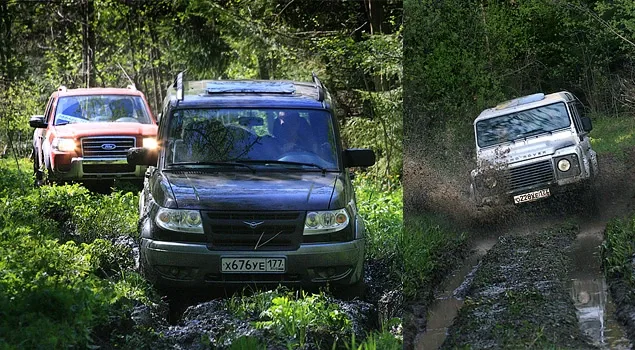 |
On the next section of the route, we sent the Defender ahead — let it blaze the trail for the others. And ahead of it, we dispatched a foot scout in boots to assess the depth of the flooded road. After all, we really didn't want to end up in a real swamp without proper winches. But even the "trained" assistant didn't help: at the edge of the forest, the Def got stuck. Properly stuck — it was driving along, and then within seconds buried itself in the mud up to its sills. And it couldn't move backward or forward.
We tried pulling it out with the Ranger from behind — useless. It was stuck solid. While we were tugging, we also planted the "American with Asian roots" in the rut we ourselves had dug (almost knee-deep). And the Ranger was stuck just as firmly — hanging on its rear axle. Well, it was time to test our new jack.
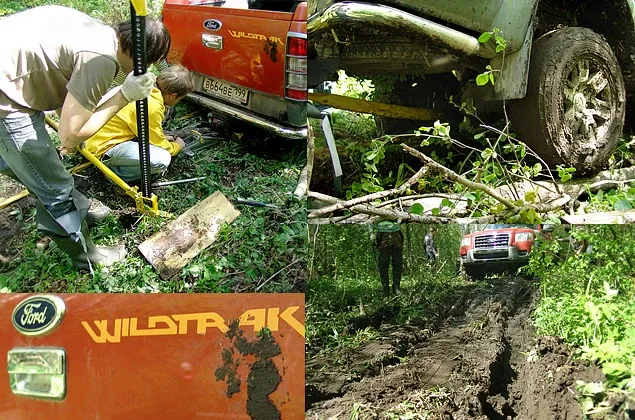 |
We brought it over, placed it on a pre-prepared board, hooked it to the sturdy tow hitch, and within a few minutes lifted the Ranger's rear almost a meter! While we were doing that, the other participants sawed up dry trees and placed them under the wheels hanging in the air. We brought up the UAZ and on the second attempt pulled the Ranger onto solid ground — the whole rescue operation took about 20-30 minutes!
Inspired by our jack's capabilities, we moved on to the Def. Working with it turned out to be even more pleasant — we lifted it by the iron front bumper, added branches and pre-cut pieces of wood. There was no rear bumper at all — instead, a piece of frame stuck out. Perfect! We hooked it, lifted it, placed wooden blocks, and decided to drive out without a tow.
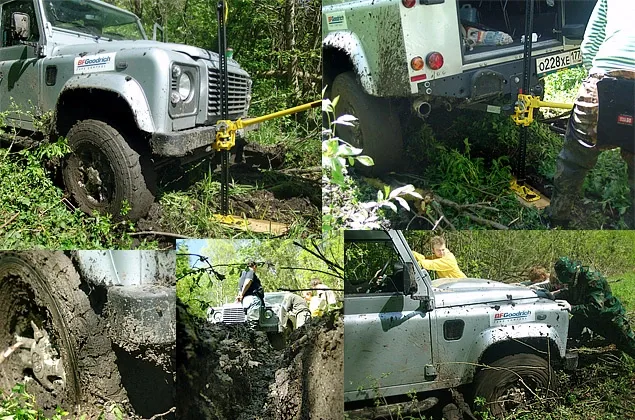 |
We engage low range, smoothly release the clutch — nothing. Our "off-road monster," as we'd nicknamed it, spins in place. We try rocking it — one, two, three... As soon as the wheels started gripping the firm ground at the edges of the rut, the Def slowly, as if reluctantly, crawled out onto the hard surface. Phew, adrenaline is surging: yes, we did it! We pulled out a stuck vehicle ourselves! It turns out this huge yellow jack is a great thing!
But then disappointment awaited us — it turned out to be impossible to drive further. The overgrown road ahead was flooded with water for about 200 meters, and on both sides was dense forest. And those tracks in the turf — either an elk or a wild boar had been there. Brrr! We turn around...
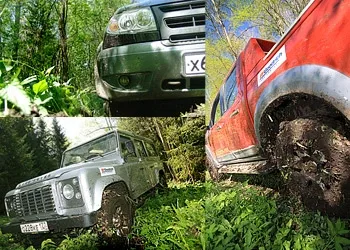 4 X 4 4 X 4 All three SUVs are equipped with "honest" all-wheel-drive transmissions, without any trendy electronic "gadgets." But while the UAZ Patriot and Ford Ranger are rear-wheel drive in normal conditions, with the front axle engaged manually when needed, the Defender has permanent all-wheel drive with the ability to lock the center differential. Surprisingly, the legendary Def doesn't have a single wheel lock! Instead, it has an electronic ETC system that brakes the spinning wheel using ABS actuators. As practice has shown, this system works well on the Defender and in most cases really helps cope with diagonal wheel hanging. The Ranger pickup has a self-locking rear differential, but it's too "soft" and without forced locking. So it doesn't provide any noticeable advantage off-road. However, there's a very convenient system that allows disengaging the front axle without disconnecting the front wheels from the transmission. This is done so the driver can quickly engage and disengage front drive while moving — at speeds up to 100 kilometers per hour. This can be done by pressing a special button on the dashboard. The UAZ Patriot has the simplest all-wheel-drive design: a rigidly engaged front axle with manual hubs in the front wheel hubs. Currently, the Ulyanovsk Automobile Plant has already started producing Patriots whose hubs are locked electronically, but we got a pre-restyling vehicle. The UAZ has no wheel locks. |
We had to look on the map for routes around the flooded area. We returned to the highway, drove a few more kilometers, and turned off again — onto a road paved with concrete slabs, between which deep gaps 30-40 centimeters wide had formed over the years. And how do the locals drive here in their cars?
The SUVs handled the "concrete road" differently. The Defender bounced like a ball, making its passengers jump in their seats, but it didn't bottom out. The Ranger rode much softer, swallowing most bumps, but on large potholes there was strong rocking that made the suspension hit the bump stops, and the driver had to slow down. And the most comfortable turned out to be the Patriot — it just flies along, rumbling with its suspension, noticeably tired after the 20,000 kilometers it had covered in the press fleet. And it flies as if under the wheels there's not battered concrete but barely noticeable bumps.
A few kilometers later, we came across a small village whose residents looked at our convoy with surprise. We looked at them too — does anyone really live here?
We left the village along an abandoned country road — through a field, into the forest, and somewhere further. But we know where — to the long-awaited water obstacle. The map doesn't show whether there's a bridge or if we'll have to find a ford, but that's the beauty of an "expedition"!
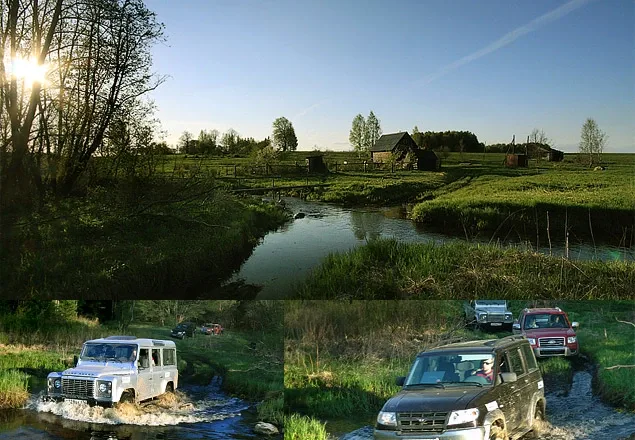 |
There was no bridge. But we didn't have to look for a ford either — when we drove out onto a picturesque clearing, we saw our road ending at a narrow river and then reappearing on the opposite bank. We checked the depth — no more than 40 centimeters at the deepest point, and underfoot was a firm bottom of small stones. We crossed the ford quickly and even made a couple of extra passes for the videographer.
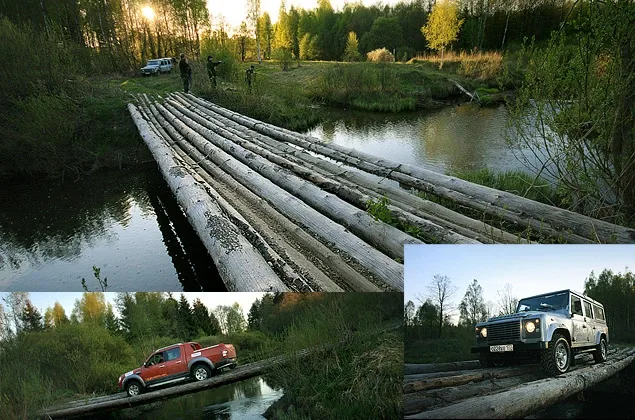
Then — a few more kilometers across an endless field, a small forest, and another river, only deeper, with a "bridge" thrown over it. I put this word in quotes for a reason — calling that dozen thick logs bound together with metal brackets a "bridge" just doesn't feel right. Moreover, the logs are long and sag in the middle, swaying ominously even under the weight of two or three people. But overall, the structure looks sturdy and capable of supporting the weight of our SUVs — we saw tire tracks of trucks and tractors on the approaches to this place with our own eyes.
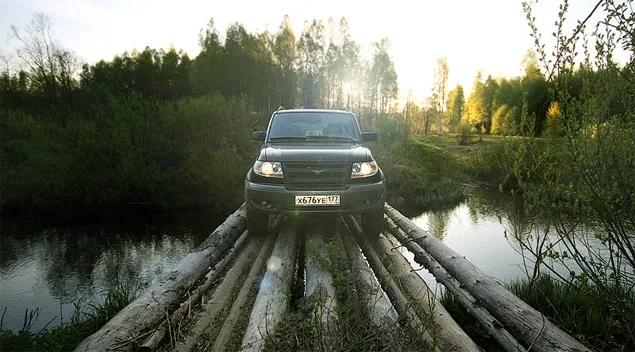 |
The first to go across the narrow deck — with one and a half logs remaining on each side of the vehicle — was the Def, slowly and carefully. However, the "bridge" really turned out to be sturdy and easily held the 2.5-ton SUV.
Ferrying the others across the deck seemed too boring to us. After all, there was an excellent ford nearby! We measured the depth — about 70-80 centimeters, if not more. We open the hoods of our SUVs and look at where the air intakes and alternators are located. It turns out all three vehicles are well-prepared for fording water obstacles: the alternators are on top and protected from dust and splashes, and the air ducts are routed upward. On the Ranger, the air intake goes into the fender, and on the Defender — "outside," for easy snorkel installation.
 |
Let's go! The water rises higher and higher, and it seems it's about to cover the hood, and the sound of the running engine changes to a dull rumble (because the exhaust pipe has disappeared underwater) — at that moment it gets scary! Here it's important to remember the main rule when fording — don't create a strong wave that could flood the air intake. So you need to enter the water as smoothly as possible and try to drive steadily. And only at the very end should you speed up a bit to avoid digging into the silt when climbing onto the bank.
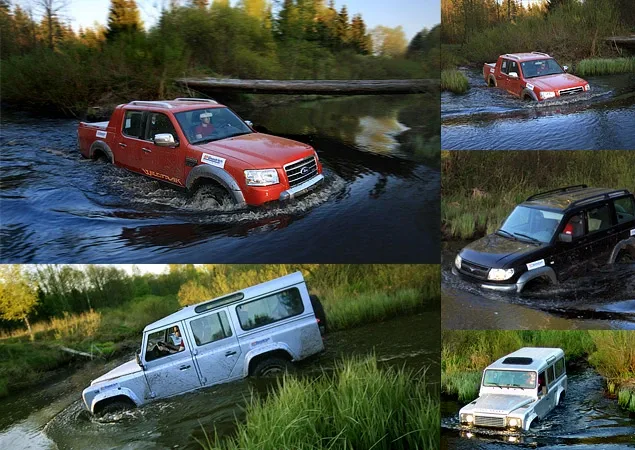 |
In general, all three SUVs (yes, yes, we later sent the Def into that river too) safely reached the opposite bank, although the low-slung Ranger made us nervous: at one point, its badge on the radiator grille completely went underwater...
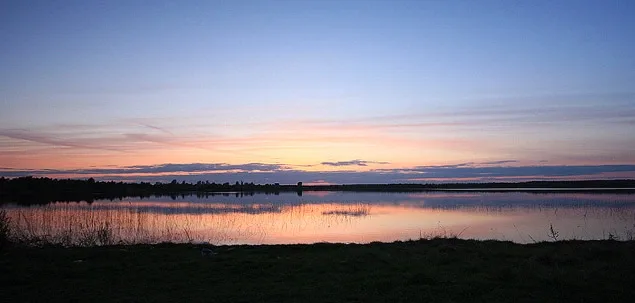
The funniest adventure of the day happened already in the evening. Having run into a large lake, we decided to go around it on the left, but that road led us to a scary swamp. We turned around and went right — through the forest. We had to crawl about five kilometers along an abandoned path with huge puddles full of water. We drive out to the lake — and there are cars, tents, people, everything civilized.
It turned out that entry to this area is paid — through a barrier installed on the other side of the lake. And no one has driven along the road we came on for a long time: no "normal" car can pass there. You should have seen the guards' eyes when we drove out to "freedom" — they clearly couldn't understand where we had come from.
 |
Day Two
In the morning we planned to reach a big beautiful lake located about fifty kilometers from the camp. But in the end, in ten hours we covered only a few kilometers…
Troubles started from the very morning. After driving a couple of kilometers from the asphalt, we lost the road: we drove out onto a huge clearing from which, at first glance, there were no exits at all. We had to look for a forest clearing along the perimeter of the forest — after half an hour we found a barely noticeable "tunnel" between the trees, overgrown with bushes. The road had to be cut through with a chainsaw.
And about five hundred meters later we ran into a swampy edge with rare islands of more or less solid ground. We decided that the "Defender" would go first, and the "Ranger" and "Patriot" would follow — if anything, the "Def" would pull them out with a tow rope.
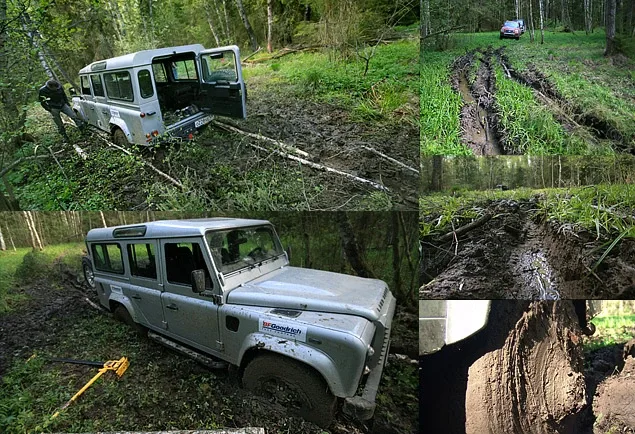 |
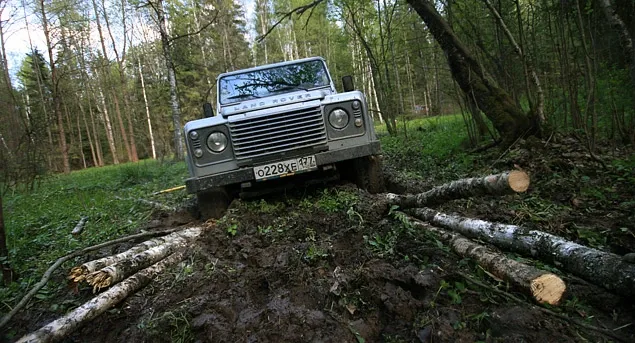
But the "Def" got stuck without driving even thirty meters. The ground turned out to be so soft that the SUV, like yesterday, quickly dug itself in up to the axles. We got out the jack — it sinks into the ground. We put a couple of logs under it — that seemed to help. With a shovel we widened and lengthened the ruts, threw in branches and trunks of cut trees. After an hour, the "Def" still got out, again without outside help. But, having driven another forty meters, it got stuck again — this time for real.
The wheels were clogged with clay, and they spun helplessly in the soggy mess. The jack didn't help — it instantly sank into the ground. There was no way to bring the second car up from behind: it was too dirty around, and the ruts left by the "Defender" were so deep that the "Patriot" and "Ranger" would have gotten stuck in them instantly. There was only one option left — to cut through the forest from the side, drive up to the car from the front, and try to pull the "Englishman" out with a front tow.
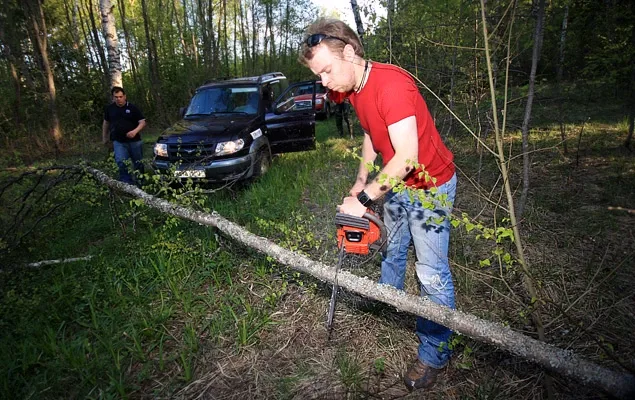 |
It took about an hour and a half to make a detour for the "UAZ". We drove up, hooked the "Def" with a strap, pull — it doesn't budge. We didn't even move it from the spot. We tried to drive the "Patriot" aside so it wouldn't interfere… Ha! It turns out it was stuck too, having dug shallow but very slippery holes under its wheels. The soil here is such that even the "Goodrich" tires have nothing to grip.
Someone remembered the hand winch. Well, let's try that too. We fold the tow strap in half, hook one end to a tree, and the other to the winch bought at a garden store for 600 rubles. The instructions say it can handle a load of up to a ton, and our "Def" weighs two and a half times more. It's scary: what if the cable breaks and the winch "fires", hitting someone. So we work only from the side of the mechanism, wrapping the cable in someone's sweater.
It turned out that even such a flimsy winch can be useful! The cable literally hums from tension, but the "Def" slowly, a few centimeters at a time, crawls out of its "mud bath". In twenty minutes we dragged it half a meter! We re-hook the cable, shorten the strap, and pull again, while placing thin logs under the wheels.
 |
It seems like just a little more — and the "Def" will find traction with its wheels and get out on its own. But then the driver for some reason turned the steering wheel, the wheels slipped off the logs and sank back into the mud! Unbelievable! There was so little left!
The epithets that flew at the person behind the wheel, I won't dare to repeat here…
We have to start all over again. We re-hook the winch and pull the "Def" centimeter by centimeter again. After an hour of work, the SUV, finally gripping with the "Goodrich" tires on the hard turf, breaks free! The "Patriot" standing nearby is also pulled out with the winch, and quite quickly — fortunately, it wasn't seriously stuck.
The "Ranger" reached the others along the same route as the "UAZ" — along the cut clearing. Do we continue or turn back? It's already evening… After consulting, we decided to try to push further.
 |
I led the column — behind the wheel of the "Patriot". The first two hundred meters of the soggy road, strewn with branches and tree remains, we drove in one breath: the toothed tires ground rotten trunks into chips, and the "UAZ", periodically spinning all wheels, stubbornly crawled forward. But then…
I noticed the half-buried tree too late and didn't have time to gain speed — the front wheels of the "Patriot" hit the trunk, the car spun its wheels and immediately sat on the axles. As it turned out later, an underground stream flowed under this section of the road, so the soil here was very soft and loose, with a lot of sand. What happened next, you already know. Several hours of "digging", a shovel handle broken twice, and then — a confident jerk from the "Def", and the "UAZ" is free again. But we decided not to go further: it was already getting dark outside, and we still had a long road to Moscow ahead.
Later we calculated: on the second day, our off-road mileage was only three kilometers. But what kilometers they were! Real ones, soaked in sweat, fatigue, and… joy. Joy from the fact that we got out ourselves, without outside help. And, most importantly, without a tractor.
We must admit, it was truly great!
We decided not to name the winner of this test expedition. The cars turned out to be too different — both in consumer qualities, and in price, and in "character".
Take the "Patriot", for example — it turned out to be not at all as "terrible" as we thought a month ago. Of course, it has plenty of shortcomings, there are questions about quality, and so on. But we shouldn't forget that this "UAZ" costs almost half as much as the "Defender", while almost not yielding to it in off-road capability. And in terms of comfort — it's head and shoulders above.
 |
The "Ranger" is a model of versatility. It's not scary to drive it in the city, or go on a trip, or go off-roading. Very easy to drive, with a torquey engine — a good option for those who are just planning to switch from a car to an SUV. And it's relatively inexpensive: the tested pickup in maximum trim can be bought for 40 thousand dollars.
Well, the "Def"… The "Def" is power. It's probably hard to say it better.
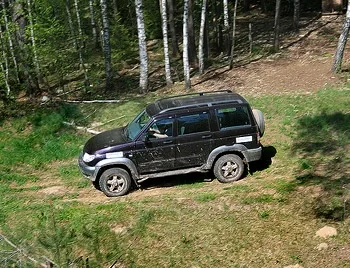 UAZ Patriot UAZ Patriot The "UAZ" seems to be woven from contradictions. On one hand — a nice appearance, spacious interior, large trunk, comfortable suspension, and a torquey gasoline engine. And on the other — rattling interior plastic and a cup holder that pops out on every bump, noise and creaks in the suspension, an absurdly huge and very heavy rear door, as well as an anachronism in the form of two fuel tanks (at least with automatic fuel transfer). For passengers, this is the most comfortable car — soft and comfortable even on a broken road. But being the driver of a "UAZ" is not a pleasant experience. The long and completely empty "at zero" steering wheel, which trembles in your hands from any bump and forces you to constantly correct, the vague clutch pedal, and instability during hard braking, threatening to turn into a deep skid. Off the asphalt, the "Patriot" transforms. The energy-intensive suspension allows you not to slow down before potholes, and the 2.7-liter engine pulls already from idle. You can also engage the "low range". True, it doesn't always work the first time — the vague transfer case drive and the lack of indication of the current four-wheel drive mode get in the way. Off-road capability is excellent! In this parameter, the "UAZ" yields only to the "Def", and only due to the lack of ground clearance and too narrow stock wheels. However, of our entire crew, it was the "UAZ" that turned out to be the least prepared for serious off-roading. The steering rods and transmission remained unprotected, the side steps eat up several centimeters of the already modest clearance, and the plastic body kit doesn't allow hooking a "hi-lift" jack to the metal body elements. The rear tow hooks are hidden deep under the bottom, and it's extremely inconvenient to get to them.
Lenta.ru thanks the Russian office of Michelin for providing BFGoodrich Mud Terrain tires for testing. We express gratitude to the online store Shinatut.ru for tire fitting services.
Mikhail Tsymbal |
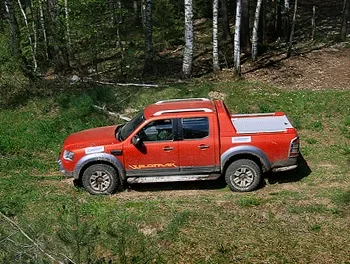 Ford Ranger
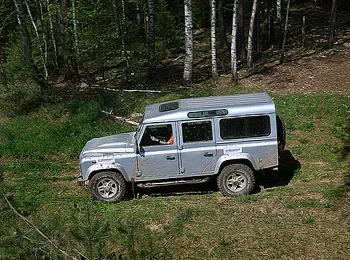 Land Rover Defender 110