
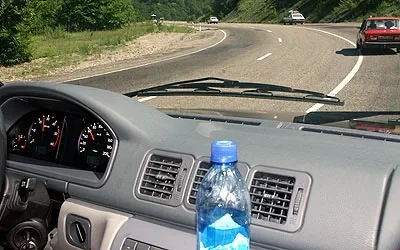
The route from Krasnodar to Sochi is perhaps the best natural testing ground for any vehicle. That's why when we were offered to start testing the new Ulyanovsk SUV with a 350-kilometer drive along this very highway, our entire team embraced it with enthusiasm. The smooth asphalt of the plain allows you to assess the car's behavior at high speeds, while the mountain serpentines test how obedient the steering is and how effective the brakes are. And all this in the sweltering heat and with significant elevation changes.
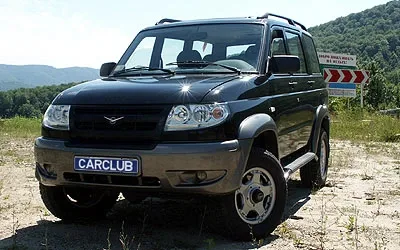
In Krasnodar, we were greeted by asphalt melting from the heat and scorching air shimmering over the road—a real oven. First, I asked whether the Patriot had air conditioning. Alas, even in the top Limited trim, it doesn't, and we'd have to wait at least a year for it (if you install air conditioning yourself at a specialized service center, it will cost about $1,500). However, the cabin did feature a sunroof, which, along with fully lowering windows rather than the vents of old UAZs, provides quite tolerable ventilation while driving. True, the wind noise is so loud that you can't even hear the engine.
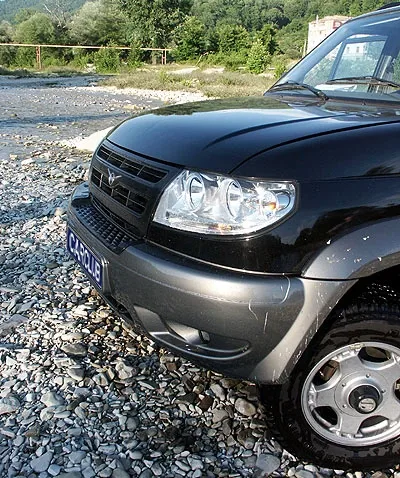
The main thing that sets the Patriot apart from all previous UAZ models is its modern cabin and quite attractive exterior. The front panel is of Iranian production, the instrument cluster with an electronic odometer comes from Latvia, and the striking headlights were developed by Bosch. No matter how you look at it, the Patriot is the most appealing and comfortable of all domestic SUVs.
Up front, there are seats from the Niva, and the soft rear bench is split into two unequal parts, with backrests that can be adjusted for angle over a fairly wide range. If desired, the Patriot's cabin easily turns into a large bed. Another plus: to fully fold the rear seat, you don't need a wrench—just unscrew a couple of wing nuts by hand. However, you won't have to fold the seats often. In the five-seat configuration, the Patriot's trunk is simply huge, and hidden inside are fold-down seats for four more passengers. So the UAZ can be turned into an eight-seat minibus. True, for long trips, this option is hardly suitable: sitting on the fold-down seats won't be too comfortable.
For the test drive, we were given Patriots with both petrol and diesel engines. The diesel is a new addition to the UAZ lineup. For the drive to Sochi, I chose the more powerful petrol version: I really wanted to make it to the sea for a swim before sunset. Surprisingly, the four-cylinder 2.7-liter engine with just 128 hp proved quite suitable for the heavy Patriot. Paired with a Korean five-speed manual gearbox, it gives the UAZ almost car-like dynamics. There's no trace of the old sluggishness of the previous "goats" and "loaves"—the Patriot accelerates no worse than domestic nines and tens. Moreover, the engine revs easily to the red zone, which starts at 5,000 rpm—almost like a diesel.
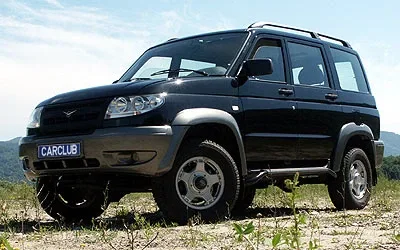
On the dry asphalt of the highway, of course, only the rear axle was engaged. Four-wheel drive is engaged rigidly, without a center differential, so in that mode you can only drive off-road or on slippery surfaces. Rear-wheel drive was quite enough to avoid wheelspin. On straights, the Patriot accelerated to 140 km/h without much effort and behaved quite decently at that speed. The main thing is to hold the steering wheel firmly and remember that this is still not a passenger car. The steering wheel, borrowed from the Niva, is equipped with power steering, but it can't be called too light. As for the brakes, you need to get used to them: my first braking caused a slight shock. It seemed that the pedal hit something hard and couldn't be pressed. But if you stay focused and adapt to the stiff pedal, the car stops fairly quickly—there are disc brakes up front.
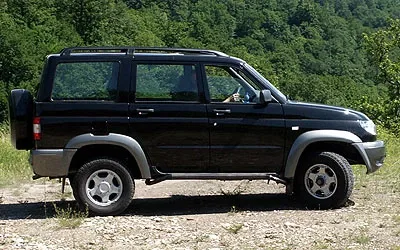
In the mountains, the Patriot also didn't let us down. The long wheelbase and classic layout make the UAZ's behavior on serpentines predictable. Of course, on mountain roads, the Patriot can't compare with modern crossover SUVs that on the highway are almost as good as cars: the UAZ is far behind them. But I didn't expect sporty handling from a vehicle with dependent suspensions.
After such a grueling dash, by evening my arm and leg muscles ached considerably. Say what you will, but a UAZ, even one as refined as the Patriot, is a special vehicle that requires certain skills and physical fitness. At the same time, all ten cars in our convoy completed the challenging route without serious technical issues, which wasn't so common with previous Ulyanovsk models. The only complaint was fuel consumption. Over 350 km, the Patriot consumed about 50 liters of petrol, or 14.3 liters per 100 km. For a highway, even a winding one, that's a bit much, and it doesn't match the manufacturer's stated figures.
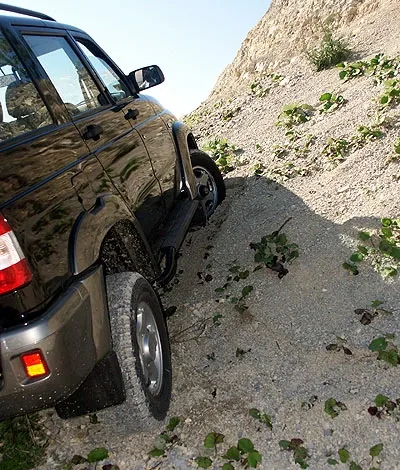
The main part of the Patriot test drive took place in the vicinity of Sochi. The UAZ folks weren't afraid to take us high into the Caucasus Mountains, where the asphalt gradually gave way to concrete slabs and then just gravel fill with boulders the size of watermelons. In such conditions, the diesel engine proved quite appropriate. The ZMZ-514 in terms of traction characteristics slightly outperforms the petrol engine in the low and mid-range, but loses to it at high revs due to lower power. In terms of noise insulation, both engines turned out to be very similar. We couldn't compare fuel consumption: the two days of tests took place in completely different conditions. But if we trust UAZ's data, the difference should be about 15–20% in favor of the diesel.
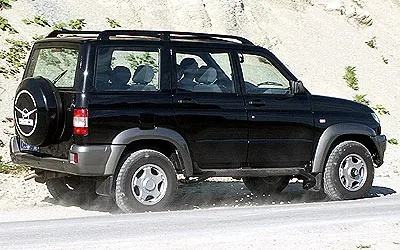
In the rocky mountains, we had to stop, lock the front axle hubs, and engage four-wheel drive. After that, the Patriot turned into a true off-roader. To tackle some climbs, we had to engage low range, and sometimes even start from a standstill on a slope. Despite everything, the UAZ climbed up with manic persistence. At times, I feared the Patriot wouldn't handle diagonal wheel articulation—after all, it has no cross-axle lockers. But the suspension travel turned out to be so great that the wheels never left the ground. The suspensions also successfully shielded passengers from jolts—throughout all the tests, there wasn't a single hard impact.
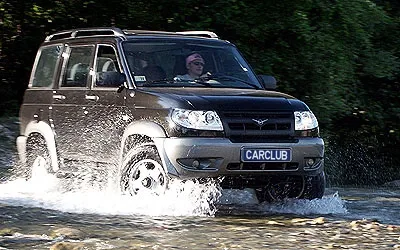
With the manufacturers' permission, we decided to test the vehicle in truly extreme conditions by tackling a small mountain river. The UAZ crossed to the other bank without much difficulty. Then we decided to make it harder and continued driving against the current. In places, the water reached the body sills, but the UAZ stubbornly "swam" forward. Few vehicles can get into such wilds and, even more so, get out under their own power without damage. And that, perhaps, is the Patriot's main market niche.
Of course, those who need an SUV for the city with occasional trips into nature should probably look at a used imported crossover or a new Chinese pickup for $15–19 thousand (the same price as a new UAZ Patriot). The Patriot's element is off-road. Phenomenal off-road capability and suspension reliability make this model unique for hunters and fishermen. The Patriot also benefits from the brand's prevalence in the Russian hinterland, meaning no problems with spare parts and their low cost compared to imported ones. So, I think the 40,000 vehicles UAZ hopes to produce as early as 2007 will find their patriots. By the way, sales of Patriots with air conditioning have recently begun, which should significantly expand the audience of potential buyers, especially in the southern regions of Russia and other hot countries where UAZ has traditionally enjoyed steady demand.
Leonid Pavlov