
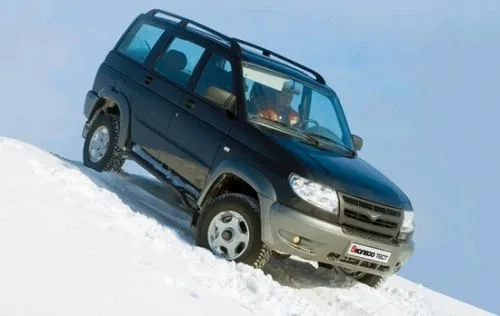
Six months ago, the first production UAZ Patriot rolled off the assembly line at the Ulyanovsk Automobile Plant. Even then, representatives of Severstal-Auto, which includes UAZ, openly admitted that the vehicle required refinement. Let's try to figure out whether the problems that plagued the very first batch of SUVs have been resolved.
2006 UAZ Patriot
© Photo: Sergey Krestov, 5 Koleso
In the first Patriots, the braking system drew the most complaints — this was confirmed by a July test in the Krasnodar region. The pedal required significant effort, and there wasn't enough feedback to accurately gauge the stopping distance. The steering felt vague: there was no precision near the center position, and the free play was too large. At speeds of 80–100 km/h, the vehicle began to wander from side to side. Other shortcomings on the list included considerable effort required to transform the seats, unreliable attachment of the box lid on the tunnel, and vibrations in the steering column.
What has changed? Let's start with the brakes. They have clearly improved. True, the pedal still requires a lot of effort. But now the stopping distance can be calculated with acceptable accuracy. We'll count that as a plus.
The steering has also gotten better. The center position is now more distinct, and reactions to the steering wheel are more understandable. They managed to reduce wandering on the highway — adjusting the wheel alignment angles helped.
In the cabin, the situation is mixed. The box lid between the seats is still held on by two self-tapping screws. The steering column continues to vibrate in your hands, and folding the rear seats takes a lot of time and effort. However, the seats now have a more pronounced profile with good lateral support.
For a thorough test, we took the SUV into 30-degree frosts, near Lake Seliger. After cold nights, the engine started fairly confidently, though not on the first try — usually on the second or third attempt. The cabin warmed up to a comfortable temperature with two heaters in 15–20 minutes. But the air distribution leaves much to be desired: you have to choose between warm feet and clear windows.
At the start of the test, the odometer read 6000 km. By 8000 km, the driver's window regulator guide gave out. Then the turn signal stalk stopped returning to its original position. And the box lid between the seats fell off — as usual, no surprises.
An interesting feature was found in the mirror heating: it doesn't turn off with the ignition. The driver can easily forget about it, and in the morning you might find a dead battery.
Let's sum it up. The Patriot has become noticeably better, but there are still plenty of shortcomings. The cabin could use better plastic trim, and the brake pedal should be softer. Proper air distribution needs to be sorted out. The door locks and handles need replacement — opening and closing them takes too much effort. And, of course, the steering column with its vibrations remains a major annoyance.
As representatives of Severstal-Auto promise, this year the Patriot will get versions with ABS, air conditioning, and new engines. Ulyanovsk engineers are also working on installing a modern power steering system with variable assist.
© 5 Koleso