Despite the front panel being a feast for the eyes and the cabin exuding a warm, homey atmosphere, the exterior looks a bit wild: the rear seems chopped off and lives its own life, separate from the rakish front end. On asphalt, it runs quite briskly, but it stumbles capriciously over every pothole. The engine and transmission are well matched, but the chassis is clearly problematic. It feels as if the suspension and steering were pulled from various Japanese and American models, then inserted into a Swedish body, with the whole mishmash covered by electronic damper adjustment.
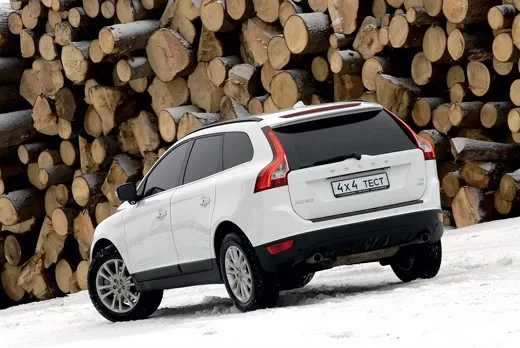
The most important thing here is, of course, the ground clearance. 230 mm is almost unbelievable for a crossover
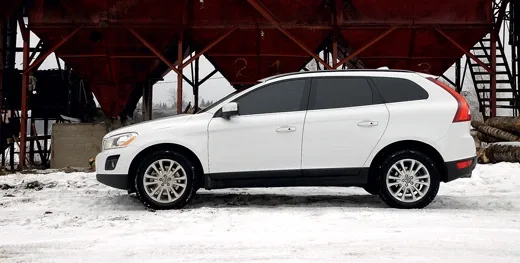
The engine and gearbox combination is solid and would be pleasing even apart from the suspension. Just look at the V-shaped “six” in the GLK with a 3.5-liter displacement and the inline three-liter unit in the XC 60. The Mercedes engine produces 271 hp at 6000 rpm, with peak torque of 350 Nm available between 2400 and 5000 rpm. The Volvo engine, despite smaller displacement, manages to deliver 285 hp at 5600 rpm and 400 Nm, in a much more attractive range of 1500–4800 rpm. If the Volvo didn't have an extra 160 kg of mass and longer transmission ratios tuned for economy, it would never concede 0.8 seconds to the Mercedes in the sprint to 100 km/h. But for now, 7.5 seconds versus 6.7 – and the Germans are ahead.
FIRST IT SQUATS, THEN IT DIVES
As soon as I left the dealer onto the Moscow ring road, for the next few dozen kilometers all I did was overtake. And that's no surprise – in this car you immediately want to move to the left lane; the Volvo's ambitions are impressive.
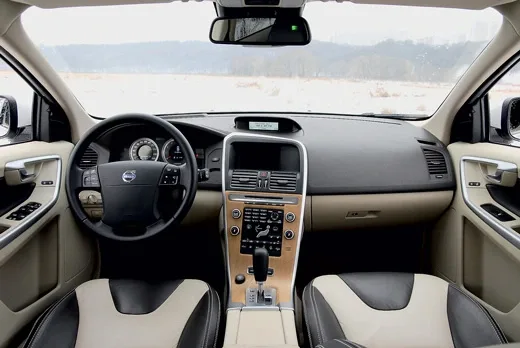
The fact that the Volvo XC 60 is a premium car is felt not behind the wheel, but while sitting in the cabin

He thought for a moment, then went off somewhere, came back, and said: “This is real sport!” And smiled.
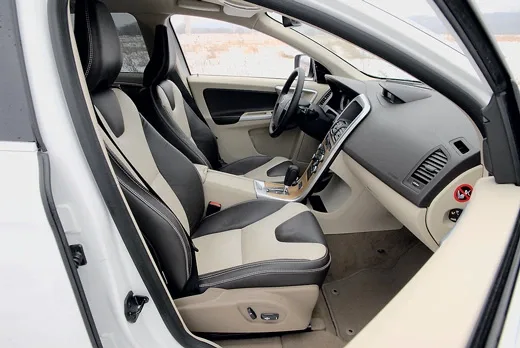
The photographer noticed that these seats are very comfortable for sleeping. Driver, don't relax!
The Volvo automatic gearbox, although it has one fewer gear than the Mercedes, briskly revs the engine up to 5000 rpm, and in sport mode allows even more. This Volvo “engine-gearbox” duo definitely has character. It tempts you to floor the pedal, just like the Ingolstadt provocateur Audi Q5. But a heated-up XC 60 driver shouldn't always count on the suspension. In the city, I have a couple of sharp turns that I love to use as a test ground when the road is clear. Now the road is empty, and there's a familiar bend ahead. My actions are automatic, and I just want to enjoy a high-speed pass. And what does the Volvo do? First it squats on the outer wheel, then sharply dives into the turn, almost toward the barrier. I had to actively turn the wheel to catch the right line. I managed somehow, but more thanks to my vestibular system. I get onto the highway – and then the rut test begins. With soft dampers in “comfort,” the car wanders a bit, but I glance at the speedometer – 140–150 km/h. In principle, not bad. But with the suspension stiffened in “sport,” the car starts to get thrown out of the ruts. At the end of the trip, another sharp bend – and at the peak of the turn, the Volvo starts jerking as if driving on a locked all-wheel drive. And that's exactly what's happening! The discs in the coupling clamp when there's a difference in rotation. The algorithm, let's say, isn't designed for street racing.
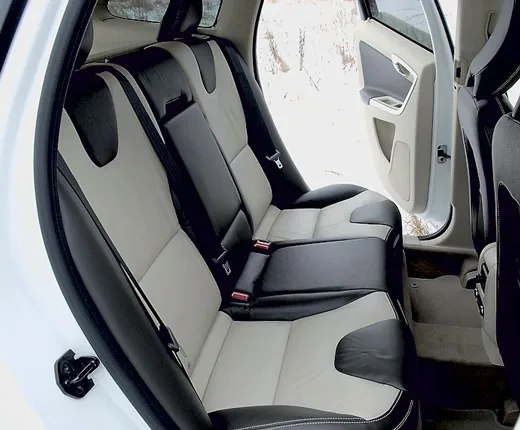
There's quite a lot of space in the back – more than in competitors
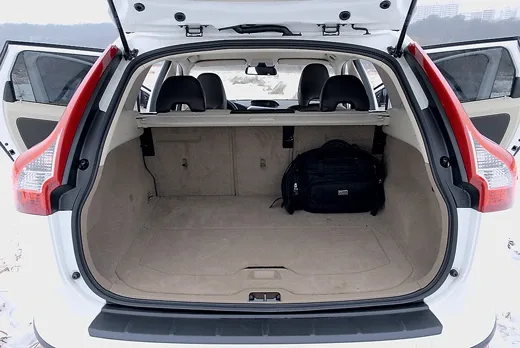
The trunk is far from the worst in its class, and the transformation possibilities are quite decent
REAL SPORT FOR HOUSEWIVES
Forget those turns. Only madmen take them at the same speed as journalists. Ordinary people – peaceful, calm, family-oriented… For them, there's a comfort button on the front panel. But why is there a sport button next to it in this safe family crossover? If it were up to me, I'd never turn it on. It clearly got there by accident.
“Does sport mode make the dampers stiffer? I understand, but there's also an advance button. What's that for?” I asked the technician who gave me the car for the test. He thought for a moment, then disappeared somewhere, came back, and said: “This is real sport!” And smiled.
I didn't torment myself with sport and advance modes for long and quickly returned to comfort. Although in any mode, the XC 60 rides delicately. It's hurt by speed bumps and even the smallest cracks in the asphalt. Instead of a proper suspension, there's a desire to attract as many buyers as possible – both reckless pilots and wise housewives.
SPECS: VOLVO XC 60


IT WILL GO ANYWHERE THE CONSUMER WANTS
But the Volvo is cheaper than all competitors, and its front panel is excellent. In the center is an aluminum figure, and on the sides are round temperature and volume controls. Even if you wanted to, you wouldn't get confused. And you don't have to lower your eyes much. However, I didn't find the ESP off button here. So the question of off-road capability remained open. But you don't expect much off-road capability from a crossover of this class, since it's not designed for off-roading. As one engineer said: “If the consumer needed it, we'd have made it long ago.” So even the most modest result is pleasing.
I never managed to get the XC 60 stuck. It passed the diagonal wheel hang without issues, and snow drifts too. It even climbed a steep hill – what more do you need? Certainty! You can't satisfy all tastes. There's a lack of healthy cynicism. You just have to ignore some buyers. But Volvo doesn't have the courage for that.