
Volvo C70. Wind in the Hair
I think the first convertible was created by a person who lacked the main sensation in a car — the sensation of speed from the wind rushing into the face and a scarf fluttering behind the back. As soon as the rider traded his horse for an iron beast with a whole herd under the hood and locked himself in the car cabin, he became bored, lost the feeling of unity with nature, and it no longer mattered what season it was outside or what the weather was like. Romantics were found who wanted to bring all this back — the convertible appeared.
Today, 29 convertible models are officially available on the Russian market. From Bentley and Rolls Royce to the modest little Peugeot 207 CC, Ford Focus, and Opel Astra Twintop. Recently, a new player joined this company — the Chrysler Sebring Convertible. So there is plenty to choose from. The main thing to consider when buying such a vehicle is that not every convertible can become all-weather, since these are mostly cars with soft tops, and Russia is not California. Yes, and the price of a convertible will be significantly higher than a regular hatchback or sedan. With this in mind, convertibles, like powerful sports cars, are toy cars — they are created primarily for enjoyment, not as a regular means of transportation, and cannot be the only car in a family. But our today's test hero, the Volvo C70, can theoretically handle even such a task.
Now without a coupe
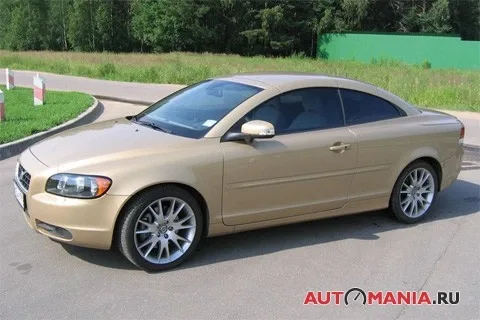
The C70 is not a new name for Volvo. But if in 1999 the C70 could be either a coupe or a convertible, now these two models have transformed into something qualitatively new. The Volvo C70 is the first joint product of Volvo Car Co and the design studio Pininfarina. The famous Italian designer did his best. Even the most discerning car enthusiast, approaching the car with the roof closed, is unlikely to immediately realize that it is a convertible. Only two small details can give away the C70 — the split rear taillights and the seam on the roof (the roof folding mechanism here is three-section). However, the designers aimed to achieve exactly this effect. The classic coupe has disappeared from the Volvo model range, and the new convertible has managed to retain its appearance with the roof closed.
If you ask the driver to open the front door, another detail will appear that indicates the car can also drive without a roof. In a regular coupe, the wide doors open at an angle of almost 90 degrees, but here you cannot open them more than 40 degrees (this is done to increase body rigidity). As soon as you open the left door, you find 4 window switch buttons, not 2, as one might logically assume. The front and rear windows are separated by a soft rubber gasket that prevents the glass from touching. They can be opened individually, or all together synchronously. An additional button is responsible for the synchronous opening of the windows; after pressing it, the front windows lower first, then the rear ones. Rear passengers are deprived of the ability to control the windows; only the driver commands here.
No more than two in the back
By the way, about the two (more won't fit!) rear seats. The Volvo C70 has one of the best rear legroom figures, and the car can rightfully be called a 4-seater. The closed roof does not create a feeling of crampedness or hanging over tall passengers. They also have convenient shelves for small items, two cup holders, and individual lighting, which is located not in the usual place for all cars — on the roof, but in the door, at a height slightly above the elbow. By the way, a very convenient place. The car even has a ski hatch behind the central armrest. A cover is hidden there, which can come in handy if the roof closing mechanism fails.
As an additional option (as was on the test car), front seats with electric adjustments and memory for three people can be installed. If there are no questions about the passenger seat — three girlfriends for a dashing convertible owner is not too many, then behind the wheel of such a car, as a rule, there is one driver, well, at most two. So the creators overdid it. But the steering wheel can only be adjusted manually for height and reach. Here, for some reason, they decided to save money.
Beach disco
The high-quality audio deserves special mention. If you listen to FM stations, you can easily get information about who exactly is singing which song at the moment. True, not all stations support this function. It is available on "Avtoradio", "Relax", and "Silver Rain". As for the acoustics, it was developed specifically for open spaces, so a powerful subwoofer was installed. Rear passengers may not appreciate the acoustic vibration massage, but when you arrive at the beach, open the roof, and voila — the disco has arrived with you.
Not on the move
But to organize a beach disco marathon, you first need to open the roof. Unlike BMW or Audi convertibles, here you cannot do this on the move. You will have to stop to extend the plastic tray in the trunk, onto which the roof will actually fold, and only then proceed with the transformation, which takes exactly 30 seconds. When pressing the "open" button, you must not forget to constantly press the brake pedal. So, the process has begun. I staged the first public demonstration in the courtyard of my house, which greatly interested the spectators. I had to repeat the procedure several times "for an encore", because folding the convertible top and its transformation is a real show that invariably attracts the attention of viewers. It is unlikely that any spectator on the street can catch the moment the turbine kicks in on sports cars or see what is so special about the air suspension of a Land Rover or Citroen C5. But a convertible folding its roof looks almost like a transformer robot, and everyone wants to see what it will turn into. It is a pity that our website does not have video, and we cannot show you all this, but we tried to reflect everything as much as possible in photos.
The thrill is only for the very hardy
Daily observations of the capital's traffic show that if a person has bought a convertible, then no weather (except, perhaps, a thunderstorm rain) will prevent him from driving with the roof open. And neither diesel-belching trucks and buses, nor piercing wind, nor dust and poplar fluff will stop him. Having joined the cohort of happy owners of these very convertibles for a couple of days, I decided to check what the thrill of such movement is, and open the roof before leaving the press parking lot. I will say right away — I did not appreciate the thrill, also because I was poorly prepared. It is not for nothing that all convertible drivers drive in headgear; they are needed not only to preserve the hairstyle. After 40 minutes of driving in 30-degree heat, my head was baked so much that I got a real heatstroke. My vision darkened and everything spun. I closed the roof, turned the air conditioning to full, but it was too late. I barely made it home and spent the whole day in bed — I was in no mood for the test. We will talk about other dangers awaiting future convertible owners a little below. In the meantime, finishing the topic of opening the space above the head, let us note a point read in the instructions. Before opening the roof, you need to provide at least 2 meters of free space above and 0.2 m of space between the bumper and the object behind the car.
What is under the hood?
Carried away by the story about the roof, we completely forgot to mention the powertrains provided for the Volvo C70. There are three of them — 2.4 i 170 hp, a 2.4-liter with a 140-horsepower engine, and the top version T5 with 230 hp. There is a choice between manual and automatic. The latter — the C70 with the T5 engine, was with us for the test. It seems to us the most suitable for this car. The reason is as follows — convertibles are much heavier than their counterparts with a coupe or hatchback body. Due to the fact that by removing the roof, the designers reduce the strength and rigidity of the body, they have to compensate for this by reinforcing the floor. Powerful reinforcement profiles are attached to it, without which an open car at high speeds could simply bend. And if so, a weak engine will no longer pull.
The 230-horsepower engine copes well with the task assigned to it. And sometimes even overdoes it. On the specific Russian asphalt — with ruts, the car starts to throw from side to side, and if not for the tenacious steering, this could lead to disastrous results. Considering that low-profile tires 235/40 ZR18 are installed on the wheels, the convertible has to be driven very carefully. We do not recommend it to women at all. The car behaves very aggressively on the road, so the fairer sex would be better off behind the wheel of a more budget-friendly option.
Minor "troubles"
Let us try to summarize our impressions and tell what awaits potential buyers of "summer" or "resort" cars. In addition to sunstrokes, they can easily catch a cold. Leaves, dust, small debris from the road, and soot will penetrate the open cabin. You should forget about fashionable hairstyles and makeup (during the three days of the test, neither my wife nor my daughter ever agreed to ride with the roof open, saying that such extreme is only suitable for walks along the sea coast, but by no means for Moscow). Well, and finally, no automaker has yet managed to ensure sufficient sealing of the cabin (when open) and defeat drafts. Volvo is among them. And finally, convertibles, due to the complexity of the design, are much more expensive than their relatives in the form of hatches or sedans.
Dmitry Shavyrin
Technical specifications
| Dimensions (mm) | 4582 x 1836 x 1400 |
| Wheelbase (mm) | 2640 |
| Curb weight (kg) | 1646 |
| Ground clearance (mm) | 123 |
| Tires | 235/40 ZR18 |
| Trunk volume (l) | 200/400 |
| Engine displacement (cc) | 2521 |
| Max. power (hp) | 230 |
| Max. torque (Nm/rpm) | 320/1500-4800 |
| Max. speed (km/h) | 235 |
| Acceleration 0-100 km/h (s) | 8.0 |
| Fuel consumption (avg l/100 km) | 9.8 -14.7 (in our test 14.7 – minimum) |
| Fuel tank capacity (l) | 62 |
| Turning circle (m) | 11.8 |
| Price (RUB) | 1 537 900 |
We thank Volvo Car Russia for providing the car for the test.
Cost of maintenance and some spare parts
| Maintenance 1 | 13 600 |
| Maintenance 2 | 13 600 |
| Maintenance 3 | 18 400 |
| Oil filter | 740 |
| Air filter | 1490 |
| Fuel filter | 1800 |
| Spark plug, one piece | 590 |
| Brake pads front/rear | 4370/3850 |
| Front fender | 15 900 |
| Rear bumper | 28 300 |
| Hood | 18 400 |
| Windshield | 19 200 |
| Front headlight | 17 400 |
| Rear taillight | 8 900 |
List of standard equipment
Side mirrors painted in body color
Door moldings painted in body color
Interior
3-spoke leather-wrapped steering wheel
Leather gear shift knob
Leather parking brake lever
Bauxite interior trim
Cup holders in center console
Lowered trunk floor
Sliding cover in center console (black)
Textile floor mats
Safety
ISOFIX for child seat
Driver and passenger airbags
Anti-lock braking system ABS
SIPS side airbags
Warning triangle
Inflatable curtain airbags, IC
Seat belts with pretensioners (front, rear)
WHIPS whiplash protection system, front seats
Emergency brake assist system, EBA
Security system
Remote control for alarm and central locking, integrated into key
Exterior lighting
Tilt sensor for anti-theft system
Vehicle level sensor for anti-theft system
VOLVO anti-theft system
Dead Lock system
Follow-me-home lighting
Seats
Manual driver seat adjustment
Two-stage front seat heating
Manual passenger seat height adjustment
Suspension
Dynamic stability and traction control system, DSTC
Comfort chassis (Dynamic chassis, if AWD)
Brakes 16.5"
Lights
Additional brake light
Rear fog light with auto-off
Fog lights in front bumper spoiler
Separate low and high beam headlights
Climate
Cabin filter
Electronic climate control, ECC
Transmission
Gear shift lock system, automatic transmission
6-speed manual transmission FWD
Systems
Clock
Intelligent Driver Information System (IDIS)
Trip computer
Russian language for computer and radio
Tachometer
Outside temperature thermometer
Audio equipment
AM/FM radio with single-disc CD player
Performance audio system (4 speakers, amplifier - 4x20 W)
AUX input
Tweeters in front doors
Illuminated vanity mirrors for driver and passenger
Manual headlight leveling
Cruise control
12V socket in trunk
Lockable glove box
Storage compartment behind center console
Storage compartments in front doors
Front armrest
Lowered trunk floor
List of additional equipment of the tested car (prices in rubles)
| Leather gear shift knob with aluminum insert | 3900 |
| Interior trim - Virtual White | 10300 |
| Interior trim with brushed aluminum | 10300 |
| Leather-wrapped sport steering wheel with aluminum insert | 7800 |
| Leather gear shift knob with wood insert | 5200 |
| Sliding cover in center console (natural wood) | 5200 |
| Textile floor mats matching seat color | 2600 |
| Passenger airbag deactivation | 1300 |
| Illumination in side mirrors | 2600 |
| Keyless ignition technology | 25800 |
| Power driver and passenger seats | 38800 |
| BI-XENON headlights with automatic leveling | 25800 |
| Humidity sensor | 5200 |
| IAQS, Air quality system | 5200 |
| 5-speed automatic transmission | 51700 |
| PREMIUM SOUND audio - 12 speakers, amp 4x70W, DolbyProl2 | 25800 |
| Audio controls on steering wheel | 2600 |
| Subwoofer | 12900 |
| Rain sensor | 3900 |
| BLIS – blind spot information system | 38800 |
| Bag holder in trunk | 2600 |
| Rear parking radar | 12900 |
| Compass in interior rearview mirror (auto-dimming mirror) | 7800 |
| Auto-dimming rearview mirror | 5200 |
| Headlight washers | 3600 |
| Built-in GSM phone | 25800 |
| Water-repellent coating on front door windows | 7800 |
| Power-folding side mirrors | 5200 |
| Total | 348800 |
| Price of tested car | 1 886 700 |
Source – AUTOMANIA.RU