
Cute outside, dull inside
The Volkswagen Touran turned out to be not just a car, but also an interesting toy. Where else on a car officially sold here can you play with a semi-automatic parking system where the steering wheel turns by itself? So far, only the Touran can do this. It's all quite simple: parking radars find a free spot, and the electric power steering motor turns the wheel. Before taking this compact MPV, I watched a bunch of videos and read colleagues' reviews and realized: describing Park Assist in words is useless. It's better to see how the system works in the video at the end of the article, and for the most meticulous, I advise checking the manual — everything is described there briefly and clearly.
Bottles are better returned
Long ago, when I knew about Europe only from friends whose fathers (mothers, grandfathers, grandmothers, uncles) worked in the KGB or the Foreign Ministry, I heard stories about the German character. They say Germans are a practical and thrifty people. One of the anecdotes was about a German picking up an empty beer bottle thrown by a Russian tourist, returning it, and giving the surprised guest the money with the words: "Don't throw away what can bring profit."
How does this national trait reflect in the German auto industry? Let's estimate. Modern BMW, Audi, Mercedes-Benz are image-driven, expensive, and luxurious cars for people with high income; they don't skimp on them. Opel is noticeably cheaper, and many of them are indeed practical, but that's not the Germans' merit but the Americans' from General Motors, which owns the brand. Among mass-market German brands, only Volkswagen remains — it embodies that very reasonable economy and practicality in an almost ideal combination of "price – quality – characteristics – capabilities." The most vivid example is the Touran, and here's why…
 |
 |
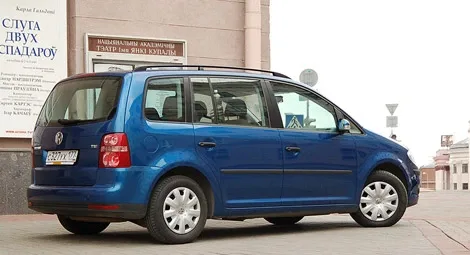
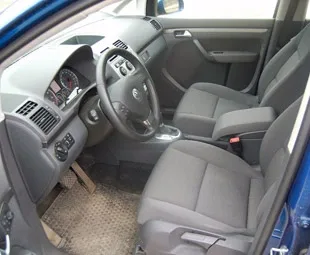
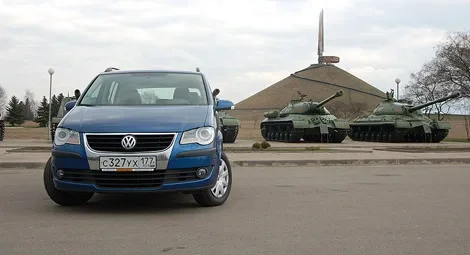
One of my colleagues once noted that cars of this brand have no soul. I have to agree with him, looking at the Touran. The exterior of the compact MPV can still be called cute, but inside it's like an army barracks: everything is monotonous, but you can't call it ugly.
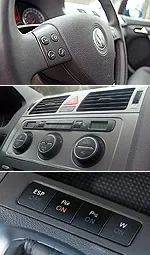
However, among all Volkswagens, the Touran is perhaps the most practical. In the cabin of the Conceptline version we tested, there's nothing superfluous — everything is convenient and at hand: buttons, handles, air vents.
The audio and climate control units on the center console, the instrument cluster, and the steering wheel are like those in the Golf and Passat. Only the shape of the dashboard and the quality of materials differ, and in the compact MPV, it's noticeably worse.
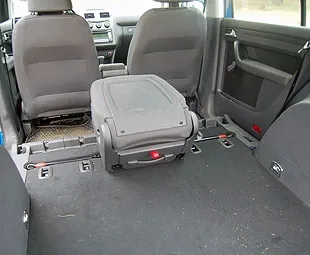
The Volkswagen Touran also comes in a seven-seat version, but we got a five-seat variant with a huge 695-liter trunk. The rear seats can be removed entirely from the cabin, and then the cargo volume grows to 1989 liters — that's really serious. Plus, there's certainly a convenient system for folding and removing the rear seats, as well as many options for transforming the cabin. A full-size spare tire can only be ordered for the five-seat version. In our case, it was like the seven-seat version: instead of a spare wheel, there's a repair kit with a 12-volt compressor and sealant. Not every driver can patch a punctured tire with such means.
 |
 |
The space inside the car is used very rationally: wherever you look, there are niches for small items, and on the ceiling there are as many as three sliding boxes. One of them is a "case" for sunglasses, but it's inconvenient for the driver to use it while driving. It's located almost behind the front seats, so you'll have to either stop to get the glasses from there or ask a rear passenger to do it.
Sporty ambitions
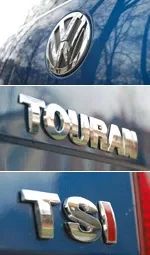
The compact MPV is based on the universal Volkswagen PQ35 platform, which was first "tried on" by the Touran, not the Golf V, although it's often called "Golf-based." Under the hood of the test car, a transversely mounted 1.4-liter engine with a turbocharger and a mechanical supercharger produces 138 horsepower. In the Highline trim, this engine is offered in two versions: 138 and 168 horsepower.
But even the "weak" 1.4 TSI paired with the 6-speed robotic DSG gearbox can turn a family compact MPV into a spirited sprinter. The peak torque of 220 Nm is reached already at 1500 rpm, but up to two thousand rpm, the test Touran behaved calmly. As soon as the tachometer needle crosses this mark, the turbo comes to the compressor's aid — the compact MPV becomes noticeably more agile and accelerates more eagerly.
The suspension handles any bumps equally: if you drive over a large or small pothole, a joint, or a speed bump at speed, the seat may feel a bit stiff, and the cabin will respond to the impact with a short creak. However, everything is moderate and doesn't raise concerns about the integrity of the body or suspension components.
 |
 |
Driving the Touran is a pleasure. It's a truly driver-oriented car, but you should be careful in corners: due to the tall body, body roll is noticeable during sharp maneuvers. Gear changes are lightning-fast and almost imperceptible — that's the merit of the DSG, which for a long time remained a unique trump card of the Volkswagen Group. Now, dual-clutch "robots" are spreading more widely — such gearboxes are already available in Ford, Volvo, BMW, Mitsubishi, Nissan…
You have to pay for pleasure
The base version of the VW Touran costs 678,871 rubles. That will be a car with a five-speed manual and a 102-horsepower 1.6-liter engine. The most expensive — 956,054 rubles — are compact MPVs in Highline trim with 2.0-liter diesels and DSG. Naturally, such cars have a wider list of standard equipment. Park Assist is an option for all trims, currently costing 23,312 rubles; a seven-seat cabin costs 22,577; for 22,669 you can install a navigation system, and to also listen to MP3, you need to add 49,291 rubles. You'll also have to pay 10,346 rubles for any body color except the "standard" white and blue. As a result, the cost of a well-equipped Touran noticeably increases, and this, on one hand, is a minus. On the other hand, the ability to "construct" a car to your liking is a big plus. You can, for example, save on bi-xenon or tire pressure sensors, which many may not need.
The Volkswagen Touran is a truly practical "German." It wins you over with its spaciousness, thoughtfulness, driving manners, excellent engine, and wonderful gearbox. As for me, I wouldn't buy the Touran for one single reason, which was already mentioned at the beginning — it has no soul. You can't see it from the outside, but inside it's really boring and gray (and it's not just about the interior color).
Technical specifications of the Volkswagen Touran 1.4 TSI
| Length, mm | 4407 |
| Width, mm | 1794 |
| Height, mm | 1635 |
| Wheelbase, mm | 2678 |
| Curb weight, kg | 1640 |
| Engine displacement, cm3 | 1390 |
| Power, hp/rpm | 138/5600 |
| Torque, Nm/rpm | 220/1500 |
| Acceleration time from 0 to 100 km/h, s | 9.7 |
| Top speed, km/h | 198 |
Video advertising the Park Assist system
Instructions for using the Park Assist system
ATTENTION: we brake and supply fuel OURSELVES!
You are driving along parked cars that are on one side of the road, looking for a free spot. The speed drops to 30 km/h or less. The distance to the cars is no more than one and a half meters. To activate Park Assist, you press the button with the steering wheel icon — it is located in front of the gear lever, slightly to the left of the center line. When you notice a suitable gap, you estimate it by eye: for parking, the spot needs to be the length of your Touran plus another 1.4 meters. If you are parking on the right side, you turn on the right turn signal — although it is not mandatory for that side. If the spot is on the left (on a one-way street or if you have just returned from England), you need to turn on the left turn signal. Otherwise, the system will look for a spot on the right by default. A diagram appears on the screen where parked cars are shown as rectangles. You drive past the free spot. If it is sufficient, the middle rectangle disappears, and a flashing arrow appears in its place, which then turns in the opposite direction, showing the trajectory for entering. The letter R lights up on the display. At that moment, you stop, engage reverse gear, and smoothly press the accelerator yourself. You control the fuel supply and braking manually. The steering wheel is turned by the Park Assist system — it automatically guides the car into the spot along the correct arc. During this time, you carefully listen to the parking sensors: their signal becomes more frequent. As soon as the beep becomes continuous, you immediately brake yourself. Then you move the selector to position D. The system itself turns the steering wheel in the other direction to align the car. An inscription in German appears on the screen, meaning "continue on your own." You smoothly press the accelerator and slightly move the car forward. That's it, the maneuver is complete!
Lenta.Ru thanks the company LLC "Volkswagen Group Rus" for providing the car for the test drive.