
Restyling rules
When a journalist receives an invitation to test-drive an updated version of an already familiar model, there is usually little joy. The first reaction is something like: "And what is there to write about? The car has hardly changed. Another marketing ploy, and I'll have to answer for it." But every time, returning from such a trip, I realize I was wrong. Engineers and designers manage to find ways to surprise both future owners and, accordingly, us.
No one will argue that testing fundamentally new cars is much more exciting. However, the development of the automotive industry is gradual, and readers need to know about all its stages. By and large, this is exactly what test drives of restyled versions are for.
Light makeup
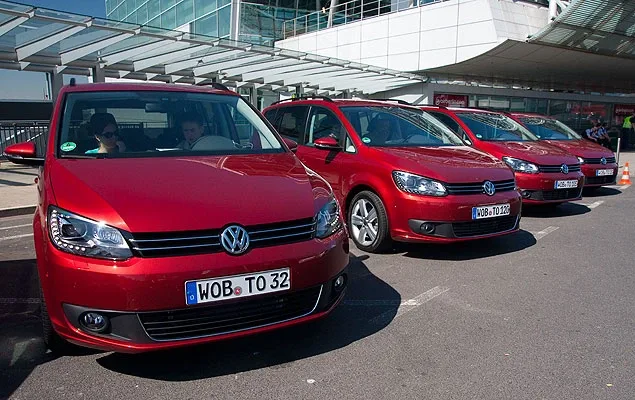
This time we were invited to the presentation of the updated Volkswagen Touran. The event was quite modest, without trips to exotic countries. Instead, we were given the opportunity to drive the compact van in its natural environment — on ordinary German roads. Moreover, on the route laid between Cologne and Dusseldorf, we encountered several "Tourans" of the previous generation, which allowed us to compare them with our test car in person.
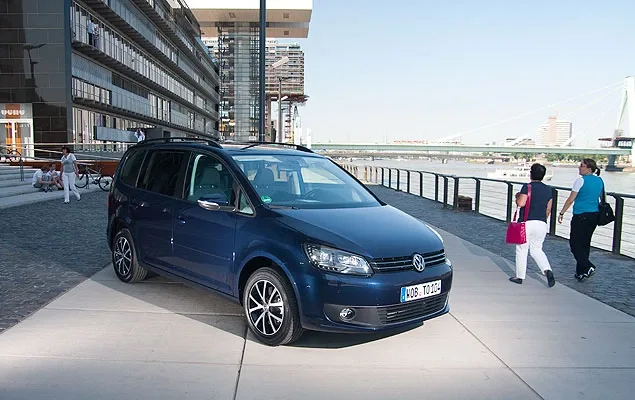
The restyling clearly benefited the appearance of the German compact van. Previously, due to the simple design of the front end and the emphasized utilitarian body proportions, the car seemed closer to Volkswagen's commercial lineup than to passenger models. Now, thanks to the hood with expressive ribs, new headlights, and a chrome grille in the signature "Volkswagen" style, the compact van finally began to look like a real passenger car.
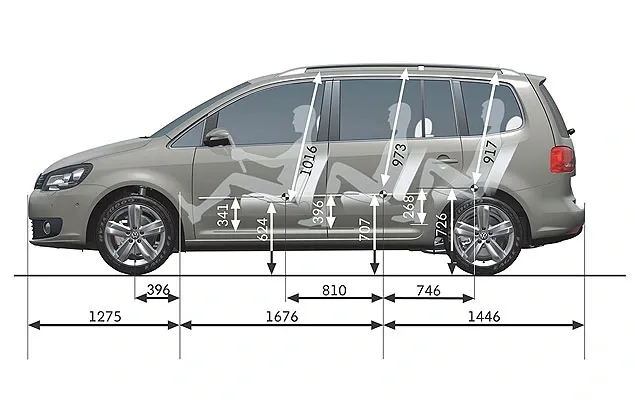
True, the almost horizontal roofline and flat side panels still look a bit boring, but this is more than compensated by the spacious interior. It is the spaciousness that is the main trump card of the "Touran". For example, in addition to the five-seat version, there is a variant with seven seats. And this is despite the fact that the car's wheelbase is only 10 centimeters longer than that of the related "Golf" and amounts to 2678 millimeters.
Here it is also worth mentioning the outstanding "cargo" talents of the German compact van. In the five-seat version, with the rear seat backs raised, the trunk volume is almost 700 liters. And if you completely remove the second-row transformer seats (this option is available on all "Tourans"), the cargo compartment volume grows to 1989 liters.
The numbers are impressive. Especially when compared with classmates or "adult" station wagons. For example, in the Citroen C4 Picasso, which surpasses the "Touran" in dimensions (the French car is 73 millimeters longer and 36 millimeters wider), "only" 1734 liters of cargo fit. And there is no third row of seats there either. Another illustrative example is the VW Passat Variant: with the rear sofa folded, its trunk holds 1730 liters.
Where does so much space come from in a compact car 4397 millimeters long? The secret lies in the well-thought-out layout and... the high roof (the car's height is 1635 millimeters). The Touran is 12 centimeters taller than the same "Passat" and 16 centimeters taller than the "Golf".
By raising the roof, the engineers killed two birds with one stone. Firstly, the car with a short wheelbase got more "useful" volume. Secondly, it became possible to organize a third row of seats, where an adult can sit without much trouble — precisely thanks to the high ceiling.
Of course, the restyling has nothing to do with these engineering solutions — they appeared at the concept development stage of the compact van. However, the update is a great reason to remember them and take stock. At the very least, now we can answer the question of whether it is worth sacrificing appearance for such interior space.
Judging by the sales of the Volkswagen Touran on the domestic German market, it is worth it. Local drivers voted with their wallets: the Touran is the best-selling compact van in Germany. And in the rest of the world, the car has also appealed to buyers — the total production run of the first generation exceeded 1.1 million units.
Do no harm
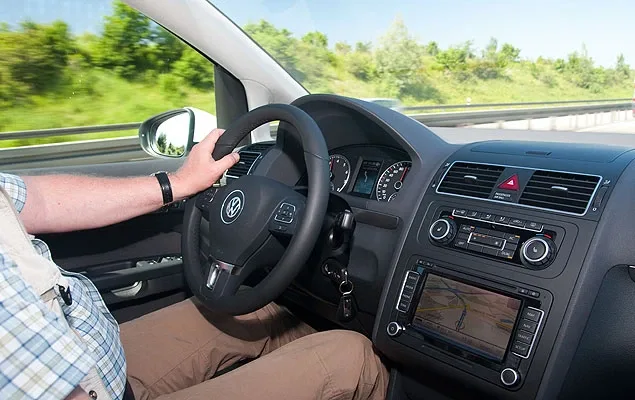
The interior of the "Touran" has changed less than the body. White instrument scales, a three-spoke steering wheel from the "Golf", new trim inserts — that's probably all. But the model has retained its reference ergonomics, which many competitors would envy.
Take, for example, the driver's seat. The high seating position and excellent visibility are combined here with logically located climate control and audio system units inherited from the "Golf". Everything you need is easy to find, turn on, or adjust. The only serious complaint about the "Touran" interior is that it is "Volkswagen-style" a bit boring. Although brand fans would probably call it calm.
Volkswagen marketers went their own way: they present the "Touran" as a car whose options are more often found in the premium class than among mass manufacturers. For example, the new model offers adaptive suspension DCC.
True, it is unclear why it needs it, given that it has the reference chassis from the Volkswagen Golf. The suspension, refined, reinforced, and retuned for the needs of the compact van, works perfectly on any surface even with standard shock absorbers. In corners, due to the high center of gravity, the car noticeably rolls, but this does not affect the delayed reactions to the steering wheel. In general, the Touran confidently holds its trajectory even without additional electronics, and there are no complaints about the energy intensity of the suspension — the car easily "swallows" large irregularities like speed bumps.
Another option that the "Touran" got clearly at the insistence of the marketing department is the second-generation Park Assist parking assistant. This device is a kind of calling card of the compact van. Seven years ago, it was the Touran that became the first VW model to receive such a system. Now, after the restyling, it is again the first in the entire concern lineup to acquire Park Assist 2.0.
The new "assistant" can not only help park in hard-to-reach places but also pull out onto the road if a car parked at the roadside is squeezed by neighbors. In this case, Park Assist acts the same as when parking: the electronics themselves turn the steering wheel with a servo drive, and the driver only controls the pedals. Moreover, the system can rescue the car even when there is only 25 centimeters of free space left in front and behind the "Touran".
In real life, this system impresses even more — the steering wheel turns by itself, and you get the feeling that you are participating in the filming of a science fiction movie. However, it is unlikely that Park Assist will be in high demand among Touran buyers. In European cities, where there is a shortage of free parking, most drivers, even without any assistants, virtuously park in any, most unimaginable places.
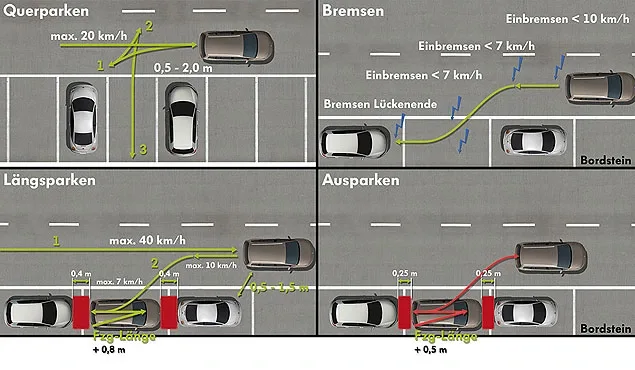
So in Wolfsburg, they are unlikely to harbor illusions about the market prospects of the "electronic parking attendant". It is clear that at the current stage, the main task of Park Assist is to attract additional attention to the car.
However, instead of it, another, more useful system could be used for these purposes. For example, adaptive cruise control, which can anticipate emergency situations and prepare the car for them by increasing brake pressure and tightening seat belts. But in defense of the "Touran", it is worth saying that even in the basic configuration there are six airbags, as well as ABS and a stability control system.
Heavy artillery
Restyling, as usual, was invented by marketers — if not for them, cosmetic changes to the appearance and technical updates to platforms could be done quietly and without unnecessary hype. But the market dictates its own laws, and we, buyers, are completely satisfied with this.
Moreover, almost every automaker times the presentation of new or refined engines, created specifically for it, to the next model update. A striking example is the test "Touran", which this time received five fresh engines at once: one gasoline and four diesel. True, only the base turbo engine with a volume of 1.2 liters and a power of 105 horsepower will reach Russia from this entire range.
We are already well acquainted with this engine from other cars of the German concern, and we have always been won over by its confident torque — 175 Newton-meters in the range from 1500 to 4100 rpm. For the Touran, its reserve is also quite sufficient. Especially in combination with a six-speed manual gearbox, which allows you to constantly keep the engine in good shape.
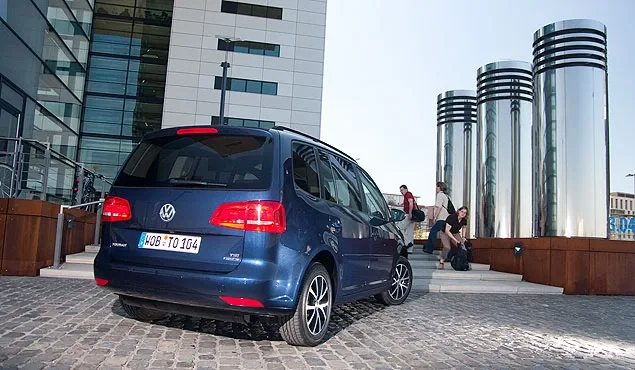
But if you want to drive more lively, it is better to take a closer look at the "old" 1.4-liter engine, which depending on the version produces 140 or 170 horsepower. In Germany, we tested the 140-horsepower version of the Touran — it turned out to be not only noticeably more responsive than the base engine, but also about ten percent more economical, because it had to be revved to the red zone less often. In addition, unlike the 1.2-liter unit, this engine can be paired with a seven-speed DSG robotic gearbox. We happened to drive such a car.
But as for the new turbo diesels, none of them will reach our market. It is a pity for the 1.6-liter engine, which depending on boost develops 90 or 105 horsepower, and for the two-liter engine, available in 140- and 170-horsepower versions. Instead, we will be supplied with a single 110-horsepower two-liter diesel, which in Europe is mainly used in golf-class hatchbacks — for example, the Golf and the Octavia.
Conclusion
The price of the new Touran has not been announced yet, but based on the cost of the current generation, the new model has a chance on the Russian market. And the main trump card here is not the price (closest competitors like the Ford C-Max or Renault Scenic are cheaper), but the rich standard equipment: air conditioning, full power accessories, and an MP3 audio system already in the "base", plus unique cargo-passenger capabilities.
However, Volkswagen should not count on large sales in our country — this segment of the Russian market has historically been poorly developed. The main problem of compact MPVs in Russia is image-related: crossovers with similar capacity and comfort are perceived as more prestigious.
As a result, Russian buyers more often choose small SUVs, overpaying for increased ground clearance and all-wheel drive, and later — for maintenance and fuel, although many could easily do with a regular passenger car chassis.
that with a 140-horsepower petrol engine it consumes
less than seven liters of gasoline per 100 kilometers
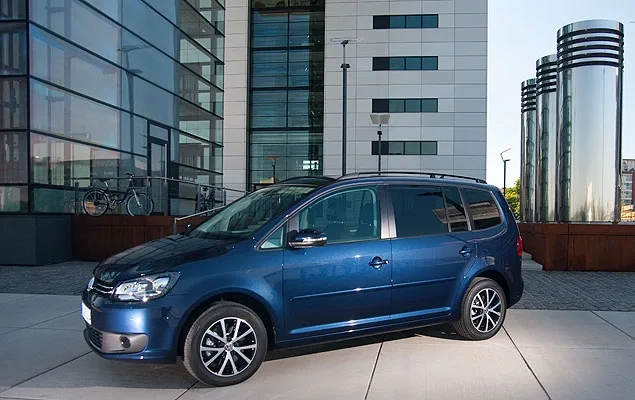
Complaining about this stereotype is already tiresome. All that remains is to continue publishing materials about new and updated compact MPVs so that as many Russian motorists as possible learn about the pros and cons of small practical cars. We have no illusions — sales in this segment are unlikely to grow sharply after such an article. But we really want to take at least a small step towards the Western automotive market. If only because there, cars of this type are no less popular than crossovers. This means that European buyers are much less susceptible to image stereotypes and marketing tricks than ours.
Technical specifications of the Volkswagen Touran
| Length, mm | 4397 |
| Width, mm | 1794 |
| Height, mm | 1635 |
| Wheelbase, mm | 2678 |
| Curb weight, kg | 1536 |
| Engine displacement, cm3 | 1390 |
| Power, horsepower/rpm | 140/5600 |
| Torque, Nm/rpm | 220/1500 |
| Acceleration time from 0 to 100 km/h, s | 9.5 |
| Maximum speed, km/h | 202 |
| Fuel consumption in combined cycle, l/100 km | 6.6 |