
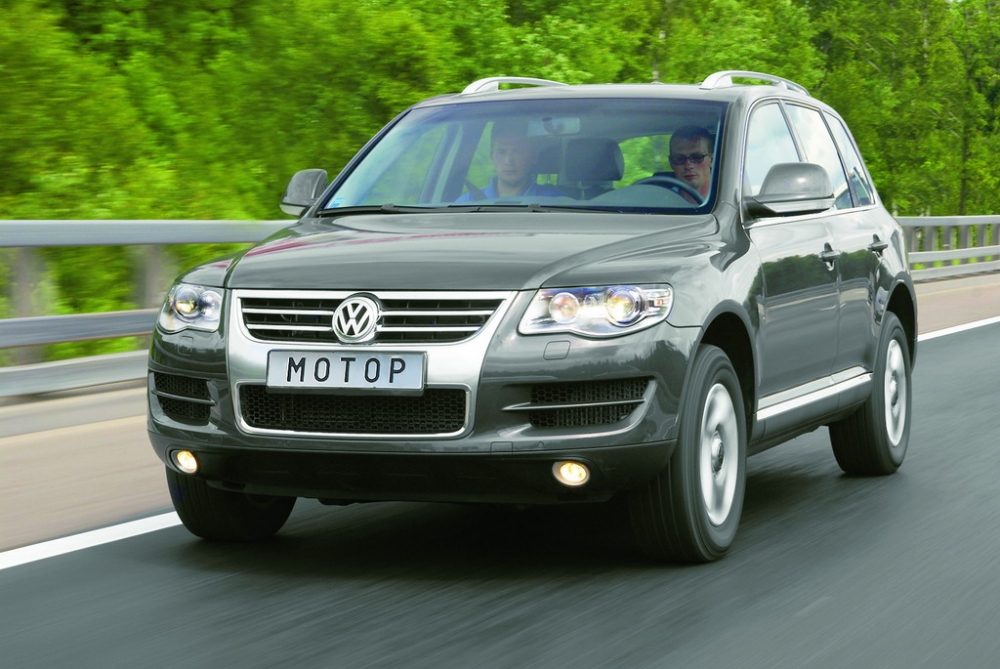
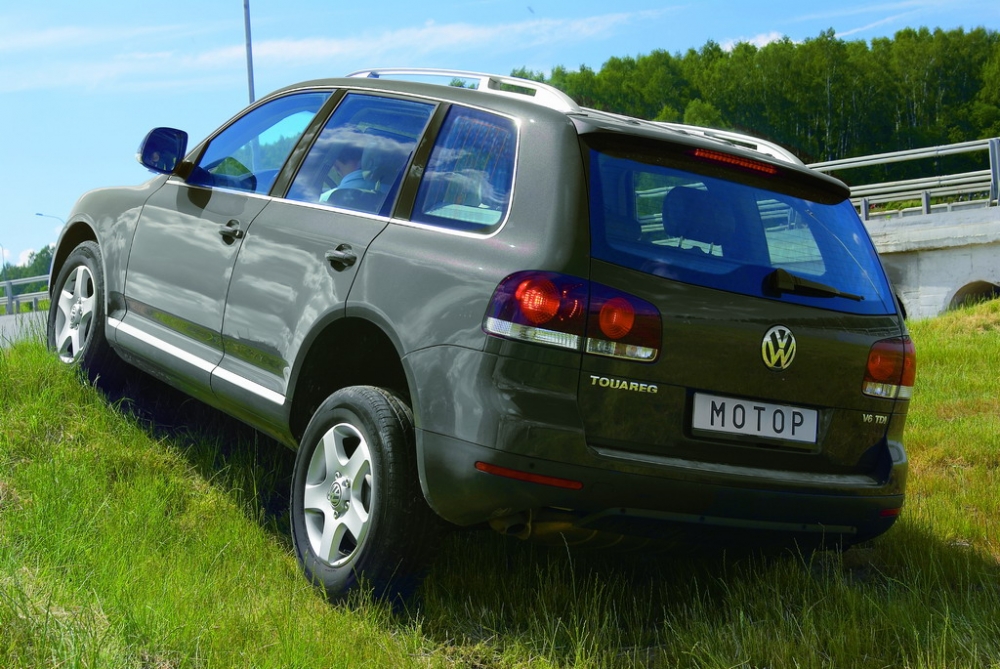
 The Touareg update affected only the exterior and the engine lineup. The design changes include different front and rear lighting, a new grille, new mirrors, and a slightly optimized rear spoiler. To notice the difference between the restyled version and the previous one, you need to place them side by side. Volkswagen considers this approach correct: to maintain recognizability without departing from restraint and solidity — and this is certainly a sign of high design mastery. In addition to the time-tested but not too powerful R5 turbodiesel (174 hp), the lineup now includes FSI V6 gasoline engines of 3.6 liters (280 hp) and V8 4.2 liters (350 hp), as well as a fresh 3-liter V6 turbodiesel (225 hp). For the test, we chose a car with the V6 TDI, deciding that this is the optimal compromise. A pleasant addition was the air suspension in the options list of our car. The Touareg update affected only the exterior and the engine lineup. The design changes include different front and rear lighting, a new grille, new mirrors, and a slightly optimized rear spoiler. To notice the difference between the restyled version and the previous one, you need to place them side by side. Volkswagen considers this approach correct: to maintain recognizability without departing from restraint and solidity — and this is certainly a sign of high design mastery. In addition to the time-tested but not too powerful R5 turbodiesel (174 hp), the lineup now includes FSI V6 gasoline engines of 3.6 liters (280 hp) and V8 4.2 liters (350 hp), as well as a fresh 3-liter V6 turbodiesel (225 hp). For the test, we chose a car with the V6 TDI, deciding that this is the optimal compromise. A pleasant addition was the air suspension in the options list of our car. |
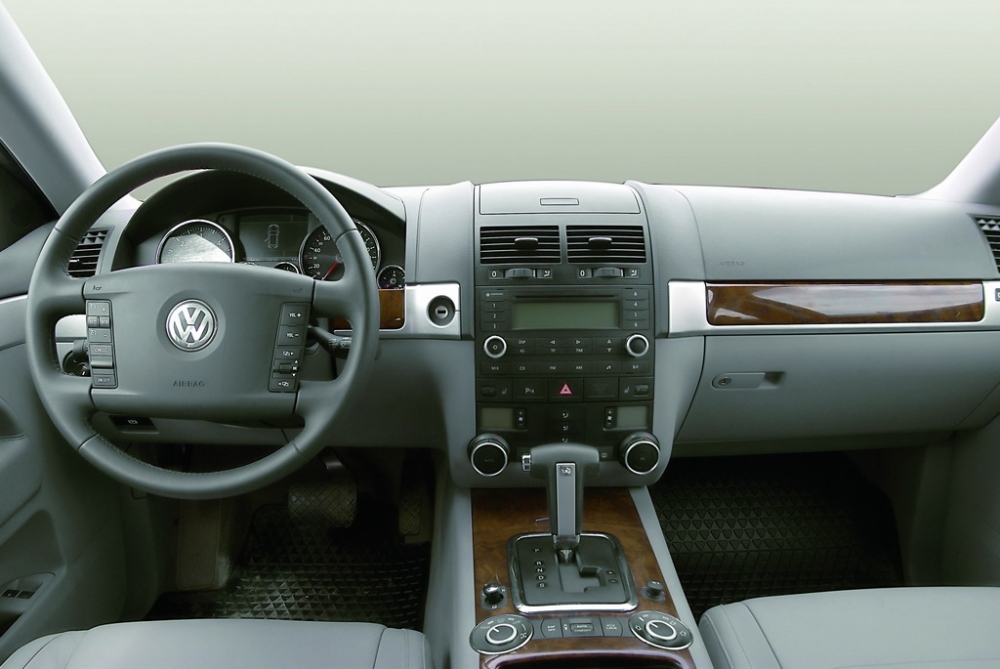
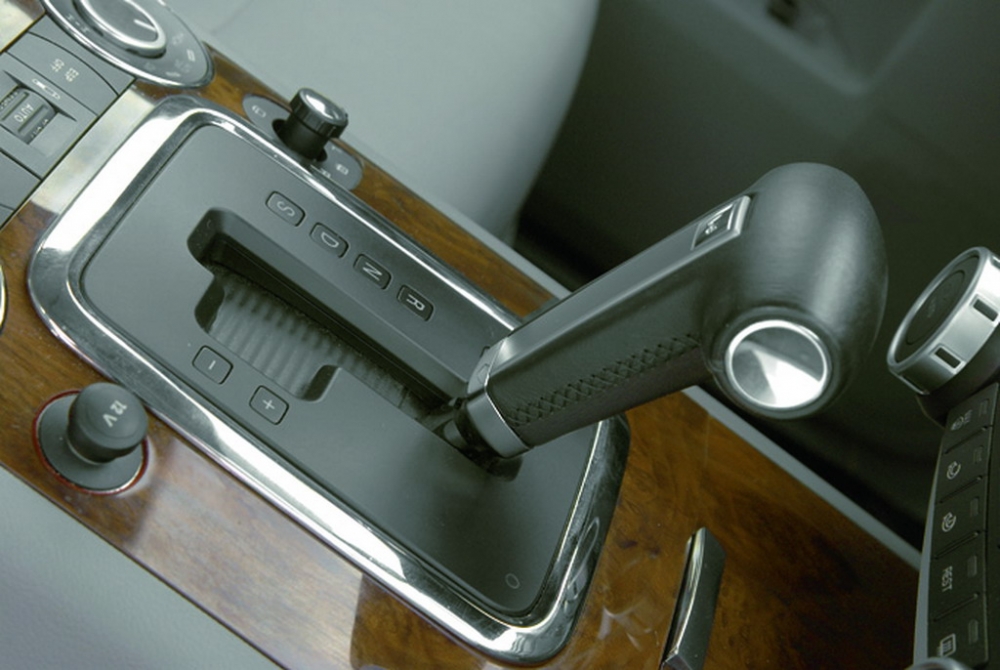
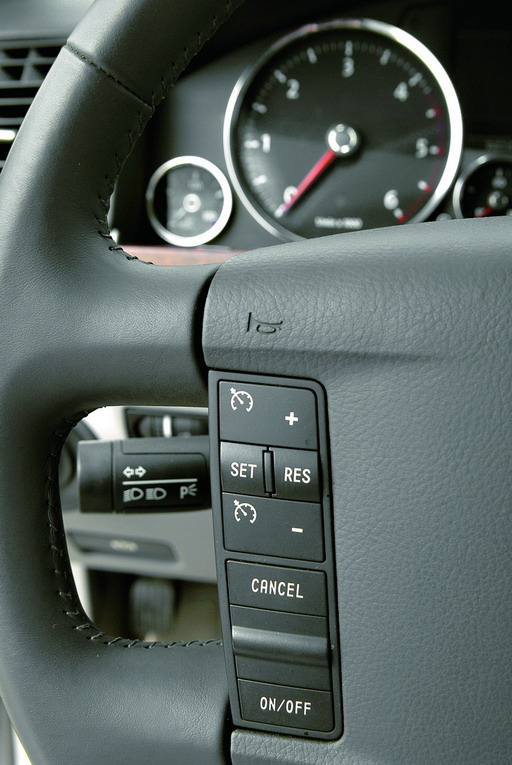
 With a ground clearance of 215 mm, getting into the car is only slightly less convenient than into a regular sedan — thanks to the low floor. As a result, the feeling is almost like in a passenger car. Even if you lower the seat to the lowest position (the adjustment ranges are huge), the dimensions are felt perfectly. The parking sensors with multi-colored light indication at the top of the central console are almost unnecessary — visibility is excellent. The four-spoke steering wheel with music and cruise control buttons fits comfortably in your hands. However, the automatic transmission lever disappointed: it looks impressive, but feels flimsy and creaks when shifting. The plastic climate control knobs also do not please when rotating, although the Climatronic itself works properly, as is usually the case with VW. On the instrument panel, familiar from other models of the brand, two side dials were added to the four standard scales — a voltmeter and an oil temperature gauge. With a ground clearance of 215 mm, getting into the car is only slightly less convenient than into a regular sedan — thanks to the low floor. As a result, the feeling is almost like in a passenger car. Even if you lower the seat to the lowest position (the adjustment ranges are huge), the dimensions are felt perfectly. The parking sensors with multi-colored light indication at the top of the central console are almost unnecessary — visibility is excellent. The four-spoke steering wheel with music and cruise control buttons fits comfortably in your hands. However, the automatic transmission lever disappointed: it looks impressive, but feels flimsy and creaks when shifting. The plastic climate control knobs also do not please when rotating, although the Climatronic itself works properly, as is usually the case with VW. On the instrument panel, familiar from other models of the brand, two side dials were added to the four standard scales — a voltmeter and an oil temperature gauge. |
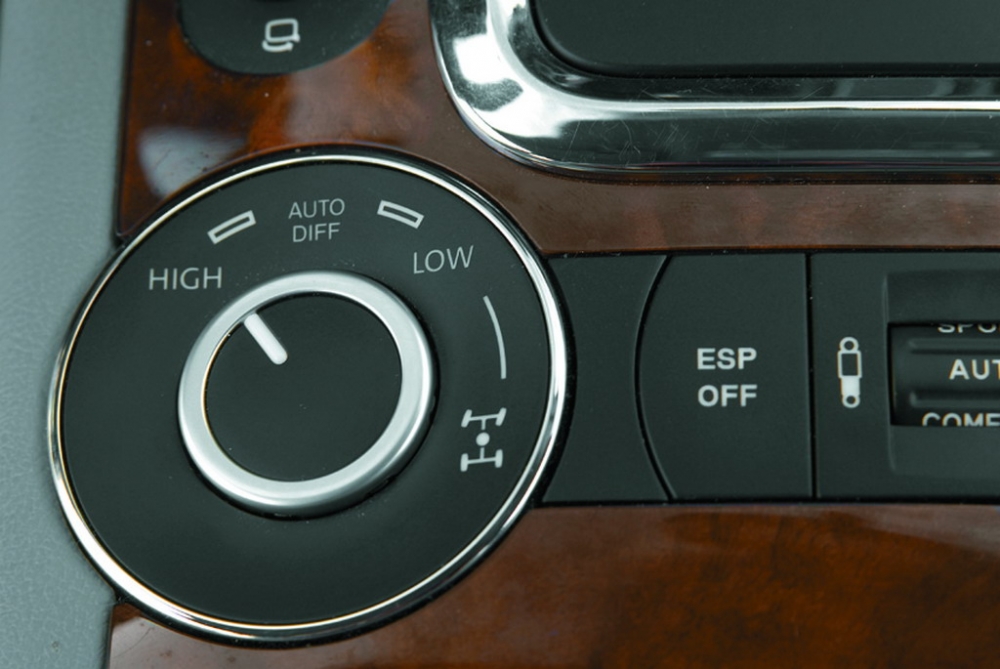
 On the central tunnel, there is control of the off-road arsenal. Two rotary cylindrical knobs extend when pressed. One is responsible for the low range and the locking of the center differential, the second — for the height of the air suspension, with a total of six positions available. Four of them can be selected manually. Up to 60 km/h, the clearance increases to 240 mm, and at speeds below 25 km/h — to a maximum of 300 mm. When the speed reaches 125 km/h, the ground clearance automatically decreases from the standard 215 mm to 190 mm, and after 180 km/h — to 180 mm. On the central tunnel, there is control of the off-road arsenal. Two rotary cylindrical knobs extend when pressed. One is responsible for the low range and the locking of the center differential, the second — for the height of the air suspension, with a total of six positions available. Four of them can be selected manually. Up to 60 km/h, the clearance increases to 240 mm, and at speeds below 25 km/h — to a maximum of 300 mm. When the speed reaches 125 km/h, the ground clearance automatically decreases from the standard 215 mm to 190 mm, and after 180 km/h — to 180 mm. |
 The air suspension, together with the Skyhook system, which dynamically adjusts shock absorber damping, operates in one of three modes — Comfort, Auto, or Sport, selected by a wheel on the same central tunnel. In Comfort mode, the car responds softer, and the suspension readily absorbs bumps — an excellent option for a broken road at high speed. In Sport, the car becomes more composed, the steering wheel sharper, but the jolts from road surface defects are felt much stronger. I would say, even too strong — it shakes noticeably. Therefore, personally, I prefer the Auto mode, when the suspension itself adapts to the road. The air suspension, together with the Skyhook system, which dynamically adjusts shock absorber damping, operates in one of three modes — Comfort, Auto, or Sport, selected by a wheel on the same central tunnel. In Comfort mode, the car responds softer, and the suspension readily absorbs bumps — an excellent option for a broken road at high speed. In Sport, the car becomes more composed, the steering wheel sharper, but the jolts from road surface defects are felt much stronger. I would say, even too strong — it shakes noticeably. Therefore, personally, I prefer the Auto mode, when the suspension itself adapts to the road. |
 Overall, the air suspension performs excellently, not letting down at high speeds either. With a body height of 1726 mm, body rolls are minimal, the car obediently follows the steering wheel, which is not heavy but informative enough, without delays. 200 km/h is reached easily and effortlessly, while the Touareg's behavior remains adequate not only on a straight line. Perhaps, in its price segment, it has no equal — the Porsche Cayenne, BMW X5, and Audi Q7 are noticeably more expensive. The combination of the V6 turbodiesel and the 6-speed automatic with dynamic shift program (DSP) is simply magnificent. The engine is amazing. Outside at idle, a slight diesel rattle is audible, but inside I would never have guessed that there was a diesel under the hood if I had not known in advance and had not seen the tachometer. Rather, I would have thought it was a gasoline V8 — such powerful traction. A huge torque of 500 Nm is available from 1750 rpm, which is where the impressive dynamics for a 2.5-ton car come from — 9.2 seconds to 100 km/h with the automatic transmission. Overall, the air suspension performs excellently, not letting down at high speeds either. With a body height of 1726 mm, body rolls are minimal, the car obediently follows the steering wheel, which is not heavy but informative enough, without delays. 200 km/h is reached easily and effortlessly, while the Touareg's behavior remains adequate not only on a straight line. Perhaps, in its price segment, it has no equal — the Porsche Cayenne, BMW X5, and Audi Q7 are noticeably more expensive. The combination of the V6 turbodiesel and the 6-speed automatic with dynamic shift program (DSP) is simply magnificent. The engine is amazing. Outside at idle, a slight diesel rattle is audible, but inside I would never have guessed that there was a diesel under the hood if I had not known in advance and had not seen the tachometer. Rather, I would have thought it was a gasoline V8 — such powerful traction. A huge torque of 500 Nm is available from 1750 rpm, which is where the impressive dynamics for a 2.5-ton car come from — 9.2 seconds to 100 km/h with the automatic transmission. |
 Even with very dynamic driving, it is difficult to exceed 15 liters of fuel per 100 km. On average, consumption is 11-12 liters. Just a miracle, not an engine! Thanks to the constant reserve of torque, the gearbox shifts less often. In D mode, shifts are almost imperceptible, but not too fast; in S — fast, but more noticeable. Tiptronic selects the right gear in time, and the car brakes well with the engine. It would seem that the Touareg is tuned for the highway, but off-road it will not let you down either. The low range with 4XMotion all-wheel drive, center differential lock (EDL), air suspension, and auxiliary systems ESP, TCS (traction control), EBC (engine braking control) can rescue the car from the most difficult situations. Geometric cross-country capability is excellent: departure and approach angles — 33º, climbable grade — 45º, ramp angle — 27º, side angle — 45º, wading depth — 580 mm. During diagonal articulation, the VW continues to confidently crawl forward. If you seriously intend to conquer off-road in a Touareg, take the version with a turbodiesel and manual transmission, put on "toothy" tires — and you will have few equals. And on the highway too. Even with very dynamic driving, it is difficult to exceed 15 liters of fuel per 100 km. On average, consumption is 11-12 liters. Just a miracle, not an engine! Thanks to the constant reserve of torque, the gearbox shifts less often. In D mode, shifts are almost imperceptible, but not too fast; in S — fast, but more noticeable. Tiptronic selects the right gear in time, and the car brakes well with the engine. It would seem that the Touareg is tuned for the highway, but off-road it will not let you down either. The low range with 4XMotion all-wheel drive, center differential lock (EDL), air suspension, and auxiliary systems ESP, TCS (traction control), EBC (engine braking control) can rescue the car from the most difficult situations. Geometric cross-country capability is excellent: departure and approach angles — 33º, climbable grade — 45º, ramp angle — 27º, side angle — 45º, wading depth — 580 mm. During diagonal articulation, the VW continues to confidently crawl forward. If you seriously intend to conquer off-road in a Touareg, take the version with a turbodiesel and manual transmission, put on "toothy" tires — and you will have few equals. And on the highway too.PRICES AND TRIM LEVELS In Russia, the updated VW Touareg is sold with R5 turbodiesels (2.5 L, 174 hp) and V6 (3.0 L, 225 hp), as well as with gasoline engines FSI V6 (3.6 L, 280 hp) and V8 (4.2 L, 350 hp). All engines work only in conjunction with the 6-speed Tiptronic automatic, 4XMotion all-wheel drive, low range, and center differential lock. The most affordable VW Touareg R5 TDI in the base trim will cost $54039. Prices for the version with the V8 engine start from $85500. |
Couldn't ask for better
In the new modification of VW Touareg – 7L, there are no serious technical changes. They are not needed yet – the internals were made with a reserve for the future. In particular, due to this, more than four years after the start of sales, the model has quite strong market positions worldwide.
Test drive photos
Comments
No comments yet. Say the first word.