Volkswagen was in no hurry to introduce its compact crossover — the preparation was long and thorough, to confidently descend the mountain and showcase all its talents. The result came out in the best traditions of the brand: balanced, solidly built, and without unnecessary frills. If you crave unbridled drive and adrenaline — this is not the place. But if you need a car that delivers predictable pleasure every day and is almost perfect in its class, take a closer look at the VW Tiguan.
Of course, this model also has its drawbacks, but more on that later.
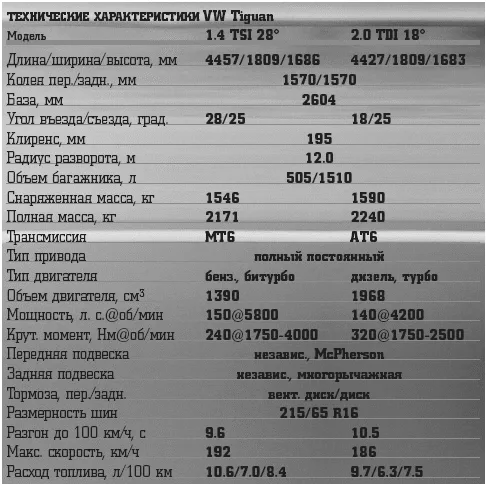
No matter how you look at it, appearance matters. Even when buying tires, most people look at the tread pattern, not the specifications. So, the Tiguan is not one of those that looks great in photos but disappoints in reality. In person, it looks exactly as it does in pictures: expensive, solid, moderately stylish, with a slight off-road accent, and quite compact. The car is indeed small — 4.43 meters in length, making it one of the shortest in its segment. In a parking lot, it will easily fit even into a spot left for a subcompact. By the way, an optional Park Assist is available — a real robot parking assistant. Ultrasonic sensors themselves assess the distance to obstacles and... turn the steering wheel with phenomenal speed. True, the driver has to press the pedals themselves. It's quite a sight, I must say. I personally never dared to trust this "parking demon."
THE SHORTER, THE BETTER
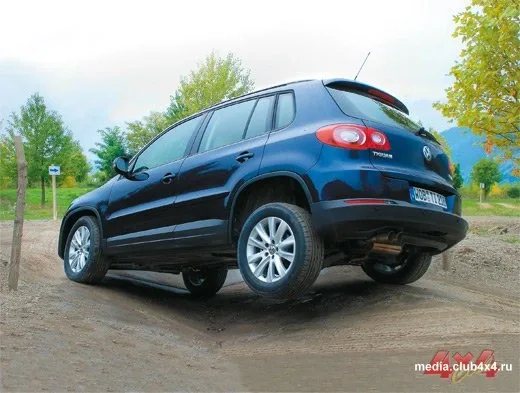
The Germans took a clever step by offering two versions with different geometric off-road capability. The first has an approach angle of 18 degrees, and the front bumper is standard, designed more for aerodynamics. The second has a bumper with a sloped lower part, allowing it to tackle inclines up to 28 degrees. Along with this "snub-nosed" bumper comes the Track & Field off-road package: plastic protection, an electronic hill descent assistant (the car brakes with the engine, keeping speed within 8–9 km/h), and special transmission settings where the automatic gearbox shifts earlier to reduce the risk of wheel spin. All of this is activated with one button.
Inside, the new Volkswagen is impeccable: materials are top-notch, panels fit perfectly, climate control is simple and logical. The instrument panel seems to have migrated from the Golf, the leather on the seats is no worse than in the Touareg, and there are no design experiments. It is precisely for this conservatism and solid interior quality that brand fans love it.
The driver's seat transforms endlessly. The seat slides back so far that even a two-meter-tall driver can fit, plus the cushion angle and height are adjustable. The steering column adjusts over a wide range both for reach and tilt. After a bit of fiddling, you'll definitely find a comfortable position. Rear passengers can slide the bench forward and backward by 16 centimeters. This is, of course, a luxury — the second row is already spacious — but it's nice. As they say in Sicily, the family will be satisfied. The trunk is spacious, and the loading height is convenient. And most importantly, there are none of those little things that usually annoy. Everything is done correctly, clearly, and within reach.
On the road, the Tiguan is a benchmark. In Hungary, the asphalt is smooth, but even there, there are plenty of cracks and joints. The suspension is tuned so that small irregularities are not felt at all. Usually, this happens with soft cars, but here even large potholes are handled excellently. Comfort and ride smoothness are top-notch. And handling, surprisingly, is also excellent: there's nothing to fault. Reactions are precise, and the steering is informative to a degree. At the same time, the Tiguan doesn't feel overly sharp or nervous. No, it's simply tuned to drive actively every day and enjoy it without getting tired. For those who want something hotter, there's a Sport & Style version with a stiffer suspension.
NO METER WITHOUT A TURBO
As for dynamics, at the start of the test, when dividing the cars, we rushed to the version with the off-road bumper, ignoring the rest. Under the hood was a petrol 1.4 TSI (150 hp, 240 Nm) with two superchargers — mechanical and turbo, paired with a 6-speed manual. No complaints about the manual: gears engage clearly, and the ranges are chosen conventionally and conveniently. But the engine... On asphalt, everything is fine: quick acceleration, torque — very pleasant sensations. And on paper, it looks good: peak torque is available from 1750 to 4000 rpm. But when we turned off the highway into the forest, things weren't so smooth. To start on a steep incline, the engine has to be revved to 1800–2000 rpm, otherwise it might stall. However, this is normal for a passenger car engine. It's just that from such power extracted from a small displacement, you expect some miracle. But the turbodiesel (2.0, 140 hp, 320 Nm) with a 6-speed automatic, which we tried on the off-road track, is ideal for off-road use. Stop at an obstacle, spin a wheel in the air — and smoothly continue. The automatic has a sport mode and manual shifting, so enthusiasts won't be disappointed. In both cases, the gearbox does exactly what it promises. And on the highway, the diesel is almost as good as the 1.4 TSI. For us, it all comes down to the quality of local diesel fuel, but from leading producers, it seems to have improved.
Soon after the start of sales in Europe, the engine lineup should be expanded with two 2-liter TSI units — 170 and 200 horsepower. They can be ordered with an automatic transmission. A 170-horsepower turbodiesel will also appear. Note: only turbocharged engines will be installed on the Tiguan. They all stand out for their environmental friendliness and efficiency.
QUICK "HALDEX"
All-wheel drive is implemented on an on-demand principle. When wheels slip, the electronically controlled Haldex clutch engages instantly. Under normal conditions, about 90 percent of power goes to the front axle, but if necessary, the system can transfer all horsepower and newton-meters to the rear wheels. Of course, there are also many intermediate options. Additionally, the Tiguan is equipped with an effective traction control system: as in the VW Touareg, it brakes wheels that lose traction.
How does this manifest in practice? How fast is it? In short, it's lively enough to start and continue moving without problems during diagonal wheel hang. The wheels hanging in the air barely have time to start spinning. This is implemented similarly on the VW Touareg and Audi Q7, but, unfortunately, not on all of the Tiguan's classmates. By the way, about wheel hang — the suspension travel is small, quite car-like. However, with a properly functioning transmission, this nuance takes a back seat. What matters to you — external effect or the ability to drive? Exactly.
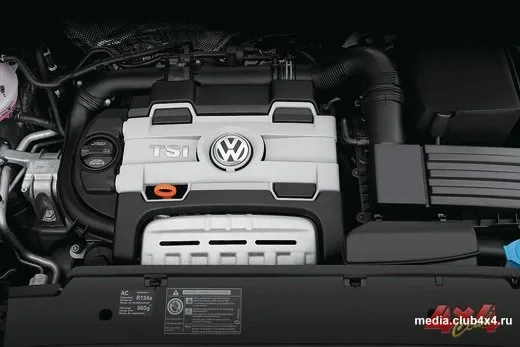
The letters TSI indicate membership in the line of turbocharged petrol engines. In this case, the engine combines a mechanical supercharger and a turbine
Although, honestly, these European presentations, despite their significance and usefulness, usually look amusing in terms of off-road. Our Western neighbors are not on good terms with mud — they don't like it and don't understand it. They didn't even offer us loose sand — did they feel sorry, or what? A full test awaits in spring when the VW Tiguan appears in Russia.
RIGHT AFTER THE GOLF
According to VW marketers' calculations, the main buyers of the new model in our country will be those who currently drive a VW Golf. People are relatively young, active, have outgrown a passenger hatchback, but are not eager to switch to a sedan. I would add from myself — those who initially wanted a crossover but simply didn't have enough money for such a purchase.
As for prices and supply volumes, they have not yet been determined. The Russian representative office plans to seriously hit competitors by offering the new model for about $35,000. If they manage to stay at this mark, the car will be a big success. True, I have a feeling that real prices will more likely fall in the range from $35,000 to $45,000. But even that would be quite good...