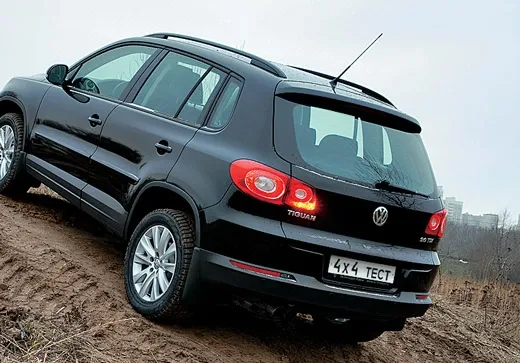
First, you'll have to approach the rear and look at the badge: TSI means petrol, TDI means diesel. Although telling them apart by ear isn't so easy, especially inside the cabin. In Wolfsburg, they clearly worked hard on sound insulation, and the diesel itself is perfectly balanced.
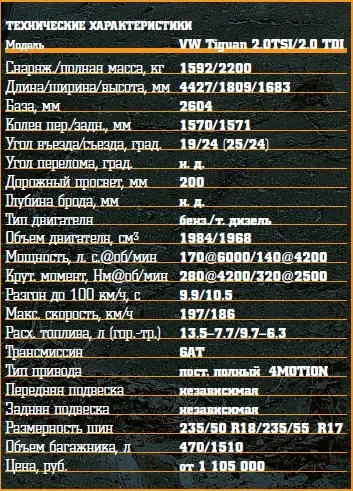
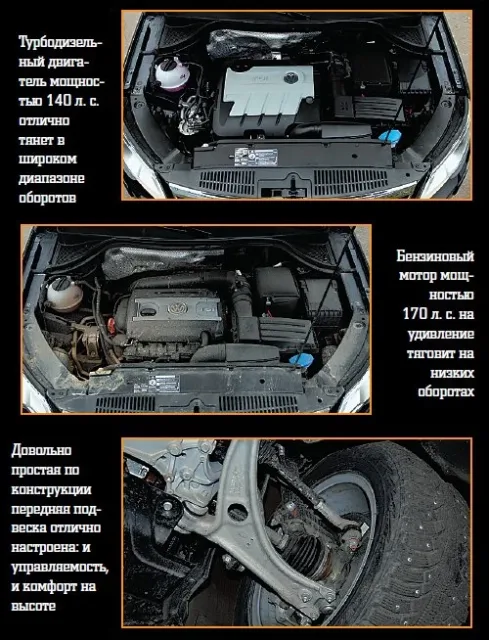
Choosing between the diesel and petrol versions of the same car is always tricky. On one hand, diesel is more economical; on the other, there's a belief that diesel can cause trouble, especially in cold weather. The characteristics also differ: the diesel Tiguan lags behind the petrol one by 30 hp (140 vs. 170), but its torque is 320 Nm at 2500 rpm, while the petrol's is only 250 Nm at 4200 rpm. However, the difference in dynamics in favor of petrol was only felt during deliberately sharp starts.
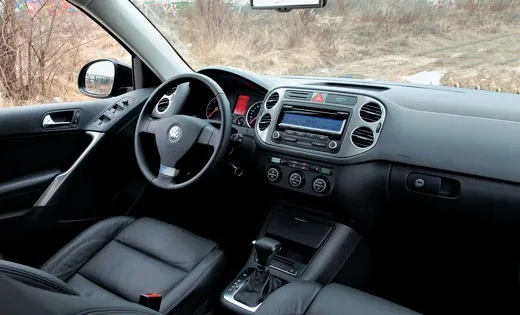
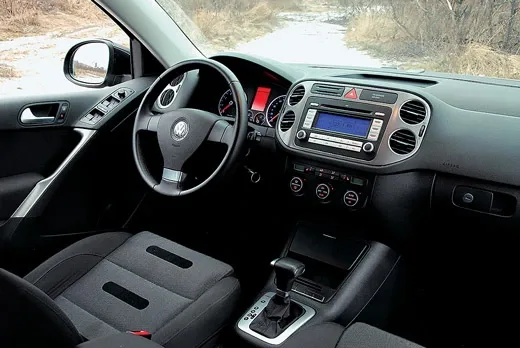
The center consoles, primarily the audio systems, turned out to be different in our test cars
DON'T TOUCH WITH YOUR HANDS
In the city, the Tiguans behaved like exemplary crossovers. They handled speed bumps and other irregularities perfectly, didn't wander in ruts, and generally created no stress. Perhaps these cars lack sharpness, but for daily driving, their slightly smoothed reactions are just what you need. After spending many hours behind the wheel, you get out almost rested. I also noted the thoughtfulness of small details: for example, along the bottom of the doors there's an elastic trim that protects the sills from dirt. The result — clean trousers, skirts, fur coats.
The manual mode of the 6-speed hydromechanical automatic transmission surprised me. I couldn't achieve engine braking when shifting manually. The indicator for a lower gear is already lit on the panel, but nothing happens. Otherwise, the "automatic" is excellent; it does everything itself, when and how needed, the main thing is not to touch the joystick. By the way, on the diesel, starting in D ("drive") mode goes from second gear.
On the highway, our test subjects showed nothing unexpected. Although there was a feeling that the petrol one held the road slightly better in corners. The explanation was on the surface, or rather, rolling under us. An inspection revealed different wheels: 18-inch versus 17-inch.
In the city, the Tiguans behaved like exemplary crossovers. They handled speed bumps and other irregularities perfectly, didn't wander in ruts, and generally created no stress. Perhaps these cars lack sharpness, but for daily driving, their slightly smoothed reactions are just what you need. After spending many hours behind the wheel, you get out almost rested. I also noted the thoughtfulness of small details: for example, along the bottom of the doors there's an elastic trim that protects the sills from dirt. The result — clean trousers, skirts, fur coats.
The manual mode of the 6-speed hydromechanical automatic transmission surprised me. I couldn't achieve engine braking when shifting manually. The indicator for a lower gear is already lit on the panel, but nothing happens. Otherwise, the "automatic" is excellent; it does everything itself, when and how needed, the main thing is not to touch the joystick. By the way, on the diesel, starting in D ("drive") mode goes from second gear.
On the highway, our test subjects showed nothing unexpected. Although there was a feeling that the petrol one held the road slightly better in corners. The explanation was on the surface, or rather, rolling under us. An inspection revealed different wheels: 18-inch versus 17-inch.
ARMORED VEHICLE ON DIRT ROADS
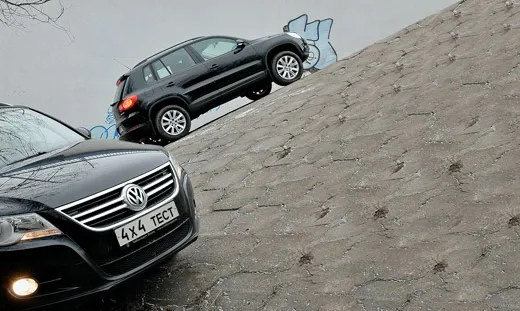
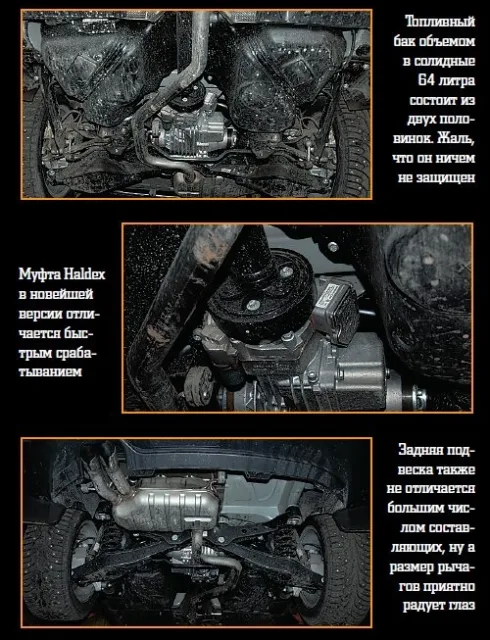
Well, the asphalt ended, and we're on dirt. Ideally, the 200 mm ground clearance and the latest-generation Haldex coupling with its newest fast-thinking brains should provide decent off-road potential. But what's this? Quite low mounds of frozen earth scrape against the underbody. It's strange, after all, my second test pilot Ivan Evdokimov and I are, so to speak, veterans of mud-stirring in our country, and our eye is trained for obstacle heights. And here... We drive the cars onto a slope so that the belly is visible, and we understand where the dog is buried. The steel engine protection, included in the standard equipment for Russia, reduces ground clearance by no less than 30 mm. Well, okay, better to crawl to the goal scraping the protection than to wait for a tow truck while leaking oil from a punctured oil pan.
Well, the asphalt ended, and we're on dirt. Ideally, the 200 mm ground clearance and the latest-generation Haldex coupling with its newest fast-thinking brains should provide decent off-road potential. But what's this? Quite low mounds of frozen earth scrape against the underbody. It's strange, after all, my second test pilot Ivan Evdokimov and I are, so to speak, veterans of mud-stirring in our country, and our eye is trained for obstacle heights. And here... We drive the cars onto a slope so that the belly is visible, and we understand where the dog is buried. The steel engine protection, included in the standard equipment for Russia, reduces ground clearance by no less than 30 mm. Well, okay, better to crawl to the goal scraping the protection than to wait for a tow truck while leaking oil from a punctured oil pan.
SPECS: VW TIGUAN
FIELD, FIELD, FIELD
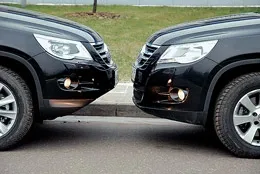
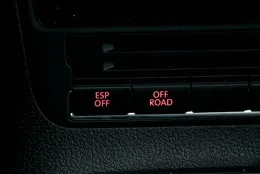
However, further comparison of the cars off-road turned out to be incorrect. The fact is that the diesel Tiguan was in the Track&Field trim (track and field). This means a beveled bumper providing an approach angle of 25 degrees versus the standard 19. Also, the field-going Tiguan is recognizable by the "off-road" button at the bottom of the center console. Pressing it makes the gas pedal less responsive, activates the hill descent assist, and changes the ABS settings. Additionally, its instrument panel has an electronic compass. It's of little use, especially given the availability of any GPS navigators, and it's a somewhat far-fetched hint at a travel car.
However, further comparison of the cars off-road turned out to be incorrect. The fact is that the diesel Tiguan was in the Track&Field trim (track and field). This means a beveled bumper providing an approach angle of 25 degrees versus the standard 19. Also, the field-going Tiguan is recognizable by the "off-road" button at the bottom of the center console. Pressing it makes the gas pedal less responsive, activates the hill descent assist, and changes the ABS settings. Additionally, its instrument panel has an electronic compass. It's of little use, especially given the availability of any GPS navigators, and it's a somewhat far-fetched hint at a travel car.
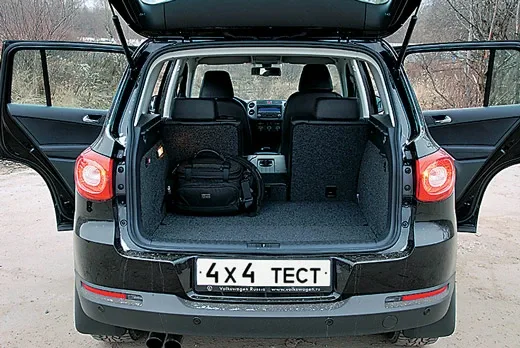
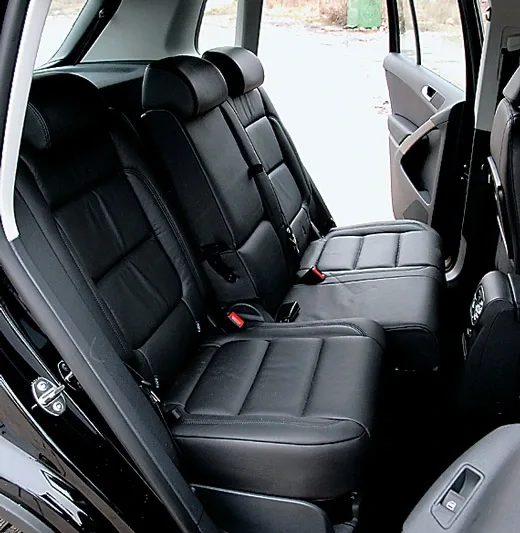
Well, as for the notorious diesel low-end torque, it was certainly there. However, not enough to put the opponent on their back. And what about the petrol one? It didn't drop the honor of its older brother Touareg in the mud. In short, where its low bumper "skirt" didn't catch on obstacles, the difference between the two VWs was practically unnoticeable.
IT'S IMPOSSIBLE TO LOSE
Of course, cars like the Tiguan spend most of their lives on asphalt, and engine behavior off-road can't be the main determining factor. So, on hard surfaces, the petrol version is noticeably more spirited. But only noticeably — by stopwatch, the difference is laughable. As for fuel consumption, the difference is also purely hypothetical — modern petrol engines from VW are quite economical. However, both are likely not unpretentious regarding fuel: the engines are stuffed with modern technologies up to the very head and even above. And from poor fuel, they might ask for service without a farewell "croak". So, it's a victory of globalism — choose what you want, it's impossible to lose or win.
IT'S IMPOSSIBLE TO LOSE
Of course, cars like the Tiguan spend most of their lives on asphalt, and engine behavior off-road can't be the main determining factor. So, on hard surfaces, the petrol version is noticeably more spirited. But only noticeably — by stopwatch, the difference is laughable. As for fuel consumption, the difference is also purely hypothetical — modern petrol engines from VW are quite economical. However, both are likely not unpretentious regarding fuel: the engines are stuffed with modern technologies up to the very head and even above. And from poor fuel, they might ask for service without a farewell "croak". So, it's a victory of globalism — choose what you want, it's impossible to lose or win.