
The village of Gamzyuki in the Kaluga region, from time to time, reminds one of the famous Vasyuki from the novel by Ilf and Petrov. Here, at a recreation center with its own zoo, part of the Russian presentation of the Peugeot 308 took place in early spring. And now, just five months later, I found myself in these places again, but this time the reason was the Volkswagen Tiguan — the first compact crossover in the brand's history. Whether the little village will become a new center of the universe, as Ostap Bender prophesied, is hard to say, but the fact that it has appealed to two major foreign automakers is already a fact.
In Europe, the Tiguan appeared at dealers back in November 2007, but it only reached our market now. The secret is that for Russia, the crossover will be assembled at the Kaluga plant, where production has just been launched. Because of localization, the SUV was in no hurry to come to us. To get acquainted with the "younger brother of the Touareg" — as VW marketers in Europe call it — we headed to Kaluga.
Before the Tiguan appeared, in the modern history of Volkswagen there was only one SUV — the Touareg, which debuted in 2002. Attempts to create an all-wheel-drive vehicle with increased off-road capability had happened before, but only one was successful — in 1985, when VW released the Transporter minibus with a pluggable front axle. It used the Syncro system, developed jointly with Audi engineers and refined by the Austrian company Steyr-Daimler-Puch AG. The viscous coupling automatically engaged all-wheel drive when slipping, and there was also the option to lock both differentials or one of them. Syncro was also installed on the off-road version of the Golf Country hatchback, produced since 1990. But the system had a serious flaw — poor handling, and when the coupling engaged, the axles spun alternately, burying the car. This was not suitable for real off-road conditions, and two years later, production of the Golf Country was discontinued.
By the way, the Tiguan could well have been called Nanuk, Namib, Rockton, or Samun. But exactly two years ago, the concern settled on its current name. Readers of the German Autobild helped, as they liked the name composed of the words tiger and iguana the most. It sounds more familiar and echoes other universal Volkswagen models — Touran or Touareg.
VW's design director Klaus Bischoff described his creation as follows: an SUV should have a long hood and strictly vertical body lines that give a sense of confidence and power. The concept shown in 2006 in Los Angeles fully matched this description, but the production car... It differs little from the concept. Changes affected only the fog lights, and the huge 19-inch alloy wheels remained, just the pattern became simpler (and, of course, they are now an extra-cost option). Moreover, for the American market, 20-inch wheels with low-profile tires will also be offered. The monumentality of the body had to be paid for with aerodynamics: the drag coefficient of the Tiguan is 0.37. For comparison, the Toyota RAV4 has this figure at 0.31, and the BMW X3 at 0.35.
In essence, the Tiguan is a close relative of the Golf V: they share a platform, and it is related to the Passat not only by the stretched "cart" but also by the same structure of the independent suspension. True, the suspension mounting points were lowered by 31 millimeters, thanks to which the vertical wheel travel increased to 175 millimeters. New shock absorber struts appeared at the front: a hollow rubber element was added to their design, which works as an additional air damper. Under strong compression, say, on a large bump, it forces air through small holes, creating additional force.
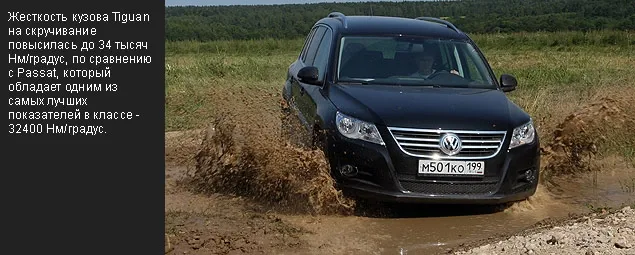
The rear four-link suspension, unlike the Passat, received more subframe mounting points to the body, which raised torsional rigidity to an impressive 34,000 Nm/degree. The volume of oil in the rear shock absorbers was increased so they would not boil during long off-road driving. The arms and silent blocks were lowered by 41 millimeters — for optimal positioning of the rear wheels under any load.
All these refinements made the Tiguan very resistant to road troubles. Small cracks and deep potholes are a trifle for it, and it is almost impossible to break the suspension. On uneven surfaces, the steering wheel remains calm, the gear selector does not shake — the energy intensity of the suspension is simply amazing! Once I had to drive several kilometers on a punctured wheel, and it did not give itself away at all. But here the credit is not only to the suspension — the steering of the Kaluga-born car also tried hard.
The Tiguan has a new steering rack: instead of a rolling bearing, as on the Golf V, there is a sliding bearing here. The electric power steering motor works in conjunction with the stability system and can itself steer the wheels to keep the car on track. If ESP senses lateral pressure, for example from a gust of wind, the motor quietly turns the wheels, while the steering wheel remains motionless, and the driver notices nothing at all. During a skid, the front axle is also steered in the opposite direction. True, there are also drawbacks: feedback on the steering wheel is partially lost (compared to the same Golf or Passat), and in sharp turns, the car does not respond too willingly to turning the wheel.
But does the Tiguan conquer real off-road? On the territory of the VW plant in Kaluga, an off-road track was built for journalists — if it can be called that. Concrete surface, exercises on diagonal hanging, an improvised embankment to test the hill descent assist system and the "auto hold" electronic parking brake function (more on that later). In such almost greenhouse conditions, the "younger brother of the Touareg" worked perfectly. But we were never allowed onto serious off-road.
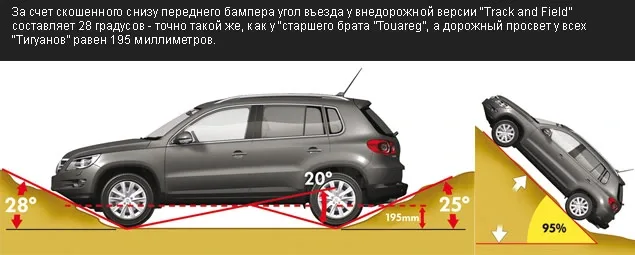
In Russia, the Tiguan will be offered in three trim levels: "Trend and Fun", "Sport and Style", and "Track and Field". The latter, off-road, differs from the road versions by a front bumper with a beveled lower part — this adds three centimeters to the overall length. At the bottom of the bumper is additional protection, and the approach angle increased to 28 degrees (like the older Touareg), while for the "Trend and Fun" and "Sport and Style" it is only 18 degrees. The departure angle for all Tiguans is 25 degrees (the Touareg has 28), ground clearance is 195 millimeters.
The "Track and Field" also comes with side moldings and an "offroad" button on the center console. Technically, the off-road version is no different from the road versions, but after pressing this button, the character of the car changes: the stability systems, fuel supply, and the fourth-generation Haldex all-wheel drive, which VW calls "4 Motion", are reconfigured.
With Haldex, the German concern has a long friendship. In 1998, Volkswagen became the first customer of the Swedish company, installing its systems on the Golf and Audi TT. Since then, all VW models on the same platform as the Golf have been equipped only with Haldex all-wheel drive.
The fourth-generation hydraulically controlled coupling first appeared on the Saab 9-3. It works like a center differential: when one of the front wheels slips, the electronics instantly redistribute torque between the axles, and ESP simulates the locking of the rear differential (unlike the Saab 9-3, the Tiguan does not have an electronically controlled limited-slip differential). The system can brake one of the rear wheels, giving more torque to the other.
When the crossover starts moving, the coupling engages, and torque is divided equally between the axles. Under normal conditions on dry asphalt, only a tenth of the traction is sent to the rear axle (minimum — four percent), but if the surface becomes slippery, almost all the torque goes to the wheel with better grip. This also helps in high-speed maneuvers — the car seems to screw into the turn.
Now about the "off road" button. If the speed does not exceed 20 km/h, it activates the hill descent assist, but only on slopes over 20 percent, and when reversing — over 15 percent. The electronics, via ABS, brake the wheels themselves, and the car smoothly descends. With a manual gearbox, you need to be more careful: pressing any of the three pedals disables the assistant, and the crossover begins to accelerate rapidly on the descent.
The off-road mode also changes the response to the gas pedal — the Tiguan responds lazily to the accelerator to avoid provoking wheelspin on gravel. ABS is reconfigured so that it briefly allows full locking of the powerful brakes (borrowed from the Phaeton sedan), allowing the wheels to heap a bit of soil in front of them for more effective braking. Plus, the algorithm of the electronic locking of the Haldex coupling changes — it engages even at the slightest slip.
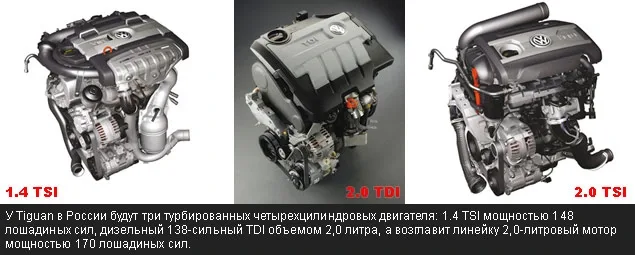 |
Despite all its off-road pretensions, the Tiguan, it seems, still prefers asphalt. The 1.5-liter engine, which performed excellently on the Touran compact van paired with DSG, showed itself weaker on the Tiguan with a manual gearbox. With almost the same mass (the difference is only 117 kg), the crossover with the 148-horsepower TSI engine, equipped with both a supercharger and a turbocharger, feels sluggish. This is especially noticeable when starting off, and even more so on an incline — you have to rev the engine, otherwise it risks stalling.
In such a situation, the "auto hold" electronic parking brake function, familiar from the Passat, comes to the rescue. With it activated, the car freezes on its own at speeds below 7 km/h and does not roll back, even if you release the brake pedal. Interestingly, the electronic parking brake cannot be disengaged without fastening the seat belt. So in the morning, you first need to secure yourself, and only then can you move off — the pads will release at the first press of the gas pedal. And this parking brake can also work as an emergency brake: if you pull the handle with the letter "P" while driving, emergency braking begins. True, the clamping force of the pads is limited to 60 percent of the maximum to avoid provoking a skid.
 |
The robotic DSG will not be offered for the Tiguan at all — Volkswagen states that its service life would not be enough for off-road loads, and it is unlikely to survive the 100,000-kilometer warranty. Russians will also not see the 200-horsepower petrol version, nor the 170-horsepower diesel — and that is a pity. The smallest engine will not be offered at all with a transmission without a clutch pedal. The two-liter petrol unit, detuned to 170 hp, and the 2.0-liter diesel (which will appear in 2009) will work exclusively with a six-speed automatic with a torque converter and manual mode. Nevertheless, the Tiguan promises to become the most "engine-rich" crossover in its class on the Russian market — at least until the main competitor, the Ford Kuga, gets a full range of engines.
In the fight against rivals, the Tiguan relies not only on intelligent all-wheel drive and three power units. The compact SUV can boast modern equipment and a wide list of options. Already in the base version "Track and Fun" (which will appear in 2009) there is dual-zone climate control, electric windows on all doors, six airbags, a stability control system, a steering column adjustable for height and reach (range — 5 cm), and a multifunctional on-board computer. The trunk in any trim level pleases with volume — from 320 liters with a false floor and spare wheel to 1510 liters with folded seats. The rear seats can not only be folded, but also moved forward and backward by 16 cm, and the backrests can be adjusted for incline by 40 degrees independently of each other. The front passenger seat folds down, allowing you to carry items up to 2.5 meters long. The load capacity is also impressive — 650 kg.
 |
The interior, with its instrument panel, materials, and comfortable seats, resembles the Golf, Golf Plus, Passat, and other models of the concern, but there are also unique details — for example, twin air vent deflectors and stylish door handles. Attention is paid to small details here: even inside the housing of the halogen headlight, you can see small letters V and W that form the Volkswagen logo.
Much of what is currently unavailable will appear in 2009: a panoramic sunroof with electric drive, the RNS 510 multimedia system with a color touchscreen, navigation (possibly Russified), and an audio system with a 30-gigabyte hard drive. For the first time for Volkswagen, Bluetooth and a rear-view camera with dynamic markings will become available. Branded features will also appear — the semi-automatic Park Assist parking system and a retractable tow bar. Surprisingly, the multifunction steering wheel with audio controls, on-board computer, and cruise control will also have to wait until 2009 — for now, the Tiguan's steering wheel only features the brand logo.
For the initial trims "Sport and Style" and "Track and Field" with the 1.4 TSI engine, dealers ask from 904 thousand rubles. The version with the two-liter engine and six-speed automatic costs 1,053,550 rubles. Whether the compact Volkswagen crossover will be successful, time will tell — sales have just started. Currently, the Japanese dominate: Nissan Qashqai, Nissan X-Trail, Toyota RAV4, Mitsubishi Outlander XL, Honda CR-V, and Suzuki Grand Vitara, each occupying about 10 percent of the market, that is, 20–25 thousand cars per year. The segment is steadily growing: in 2006 — by 64 percent, in 2007 — by 62. Soon, Mazda may join the bestsellers with the Kazamai prototype, which will be shown in August at the Moscow Auto Show. Renault Koleos has almost reached Russia, and PSA Peugeot Citroen together with Mitsubishi are working on a joint crossover, which so far exists only as the Concept-cX concept. The production version is not far off…
Technical characteristics of Volkswagen Tiguan 1.4 TSI
| Length, mm | 4427 (4457 in the Track and Field version) |
| Width, mm | 1809 |
| Height, mm | 1665 |
| Wheelbase, mm | 2604 |
| Curb weight, kg | 1757 |
| Engine displacement, cm3 | 1390 |
| Power, hp/rpm | 148/5800 |
| Torque, Nm/rpm | 240/1750 |
| Acceleration time from 0 to 100 km/h, s | 9.3 |
| Maximum speed, km/h | 192 |
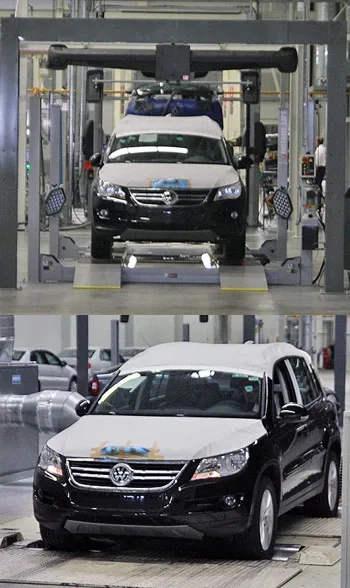 The birth of the Tiguan The birth of the Tiguan Production at the Volkswagen AG plant in Kaluga started on November 28, 2007, and since then 28 thousand VW and Skoda cars have come off the assembly lines. Recently, a sixth model, the Tiguan, joined the five models produced at the plant (Volkswagen Passat and Jetta, Skoda Octavia, Octavia Tour, and Fabia). About 600 employees hired in the Kaluga region, who had no experience in car assembly, underwent special training and work on four assembly lines, producing 180-200 cars per day, of which 30 are the compact crossover. By the end of the year, about 300 more workers will come to the plant, and two additional lines will be launched, which will increase the number of assembled cars to 340 per day, and in total in 2008 it is planned to assemble 70 thousand cars. The Tiguan is assembled in a separate workshop next to the Skoda Fabia. Parts for the SUV are supplied from the plant in Wolfsburg (Germany). Ready-assembled bodies arrive in containers, parts for which are stamped by the Spanish company "Gestamp Automocion", and engines, transmissions, and suspension components come in separate wooden boxes. |