
Volkswagen Tiguan. People's Choice
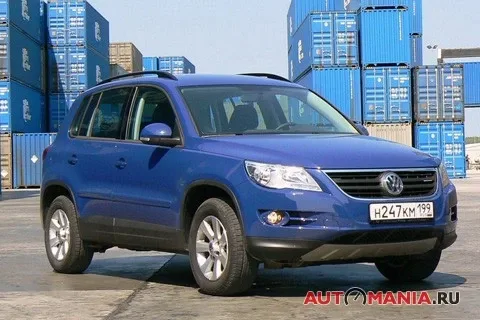
As is known, a name largely determines one's fate. It's worth recalling that the name Tiguan was chosen by the whole world — the contest was held by Auto Bild magazine. Out of a dozen contenders, including Namib, Rockton, and even Nanuk, more than 350,000 German drivers preferred Tiguan — a sort of hybrid of a tiger and an iguana.
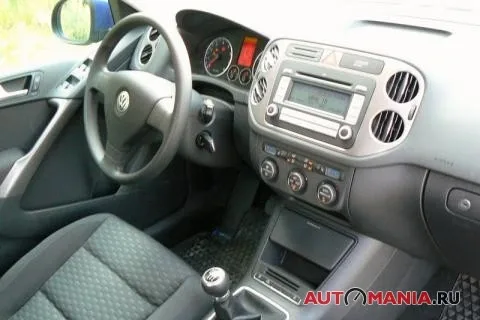
The car's exterior is powerful and dynamic; it's immediately clear that it's the younger heir to the Touareg. All the family traits are in place: the gleaming radiator grille shaped like a "shield," and the recognizable wide rear pillar. Klaus Bischoff, the chief designer of VW's Wolfsburg studio, did his best — the younger one looks even more muscular and dynamic than its older brother. Inside, everything is much more prosaic, but more attractive: the front panel with round air vents is borrowed from the Golf Plus, and it looks good.
Looking for Differences
People often ask why "Tiguans" have different bumpers: on some, the lower part protrudes, on others it seems cut off. The explanation is simple — the manufacturer wants to please different buyers. City dwellers are typically offered the Sport&Style version. It has a lower front bumper, an approach angle of 18 degrees, half-tinted windows, and lots of chrome. Inside, there are more contoured, "sporty" front seats with Alcantara and a leather-wrapped steering wheel.
Our test version, Track&Field, looks more rugged. It's for those who often venture out of town or fear high curbs and snowdrifts. Therefore, the front bumper here is "trimmed" to 28 degrees. The front seats are softer and more comfortable, there's a lot of unpainted plastic outside, and there's an "Off Road" button on the center console. When activated, a whole suite of off-road assistants kicks in: the accelerator pedal becomes less responsive, and the rev limit shifts from 6500 to 3000 rpm to prevent the wheels from digging in. The electronic differential lock simulation starts working faster, while ABS and ESP, on the contrary, switch to "dirt" mode. Plus, a descent assistant activates, which automatically holds the speed on a slope. There's also an ascent assistant that changes the engine's operating algorithms and protects the clutch.
Asphalt and Off-Road
In principle, all the differences are purely external — the mechanics are the same for both versions: ground clearance of 200 mm, MacPherson struts up front and electromechanical power steering from the Golf, and a multi-link rear suspension with a fourth-generation Haldex coupling from the current Passat. This is the standard layout for a passenger crossover; only the electronics settings and their integration with safety systems differ. So dreaming of serious off-roading is out of the question — the car is purely civilian: you sit high, see far, and have confidence on slippery winter roads or broken dirt roads, but not in deep ruts.
We managed to test its off-road capabilities on a track near Kaluga. The suspension is short-travel, so one wheel often hangs in the air. A couple of idle revs, a bit of braking — and the Tiguan, gripping with the loaded axle, crawls on. The rear coupling engages quickly. True, it turned out that the Tiguan's drive is more like non-disconnectable: at start, torque goes to all four wheels equally, and only then, realizing conditions are normal, the electronics allow the car to become almost front-wheel-drive, leaving at least 10% of traction at the rear. But you shouldn't rely too much on electronics — who knows what happens if the tread of highway tires gets clogged with clay, the brakes get tired of holding back the hanging wheels, and the coupling overheats. The nearest tractor driver might be far away... Better not to play hero and take obstacles with momentum.
It's much more interesting to see how the Tiguan behaves on ordinary Russian roads — especially since the chassis reveals itself better here. To reach the Kaluga region, I had to drive along the morning route of the Kiev highway, and by nine in the morning the traffic there is already dense: lots of trucks and other slow-moving vehicles cutting into lanes. Although I'm for strict rules, I used every gap to get ahead. I won't hide it, it was easy. The Tiguan responds to every steering movement with an instant and precise lane change, like a soldier on parade. And the engine turned out to be lively — the 150 turbo horses of the base 1.4-liter TSI were enough to launch the 1.5-ton car like a bullet after another slowpoke. According to the specs, 0-100 km/h takes 9.6 seconds — an excellent figure! The six-speed manual works like a rifle bolt — you just want to click through the whole magazine! And the engine pulls confidently from 1750 rpm, so in city traffic you don't need to shift often. The beast's appetite is modest: with active driving, about 10-11 liters. At the same time, the dynamics are almost like the more substantial 2-liter version (170 hp) with a six-speed automatic (but there, both fuel consumption and taxes will be higher). For the city and light off-roading, the automatic is, of course, more convenient. However, the 1.4-liter engine is paired exclusively with a manual. And for those who aren't afraid of diesel noise and are confident in fuel quality, the 140-hp TDI version is worth considering.
Almost Like in Nice
While I was studying the car's character, a sign appeared in the distance: "Welcome to Kaluga Region!". Time to leave the highway. Next is the hinterland with villages bearing poetic names like "Polotnyany Zavod", "Samorodka", "Kosovo", "Novaya Zhizn", or "Gamzyuki", connected by roads of dubious quality. They constantly hint at holes in the local budget, and sometimes even turn into meadows. But with their winding nature and unexpected profiling, they resemble the mountain serpentines of the French Côte d'Azur.
I drove the little "Tiguan" all day without tiring. Despite the high center of gravity, its ultimate capabilities turned out to be top-notch. I didn't try to roll it over, of course. But unlike many competitors, where stability control tries to keep the car on two or three wheels at the roadside, the Tiguan continued to handle excellently. It seemed to trace arcs and slaloms with a compass, taking corners of any curvature with almost no body roll, not frightening the driver. If the stability electronics did intervene, it did so imperceptibly, like a partisan.
But who can be surprised by electronics these days? What impressed me much more was the suspension's energy capacity: drive slowly — it shakes tediously. Increase speed — and the shaking turns into elastic damping, as if under the car there weren't springs and shock absorbers, but expensive air suspension.
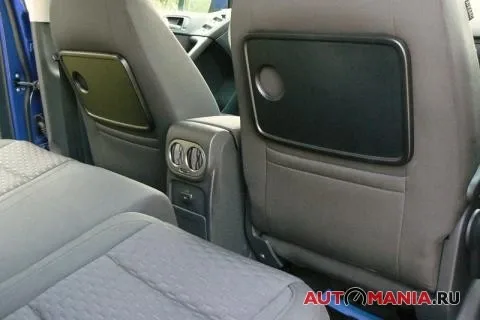
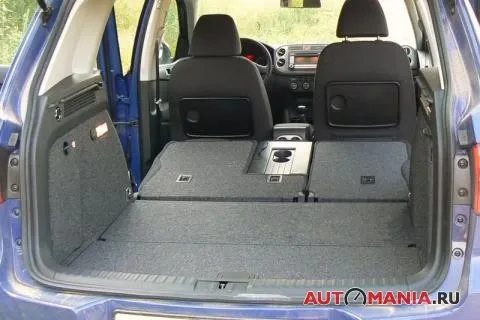
After having my fill of driving, I decided to rest, take a couple of photos, and also climb into the back row to check how it is for the family and luggage. And here's what I realized: household members will surely like the fold-down tables in the front seat backs and three pairs of cup holders around the cabin. The rear sofa, divided into two unequal parts (like many competitors), slides forward and backward, offering seating from acceptable to quite spacious, with plenty of legroom. If you fold the sofa flush with the floor, you get 1560 conventional liters of volume. And by also folding the front right seat, you can carry items up to 2.5 meters long.
Even in the base version, the "Tiguan" is well equipped: engine protection and anti-gravel coating, ESP, ABS, ASR, EDS, MSR, six airbags, dual-zone Climatronic climate control, heated front seats, MP3 radio, parking sensors, alloy wheels. In the first half of 2009, its sales totaled 3,001 cars — less than the Nissan Qashqai (8,994), Hyundai Tucson (7,531), Nissan X-Trail (6,580), Honda CR-V (5,286), Toyota RAV4 (4,973), Kia Sportage (4,727), and Suzuki Grand Vitara (4,277). But prices, despite Kaluga assembly, were rising. Last autumn, when the cars first appeared, the base city (Sport&Style) and off-road (Track&Field) versions with the 150-hp 1.4-liter TSI cost 904,000 rubles. With the 2-liter engine and automatic, the price rose to 1,053,000 rubles. Today, the front-wheel-drive Trend&Fun with the 1.4 TSI engine will cost 997,315 rubles, while the popular all-wheel-drive Track&Field and Sport&Style with the 2-liter engine or diesel and six-speed automatic — 1,199,557 and 1,251,883 rubles, respectively. What can you do, it's a good car, and good things, as we know, don't come cheap. Such is the law of life...
Vladimir Palkin
Technical Specifications of Volkswagen Tiguan Track&Field 1.4 TSI 2WD
| Length, mm | 4427 | |||
| Width, mm | 1809 | |||
| Height, mm | 1686 | |||
| Wheelbase, mm | 2604 | |||
| Gross weight, kg | 2170 | |||
| Curb weight, kg | 1546 | |||
| Trunk volume (l) | 470/1510 | |||
| Transmission | manual 6-speed | |||
| Drive | all-wheel drive | |||
| Engine displacement, cm³ | 1390 | |||
| Max. power, hp | 150/5800 | |||
| Max. torque, Nm | 240/1750 | |||
| Max. speed, km/h | 192 | |||
| Acceleration time (0-100 km/h) s | 9.6 | |||
| Average consumption (l) | 8 | |||
| Tank volume, l | 64 | |||
| Fuel | AI-95 | |||
Source – AUTOMANIA.RU