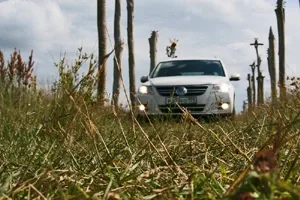
 To understand that the combination Tiger+Iguana perfectly describes the character of this car, you don't need to be a zoologist — it combines the best traits of both animals: power, swiftness, flexibility, and tirelessness…Comments (1)
Almost everyone probably knows that Touareg is not only a famous SUV from Volkswagen, but also the name of a tribe from the Algerian Sahara. But the origin of the name of the "younger brother" is not so obvious. Tiguan is a word formed from the names of two completely different and seemingly incompatible animals — Tiger & Iguana, that is, Tiger and Iguana. However, when creating this unusual creature, the Volkswagen concern carefully listened to the opinions of the main experts on natives and rare animals — that is, to its future buyers. To this end, the AutoBild magazine, even before the debut of the concept, conducted a survey on what to name the new model. And almost unanimously, the sonorous name — Tiguan — won.
 |
 |
To understand that the combination Tiger+Iguana perfectly describes the character of this car, you don't need to be a zoologist — it combines the best traits of both animals: power, swiftness, flexibility, and tirelessness.
Now let's go through the details.
The history of Volkswagen's experiments with mid-size all-road vehicles, which are now commonly called crossovers, began back in 1968 — when the public was shown not just a car, but a real amphibian, the VW Country Boogie. Later, other prototypes appeared, little known to the general public or not intended for civilian life at all — such as the VW Type 181188, nicknamed the "Ferret," created for the army. But the most successful in this class in past years was undoubtedly the VW Golf Country. This car, based on the second-generation VW Golf, despite its golf-class origin, had excellent geometric off-road capability.
 |
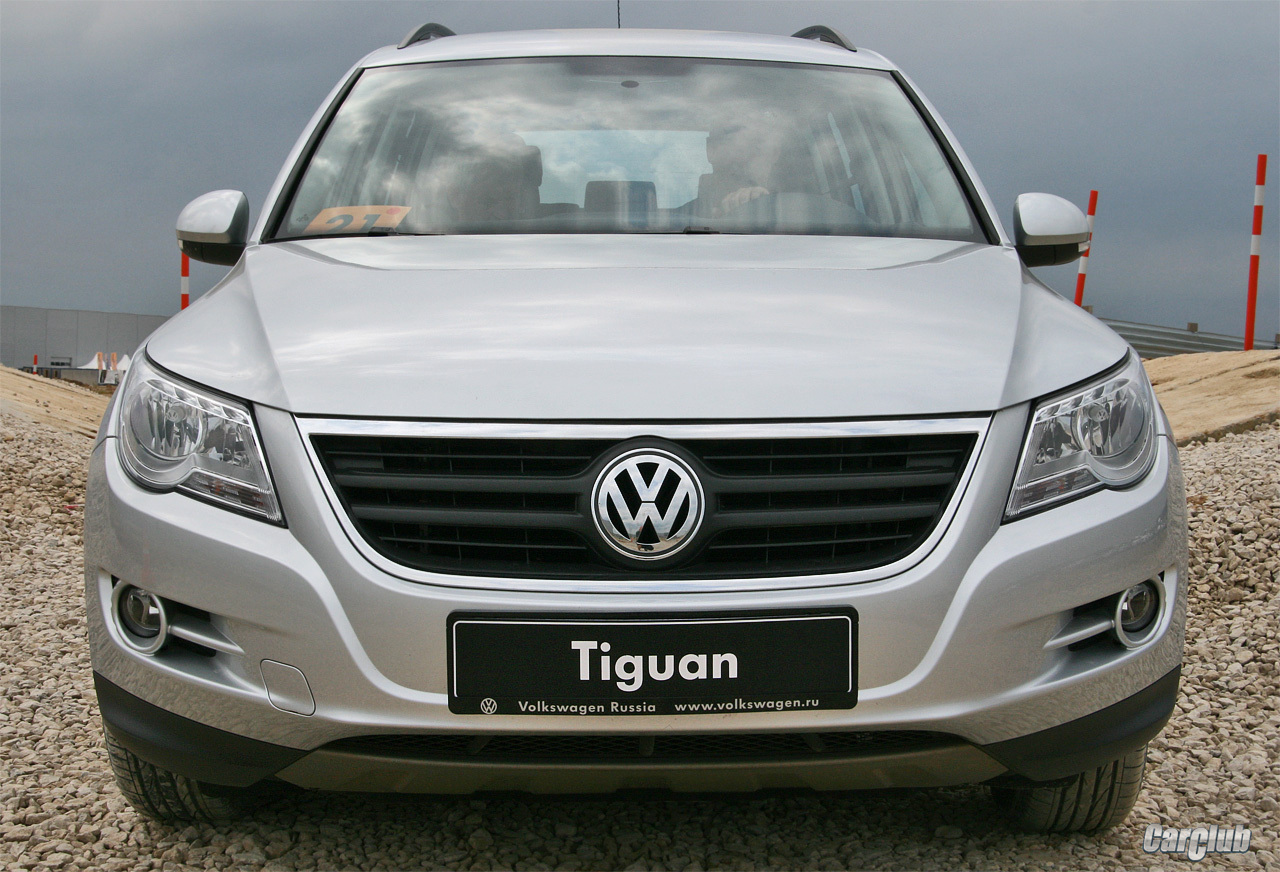 |
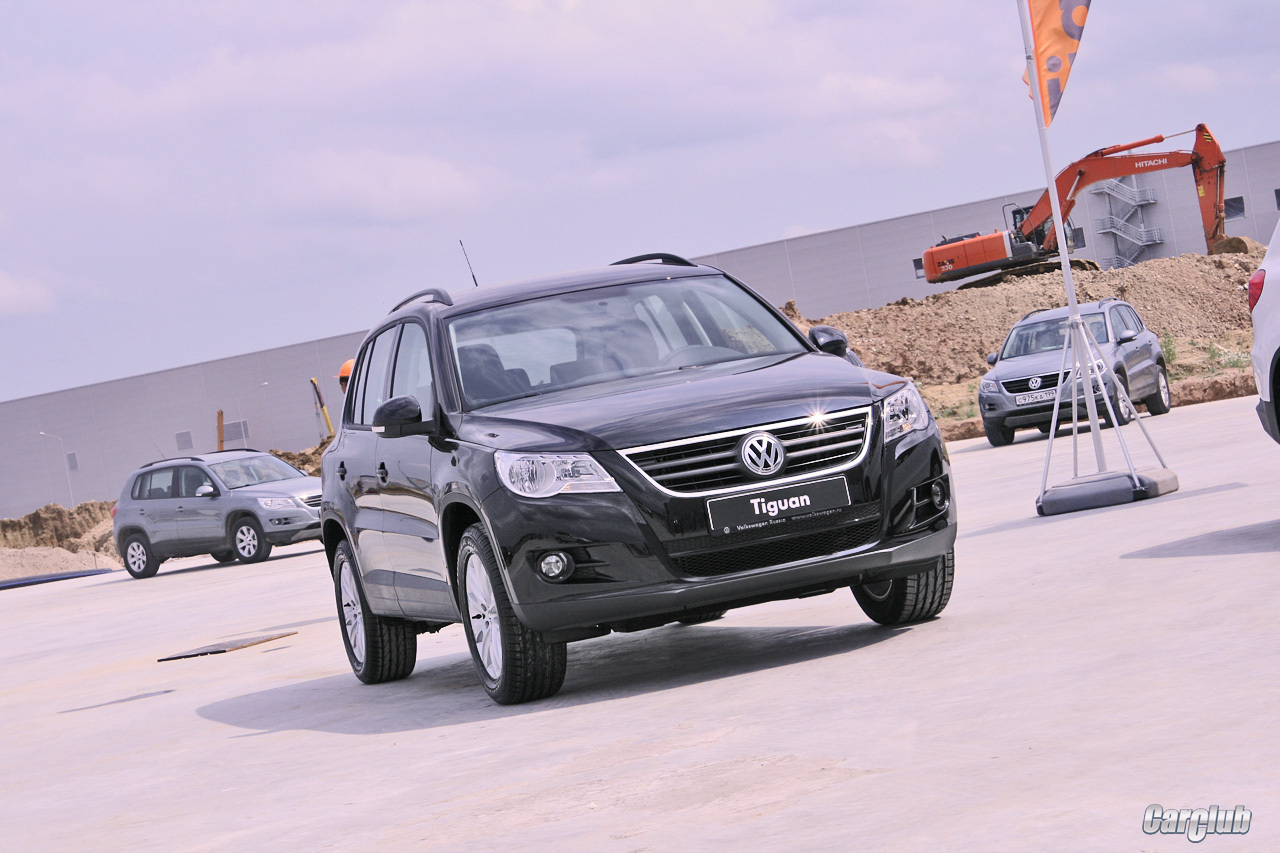
And finally, in 2006, the Tiguan concept was shown at the Los Angeles Auto Show. Its exterior was worked on by VW's chief designer Klaus Bischoff, and it's no surprise that the Tiguan looks very similar to its older class brother — the Touareg, which has been successfully sold worldwide since 2002 and has earned a reputation as a legendary SUV.
Then, in 2007, the production version was presented in Frankfurt, which differed very little from the previous year's concept — this largely justified the expectations of the brand's fans.
 |
 |
 |
And only in 2008 did this "genetic miracle" reach Russia.
We were lucky to test the car among the first: we spent almost 18 hours behind the wheel and covered more than 600 km.
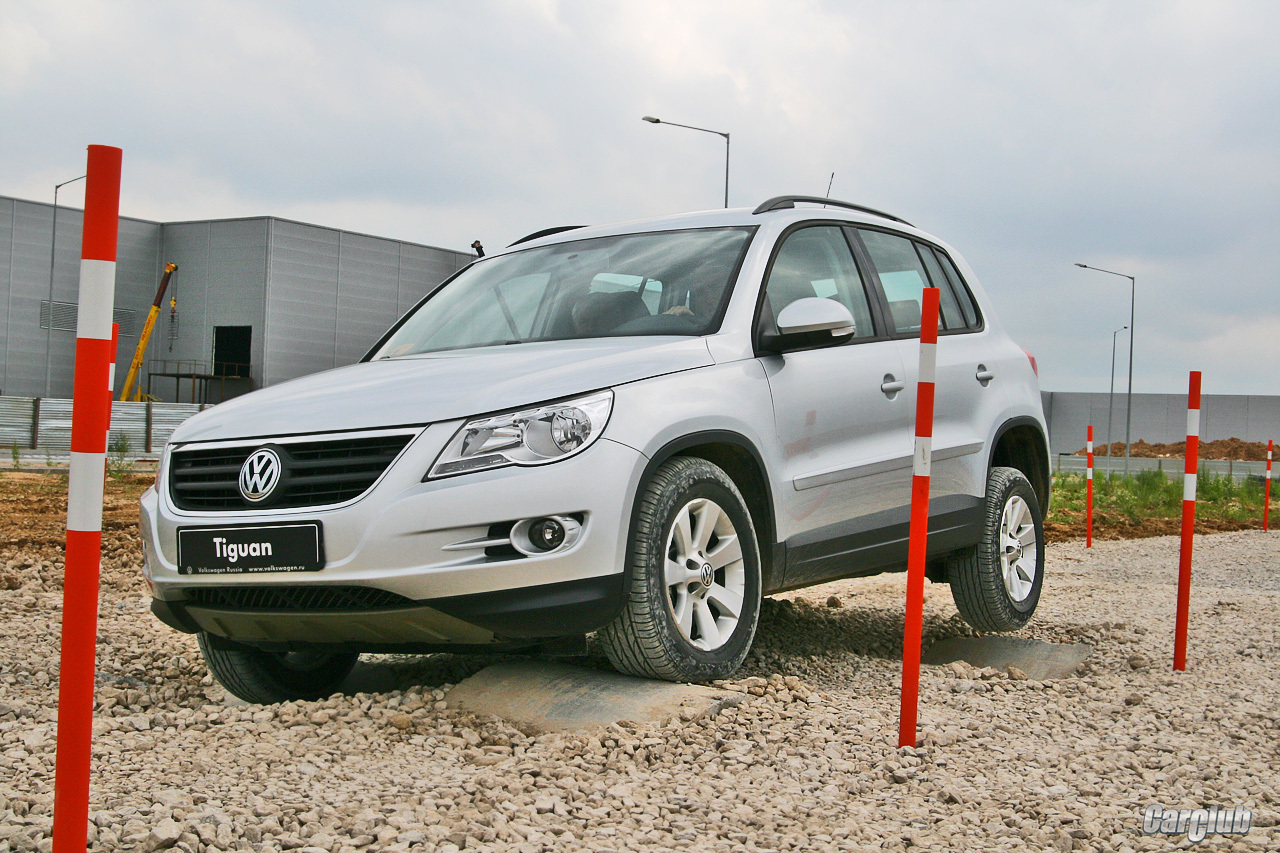
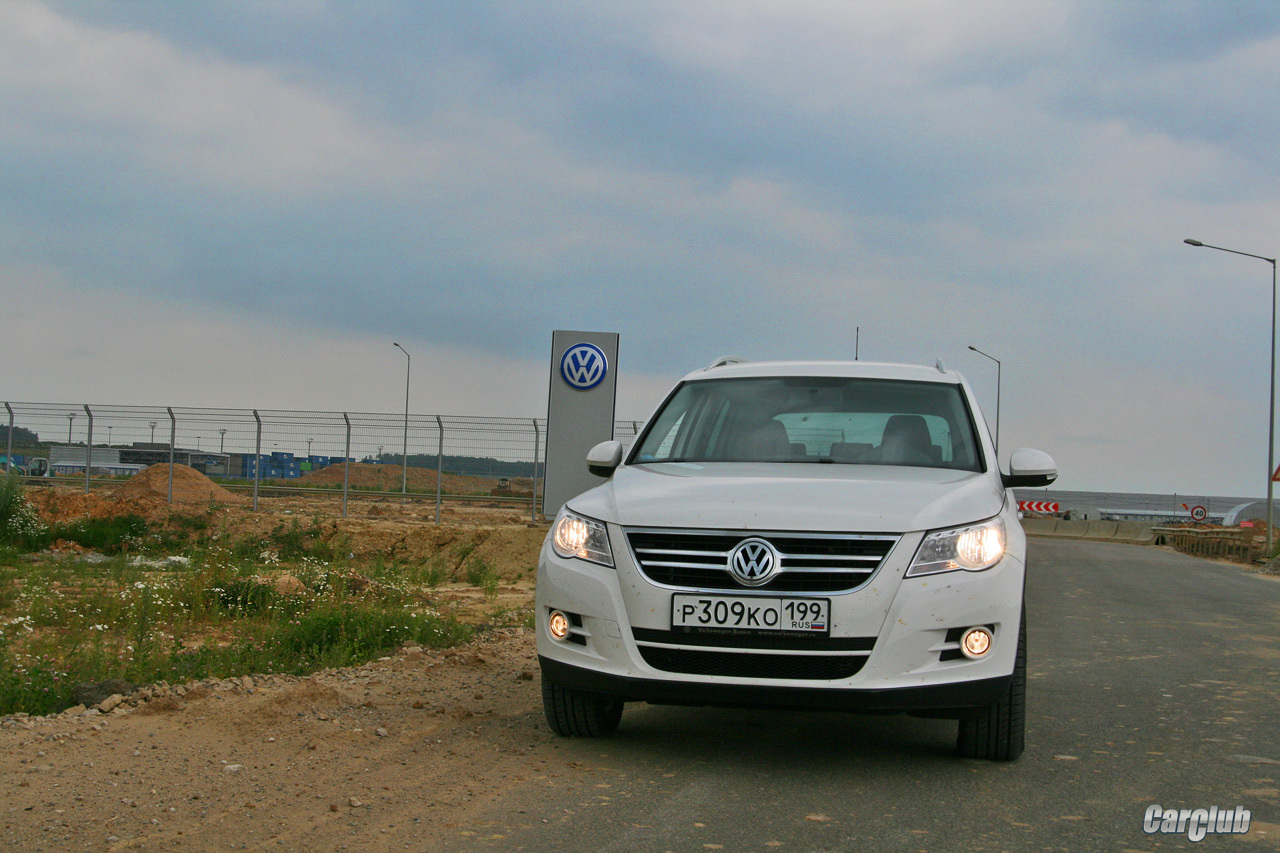
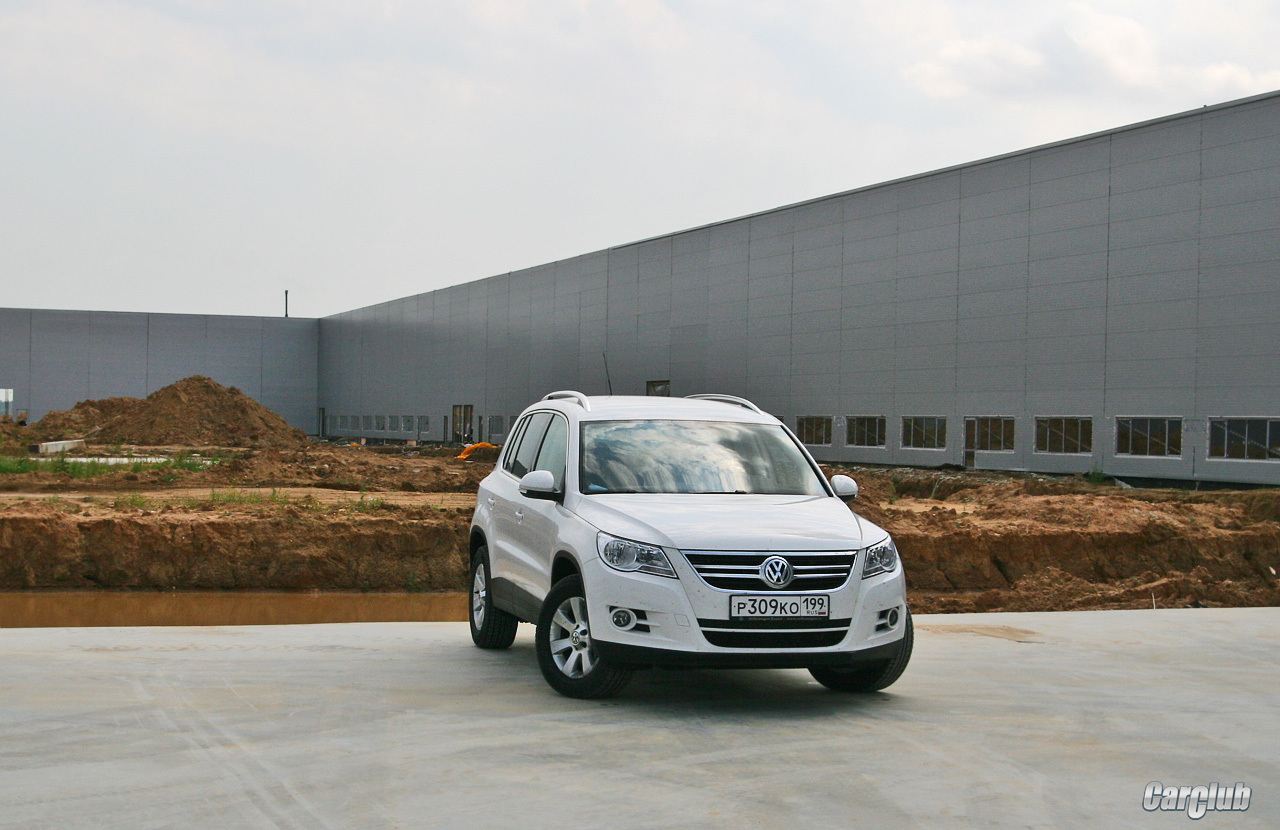
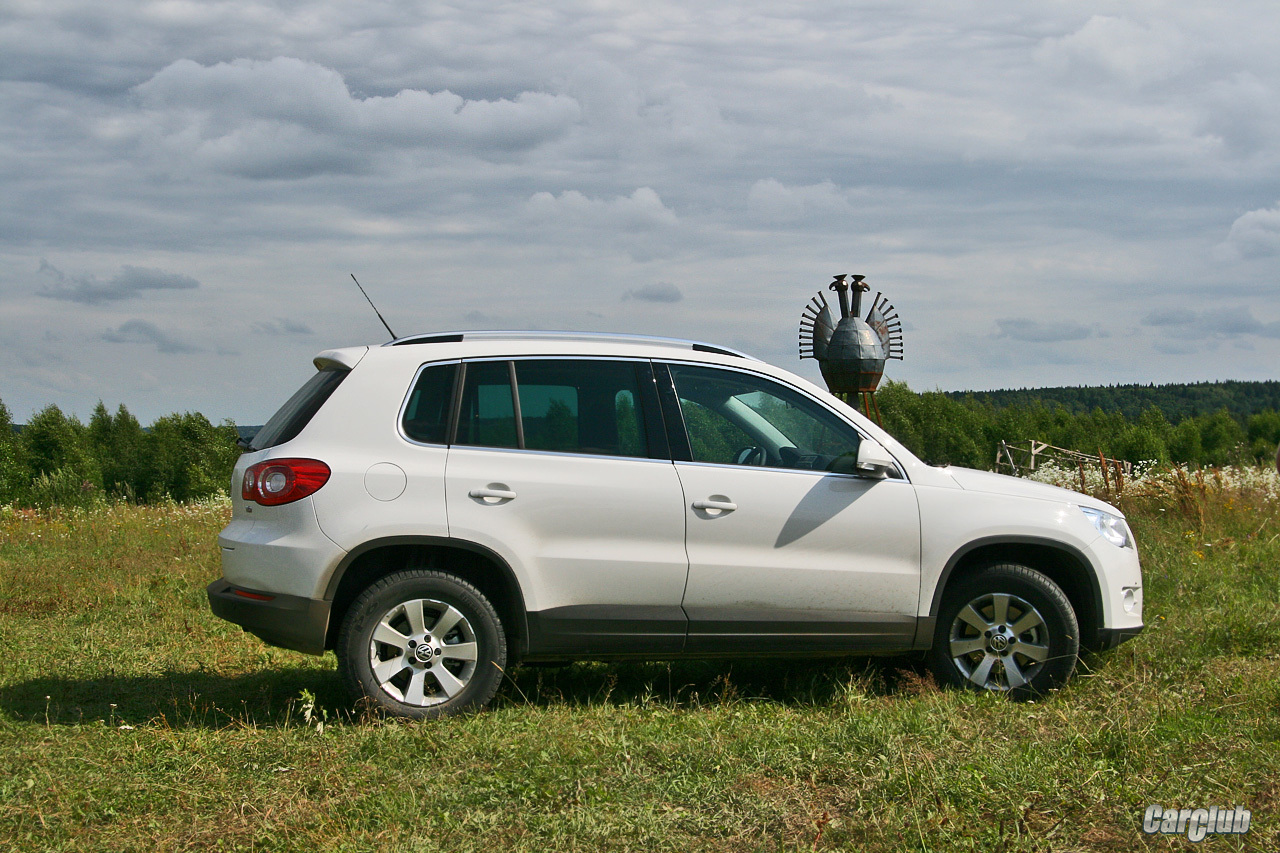
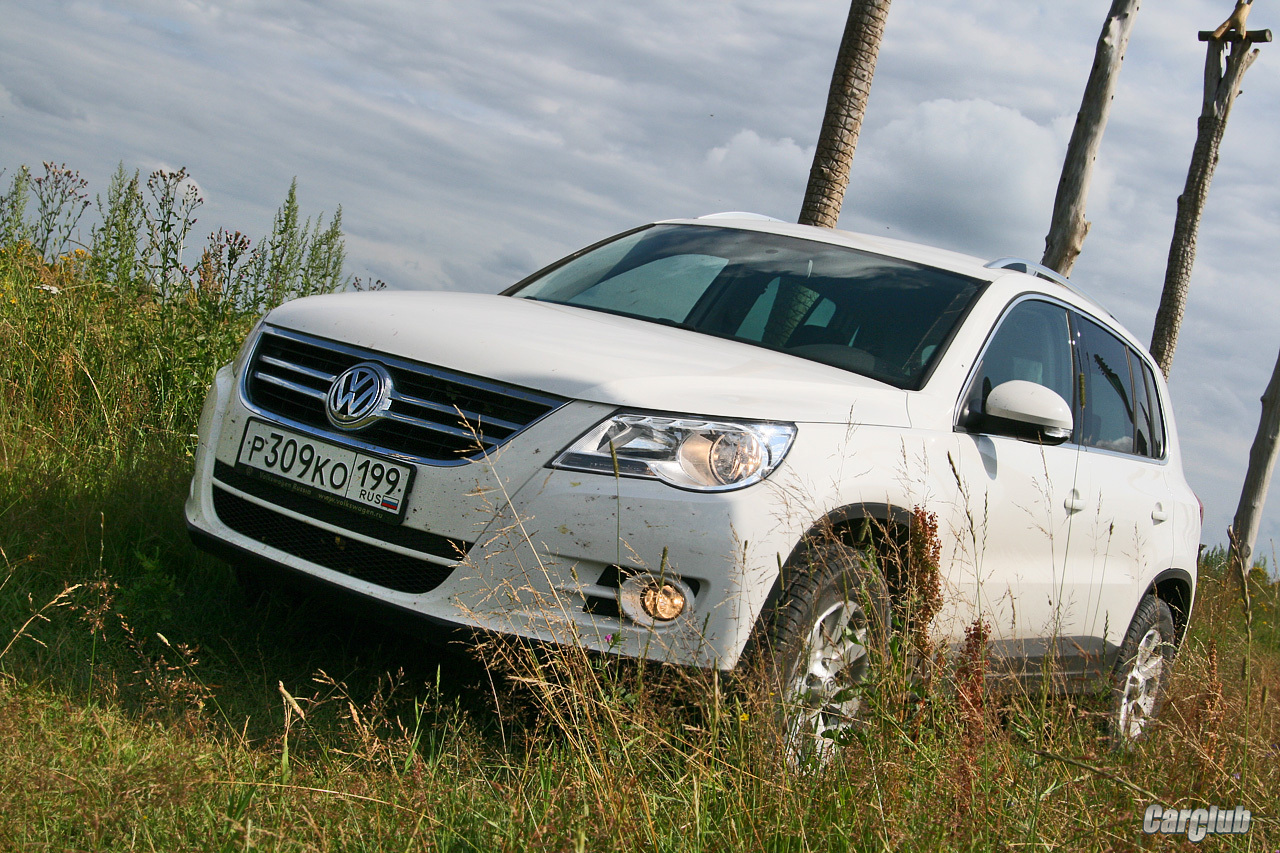
We got a snow-white example, in the Sport&Style body version, with a 1.4 TSI engine and a manual gearbox.
 |
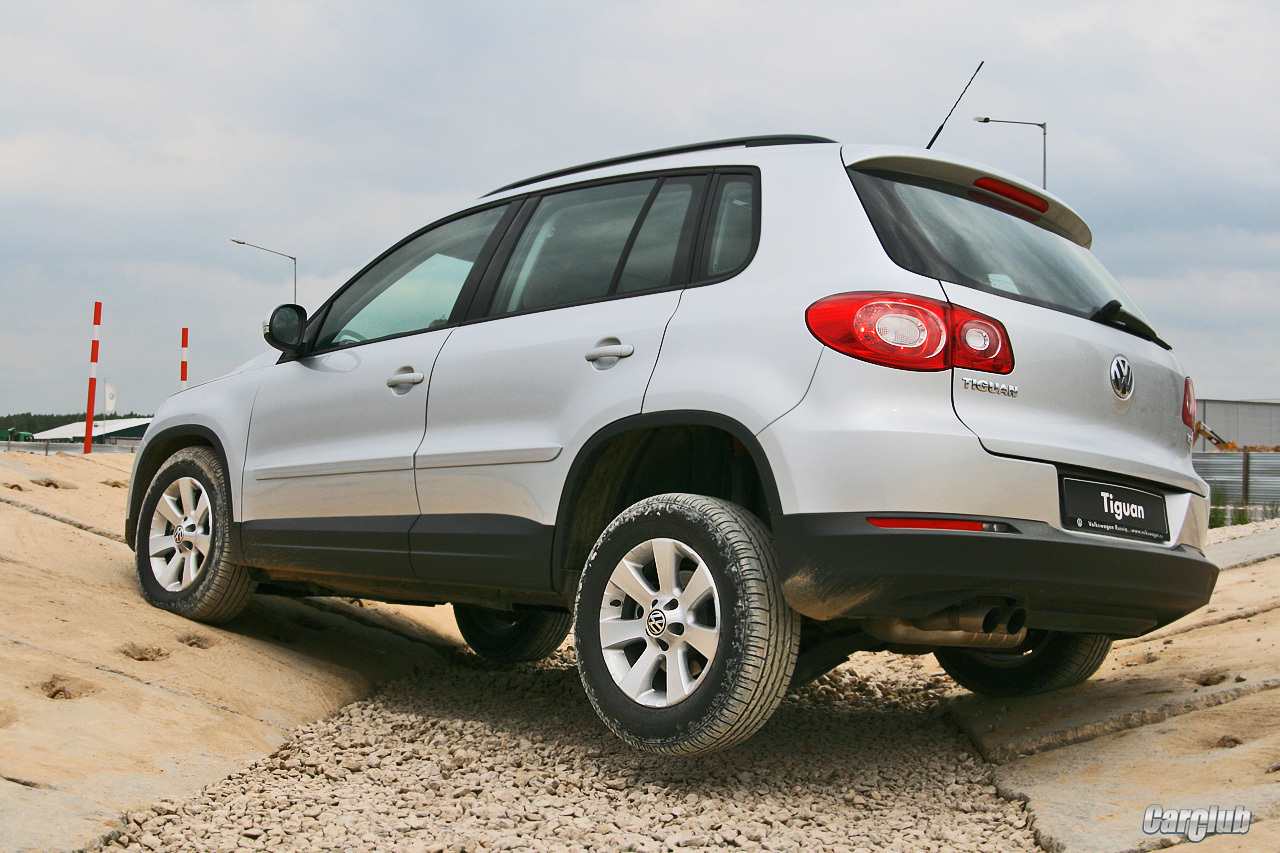 |
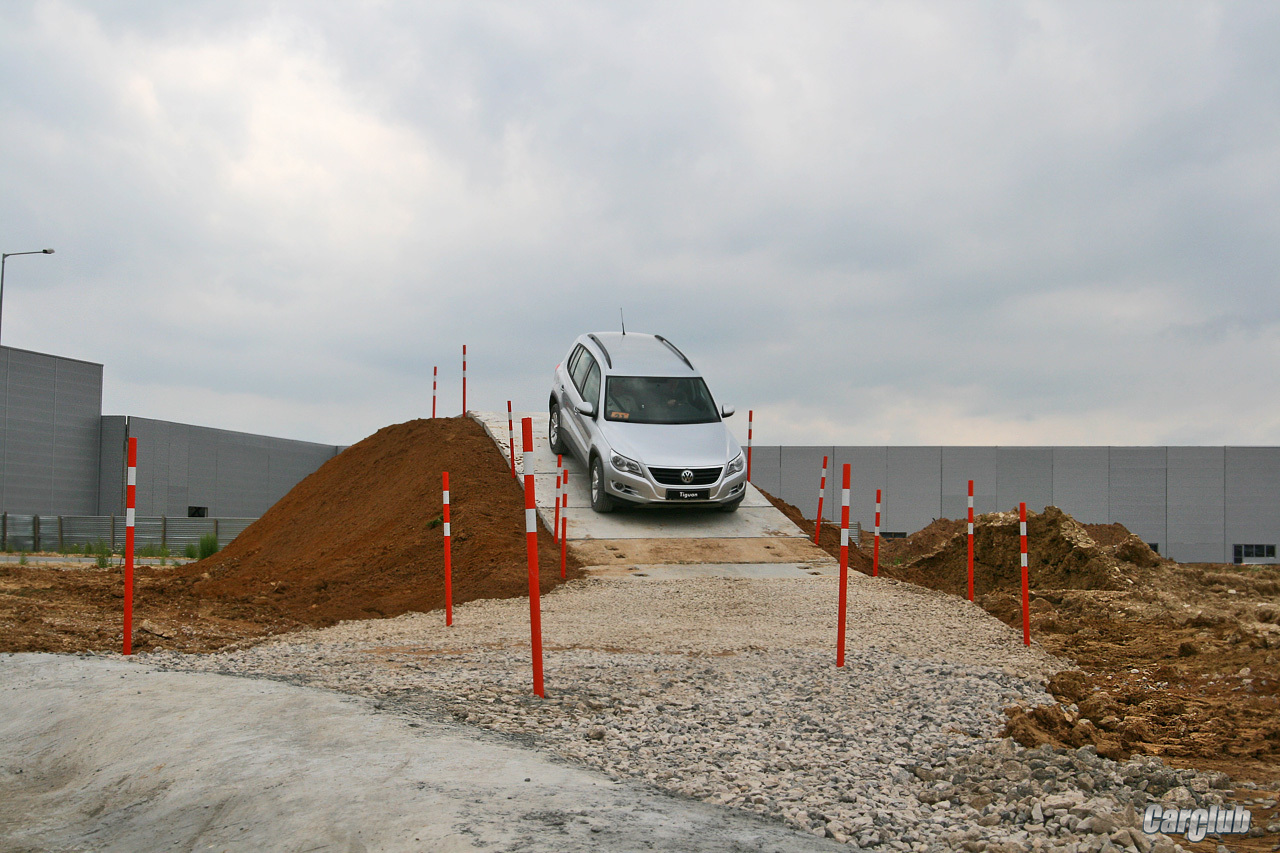
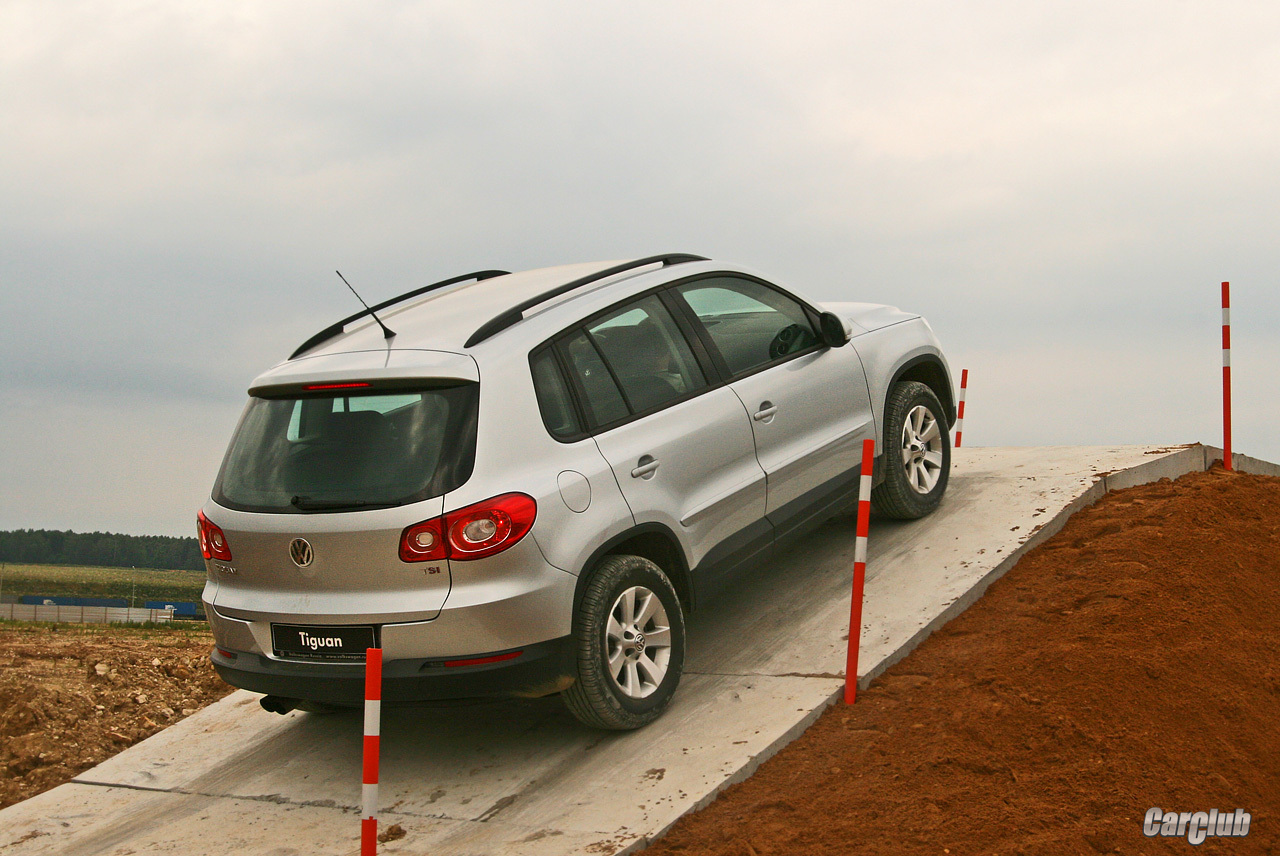
The Tiguan is also produced in the off-road body version Track&Field — thanks to different bumpers and a modified chassis, it has an approach angle of 28 degrees, like full-size SUVs. Plus, there's an off-road electronics package that is activated with one OFF-Road button. It includes rollover protection systems, soil viscosity recognition, and a hill descent assistant.
Both off-road and city versions are equipped with an automatic parking brake with the Auto Hold function, which prevents the car from rolling backward. The electric handbrake can also be used as a backup emergency braking system — it is applied evenly by all four wheels.
 |
 |
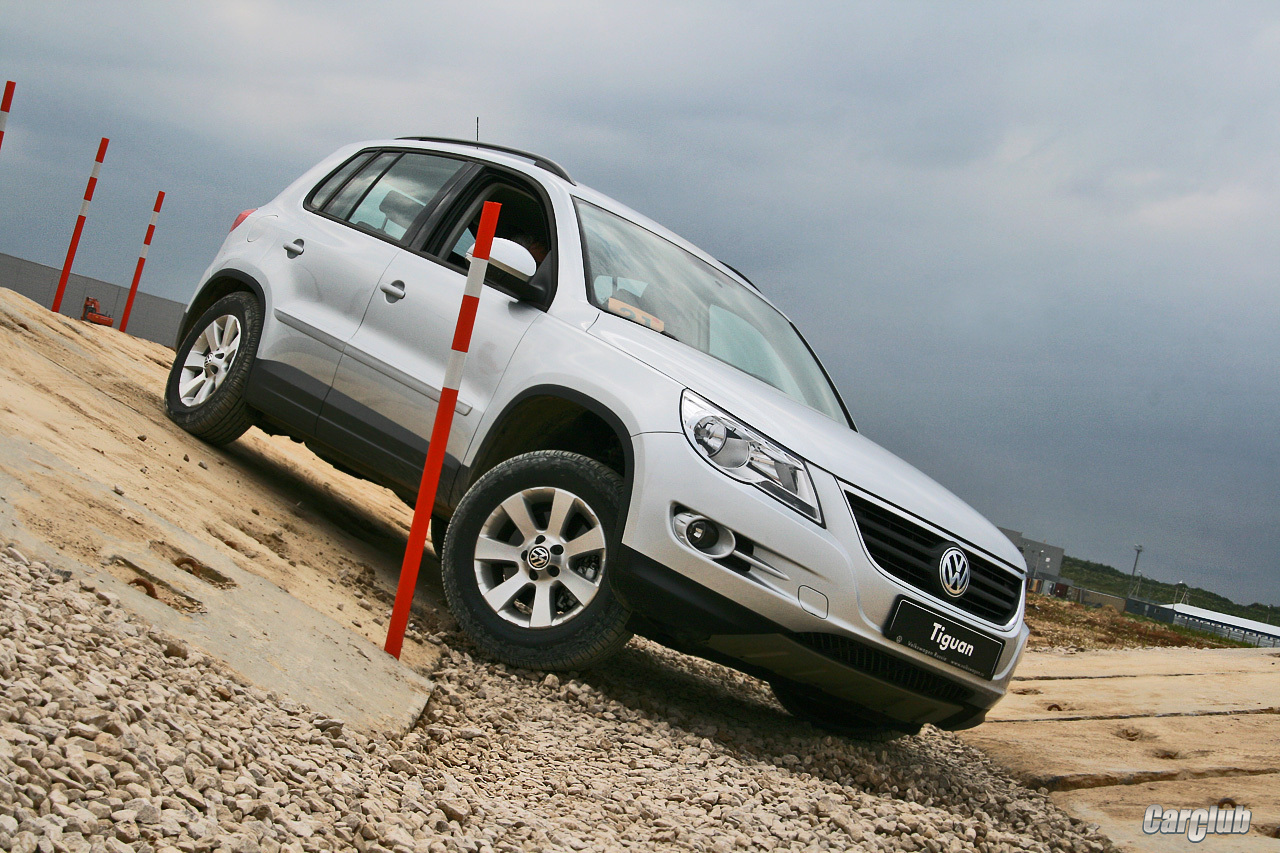 |
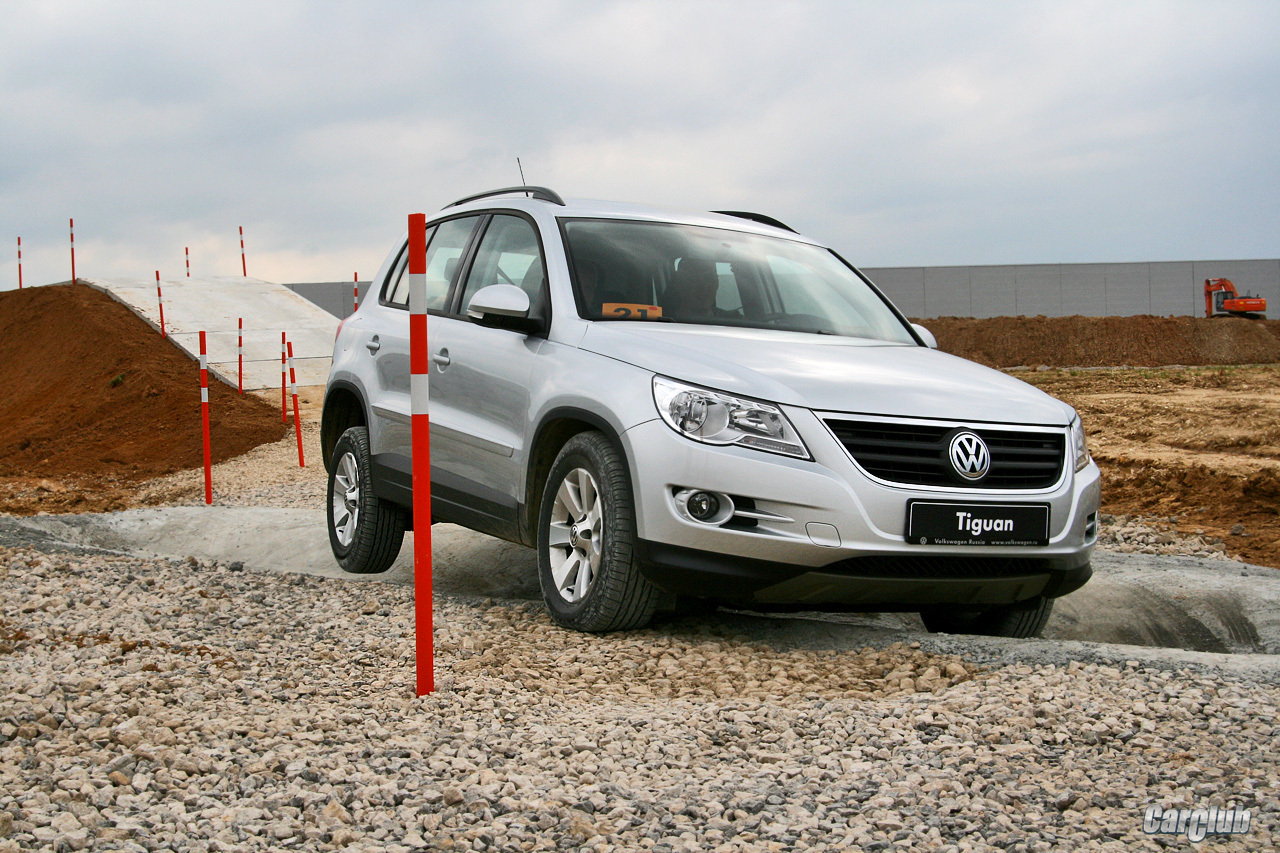
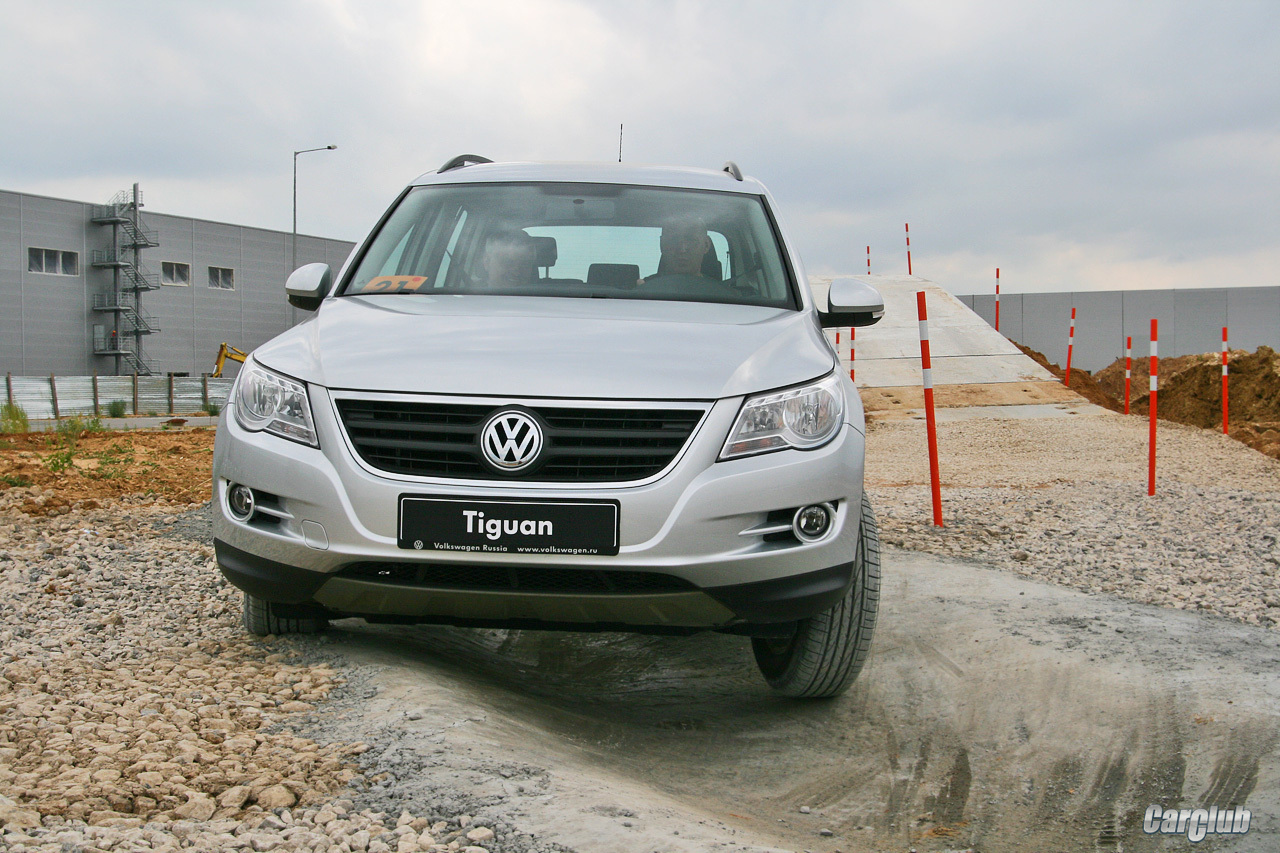
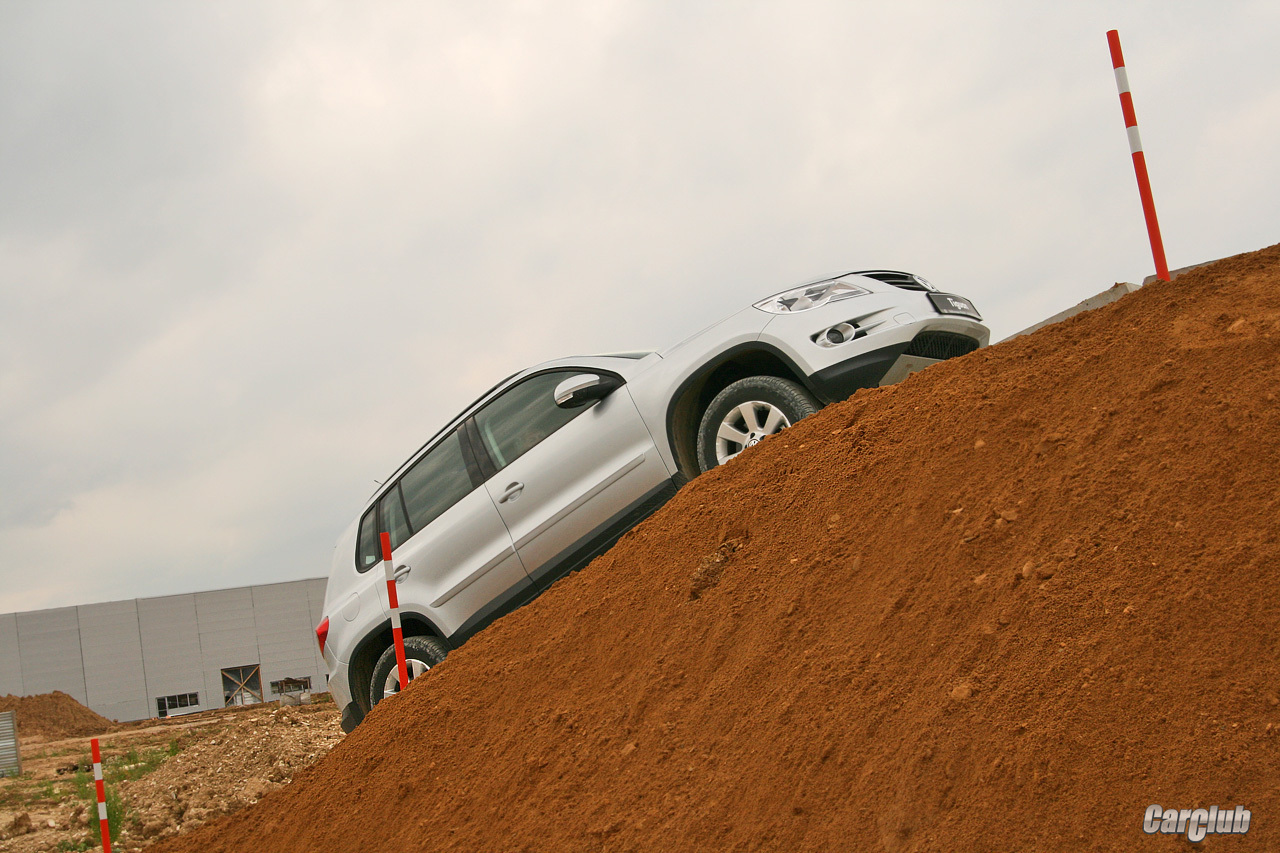
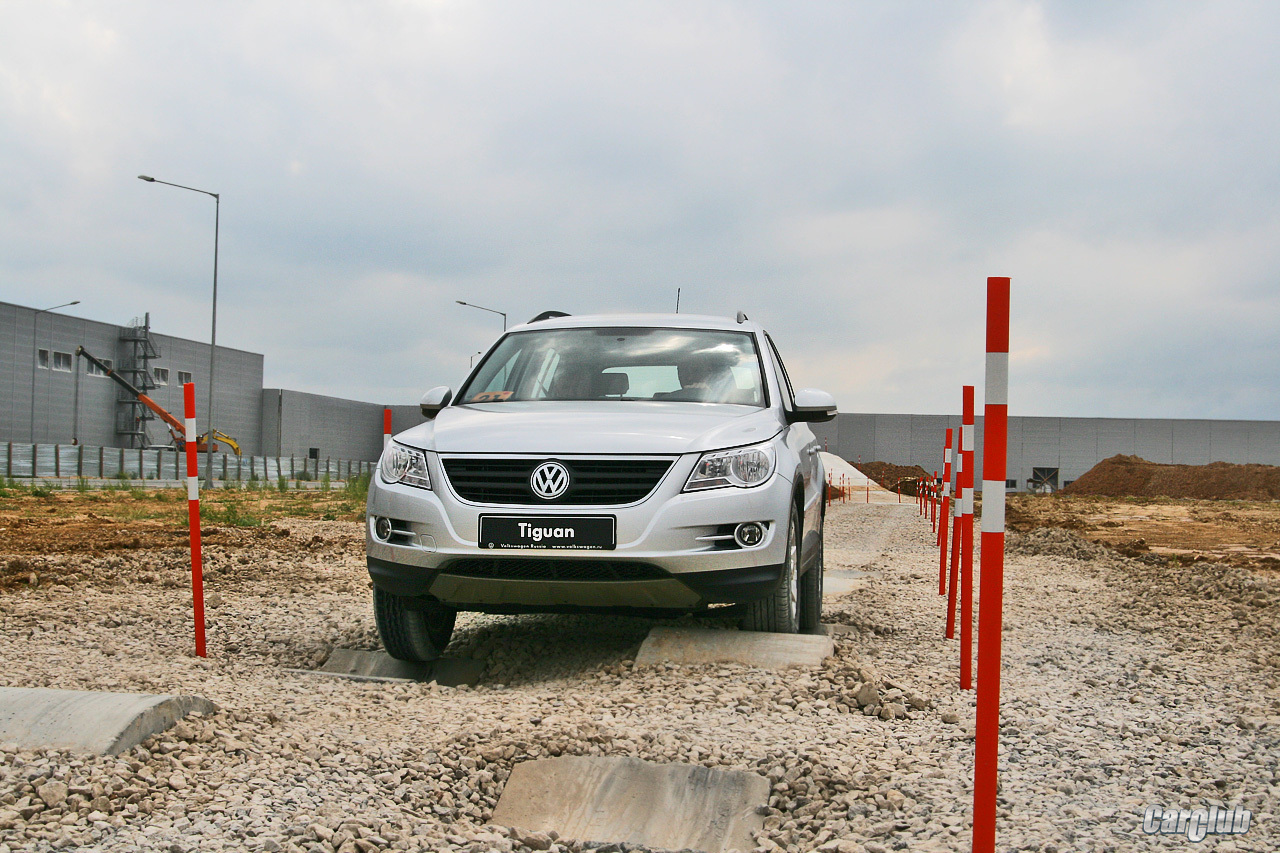
But even the city version has very serious off-road potential. We checked this in the Kaluga region — on the, to put it mildly, poor roads there and in fields where there are no roads at all.
The basis for the Tiguan's chassis was the all-wheel-drive Passat 4motion of the latest B6 generation, but, of course, the modernization of components did not go without. First, they installed the latest generation Haldex center differential — it works fully automatically and does not require driver intervention. Haldex engages all-wheel drive (50x50) at the slightest hint of difficult weather or road conditions or dangerous maneuvers.
Among the front chassis modifications, it is worth highlighting the installation of a shock absorber siphon. Wheel control is carried out through a ball screw, which is also called a rolling bearing. Together, these solutions completely eliminate such problems as bottoming out and low-frequency vibrations in the steering wheel, and provide maximum steering precision.
 |
 |
The rear suspension was also thoroughly modified: it was mounted on a reinforced subframe made of high-strength steels and equipped with shock absorbers with a large volume of oil — so that the fluid does not boil during dynamic driving over serious off-road terrain.
The brake system, also taken from the Passat, has practically not changed — in particular, there is a system for cleaning and drying the brake discs. But the Tiguan can boast some off-road functions, as well as the option of stabilizing an active trailer equipped with a full brake system.
Having such an impressive arsenal of serious technical solutions, the Tiguan turns a trip from point A to point B over almost any distance into a real pleasure.
Of course, there were some nuances. For example, the engine and gearbox combination does not work perfectly in places: on first gear in the range of one and a half to two thousand revolutions, a noticeable dip is felt. This is especially annoying in city traffic jams. It seems the reason is that at this moment the compressor hands over the baton to the turbine. Perhaps with the 2.0-liter unit, where a 6-speed automatic gearbox is available, this ailment is not so noticeable.
However, when it comes to road behavior — dynamics, directional stability, off-road capability — here the Tiguan is head and shoulders above most direct competitors. All these "driver's" qualities are at an unprecedented height.
Now let's look inside — what is hidden behind the doors.
 |
 |
 |
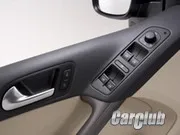
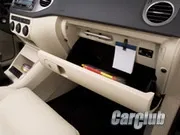
The interior greets us with a familiar picture — it has moved here unchanged from the Golf. And this is rather a plus, because the ergonomics and functionality here are top-notch. Eight air vents on the central console are adjustable in all planes, so the air flow can be set perfectly — this is a great help on a long journey. Many pockets, boxes, and pull-out drawers under the seats allow you to conveniently store a bunch of small items needed on the road. The only thing that bothers is the compartment with the ashtray and cigarette lighter: its lid flips from top to bottom, which is not very logical. Access to the cigarette lighter is difficult, and plugging in some device with a non-standard plug is a whole problem.
The quality of materials and assembly, as always, does not disappoint. The seats are comfortable, with a wide range of adjustments, so even very long trips will not be a burden.
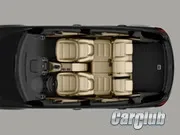
Rear passengers also feel at ease here. The bench can be moved forward and backward by 16 cm, and the backrest angle can be changed within 40 degrees. If you need to transport something bulky, the rear seats fold in a 2-to-1 ratio — then the car can accommodate an item up to 2060 cm long. The trunk with a standard spare tire holds 470 liters, and with the bench folded and without the "spare" — all 1500 liters. The Tiguan's payload capacity is 650 kg, plus up to 100 kg of cargo can be secured on the roof rails.
Let's talk about prices. The off-road version Track&Field costs the same as the urban Sport&Style, and both are available in two variants: the base one with a 1.4 TSI engine and a 6-speed manual — from 904,000 rubles, while for the 2.0-liter engine with an automatic you will have to pay 1,053,550 rubles. So the choice depends only on your preferences.
Already in 2009, front-wheel-drive versions of the Tiguan will appear, as well as an updated Common Rail diesel of 2.0 liters with piezo injectors, where the computer takes control of each injector, adapting to any driving mode. In the same year, you will also be able to order options such as park assist, bi-xenon headlights, rear-view camera, and an updated multimedia system with navigation adapted for Russia and a touchscreen.
If we formulate the result briefly and to the point, the new product from Volkswagen is the comfort level of a passenger car and almost unlimited potential both on asphalt and off-road!
Dmitry Malygin