
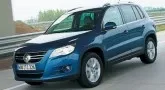
Compact crossovers have long become an integral part of the model lineups of almost all automakers, and some are just preparing to enter this segment. Sales of such cars are growing every year, and their number on the roads is constantly increasing. One of the fresh representatives of this class is an SUV from Volkswagen, which even at the concept stage bore the poetic name Tiguan.
Imagine: you are getting ready for a vacation. Your work jacket is sent to the far corner of the closet, your work phone is turned off, and your dress clothes are already in your suitcase. Your mood is upbeat, and the clock hands are inexorably approaching the moment when a taxi will pick you up. And then you discover that your passport, carelessly left on the sofa, has been torn to shreds by your pet. Real panic! It seems something similar happened at Volkswagen when they realized that the compact crossover segment was rapidly gaining momentum, and their own catalog had no such model. Without wasting time, German engineers turned the Concept A prototype into the conceptual Tiguan in less than a year and a half, and then into the production version. So what is this mini-SUV from Wolfsburg?
The company itself calls the new model nothing less than the younger brother of the Touareg, hinting at a common concept. However, kinship is also visible in the appearance of the two crossovers. Thanks to similar body shapes, the new Tiguan looks fit and composed. The "spirit" of the older model is felt mainly at the front: the same headlights and radiator grille as the Touareg are installed here. Other exterior elements are clearly borrowed from other models of the brand: the rear lights are like the Passat's, and the side windows are like the Touran's. Despite the mix of styles, the car is perceived as cohesive and harmonious. The only thing it lacks is the brutality of the Touareg: due to its smaller dimensions and perception features on our roads, the new model is unlikely to command the same "respect."
However, the designers managed to create an interesting optical effect: the Tiguan seems smaller than it actually is. Remember the cartoon where a cat climbed into a tin can, and its steps were heard for a long time? Well, here there is a similar optical illusion. In terms of dimensions and wheelbase, the Wolfsburg crossover is almost as good as its "taller" competitors, such as the Suzuki Grand Vitara. At the same time, the Tiguan is built on a modified platform of the fifth-generation Golf, which somewhat limits the space for rear passengers. However, two people of average build will be quite comfortable here. But a larger passenger is better seated in the front — it is noticeably more spacious there.
The driver's seat with a comfortable profile and wide adjustment options is excellent for long trips. At the same time, the interior evokes slight nostalgia. The familiar instrument panel with purple backlighting, the square gear lever, the funny round air vents, the three-spoke steering wheel — we have seen this somewhere before. All buttons are in their places, and you don't have to spend long figuring out the controls — beautiful! "Classics forever!" — that is the motto of the interior design. But there are also innovations, for example, a modern navigation and multimedia system on the center console. The interior trim deserves special mention: soft plastic, leather — all this creates a feeling of warmth and coziness.
The only thing that may confuse is the trunk. Or rather, the absence of a spare wheel in it: in the basic configuration, a sealant is provided instead. If you want to have a full-fledged spare tire at hand, you can install a space-saver spare wheel for an additional fee. But then the floor level will rise, and the trunk volume will decrease. In short, either conditional convenience (you won't go far on it anyway) or capacity (470–1510 l). This choice is offered in Europe, where sales have already begun. What will be in the base for Russia is still unknown.
It also remains a mystery which modifications will appear on the Russian market. Of the five possible options, two were provided for the European test drive: with the weakest gasoline engine — a 1.4-liter TSI (150 hp), and the only diesel so far — a 2.0-liter TDI (140 hp). The diesel version with a 6-speed automatic became the first "victim." It is pleasant to realize that there is always a reserve of power under your foot for overtaking a truck or a sharp start. And no wonder: the maximum torque of 320 Nm is available in the working range from 1750 to 2500 rpm. No turbo lag, no delays in shifting. The gasoline Tiguan with a 6-speed manual also performed well. It is just as agile during acceleration and allows for quite dynamic driving. The pickup starts from the very bottom — the peak torque of 240 Nm occurs at 1750 rpm. I also liked the engine's elasticity: in sixth gear, the car calmly drove at 50 km/h, and in second gear, it could move at about 80 without much noise. I only had to get used to the long-travel clutch pedal, but that also turned out to be a matter of a few minutes.
The car handles as if it were not a crossover but the same Golf. The steering wheel with electric power steering does not require excessive precision (only 2.6 turns from lock to lock), but its informativeness is beyond praise. Moreover, the effort on the steering wheel changes depending on speed.
The stiff suspension caused mixed impressions. On the one hand, softness and rocking are not needed for a dynamic car. But the fact that even the slightest joints in the asphalt are felt in the cabin somehow does not fit the image of a city car, albeit an all-wheel-drive one. Moreover, this is characteristic of the Tiguan not only in the "charged" Sport & Style version but also in the more utilitarian Trend & Fun and Track & Field.
In our opinion, the VW Tiguan has every chance to seriously compete with the current leaders of the compact crossover class. Russian sales will start approximately in the spring of next year. The price has not been announced yet, but according to company representatives, the car will cost in the range of $30–40 thousand.
Driving
A dynamic and obedient city car. In terms of handling, the crossover resembles an ordinary passenger car more than an SUV.
Interior
Quite spacious, with pleasant trim materials. Large trunk volume.
Comfort
Comfortable seats, ergonomic interior, and good sound insulation. The suspension is overly stiff.
Safety
Tested by Euro NCAP. The result is "excellent"!
Price
Not determined.
| Dimensions, mm | 4427x1809x1683 mm |
| Engine | diesel, 1968 cm3, 140 hp/4200 rpm |
| Transmission | automatic, 6-speed |
| Dynamics | max 186 km/h; 10.4 s to 100 km/h |
| Competitors | Suzuki Grand Vitara, Toyota RAV4 |
Pros and cons
+ Stylish appearance, comfortable interior, excellent handling and agility.
- Stiff suspension, as well as a clutch pedal with a long travel in the car with a manual transmission.
Our verdict
Judging by all parameters, this car is quite capable of competing with the leading market players. If the manufacturer manages to keep the price of the VW Tiguan at the stated level, then the prospects for this compact crossover in Russia look very promising.
© 5 Koleso