
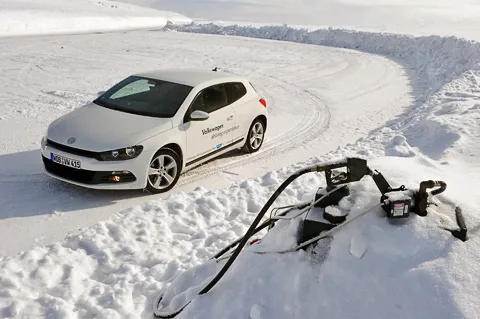
The reason is simple: the event was almost closed and was arranged specifically for the Russian press. European journalists were shown the car last year, while for us, a familiarization was organized as part of the driving program of the Volkswagen Driving Experience school.
Why such selectivity? The thing is that until recently, the Scirocco was not planned for the Russian market. But there was a person in the representative office who convinced the management that such an image model is simply necessary for the brand in our country as well.
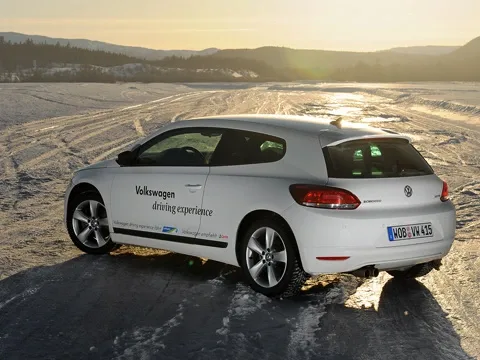
However, we had already heard a lot about the car itself. The Scirocco is a striking, dynamic, and completely impractical variation on the Golf theme. No matter what you call it, the car doesn't stop being attractive. Murat Gunak, who was then the chief designer of the concern, worked on the appearance. But in 2007, he was replaced by Walter de Silva, and the production version, which almost exactly replicated the IROC concept, was already ready. However, one of the first orders of the new boss was a demand to redo the front part, because, in his opinion, it did not fit into Volkswagen's philosophy.
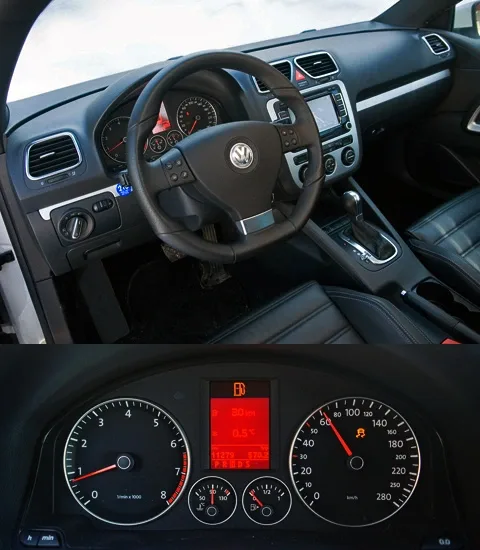
The interior is the area where they saved without a twinge of conscience. The Scirocco's equipment is poorer than the Golf GTI's. The base version lacks an auto-dimming mirror, rain sensor, large display on the instrument panel, and fog lights. The cup holders lost their cover, and aluminum inserts were replaced with plastic. However, the climate control got an automatic recirculation function, and the options list added new-generation navigation and a panoramic roof. True, the sixth-generation Golf GTI, which will reach us by the end of the year, will have almost all of this too.
The order was carried out. Thus, the Scirocco became the firstborn with the new corporate style that de Silva developed together with Klaus Bischoff and Sergio Manzoni. And it looks, admittedly, magnificent! The chrome "mouth" disappeared, but now the car unmistakably reads as a Volkswagen. De Silva often repeats that the main thing in design is proportions. Well, here they are in perfect order. And in bright green and on 18-inch wheels, the Scirocco looks simply stunning!
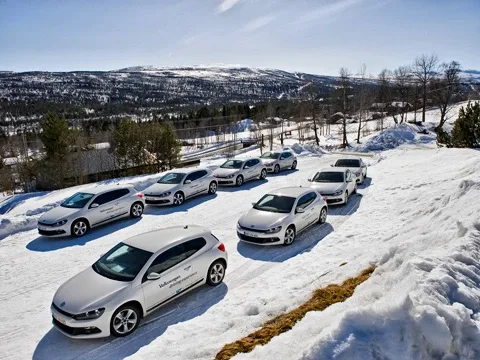
White remained the most sought-after color for the first two generations. Most likely, it will continue to be so. All the cars in the parking lot were white and with identical powertrains — a 200-horsepower TSI and a six-speed DSG robot. Plus narrow studded tires. For us, an alternative is offered in the form of a 160-horsepower 1.4 TSI with a manual gearbox or a seven-speed DSG. There are also a 122-horsepower version with a single turbocharger and a 140-horsepower diesel. But they will not reach Russia.
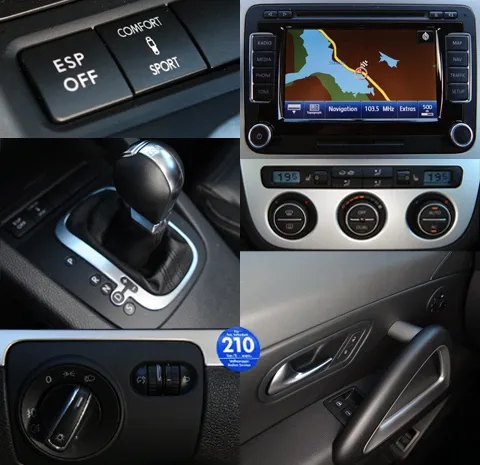
- The only design touch — the shaped door handles — is made cheaply and therefore looks alien. The front panel is borrowed from the Eos convertible, but with nicer deflectors. And this is also a trick for the sake of economy: the fifth-generation Golf has already been discontinued, while the Eos is still in production.
- An interesting detail: the instrument lighting, like in the sixth-generation Golf, is now white, but the climate control screens still glow purple.
The 200-horsepower Scirocco for Russia will be available exclusively with DSG. Why did they abandon the familiar manual? The sales statistics of the fifth-generation Golf GTI are to blame: I, for example, chose the version with a manual gearbox, but the vast majority of buyers preferred the robot.
But DSG is also an excellent option! For everyday driving in the city and on the highway, it's just the thing. On regular roads, the Scirocco with such a transmission goes no slower, and any overtaking is done without any effort. At the same time, you can move quite smoothly: just move the selector from S to D. For a sharp start, launch control is provided. You press the brake, simultaneously rev the engine to four thousand rpm (the electronics won't let it go further), release the pedal — and off you go!
The engine (note, despite similar indicators, this is not the one that was on the fifth-generation GTI) is very good. The roar is cheerful, although the Golf GTI, in my opinion, sounded more solid, the thrust is confident from the very bottom, and at the top there are small but rich pickups. The TSI causes no trouble either with fuel economy (7.6 liters per 100 km in the combined cycle) or with character!
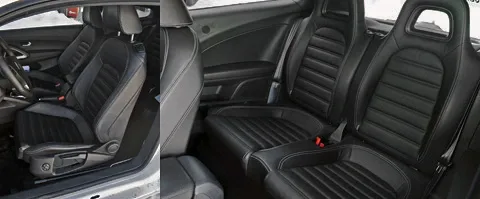
The driving position is almost perfect and very low. The front seats are slightly less contoured than in the Golf GTI. As a "gift" with the leather interior — heating and electric adjustment of the lumbar support. Full electric adjustments are only for the driver's seat.In the back, there are two separate seats. A bit cramped compared to the Golf, but there is lateral support — passengers won't be thrown from side to side in corners.
In sport mode, the DSG downshifts with rich rev-matching. There is also a manual mode with convenient paddle shifters, and you can engage it without touching the lever: just press the paddle once, and the "temporary manual mode" activates.
Usually, I don't use manual mode on cars with automatic transmissions. First, shifts still happen with a delay, and second, I simply forget which gear is currently engaged. With the Scirocco, the situation is not much better: the pauses, although minimal, but the gear number is displayed as a tiny digit on the onboard computer screen (when will they make a separate display for this?). However, for the fastest acceleration, there is kick-down: you press the pedal to the floor, and the gearbox itself selects the desired gear. This is convenient.
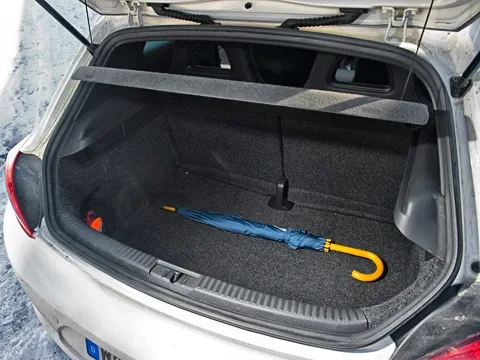
The trunk volume — 312 liters — is not much less than the Golf's. But the opening is narrow and high.
But the fact that when reaching maximum rpm, the DSG itself shifts up is not always good. And yet, having decided to indulge in manual mode for five minutes, I never left it until the very end of the trip — to a frozen lake on a high-mountain plateau. And upon arrival, I pondered for a long time what I would choose — DSG or a regular manual. And I still, by the way, haven't decided. Well, thank you to the Volkswagen folks for the pleasant torment.
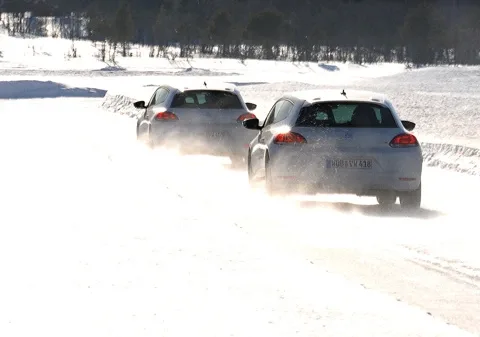
The ice driving itself wasn't particularly thrilling. Yes, the track is quite large, with turns. But we drove in a column behind the leader. That is, not too fast. But immediately the main difference between the Scirocco and the Golf GTI showed up: the stability control system (now the sensors are located directly in the control unit) cannot be turned off here!
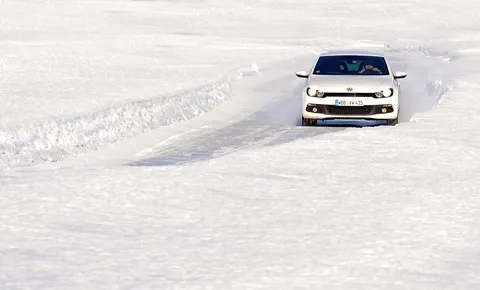
The chassis was tuned based on the GTI. And the suspension layouts are fundamentally the same. But there are differences: the Scirocco has a lower center of gravity and a wider track — by 35 mm at the front (1569 mm) and 59 at the rear (1575).
The power steering is tuned differently. The steering wheel itself seems a bit heavier, and most importantly, the return force is stronger. The steering angle sensor was moved to the housing of the drive gear, not on the steering column (which, by the way, is also new and stiffer). And all this makes the effort more believable. But these are nuances that are hard to feel. And the Golf's electric power steering was also one of the best.
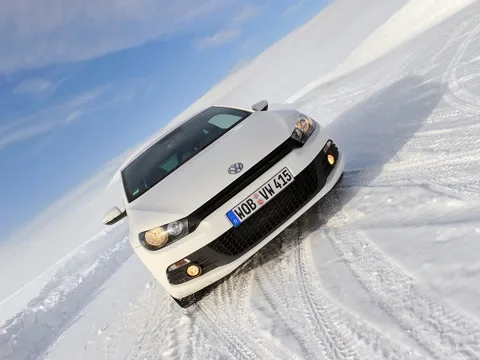
Another new feature is electronically controlled Ohlins shock absorbers. In Sport mode, the car follows the road profile much more actively than the GTI: on wavy surfaces, you drive as if instead of shock absorbers there are miniature jackhammers. But in comfort mode, there are more opportunities to play with weight distribution — when you lift off the gas, the car more readily oversteers.
By the way, about oversteer. The Scirocco loves it. It goes sideways — just hold on! The gearbox also pleases. The connection between the engine and the wheels is, so to speak, direct, so throttle inputs cause a quick and unambiguous reaction. There's no limited-slip differential here, as there wasn't before, but nevertheless, a perfectly balanced chassis! If only the ESP could be turned off completely...
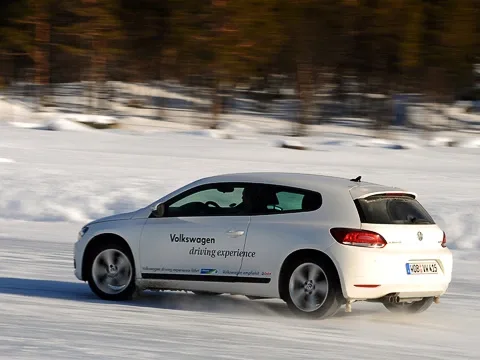
However, even when fully on, the system allows small but prolonged slides. And in the half-off state, it wakes up either during sharp actions or when correcting a slide with the steering wheel. As soon as the steering wheel passes the zero position, the brakes briefly grab the wheels, and the car stabilizes. On the Golf, I recall, the ESP cut the driver out of the control process for a longer period, and if it activated, it activated
And yet, it's sad that the system doesn't turn off completely, since the car is supposedly sporty. And the chassis balance is tuned to the micron, in the Volkswagen way. And ahead — there are still hundreds of kilometers.
And yet, it's sad that the system doesn't turn off completely, since the car is supposedly sporty. And the chassis balance is tuned to the micron, in the Volkswagen way. And ahead — there are still hundreds of kilometers.
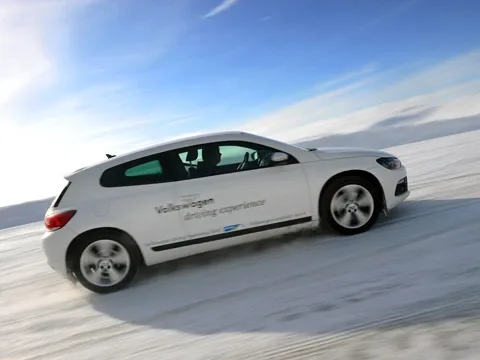
Norwegian roads are a constant surprise: you drive on dry pavement, and before a turn — bam! — bare ice. Or on a curve, just as you start to exit it. It's especially treacherous when you least expect a trick.
The surface is generally pleasing — I never saw any potholes, but I often came across strange "speed bumps in reverse": low but fairly deep ditches cutting across the road. The suspension handles them masterfully: you expect a jolt, tense up, and there's nothing. Braking is also impressive — even if you slam the pedal in a sharp bend, the trajectory doesn't change. But if you deliberately lift off the throttle, the car easily slides into a drift. How did the engineers manage to combine such behavior?
You climb higher onto the plateau, and asphalt becomes rare — only snow walls around. We're not crawling, though: on straights we confidently hold 120 km/h, and corners are taken with a slight slide. Here you understand what to thank the stability control system for, which can't be fully switched off. It's your insurance: you enter a turn sideways, and if something goes wrong, you throw the wheel to "zero," and the electronics pull you out of trouble.
A snow-covered gas station is a true oasis for those running low on fuel. Regular gas stations are hard to find here. You stop — and can admire the scenery.
And the views, let me tell you, are something else. A sight to behold! The only downside is the cold: minus 12 degrees. By the way, in this photo you can spot two small houses if you look closely.
And such beauty stretches for hundreds of kilometers. Pure delight! No wonder Volkswagen Driving Experience chooses the mountains of Sweden and Switzerland, the deserts of Morocco, Tunisia, and Namibia for its events. In such trips, the main thing isn't the instructors' lectures on how to properly enter a corner or drive a Touareg in the Sahara. Far more valuable are the impressions you take with you.
After about a hundred kilometers, the "cosmic" mountains give way to ordinary ones. Then — two very long spiral tunnels. You enter — and drive about three kilometers with the wheel cranked, practically blind. Solid rock all around, almost no lighting, and after bright sun, your eyes only adjust to the darkness right at the exit.
Another tunnel — and you're on the fjord shore. Incredible beauty! And warm: the onboard computer shows plus six, sometimes even eight degrees. Too bad the car is all dirty after our joyrides. That's why we don't show it in the photos.
However, near the ferry crossing, the road was blocked — they said wait until noon. We didn't waste time: we dashed to the nearest town, washed the car with a hose at a local service station…
…and retook the shot.
Then the most interesting part began — both in terms of roads and views. So I'd like to leave a couple of photos without any comments at all.
And one more — even without the car.
And what about the Scirocco? This thousand kilometers became nostalgia for my old Golf GTI. If I had to describe the car in one word, it would be "excellent." And, unlike the Golf, the Scirocco doesn't leave the feeling that you've been playing a computer game. It's livelier and less sterile. True, it's also more expensive: the base version with the 160-horsepower engine and manual costs 939 thousand rubles, and for the 200-horsepower version with DSG you'll have to shell out at least 1,148,000.
And yet it's not the price — the main reason the Scirocco won't become my dream car. The stability control system that can't be turned off, an interior simpler than even the previous Golf GTI, and only front-wheel drive. But Volkswagen has an answer to these complaints — if the Scirocco Studie R concept with a 270-horsepower engine, all-wheel drive, and a refined cabin goes into production. That would be the right Scirocco. On any roads.
Specifications
Tech
The two-liter TSI of the AE888 series is a completely new unit. It was created based on the 1.8 TSI turbo engine, increasing displacement through a longer piston stroke. Unlike the engine of the previous Golf GTI, the cylinder block here is cast iron, not aluminum. But the engine itself is more compact and even slightly lighter.
The Scirocco is built on the Golf platform, so the suspension layouts essentially remained the same, but the track became noticeably wider. Changes also affected steering, electronics, and safety: pedestrian protection requirements were considered during design.
History
The first-generation Volkswagen Scirocco debuted in 1974, replacing the Karmann Ghia coupe. The car was built on the components of the "first" Golf, and the famous designer Giorgetto Giugiaro participated in its development. The suspensions were unified with the Golf's: McPherson struts in front and a semi-independent beam in the rear. The base engine was a 1.1-liter inline unit, while more expensive versions were equipped with 1.4, 1.6, and 1.7 engines. Over seven years, half a million units were produced.
The "second" Scirocco came out in 1982, was produced for ten years, and sold over 290 thousand units. It was based on the components of the second-generation Golf, from which it inherited engines — for example, the 1.8 with 139 hp from the GTI version. By the end of its career, the Scirocco received a two-liter sixteen-valve engine with 150 hp.
The rightful successor to the "second" Scirocco is considered the Corrado, which debuted in 1987. This model took the front suspension from the second-generation Golf and the rear from the Passat B3. The powertrains of the Corrado were noticeably more serious than its predecessor's. The base engine was a 1.8-liter producing 136 hp, and the top ones were two V-shaped six-cylinder VR6 engines: a 2.8-liter with 12 valves (174 hp) and a 2.9-liter with 24 valves (190 hp). Additionally, there was an interesting G60 modification with a 1.8-liter supercharged engine producing 160 hp. However, the Corrado failed to repeat the commercial success of the Scirocco: due to its high price, only 97 thousand units were produced by 1995.
Design
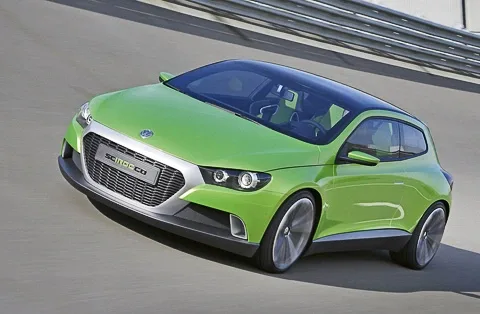
In 2006 at the Geneva Motor Show, the public that came to the Volkswagen stand froze in amazement: before them stood a bright green "monster," openly hinting at what the production third-generation Scirocco would become. The car's appearance was worked on by a team led by Murat Günak. At the same time, a similar front-end design was also predicted for the "sixth" Golf.
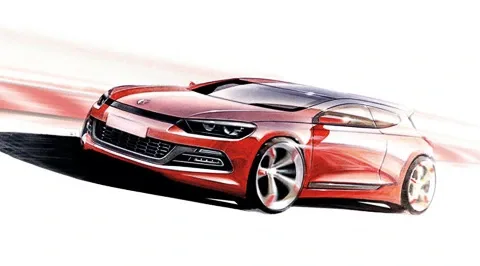
But Walter de Silva, who replaced Günak, professed a different philosophy: a mass-market car must remain simple. Therefore, when building the new corporate style, de Silva looked to examples like the first-generation Golf (by Giorgetto Giugiaro) and the fourth generation.
What's next?
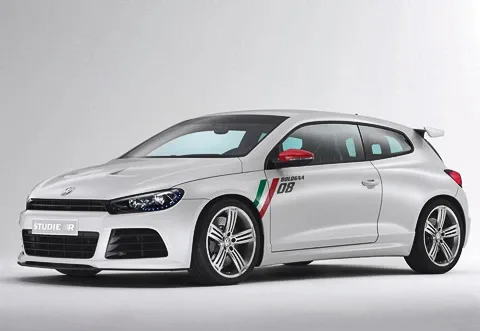
The title of the most powerful Scirocco version didn't stay with the 200-horsepower variant for long: already in 2008 at the Bologna Motor Show, the Scirocco Studie R concept was shown — with a two-liter 270-horsepower engine and all-wheel drive. All that remains is to wait for its production appearance.
Behind the scenes
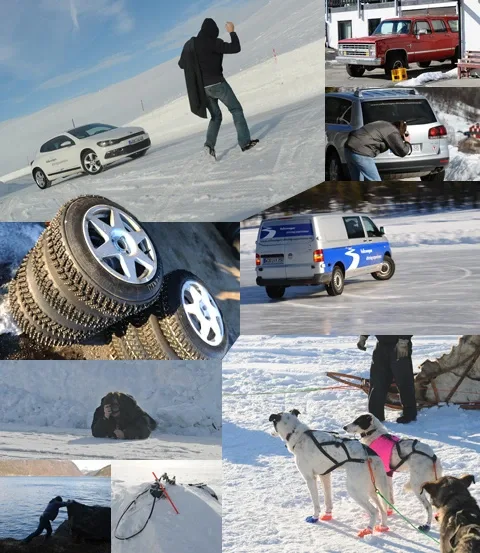
Norway is a stunningly picturesque country (you've already seen it in the photos). At the same time, in a state whose population is half of Moscow's, speeding is subject to truly harsh penalties. However, when there's such beauty around, the desire to speed doesn't even arise.