
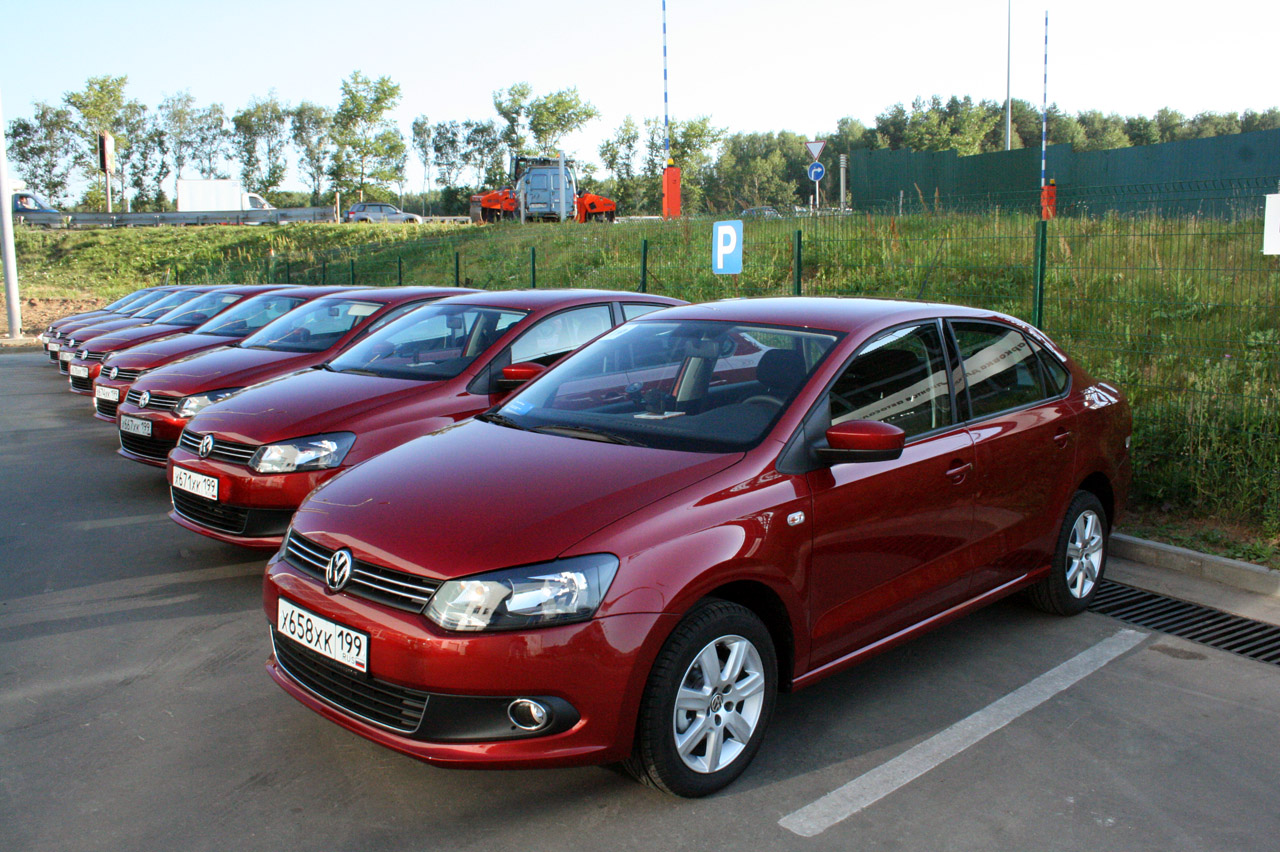
 The main paradox of the Volkswagen Polo Sedan is that buyers, accustomed to modern German cars and charmed by its impressive appearance, expect from a budget model the comfort and dynamics of a "Passat" level, forgetting that the price starts from 400,000 rubles. And perhaps this is precisely the best praise for its merits. Comments
 Winning the sympathy of the general public is not an easy task. Creating a mass-market, inexpensive car that, despite all concessions and compromises, manages to be likable, is not something every engineer, designer, and marketer can do. And yet, it is precisely such cars that form the basis of automakers' profits, not futuristic supercars or exclusive models. After discussing new products from the world of supercars and concept cars, conversations in the smoking room inevitably come down to the practical question: which car to choose for yourself.
And choosing that very one, the only one, is even harder. Everything matters here, and every little detail can be decisive.
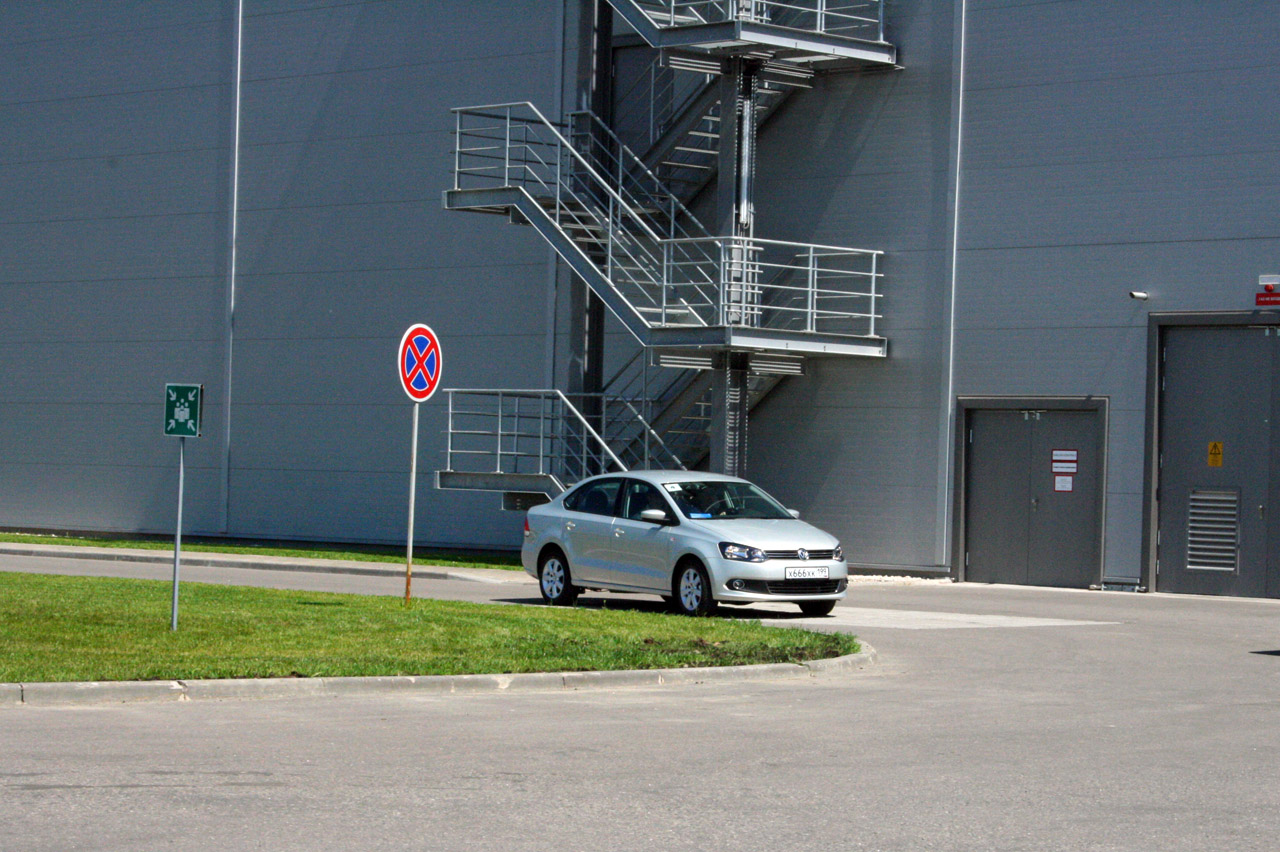 |
| While Volkswagen was polishing the handling and price of the compact Polo hatchback and creating the elegant lines of the Passat CC, Renault, Peugeot, Korean and even Chinese brands had already established themselves in the budget segment, and the name "Volkswagen" had long lost its connection with its original meaning — people's car. |
While Volkswagen was honing the driving qualities and price tag of the compact Polo hatchback and sketching the graceful forms of the Passat CC, Renault, Peugeot, Koreans, and even Chinese brands had confidently entrenched themselves in the affordable segment, and the brand "Volkswagen" has long ceased to be associated with its original meaning — "people's car".
However, VW has an ace up its sleeve that can make up for lost time — the new inexpensive Polo sedan. And judging by the hype among potential buyers, the chances of success are considerable.
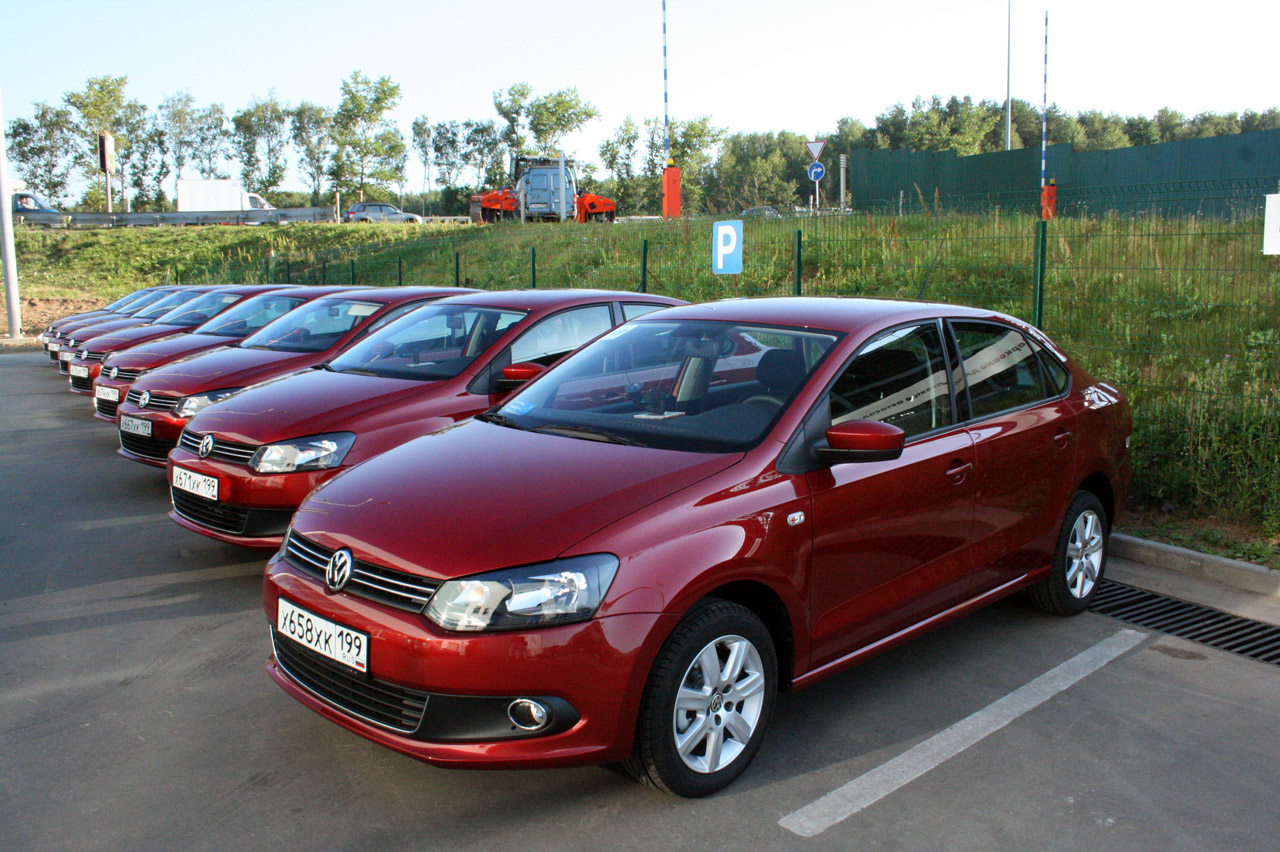 |
| VW has a trump card with which it can win the delayed game - the new budget Polo sedan. And judging by the interest of the potential audience, the chances are high. |
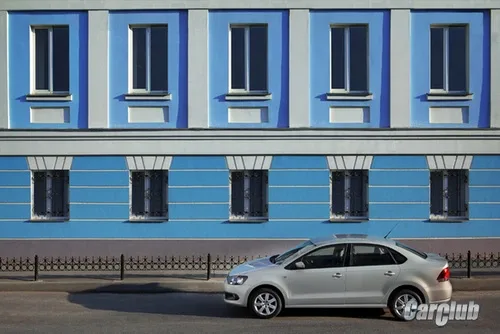
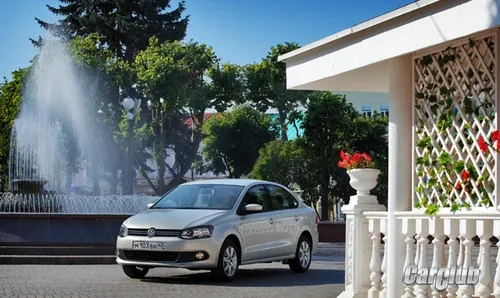
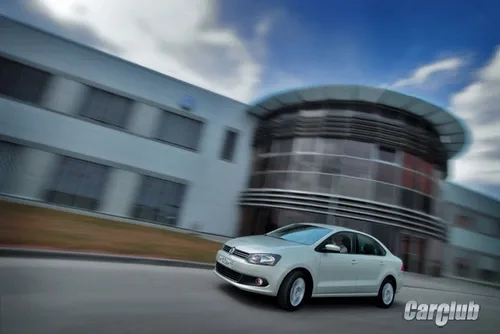
Usually, designers working on affordable sedans for the Russian market choose one of two paths: either a smooth, faceless image, or deliberate pretentiousness. Neither is impressive. Against this background, the Polo sedan, at first glance, stands out in no way: at the front — the familiar face of the stylish Polo hatchback, at the rear — a silhouette in which the Skoda Octavia is recognizable. Perhaps this is precisely where its charm lies: the Polo Sedan is the most attractive and respectable car in its class. It looks impressive, harmonious, restrained, and elegant. The "Polo" not only seems more expensive than its classmates — it gives the impression of a car from a higher category.
 |
| The Polo Sedan is the most beautiful and solid of all models in the segment. It is impressive, harmonious, laconic, and stylish. The "Polo" not only looks more expensive, it seems like a representative of a different class. |
Perhaps that is why you expect a lot from it, and expectations are not always met... But let's take things in order!
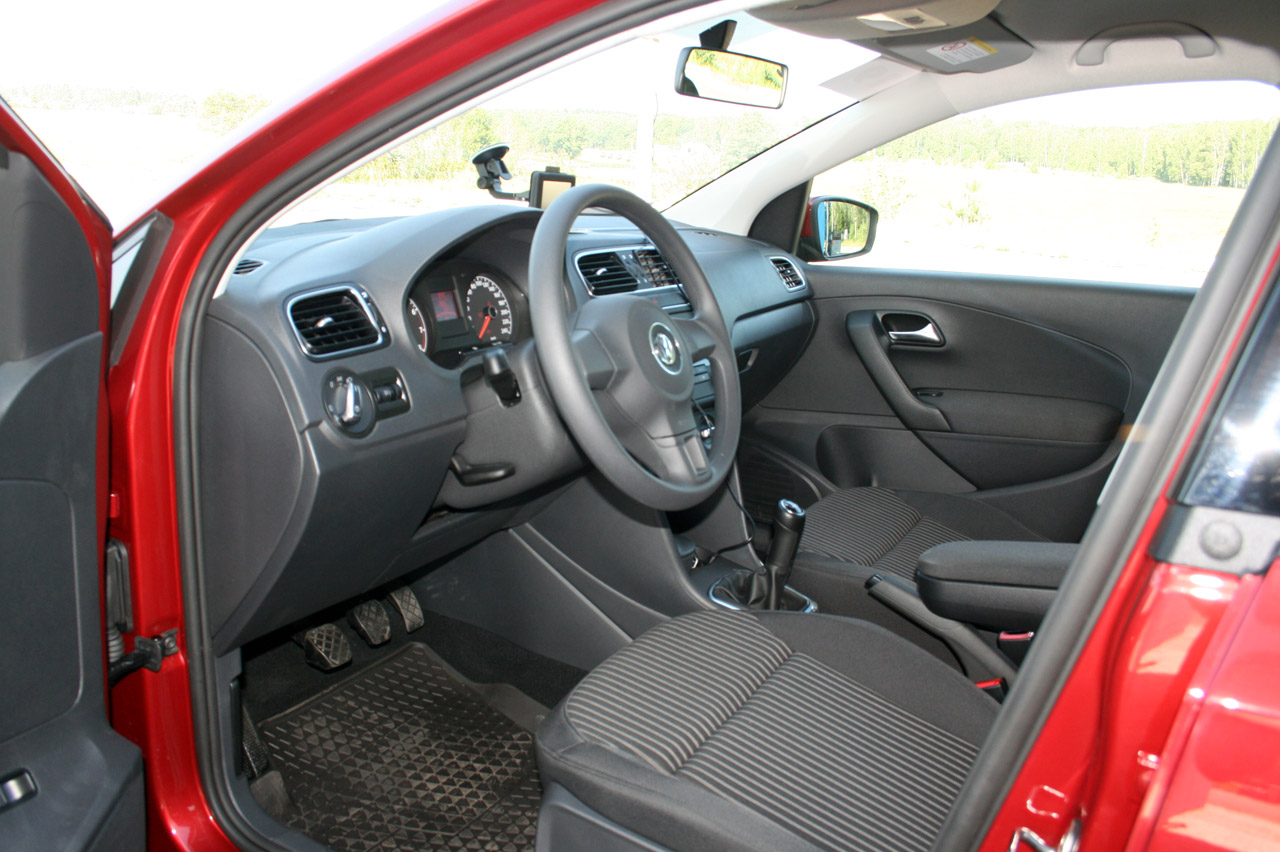 |
| At first, it seems that the interior is an exact copy of the stylish interior of the expensive hatchback with the same name, which became the basis for the new sedan. But upon closer inspection, you notice inexpensive hard plastic, a slippery plastic steering wheel without buttons for controlling the radio, and a lack of decorative elements. |
Take, for example, the interior. At first glance — a carbon copy of the stylish interior of the not-cheap hatchback with the same name, on which the sedan is based. But as soon as you look closer, you notice hard cheap plastic, a smooth plastic steering wheel without radio buttons, a lack of decorative details, and the sound of the closing door is completely different.
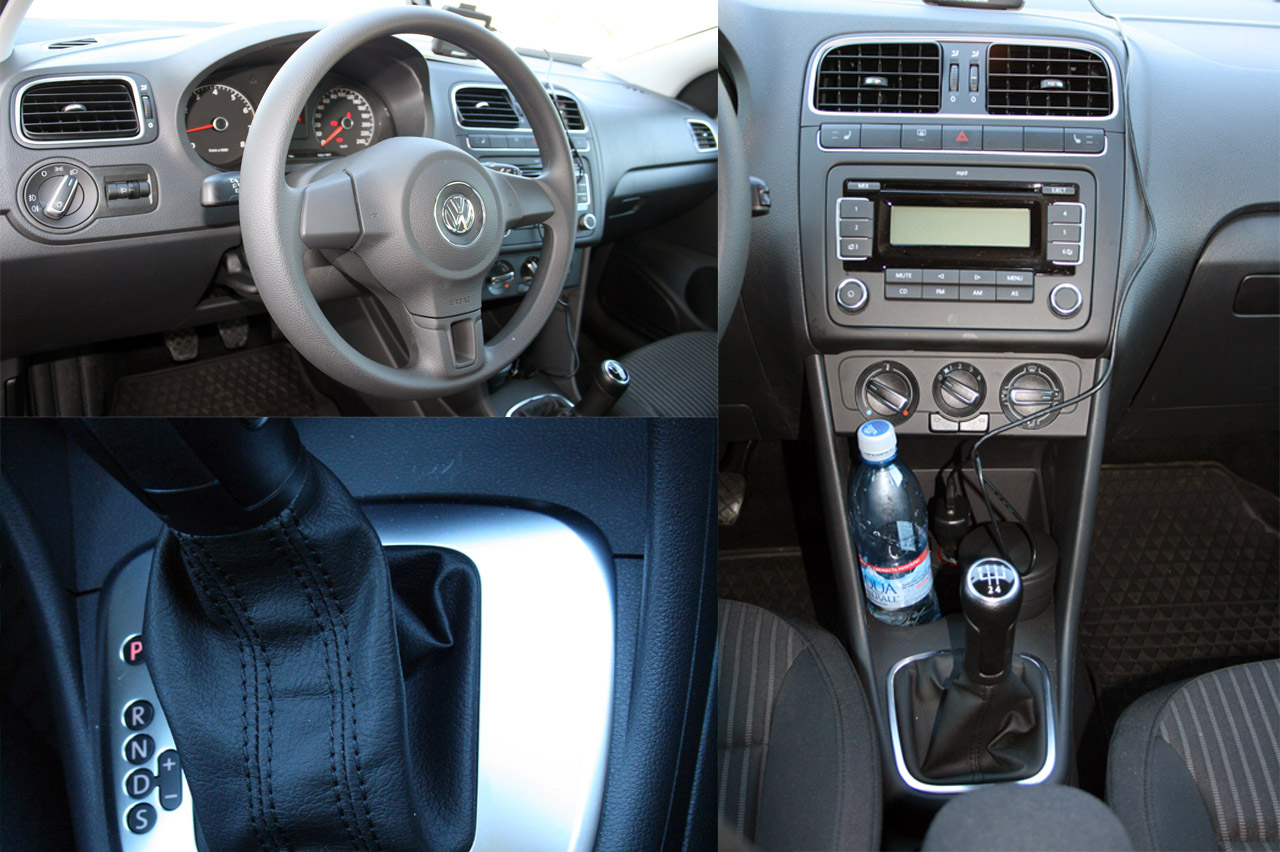 |
The difficulty is that from a car that is almost as large as the Jetta (the sedan's length is 4384 mm, width — 1699 mm, height — 1465 mm, making it the largest in its class), you expect an interior of an appropriate level. But in reality, the Polo Sedan should be compared with competitors — Renault Symbol, Peugeot 206 Sedan, Hyundai Accent, and others. And here the comparison is clearly in favor of the "German".
 |
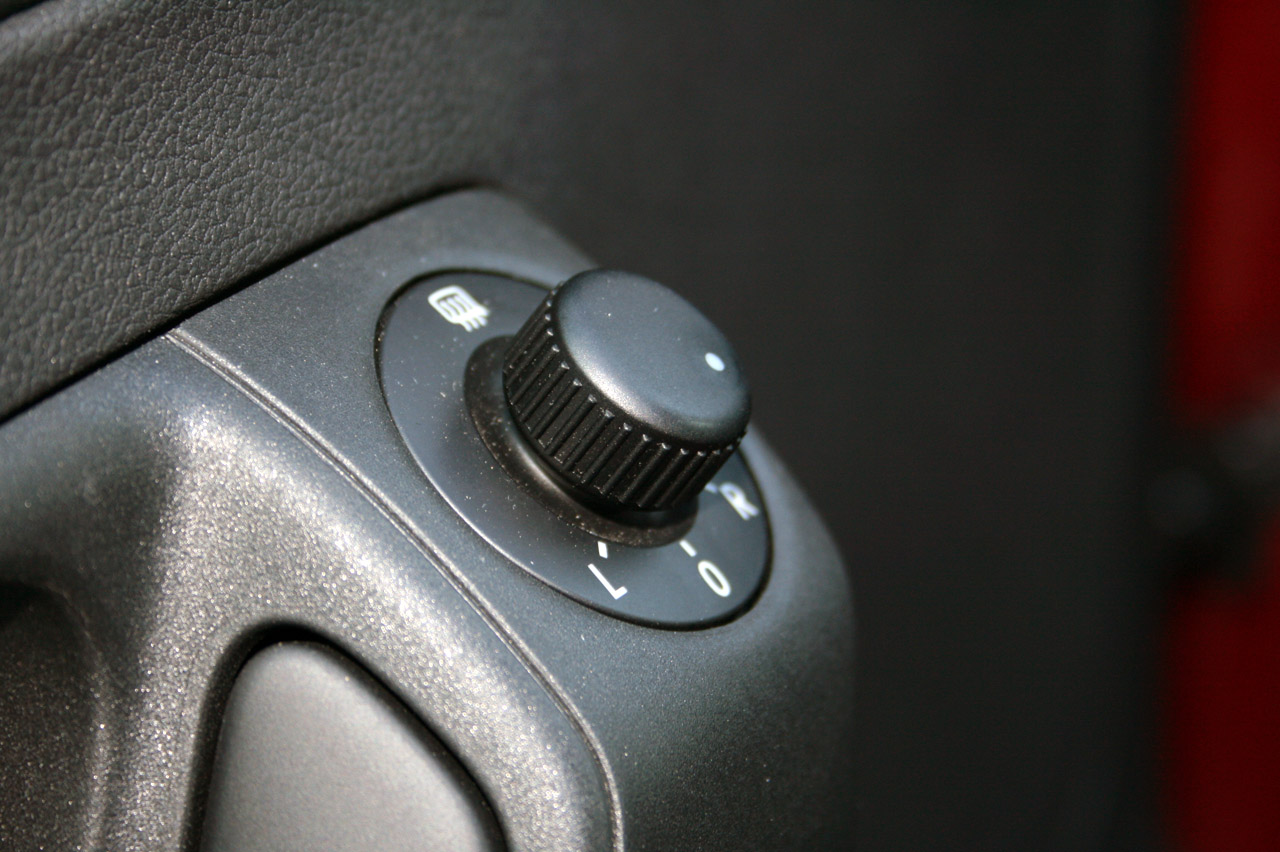
The organization of space in the glove box is well thought out — there are compartments for various small items. There are also cup holders, and in the doors — pockets for bottles. The central console and gearshift lever are decorated with metal inserts. The signature "family" shortcomings remain: the inconvenient joystick for adjusting the electric mirrors and the armrest that interferes with reaching the handbrake — these solutions were clearly born in a fit of anger at the whole world.
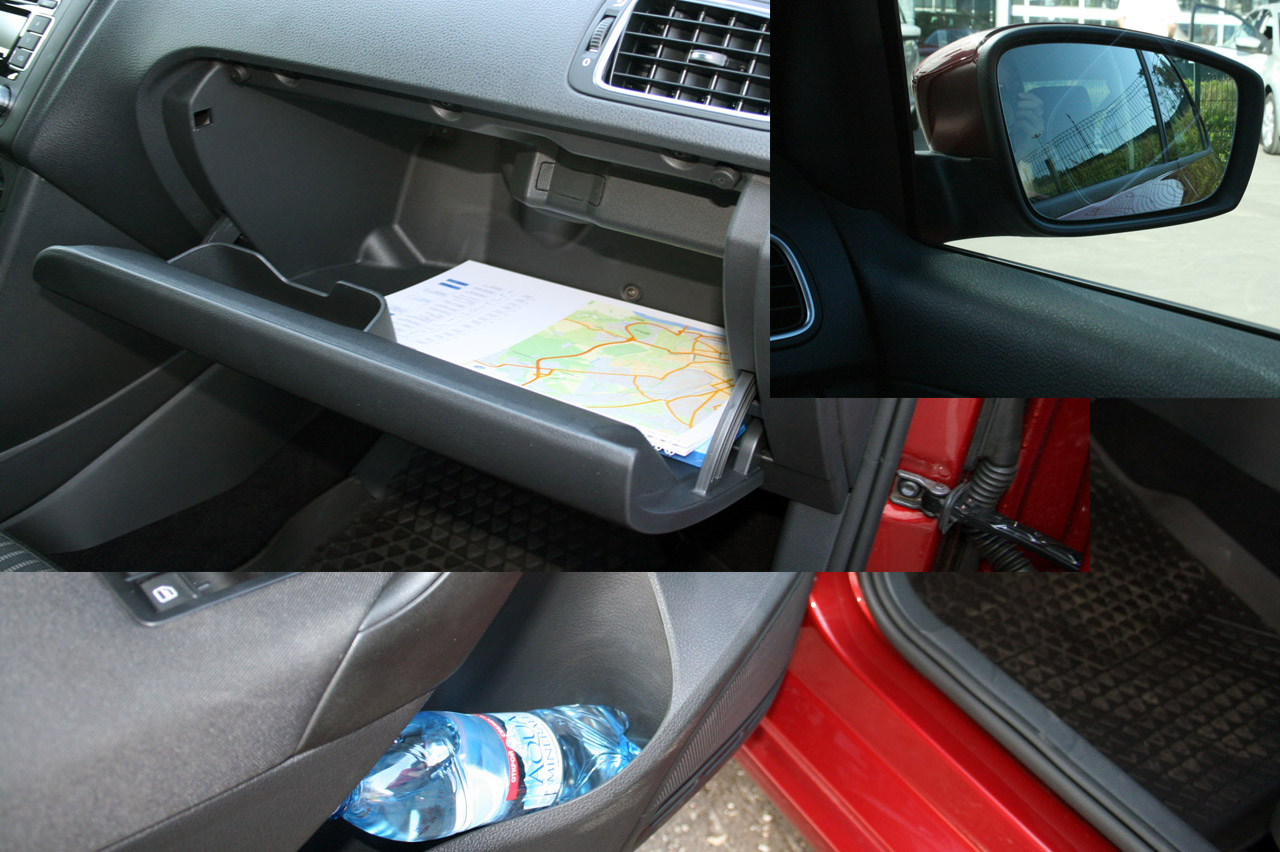 |
| The space in the glove box is excellently organized — with compartments for various things. Cup holders and bottle pockets in the doors are provided. |
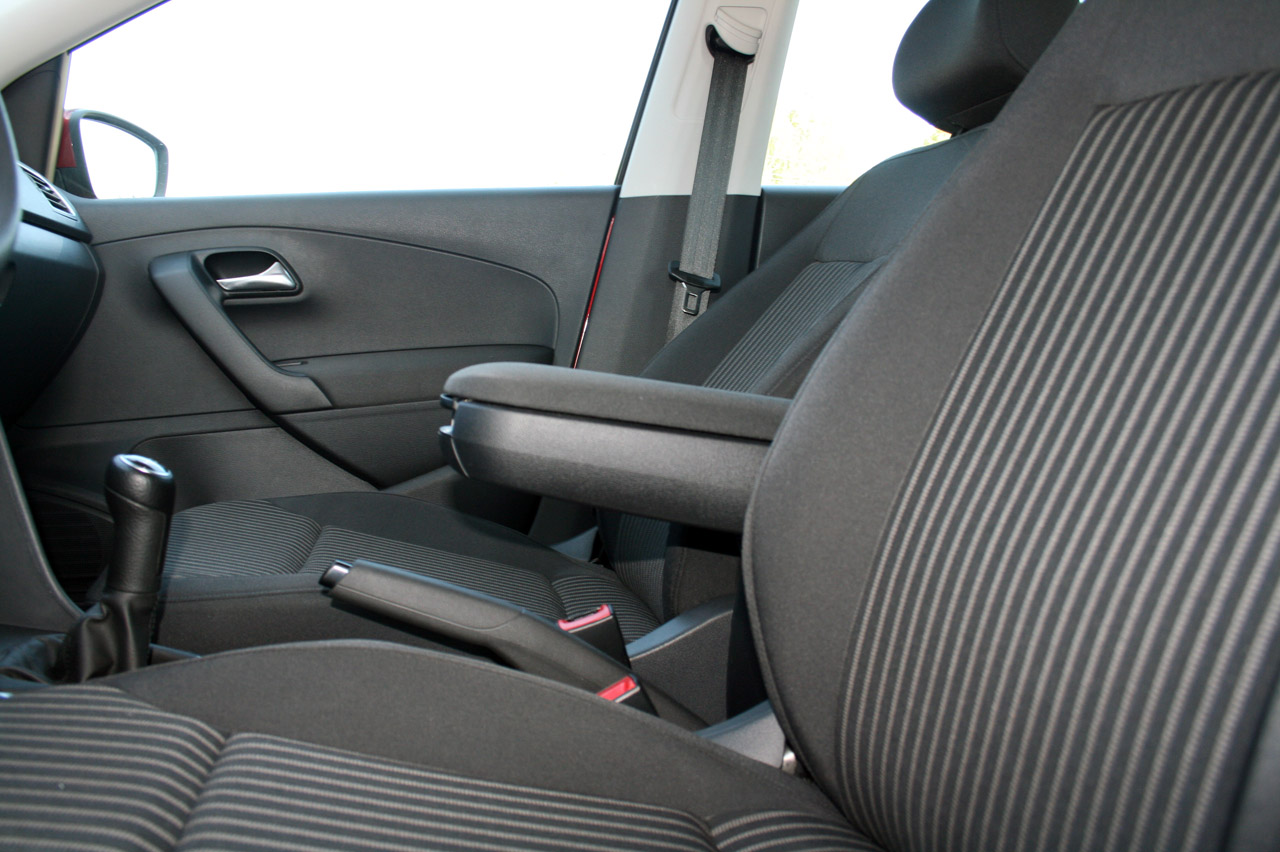 |
| The armrest, which covers the handbrake, was clearly invented by someone in a moment of resentment towards the whole world. |
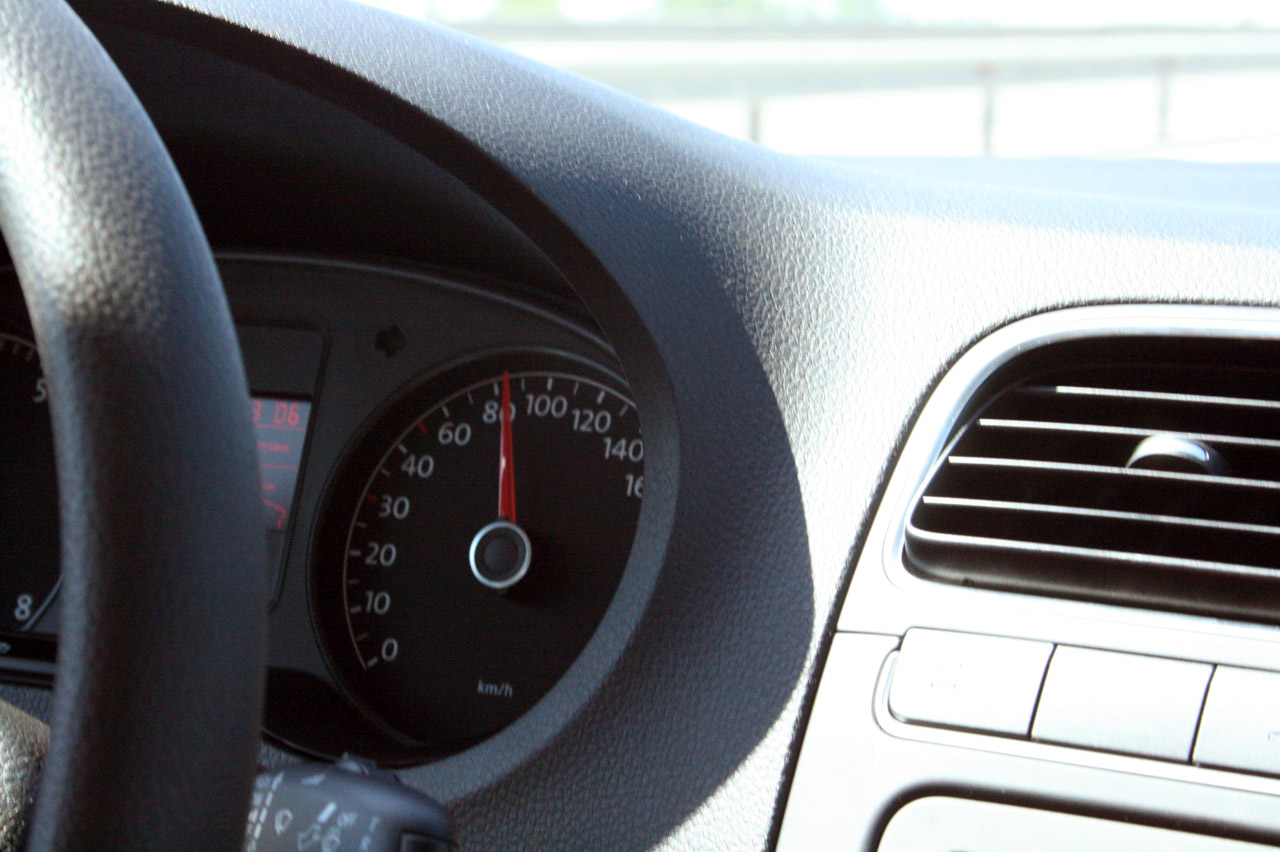
Otherwise, the ergonomics of the interior are excellent: neat assembly, comfortable seats with good lateral support and height adjustment, a steering wheel of the correct diameter with adjustment in two planes, and well-readable, albeit faceless, instruments. Between the speedometer and tachometer — a window for the on-board computer with an electronic fuel level indicator and other useful information.
 |
 |
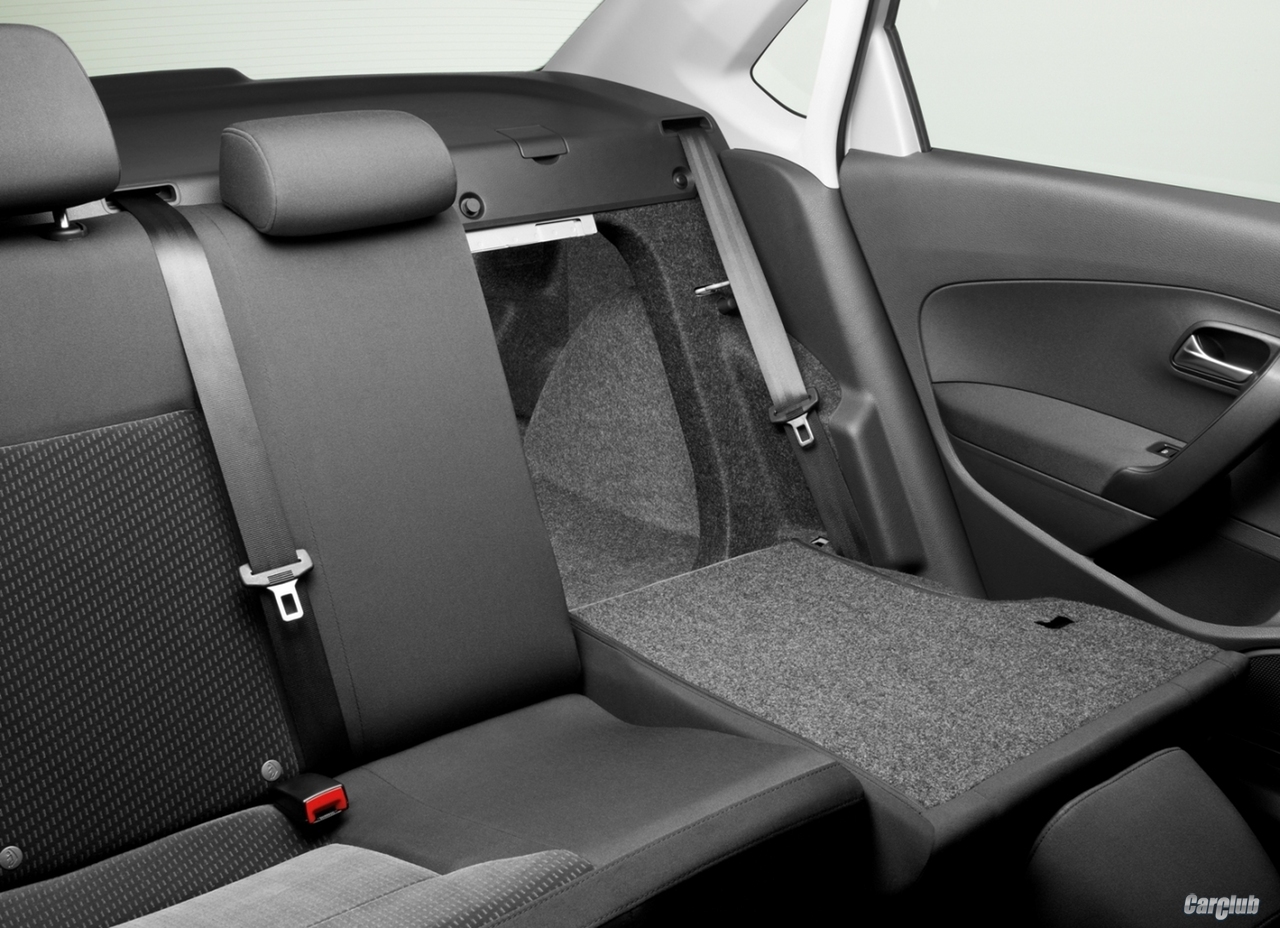
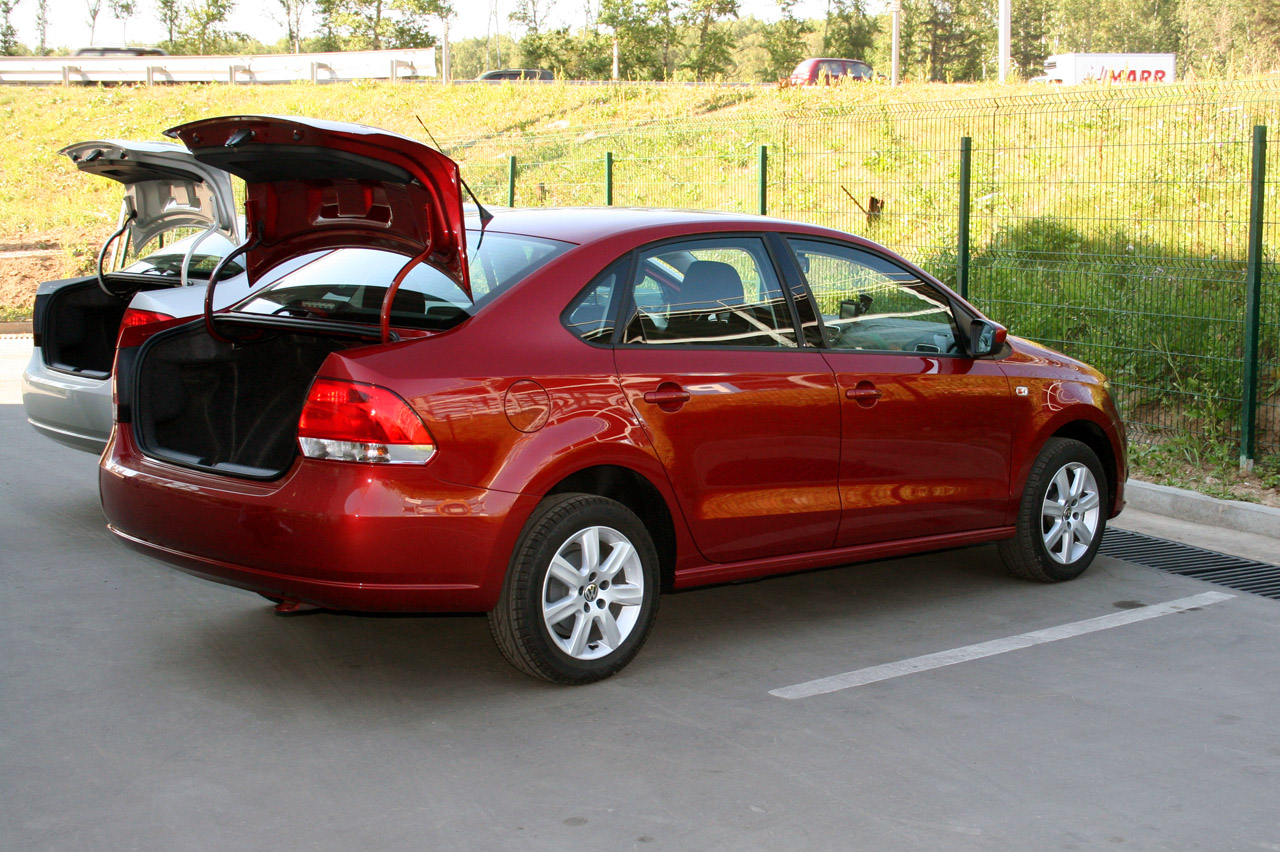
In the back, the space is again a class higher: there is enough room for legs, and it's not cramped in the shoulders, the only thing is that the ceiling is a bit low — at the level of an inexpensive sedan. The trunk holds a solid 460 liters. The seats fold down to an almost flat floor, noticeably increasing cargo space. The trunk lid opens with a key or a button from the cabin. Inside, the metal is covered with neat fabric upholstery.
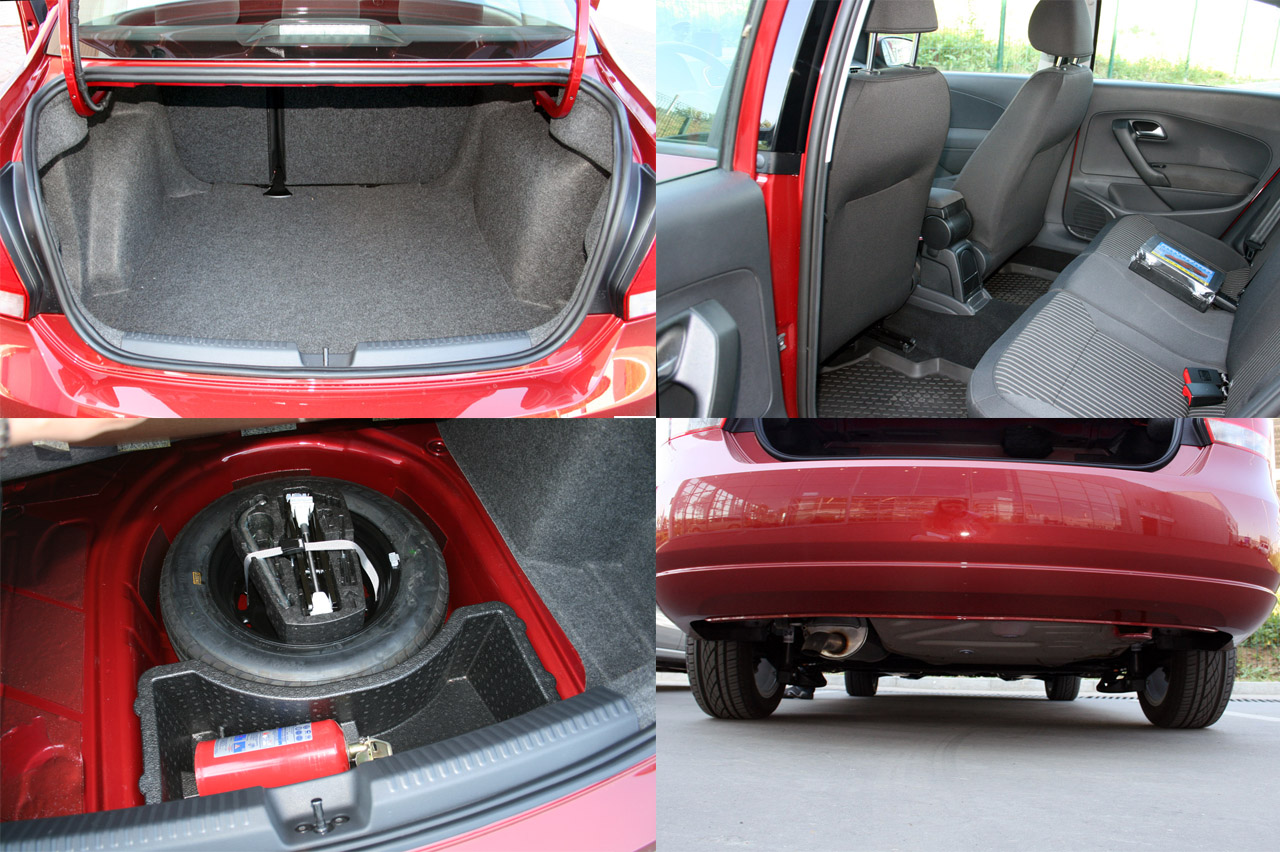 |
| The trunk volume is a significant 460 liters. The seats can be folded almost to a flat floor, significantly increasing loading space. The trunk opens with a key or a button from the cabin. In the back, there is again space a class higher: there is room for legs, and it's not cramped in the shoulders, except that the ceiling is a bit low — at the level of an inexpensive sedan. |
The presentation of the Polo sedan took place in Moscow on June 1, where it was announced that the new model would be assembled at the Volkswagen plant in Kaluga using a full cycle. Therefore, for the first test drive of the Polo Sedan, we headed to Kaluga. A convenient opportunity: both to test the car and to see the plant where Russian VW sedans are born.
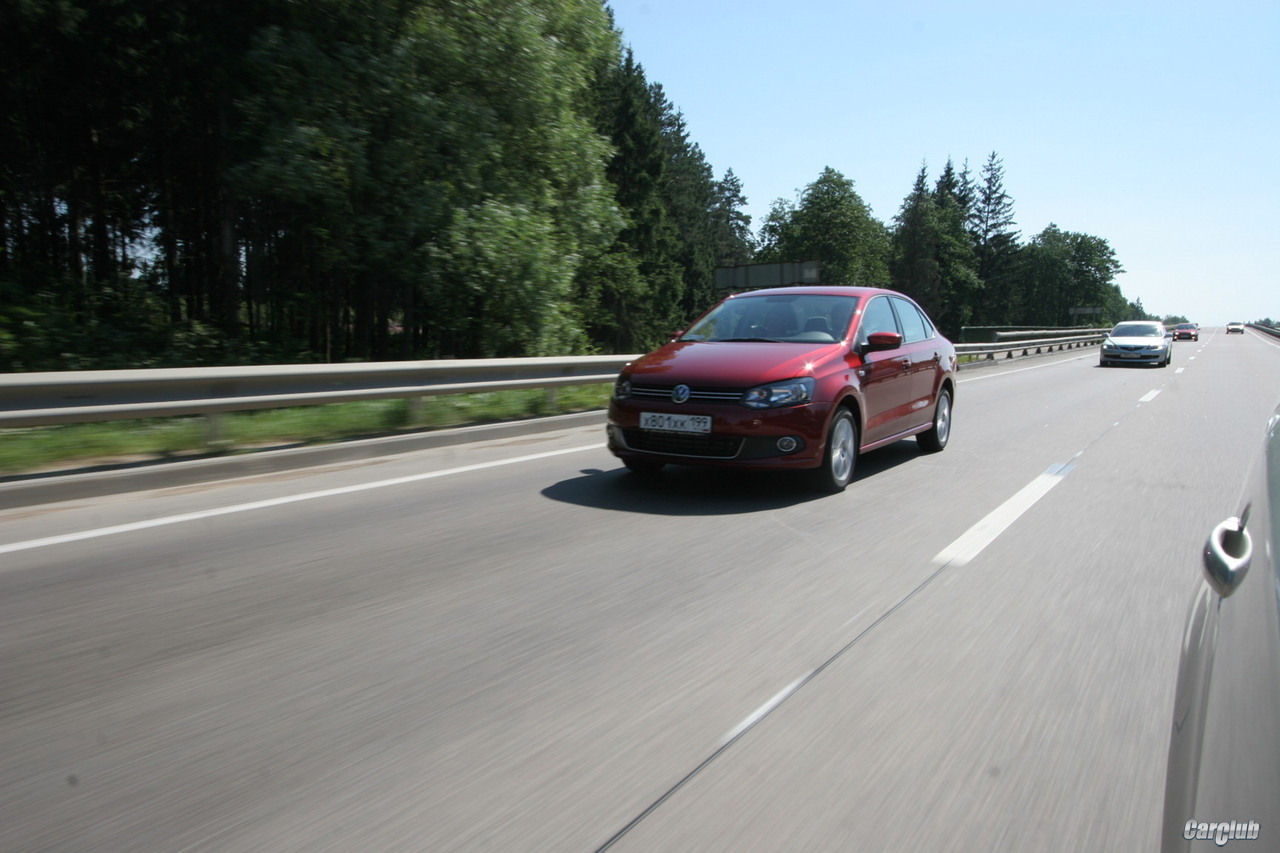 |
| Noises from the engine, rustling of wheels, howling of the wind — everything penetrates the cabin. The suspension is stiff and not energy-intensive enough; on bumps, the rear axle noticeably shudders, but there are no breakdowns |
Volkswagen representatives said that the new model underwent testing in Russian conditions for a whole year. Now it's time to see how the cars will behave in everyday life. For the test, we were given cars in the top Highline trim: a 1.6-liter gasoline engine with 105 horsepower, a five-speed manual or six-speed automatic gearbox, plus air conditioning, audio system, heated front seats, electric mirror and window adjustments, ABS, and other options. The price of such cars starts from 534,400 rubles (578,800 for the version with automatic transmission).
 |
Setting up a comfortable seating position using the seat and steering column adjustments is not difficult (though adjusting the mirrors will, as always, require fiddling with the joystick). We turn the air conditioning to full power — it's over thirty degrees of heat outside!
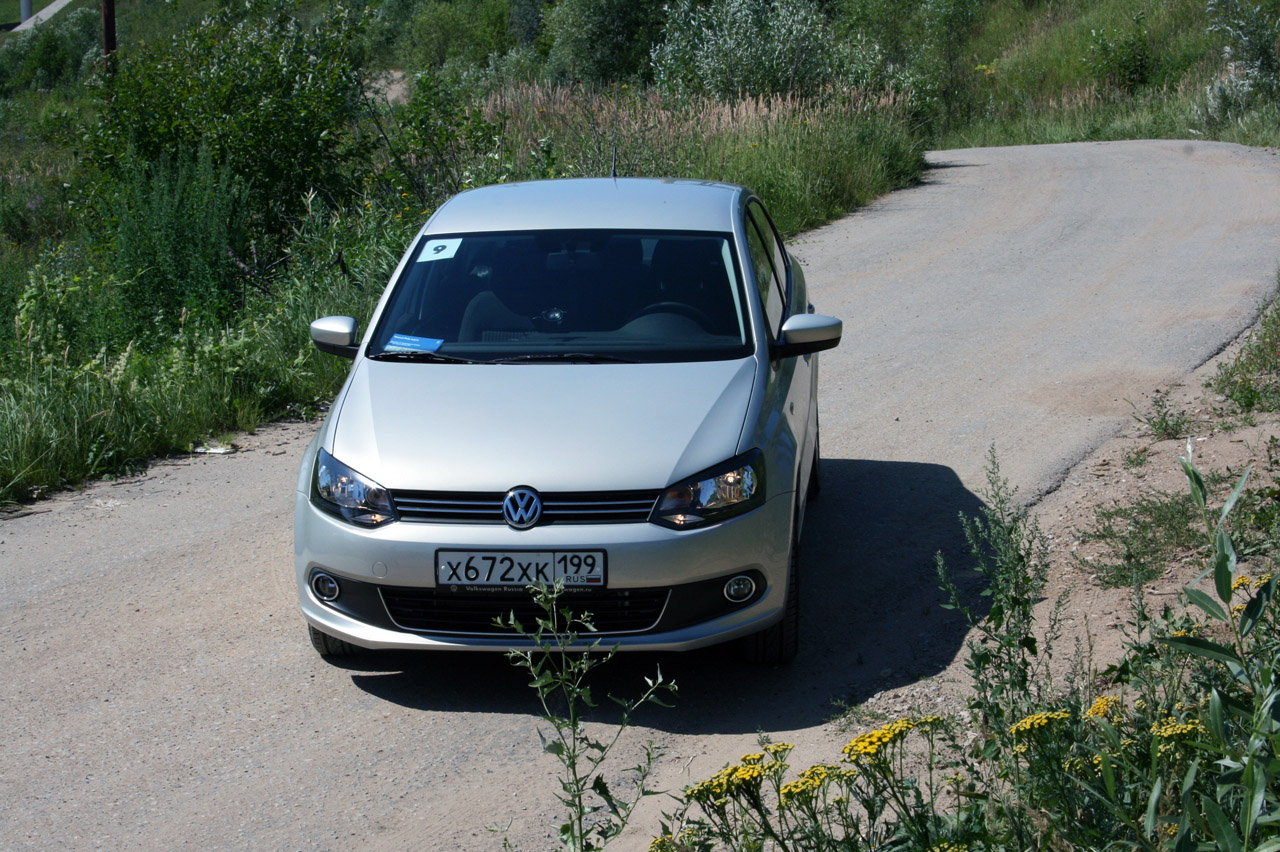
A column of silver and red sedans hits the highway and accelerates effortlessly. The cabin is filled with the hum of the engine, the rustle of tires, and the howl of the wind. The suspension is somewhat stiff and not very energy-intensive: on uneven surfaces, the rear axle noticeably shudders, but there are no breakdowns (during pre-production Russian tests, the standard rear semi-independent suspension was replaced with a reinforced "beam" from the Golf IV). On the Moscow region highway, this caused no trouble, but on imperfect Kaluga roads, discomfort was already felt. However, a big plus is its high endurance. And the 170 mm ground clearance is just what our roads need.
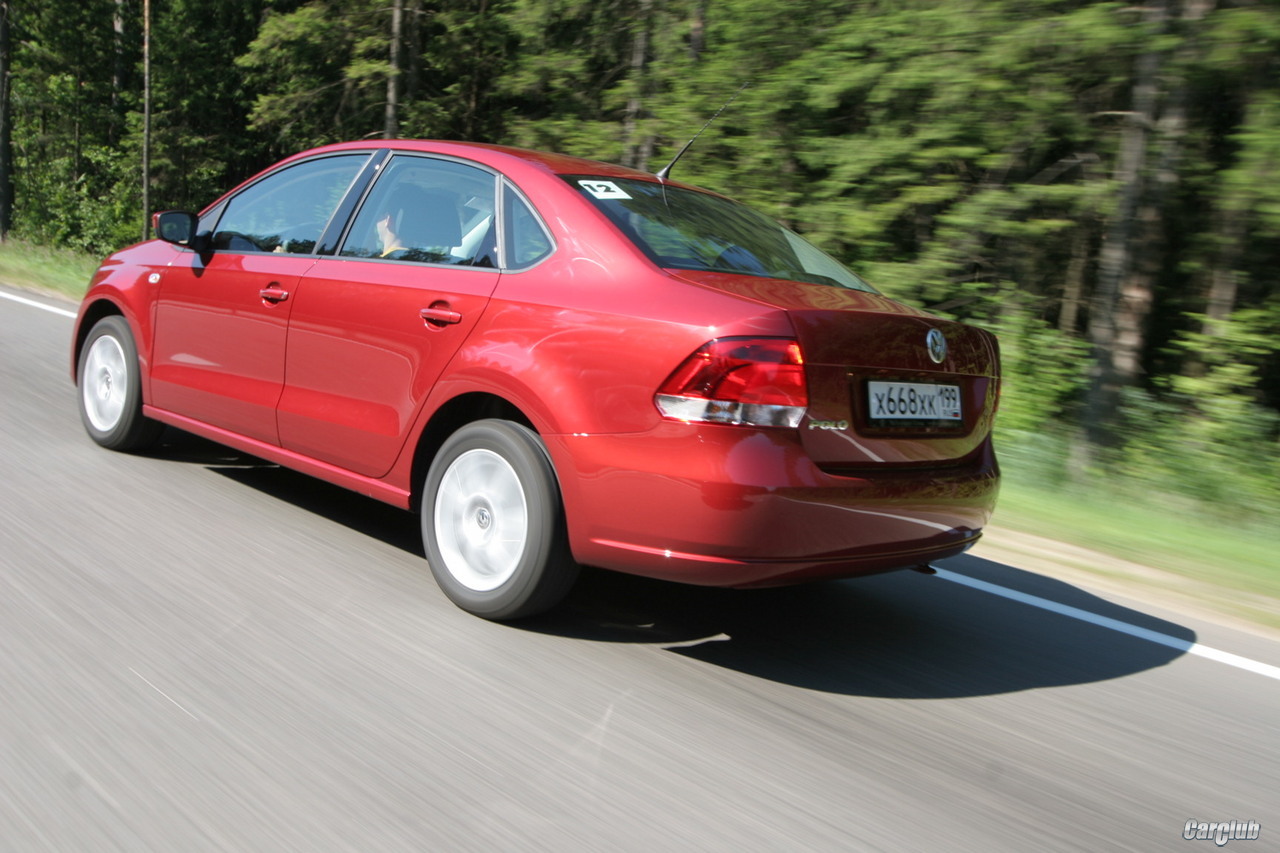 |
| The 1.6-liter engine with 105 hp pulls confidently from low revs, but when overtaking, it's better to shift to a lower gear. As revs rise, the howl becomes louder, and the sound insulation can no longer cope with it. At a cruising speed of 120-130 km/h, the engine holds about 3000-3500 rpm. The Polo Sedan confidently holds its line without requiring steering corrections, corners excellently, obediently following the steering wheel, and behaves stably at high speed on a straight line. |
The first Polo we got had a manual gearbox. Shifts are precise, pleasant and quick to work with, though the clutch pedal travel is a bit long. The car responds briskly to the gas pedal, but without unnecessary haste.
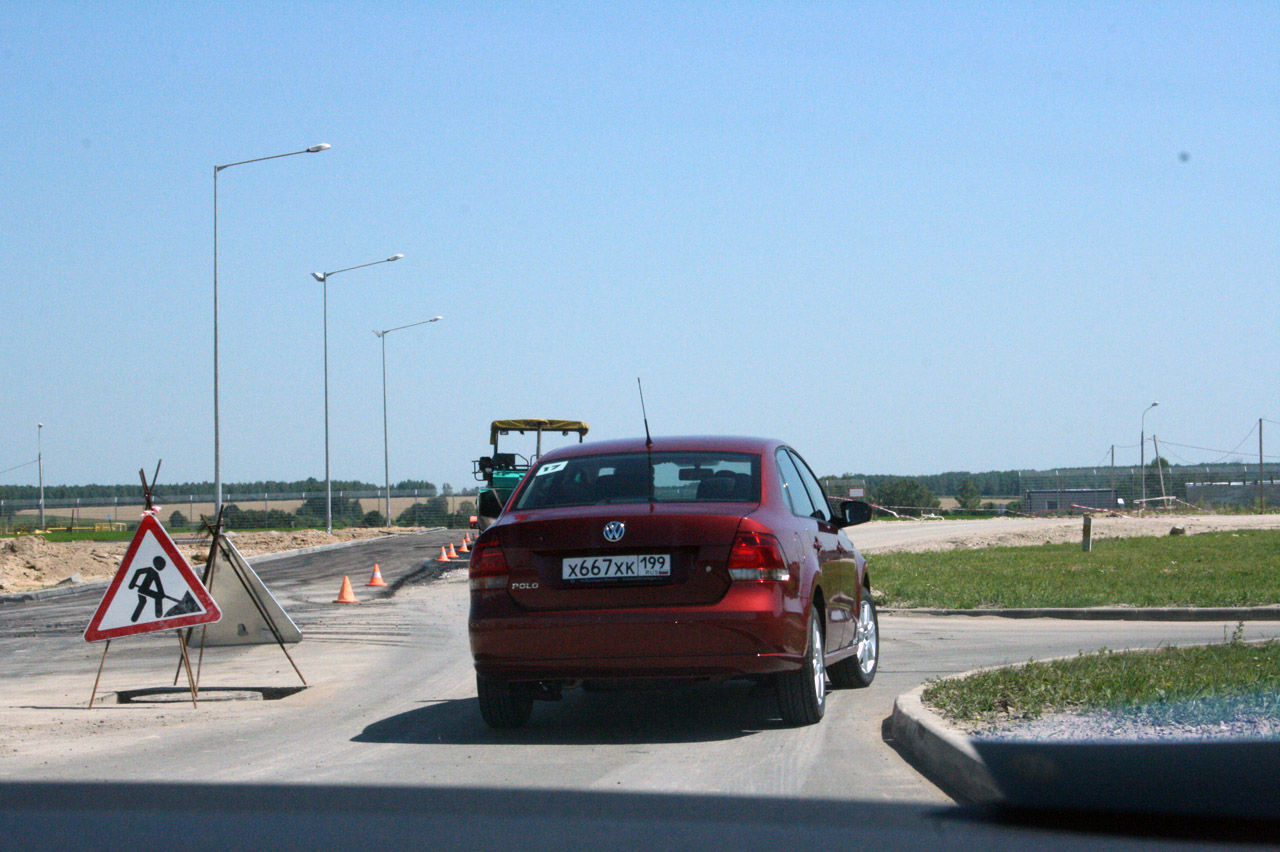 |
| The Polo sedan in its natural Russian habitat. |
A magic button helps add dynamics... turning off the air conditioning: the car immediately becomes noticeably easier to drive. True, in such heat, it's impossible to give up this necessary function, especially since the climate system quickly copes with the stuffy heat and steadily maintains a comfortable temperature in the cabin.
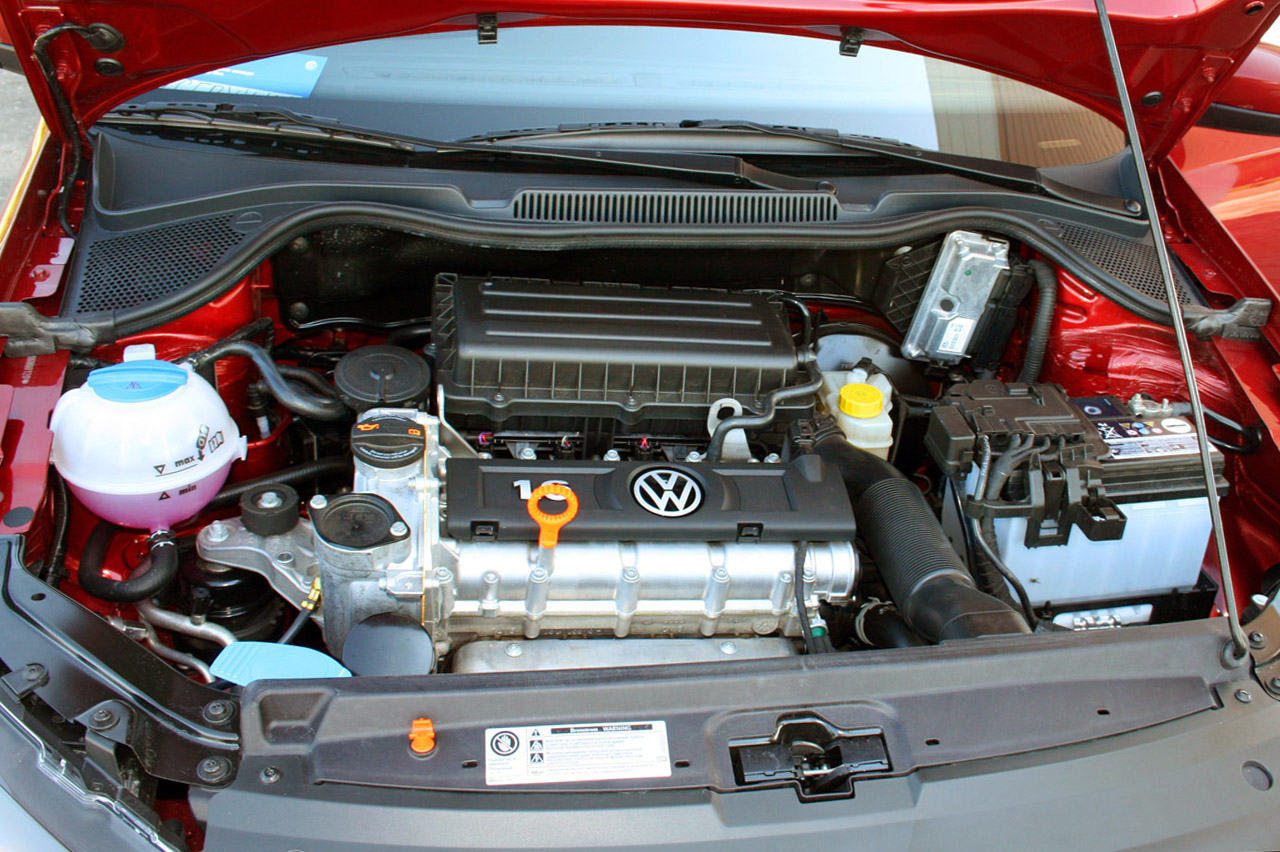
The 1.6-liter engine with 105 hp pulls well at low revs; when overtaking, it's better to shift down. As revs increase, the howl intensifies, and the sound insulation finally fails to cope. At a cruising speed of 120-130 km/h, the engine maintains about 3000-3500 rpm. The Polo Sedan holds its line well, doesn't require steering corrections, corners excellently, predictably obeying the steering wheel, and remains stable at high speeds on a straight line.
 |
| As for the automatic gearbox, the VW sedan is equipped with a six-speed Aisin transmission with manual mode — the most advanced in its segment. That doesn't stop it from responding with a delay to the gas pedal and hesitating during shifts. On kick-down, the engine's howl becomes annoyingly loud. Moving the selector to position S increases accelerator responsiveness and allows the engine to rev up to 6000 rpm, which slightly improves dynamics. |
The brakes disappointed (front disc, rear drum on the sedan), or rather the pedal tuning: it's soft and uninformative.
 |
| By the way, the average fuel consumption of the sedan with an automatic transmission during unstable test conditions was a pleasant 8.4 liters. |
As for the automatic gearbox, the VW sedan is equipped with a six-speed Aisin transmission with manual mode — the most advanced in its segment. That doesn't stop it from responding with a delay to the gas pedal and hesitating during shifts. On kick-down, the engine's howl becomes annoyingly loud. Moving the selector to position S increases accelerator responsiveness and allows the engine to rev up to 6000 rpm, which slightly improves dynamics. By the way, the average fuel consumption of the sedan with an automatic transmission during unstable test conditions was a pleasant 8.4 liters.
 |
| the most optimal version of the Polo Sedan costs 509,000 (553,300 for the car with an automatic transmission) rubles. |
The irony of the Volkswagen Polo Sedan's fate is that everyone, having gotten used to modern German cars and being taken in by its solid appearance, expects from a budget car no less comfort and dynamics than from a "Passat". Forgetting that it costs from 400,000 rubles. And perhaps that is the highest praise of its merits.
For this money, the Polo Sedan should be compared with...
-Renault Symbol: from 464,000 rubles for the base with a 1.4-liter 98-horsepower engine. The most affordable Symbol with a 1.6-liter engine will cost at least 547,000 rubles, though for that money you'll already get air conditioning, full electric package for mirrors and windows, radio, driver and passenger airbags, ABS, and driver's seat height adjustment.
-Peugeot 206 Sedan: from 424,000 rubles. Also a 1.4-liter engine with 75 hp.
-Hyundai Accent in the base is cheaper than the Polo — from 387,700 rubles with a 1.5-liter engine, but in a poorer trim, and the exterior and interior are much more austere.
-KIA Spectra is also cheaper — from 379,000 rubles for a car with a 1.6-liter 101-horsepower engine, power steering with height adjustment, and electric windows. The safety compromise is the lack of airbags and ABS.
-Chevrolet Aveo: the most powerful engine is a 1.4-liter 101-horsepower. With it, the base trim costs 446,200 rubles.
-Ford Focus is the benchmark for all comparisons. A sedan with a 1.4-liter 80-horsepower engine costs at least 459,000 rubles. True, the base is rich: ABS, front electric windows, two airbags, and electric mirror adjustment.
Unfortunately, in the base version of the Polo Sedan for 399,000 rubles, the car, like the vast majority of competitors, does not have air conditioning and it cannot be added. The rear seat in the base version does not fold down — also a minus. It has front airbags, all electric windows, driver's seat height adjustment, and steering wheel reach and height adjustment, and an electromechanical power steering. The radio is an extra 8,000 rubles.
In the Comfortline trim costing 468,000 rubles for the manual version and 512,300 for the automatic, ABS, electric mirror adjustment and heating, heated front seats, and a split-folding rear seat appear. There's no air conditioning or radio; you'll have to pay an extra 33,000 and 8,000 rubles respectively. Leather trim for the controls will cost 4,160 rubles.
The top Highline trim costing 534,400 rubles for the manual and 578,700 for the automatic is rich with 15-inch alloy wheels and front fog lights. For 87,000 rubles, you can order the Premium package: stability control, leather trim for controls, climate control, multifunction steering wheel, and an anti-theft system.
Thus, the most optimal version of the Polo Sedan costs 509,000 (553,300 for the car with an automatic transmission) rubles.
Svetlana Aleeva
Behind the scenes:
 |
 |
 |
Volkswagen plant in Kaluga:
Our acquaintance with the new Volkswagen Polo Sedan began not on the road, but at the production site. We visited the plant in Kaluga, where we clearly saw how seriously the company approaches local assembly. This is not just screwdriver assembly, but a full-fledged full-cycle production, which is a rarity for the budget segment.
Before getting behind the wheel, we inspected the workshops. Particular attention was drawn to how quality control is organized at every stage. Machines, robots, conveyor — everything works precisely and smoothly. We were shown how the body is welded, how panels are painted, and how the car is assembled literally down to the last screw. Honestly, I expected to see something more simplified, but the Kaluga plant makes the impression of a modern European enterprise.
When we finally went outside, finished cars were already waiting for us. The first thing that catches the eye is the appearance. The Polo Sedan looks older and more expensive than its actual price tag. Strict body lines, neat optics — no "budgetness" in its look. In person, the car looks even better than in photos, and this is a case where you wouldn't be ashamed to show the design to your neighbors.
The interior greets you with a familiar architecture, but with reservations. The trim materials are simple, but well-fitted. It's noticeable that the Germans tried to save money without fanaticism: the hard plastic doesn't creak and looks neat. The seating position is comfortable, the steering wheel adjusts in two planes, but personally I lacked a bit of adjustment range in the driver's seat — I want to sit a little lower, but the headliner doesn't allow it.
On the move, the Polo Sedan immediately makes it clear that it's built on a platform well known from the hatchback. The suspension is energy-intensive but resilient. On small joints and cracks in the asphalt, it works with slight stiffness, which, however, doesn't turn into discomfort. Body roll in corners is moderate, the car holds its line confidently. The steering wheel is informative, with pleasant effort, which for this class is more the exception than the rule.
Under the hood, we had a 1.6-liter gasoline engine, which, according to the specifications, produces 105 horsepower. Paired with a manual transmission, it feels lively in the city: acceleration to 100 km/h takes about 10.5 seconds, which is quite enough for such a car to confidently start from traffic lights and merge into traffic. On the highway, overtaking is not without effort, but it doesn't turn into a lottery — the main thing is to downshift in time.
Fuel consumption pleased us. In the combined cycle, the onboard computer showed about 7 liters per 100 km, which is a decent figure for such an engine and such a weight. In traffic jams, the number naturally rises, but overall, the car's appetite can be called moderate.
Special mention should be made of sound insulation. The engine is almost inaudible at idle, but as you pick up speed, aerodynamic noises begin to penetrate the cabin. This is especially noticeable at speeds over 120 km/h. For the budget segment, this is more the norm than a drawback, but it leaves a residue.
In the end, the Polo Sedan left a mixed impression. On one hand, it's a solid, predictable car with excellent chassis for its class and a decent engine. On the other hand, you can feel the savings inside, which manifest in small details: from simple power windows to the absence of some options. However, if you need a reliable, unkillable sedan that will honestly carry you every day without requiring extra expenses, this car definitely deserves attention.