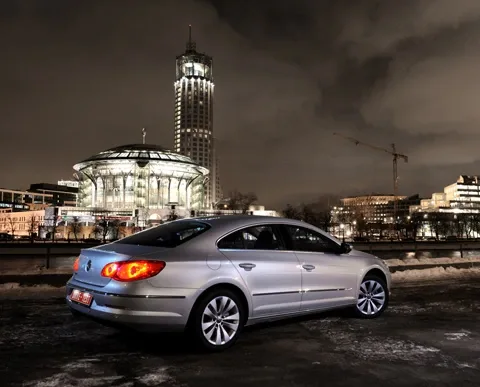
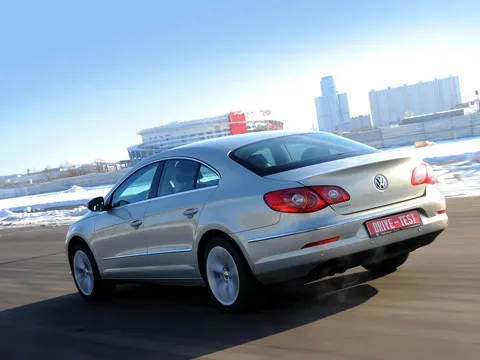
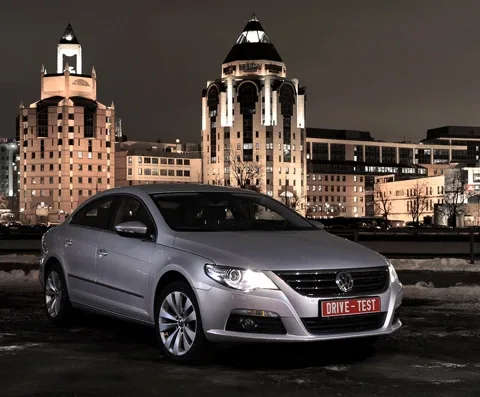
In some ways, I agree with the Americans. The previous, that is, the regular Passat, seemed to me a bit raw. There were questions about the exterior — those playful rear lights and the strange chrome "beak" — and about the interior, to be honest.
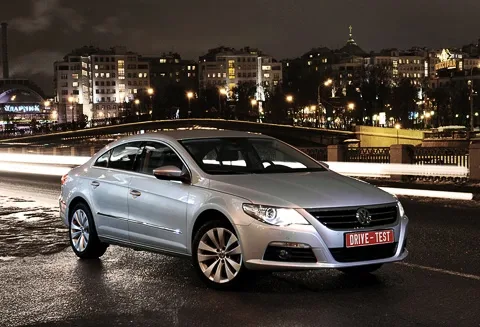
The Passat CC is longer and wider, but 50 mm lower than the regular one.
Trying to list all the complaints is a hopeless task. It all comes down to petty nitpicks, the essence of which is one: it seems decent, but boring. And recently I had the chance to ride in the BlueMotion version. That's the one with the weak, noisy, and vibrating diesel, whose consumption is measured in almost picoliters per kilometer. I'm ready to argue that the lion's share of the money saved on fuel (and that's a considerable amount) is spent by the owner of such a Passat on sedatives. And how do you conquer the market with that kind of setup?
This state of affairs does not suit the Volkswagen folks, who by 2018 dream of dethroning Toyota as the largest automaker. Even if the Corolla can't compare in popularity with the Golf in Europe, and Camry sales have completely fizzled out — as long as Americans choose "Japanese" over "German," global leadership can be forgotten. Maybe make the Passat cheaper? No — more expensive!
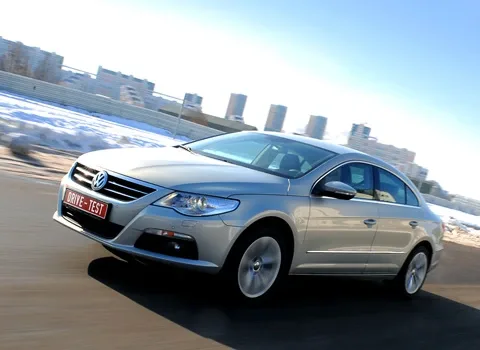
And so the Passat CC was born: a car largely aimed at the States, but no less European. It grew in size but didn't become more spacious. However, one glance at it is enough to forgive that. The coupe-like silhouette and frameless doors — beautiful! Especially against the backdrop of such ugly ducklings as the facelifted Renault Clio. A completely different car! And at the same time — the same one.
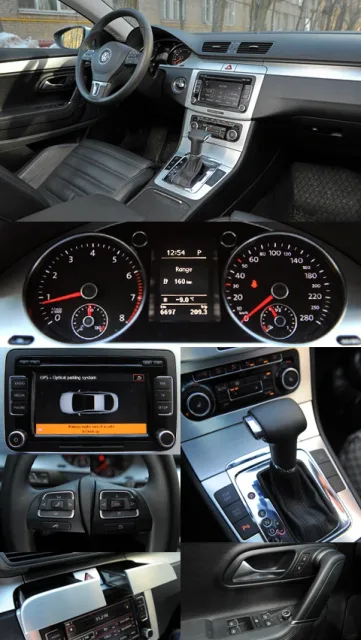
Most of the interior parts are no different from those of the regular Passat. But different instruments and controls for the audio system and climate control, a chunky steering wheel, and nice seats — and immediately you get the feeling of a more expensive car. Even the rather cheap-looking plastic trim doesn't spoil the impression much.
The interior. Almost everything here is from the regular Passat. The changes can be counted on one hand: the steering wheel, instruments in pods with white backlighting, a new climate control and multimedia unit, buttons and knobs. And, of course, the seats: the front ones have become noticeably more contoured, and the rear bench has turned into a two-seater.
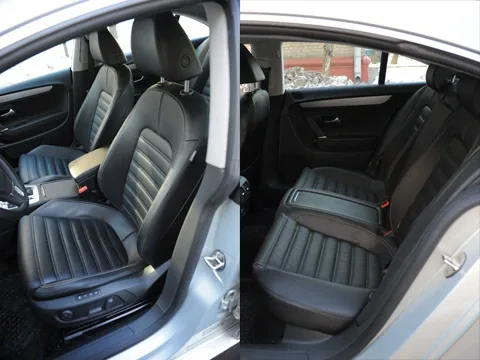
Despite the "comfort" image, the front seats of the CC version have more pronounced lateral support. Since the wheelbase hasn't changed, there's no less legroom in the back than in the regular Passat, but there's nowhere to put your head.
Plus all sorts of gadgets. Lane keeping assist, navigation, a smart rear-view camera that's impervious to dirt. And finally — an auto parker. The Passat CC somehow, in an incomprehensible way, is perceived as more expensive, seriously more expensive than the regular one. Magicians!
The powertrains are in order: there are no engines for the frugal in the lineup, but there are turbocharged petrol engines of 1.8 and 2 liters (160 and 200 hp), a 3.6-liter V6 (300 hp), and two-liter diesels (140–170 hp). The latter, however, are not for our market. Moreover, the six-cylinder engine comes only with all-wheel drive and DSG.
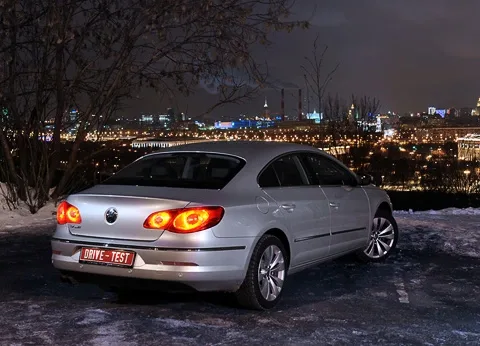
The smeared rear lights are an acquired taste, but they look fresh. The trunk has become smaller by 30 liters, but it's still not small — 532 liters.
You know how it's done these days? If a car's power doesn't reach the class-standard two hundred horsepower, the name is sure to get the trendy word Sport attached. And the name Extreme would be given to a car with a silly little engine of a hundred horsepower. But although the Passat CC doesn't have any outright weak engines, the abbreviation CC stands for Comfort Coupe. A silly name, but not dumber than all those "sports." Comfort — that's what will be appreciated not only overseas. The CC has a softer suspension and a smoother character. Including thanks to the new power steering, like on the Tiguan crossover.
I got a car with a 200-horsepower engine, a six-speed automatic, and front-wheel drive for the test.
And it really has become smoother, although I wouldn't call the suspension soft. But even on 18-inch wheels (and that's not the limit!), the CC swallows road imperfections quite well and barely rocks on waves.
Talking about the handling of yet another Volkswagen is a thankless task! Not because it's bad. If it were bad, I could exercise my wit in every test. But as it is — Polo, Golf, Passat… They're all roughly equally good. Light but informative steering, smooth yet filigree-precise reactions. Taking an extra turn at the wheel is pure pleasure.
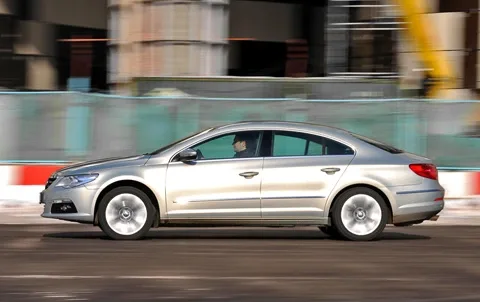
The Passat CC is well suited for long hauls: quiet, comfortable, doesn't rock, and shrugs off most bumps. Except it could react more calmly to ruts.
The noble manners are spoiled only by the automatic. And it really is just an "automatic." No direct shifts or dual clutches: plain hydromechanics. Six gears — sounds tempting, but in reality, the gearbox jerks. In sport mode, it allows for brisk driving, but during relaxed driving with a third of the pedal, the car doesn't follow the accelerator as precisely and smoothly as one would like, and there could be fewer shifts — after all, the engine, delivering a maximum of 280 N·m already at 1700 rpm, can easily pull from almost any gear. And it provides very decent dynamics — the CC accelerates to 100 km/h in less than 8 seconds. As for the brakes — not the slightest complaint.
Be that as it may, the car demonstrates a high class. The trick of turning the regular Passat into a more expensive car has succeeded! The CC looks gorgeous, feels more expensive, and drives more nobly. What else is needed? Maybe a different name?
The 200-horsepower turbo engine is the optimum for the Passat. In sport mode, the gearbox doesn't annoy with thoughtfulness, but smooth driving even in the D position is a bit of a struggle.
Everyone knows about the misadventures that plagued the mustachioed captain who liked to repeat that a ship's name affects its seaworthiness. A couple of letters have also fallen off the stern of the Passat CC — only the inscription Passat adorns the trunk lid. And fellow road users perceive it not as a niche model (although it is, with only 300,000 units planned to be produced), but as a regular Passat. Just a new one.
Americans won't have to make mistakes for long. Probably, in the States, the Passat Vulgaris will be replaced by a new model — larger, simpler, and more affordable. It will be the one to battle cars of the Camry level. And the premium version will remain only the CC.
We couldn't care less about Volkswagen's American dream, but the Passat CC is extremely interesting. The regular Passat isn't going to retire, so the choice in the D-class among the concern's models has become wider than ever. Need space and practicality — take the Skoda Superb; if you prefer moderation — vote for the Passat. Finally, if you want an old Audi at the price of a new one — there's the Seat Exeo.
Fortunately, despite the silly name, the Passat CC fits in perfectly here. After all, it's the first Passat that isn't just bought. A car with such design and equipment can also be dreamed about. And not only by Americans.
Volkswagen Passat CC: a coupe-like sedan with character
The Passat CC model occupies a special niche in the Volkswagen lineup. It's not just a sedan, but a car with a coupe-like silhouette designed to attract those seeking a more emotional design without sacrificing practicality. The car's exterior, developed under the direction of Murat Günak, went into production almost unchanged, and that has served it well — the car looks fresh and dynamic even some time after its premiere.
In the cabin and behind the wheel
The interior of the Passat CC is executed in the best Volkswagen traditions — strict, functional, and high-quality. The list of standard equipment is impressive: dual-zone climate control, heated front seats, a multifunction steering wheel with leather trim, tire pressure sensors, and hill-start assist. For an extra charge, a leather interior, power-adjustable seats with memory, swiveling bi-xenon headlights, and parking sensors all around are available.
Behind the wheel, you realize that the engineers did a good job with the tuning. Compared to the standard Passat, the suspension here has become softer, and the steering has received a new power assist, unified with the Tiguan. Active dampers offer three operating modes: comfort, standard, and sport. Switching changes not only the stiffness of the dampers but also the algorithm of the power steering and the response to the accelerator pedal.
Technical details
Under the hood of the test car is a gasoline turbocharged engine with a displacement of 2.0 liters and direct injection. It develops 200 horsepower and 280 Nm of torque, available from as low as 1700 rpm. Paired with a six-speed automatic transmission, the Passat CC accelerates to 100 km/h in 7.8 seconds, and the top speed is 232 km/h. Fuel consumption in the combined cycle is stated at 8.5 liters per 100 km, which is quite acceptable for such a car.
Among the interesting options, it is worth noting the rear-view camera, which can display parking hints and is protected from dirt. An automatic parking system is also available, though it can only park the car parallel and only on the right side of the road. The lane-keeping system works in a Volkswagen way: a camera built into the cabin mirror tracks the lane markings, and if necessary, the car itself slightly steers to maintain the course.
The trunk volume of 532 liters is one of the most spacious in its class. A full-size spare wheel is also included in the standard equipment.
On the road
The Passat CC confidently holds the road, and in sport mode the suspension becomes noticeably more composed, allowing for more active cornering. In comfort mode, the car smoothly smooths out bumps, although the ground clearance of 104 millimeters makes you cautious on our roads.
By the way, the test car did not go unnoticed by the public — we arrived in it at a meeting of DRIVE2.RU users, where community activists thoroughly examined the car. Judging by their reviews, they quite liked the Passat CC.
Verdict
The Volkswagen Passat CC is a successful attempt to combine the practicality of a sedan with the emotional design of a coupe. The car offers a wide range of options, quality trim materials, and time-tested engineering. The base version is priced at 1,330,000 rubles, and the tested example with additional equipment at 1,565,000 rubles.