
Engine — 2.0 biTDi
Max power — 163 hp /4000
Max torque — 400 Nm/1500-2000 rpm
Max speed (km/h) — 182
Acceleration 0-100 km/h — 10.8 sec
Fuel consumption:
city — 9.6 l
highway — 6.9 l
combined — 7.9 l
Gearbox — 6-speed
Drive — 4Motion plug-in
Curb weight — 1882
Length — 5 254
Width — 1 944
Height — 1 834
Cargo area — 2.52 sq m
Length — 1 555
Width — 1 620 (in wheel arches 1 222)
Tires — 255/60 R18
Trim level Highline DoubleCab biTDI:
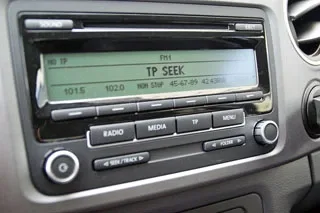
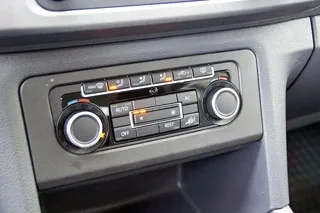
ESP, ABS, EDL, ASR, hill descent/ascent assist, dual-zone climate control, power steering, 4 power windows, front fog lights, heated mirrors, leather steering wheel, RCD 310 radio with 6 speakers, cruise control, airbags, chrome body kit, bluetooth.
Warranty — 2 years without mileage limit.
Service interval — 15 000
Price at test time — $52 988 (423 900 UAH)
base — $33 636 (269 082 UAH) maximum — $55 688 (445 501 UAH)
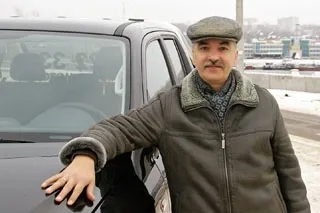
Vadim Sadykov,
«Avtoclub-Kazan»
Cheboksary greeted us with a complete absence of traffic jams. During the trip there and back and during the test drive, we repeatedly drove through the city center – no traffic jams! A motorist's paradise? Don't rush to conclusions. There are local automotive peculiarities here. For example, no one yields to those changing lanes from an adjacent lane or entering from a secondary road. However, Kazan used to be like that too, when there were few cars on the roads. Also, Alfred and I noticed that during the entire time we didn't see a single car saying "thank you" by flashing hazard lights. Well, never mind them, the cars. If there are few of them on the roads, then erecting the rule of the "main road" into a granite absolute is normal – everyone will have time to pass. The real shock was the behavior of pedestrians: they "hunch up and scurry" ("Office Romance") across the crosswalk, absolutely not looking around. And it's icy, the braking distance is long. And a pedestrian has only one life, not subject to upgrades. We just can't find the "golden mean"! In Cheboksary, a pedestrian doesn't care about cars at all, but in Tatarstan, a pedestrian has to be pushy to be let through. Oh, life.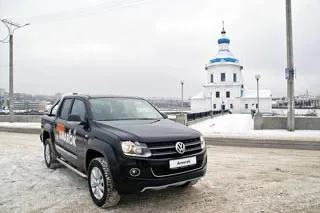
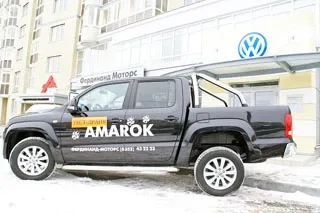
I started talking about pedestrians not by chance – the Amarok is a heavy vehicle, you can't stop it instantly. Although I liked the brakes and ABS: you get used to them instantly. The same can't be said for the clutch pedal; Alfred and I stalled a couple of times at intersections. Yes, yes, you get used to everything; in a couple of days anyone will adapt to this feature. And also to another one: the stiff gear lever. And while the driver is mastering the "basics" of driving the Amarok, they'll appreciate the 6-speed gearbox. The gears are short here, especially first. It's hard to pull away "with a squeal" from an intersection, although possible. But the Amarok isn't made for traffic light races! Its element is economical city driving (rear-wheel drive function, diesel engine, 6 gears) and plenty of torque off-road or when hauling cargo. In the city, the most comfortable driving is at low revs, while there's always the ability to "sprint" (bi-turbo, after all). Rear-wheel drive doesn't cause problems even on slippery roads as long as you maneuver smoothly. And for dangerous situations, there's the standard "stability system".
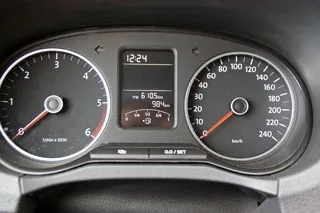
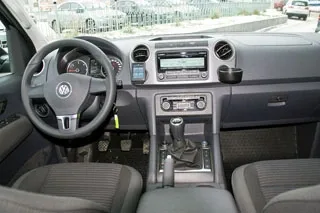
And most importantly – this pickup rides smoothly on city roads! It doesn't even shake in the back seat. Surprising but true. How they achieved this with a rear leaf spring (like trucks) suspension – I don't know. And there's an even more comfortable Amarok version with fewer leaves in the spring (and naturally less payload). You can take Alfred's and my word for it (or better, check it yourself on a test drive) – the Amarok's suspension comfort is on par with any "SUV".
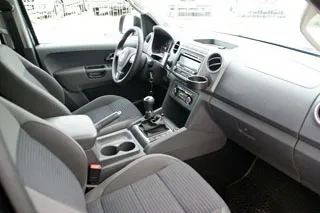
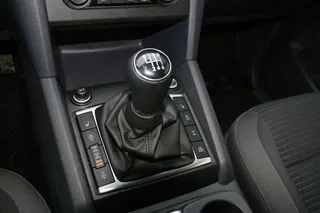
It doesn't yield. And what about the interior? The plastic is hard, comparable in quality to the trim in the Polo Sedan. But it doesn't squeak; during the ride over potholes and bumps, there were no extraneous sounds in the cabin. There's plenty of space in the front seats; that goes without saying. The usual pickup problem – little knee room in the back and an uncomfortable upright seating position. I must admit that the Amarok has more space in the back than other pickups I know. And the backrest angle isn't as uncomfortable/upright. On a long trip, of course, it's not too comfortable. But who goes on a long trip in a pickup? At most – to the nearby forest, river, or village. And most trips will be even shorter, with a minimal number of passengers. Alfred will tell you more about the Amarok's cargo platform and ways to cover it from rain/snow; I'll just state the fact: you can load heavier cargo here than in any minivan. And you can also save significantly on transporting light bulky cargo, as there's no need to rent a Gazelle.
Since it has all-wheel drive and high ground clearance, we need to test it off-road. I'll note once again the comfort when driving over uneven surfaces, whether it's a bumpy road or uneven concrete slabs. Driving such a vehicle on a regular country road is uninteresting – nothing special, it just goes. It doesn't even shake properly. We decided to tackle hill climbs. What can I say? It climbs!
Payload like a Gazelle, off-road capability like a good SUV, fuel consumption (ours – 11 liters, with off-roading) moderate, suspension performance in the city like a good sedan, cabin space like a crossover. What more do you want? And price matters to us too. It's a matter of taste, but it seems to me that the top trims of the Amarok are a bit pricey. Although... if you need the vehicle only for work... then there are good options.
Alfred Mardanov,
«Avtoclub-Kazan»
The active TV advertising of this vehicle did its "dirty" deed. People started to slowly show interest. Pickups are no longer a rarity on city streets; I personally know a couple of their owners – for one, it's a help in construction, for another, it's a way of active recreation. And this situation is likely a very accurate portrait of pickup owners in our market. We don't have that layer of farmers for whom such equipment was designed, but nevertheless, its use in urban conditions does occur. As I said, some transport cement, others ATVs. In general, the Chinese got us used to pickups; they were the "pioneers" of the Russian market. People felt the charm of owning such a practical vehicle, but as a rule, it's not the only car in the family.
The road to Cheboksary, contrary to the navigator that wanted to take us via M7, was chosen through "Mariyka". It's calmer in terms of traffic and the number of traffic police posts, which is practically zero. The navigator quickly found the new route and didn't sneer: "YOU HAVE OFF ROUTE", but silently plotted a yellow line with the destination – Pavlova Street in Cheboksary. In general, this trip was indicative in terms of trusting all these electronic gadgets. I slightly forgot the folk wisdom: "Trust, but verify" and paid for it. The climax of the navigator misadventures was wandering around a city with three (!!!) whole Pavlova streets. Academician Pavlova, Midshipman Pavlova, and someone else, also Pavlova (good thing Pavlov's House is in Volgograd). In short, as you guessed, we didn't arrive right away, but only on the second attempt. Why Cheboksary, you ask? The fact is that Kazan has no official dealer representing VW commercial vehicles. The nearest one is in Cheboksary, so we went there.
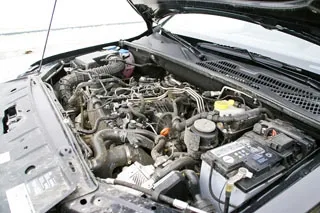
The test car is almost fully loaded, missing only a few small "extras" that would bring the price up to the maximum of one million six hundred fifty thousand, while our example costs about 1,570,000 rubles. In nature, or rather, on the Russian market, there are two types of engines that power Amaroks. These are the two-liter TDI turbodiesel with 122 horsepower and 340 Nm of torque, and the biTDI with twin turbochargers producing 163 horsepower and a maximum torque of 400 Nm. A gasoline engine is promised in the future, as is an automatic transmission. Currently, only a 6-speed manual gearbox is available. The drivetrain is also available with rear-wheel drive or plug-in all-wheel drive 4Motion, which splits torque in a 50/50 ratio between the axles. All modifications feature the classic pickup truck design: a rigid ladder frame, independent front suspension, and a solid rear axle with leaf springs, and all come standard with a rear differential lock and low-range gearing.
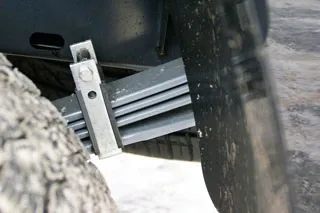
The leaf springs also come in three-leaf and five-leaf versions, which affects the vehicle's payload capacity, respectively 850 and 1000 kg. They say that different springs also affect ride comfort, but as Vadim rightly noted, even on the five-leaf version we were shocked by the suspension behavior. If in pickups it is considered normal for the rear to behave independently from the front, living its own teeth-rattling life, which rear passengers especially "appreciate," then here the picture is somewhat different, completely uncharacteristic for pickups. The Germans, by the way, note this fact and are especially proud of it, and they didn't lie, credit where credit is due. Believe me, we seriously tried to shake up the rear passengers, namely me and Vadim, on roads where local "off-roaders" like to hang out, and we only partially succeeded. How the engineers achieved this, I find it hard to answer, but nevertheless, the fact is felt.
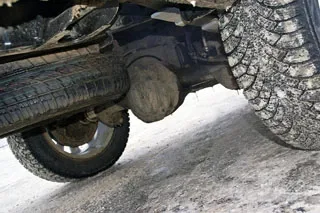
The ride is surprisingly comfortable and somewhat unusual for a pickup, and if you load it with about 500 kg, the ride will probably become even smoother. By the way, in the area where we tried to "rough up" the car, there are genuinely tricky sections, but we were a bit "lucky": the first serious frost froze the mud, turning it into hard ground, but nevertheless, I could see from the eyes of the dealership manager, assigned to us as a guide, consultant, and navigator (to hell with the GPS), how he was panicking. In general, by our wild "metropolitan" standards, we didn't do anything serious with the car—we didn't sink its license plates in a swamp like with the Honda Pilot, didn't sink the car itself in a swamp like the Nissan Patrol, didn't climb a nearly vertical mountain like in a Range Rover, but merely tried to conquer a small hill. Big deal? Actually, the hill was treacherous, with frozen mud boulders the size of two human heads. When Vadim was behind the wheel, he was overly cautious and engaged the low-range, which prevented overcoming the obstacle, dramatically lifting the nose almost at the very top. They weren't sitting but lying on the seatbacks, furtively looking around, afraid of rolling down. I didn't immediately catch on and climbed with the low-range, spinning the wheels quite a bit, but when I turned it off, I simply flew up. The tracks showed that the car really did skip over those huge boulders, but when?
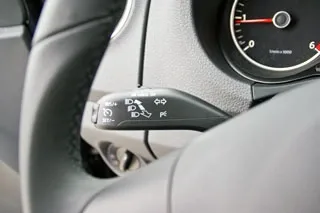
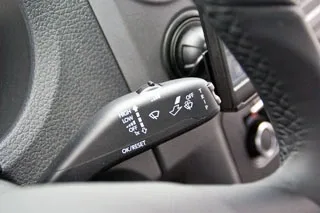
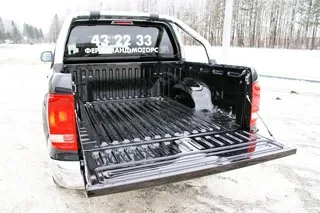
Sitting behind the wheel, I simply didn't notice them, so energy-intensive was the suspension. The low-range here is more needed when you're fully loaded and need to haul either 1000 kg in the bed or more than 2,500 kg of trailer load, of course not off-road, but to go far away. The specially designed bed, adapted for loading Euro pallets, is also a particular point of pride for the Germans. I was surprised to find out that the vehicle is built on its own individual "cart." I thought it couldn't have been done without the previous Tuareg with its frame. But no! It's not that simple. VW has vast experience in building commercial vehicles (which this one also belongs to) and it was fully used to build the Amarok. The car moves very correctly off-road, as if on "autopilot." And with the Off Road function activated, which seriously adjusts the ABS system (reducing braking distance on loose surfaces) and also activates hill descent assist, allowing the Amarok to descend from elevations "by itself." What to say about off-road discipline? The potential is very good, limited only by ground clearance (250 mm) and, which is the bane of all pickups, the rear overhang.
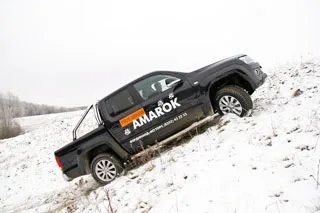
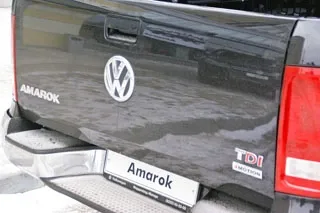
I stalled in some ditch; it's strange that a diesel can stall so easily, and Vadim mentioned it but didn't name the reason. The thing is, the clutch pedal has a long, springy travel and engagement happens right at the beginning, which requires getting used to when starting off, but press the brake harder while moving and it stalls almost without resistance. So, I'm in a ditch of ice, mud, and water. I engage the center differential, start the engine, and calmly pull away. Ha! On the way back, I drive over that spot without locks, but also without revving, almost in a tight pull. Easy! Yes, yes, the car is serious; you can climb over bumps, just without fanaticism, and this ditch is nothing for it. The rigidity of the frame in our acrobatics along the route didn't allow the cabin to squeak with its plastic, let alone an outright creak. Lately, there have been many discussions about "what the construction of SUVs should be—ladder frame or integrated," but for pickups, such a question doesn't even arise; definitely a frame. The highway part of the tests was moderate; we don't know the city and didn't plan to go far, so I decided to try the cruise control. Many cars are now equipped with it, but some work at least mysteriously; here everything is OK! I set the speed, turned it on, and we're driving. By the way, sixth gear is engaged, and it still pulls; it's a diesel, what can I say!
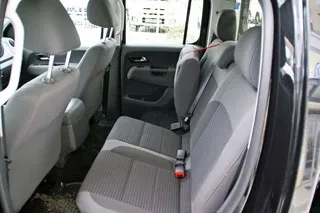
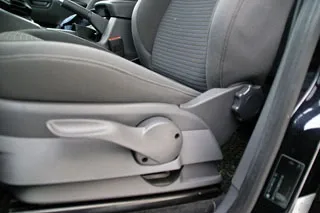
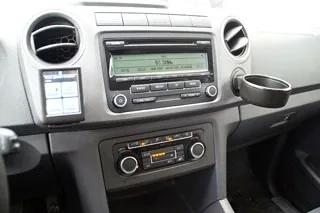
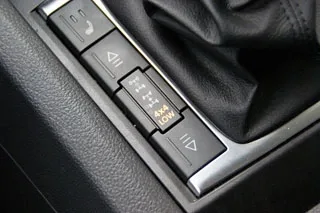
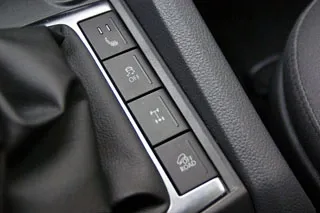
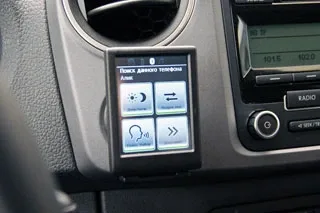
On the highway, I didn't like the ringing sound of the engine; it seems like the valves might jump out from under the hood and hop alongside. The overall sound insulation is decent, but the high-pitched engine noise dominates the cabin after slightly above average engine speeds. Also, in the test version of the car, there were such cool gadgets as a touch-sensitive phone control unit, which is to the right of the steering wheel, right under the hand that reaches for the gear shift lever and naturally hits this unit first, and only then the lever. The unit is touch-sensitive and activates on touch, usually at the most inopportune moment. Also puzzling was the cupholder/bottle holder installed under the air vent, closer to the passenger, which could easily be accidentally torn off the panel by them; it sticks out provocatively. And removing it is a whole story with unscrewing and storing it in a secret place. The vibration from the diesel operation slightly transmits to the gear shift lever and pedal assembly, which further enhances the feeling of a car that is already in your hands. A certain aura is felt around it; it is solid and not prone to the typical pickup truck "hooting" from behind. Well, it's definitely not a truck.
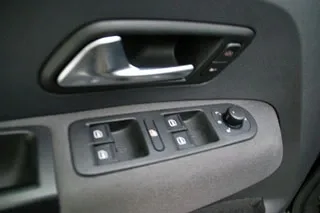
I even managed to spin it a bit on the lot near some shopping center; cornering is not its forte, the long wheelbase speaks for itself, but nevertheless, the composure of the suspension impresses. As Vadim noted, the instrument panel is from the Polo, though the plastic is a bit better, but still the design is German without pretensions or excesses, but with the same drawbacks—smallish analog gauges, although there is plenty of room for expansion. The Amarok is a freedom-loving wolf living in South America (Kolyan, imagine, besides America there is also South America), something like the Lion, the king of beasts in Africa. The car is assembled in Brazil (at the same plant where the Pointer was made) and therefore it is no coincidence that the image of the wolf from South American fauna is used in the advertising of this car, where it, the Amarok, looks, by the way, very good (just like in real life). In the exterior design, there is nothing superfluous; the Amarok fits very concisely into VW's new design line. The Germans, with their meticulousness, hit the mark. Now they should think about a good appetite in pricing, although it must be admitted that this pickup, in terms of driving feel, is the one I like the most.