German tango
There is absolutely nowhere to hide from the FIFA World Cup. At work, television vuvuzelas and the shouts of fellow fans have been blaring for the fourth week now – the entire editorial staff of "Lenta.Ru", along with the sports department that runs "live blogs", has been watching the South African tournament on office TVs.
Hiding on the internet won't work either – in Facebook and Twitter, all my "virtual friends" without exception are posting about the 2010 World Cup, even those who never cared about football before.
Because pickups for Volkswagen are, in a way,
"terra incognita"
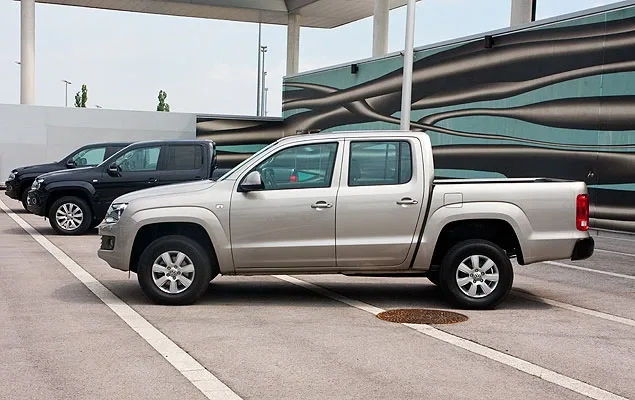
Even on a trip, you can't escape the World Cup – at the European presentation of the Volkswagen Amarok pickup in Bratislava, held at the end of the group stage, one of the concern's top managers built almost his entire speech on comparisons between the hard work of Volkswagen engineers on the Amarok and the zeal with which the German national football team achieves its victories.
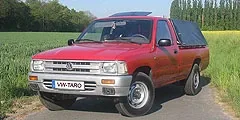
With the German national team, everything is clear. The three-time world champion confidently marched toward the title this time as well, until the Spaniards stopped it in the semifinals. But there is much less information about the Amarok. Moreover, Volkswagen had never produced pickups on its own before – the Volkswagen Taro, which appeared in VW's model lineup in the eighties, doesn't count, because under that name, the Toyota Hilux was sold in Europe.
"Amarok" with filling
Unification
The Volkswagen Amarok pickup is a rare case these days when a vehicle is essentially built from scratch. It's a body-on-frame vehicle, so engineers couldn't use the platform from the Touareg as a base. But the Amarok had a famous predecessor – the VW Taro, which was actually a Toyota Hilux pickup adapted for the European market with a Volkswagen badge. This vehicle was renowned for its incredible durability. For example, thanks to its unique reliability and off-road capability, the Toyota was eagerly purchased by the armed forces of many, mostly tropical, countries. As a result, the term "Toyota war" even appeared in official history – that's what the armed conflict between Chad and Libya was called. |
However, the Amarok apparently doesn't need its own history – the one that the Volkswagen brand has is enough. Or rather, not the history itself, but the experience of creating a wide variety of vehicles accumulated in Wolfsburg over the years of the brand's existence. At least, by the end of the one-day test drive, a strong impression had formed that this vehicle is "conceptually" thought out to the smallest detail.
Moreover, this time the Germans took on an unusual task for themselves – to create a production vehicle that should first and foremost drive excellently on bad and very bad roads. After all, the main sales markets for the Amarok are South America, Australia, and South Africa, where pickups are valued precisely for the combination of utility and off-road capability.
Volkswagen had never made such vehicles before. Even the Touareg was primarily aimed at dynamic driving on asphalt, and the "honest" off-road "filling" came to it by accident – the creators apparently "overdid it." This misunderstanding was corrected by the second generation – the transfer case and mechanical rear differential lock are now installed only on the special version.
But despite the novelty of the task, in Wolfsburg they got down to business with enthusiasm. For example, the vehicle's name – Amarok. The large branding agency Interbrand, which was tasked with coming up with a name for the new VW model, stumbled upon it while studying the language of the Inuit – indigenous peoples living from eastern Chukotka to Greenland.
In Inuit, "Amarok" means wolf. There is also a Latin meaning, which Volkswagen's PR people translate descriptively – "the one who loves to climb rocks," and in Irish Celtic, this word means "tomorrow." Three syllables – three vivid images: "Amarok" is no worse than the brilliant "Eskimo" invented by French ice cream makers.
Prelude
However, the creative name, like the pickup's current appearance that carefully repeats the "genetic code" of the Volkswagen model lineup, is embellishment, pure marketing. And the most interesting thing about the Amarok is the engineering component, which hides under the vehicle's floor and in the engine bay.
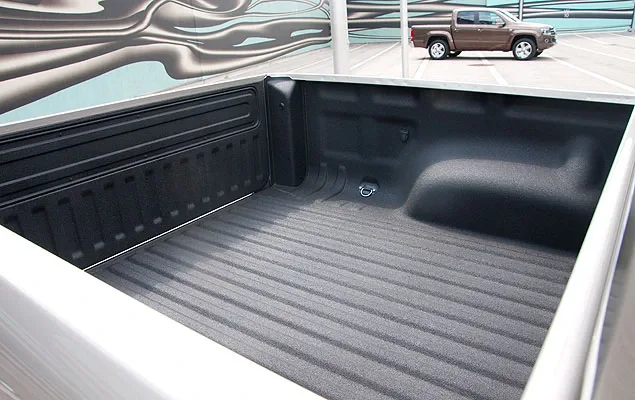
Meanwhile, as promised in Wolfsburg, in 2011 a single-cab Amarok will appear on the market, thanks to which the German pickup will turn into a real truck.
Let's start with the fact that on asphalt, the Volkswagen Amarok behaves… mediocrely. The test "truck" we got, with plug-in all-wheel drive, a six-speed manual, and a 163-horsepower diesel with twin turbocharging and a 2.0-liter displacement (it's these vehicles that will start being delivered to Russia in the fall, so we only tested this version, and below we'll only talk about it), greets the driver with an empty steering wheel, a long gear lever travel, and a stiff clutch pedal.
Moreover, the German pickup can't be called dynamic – the impressive 400 Newton-meters that the biturbo diesel produces already at 1500 rpm "run into" the short gear ratios of the gearbox.
It's hard to "gather" such a vehicle at speed "into a ball" to quickly navigate a series of sharp turns. Therefore, the Amarok (at least at first glance) doesn't resemble a real "Volkswagen" – because until now, in Wolfsburg, they tried to achieve car-like handling even for vehicles from the commercial lineup. A good example is the VW Transporter, which handles not much worse than a family sedan.
Interior
|
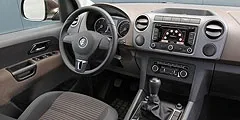
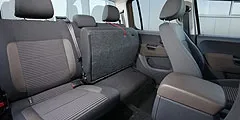

On the other hand, the Amarok is well suited for measured driving on wide straight autobahns – the vehicle holds the straight line tenaciously and, thanks to the sixth gear, spares the diesel engine even at cruising speeds. Moreover, the pickup's spacious cabin with a high ceiling and a wide armrest between the front, car-like comfortable seats, also encourages leisurely driving – in Wolfsburg, they clearly designed the interior with the expectation that the German pickup would appeal to those customers who decide to buy it for personal use.
Polarity shift
But in the case of the Amarok, the autobahn is always a prelude. The real driving begins after the pickup leaves the asphalt. It's like releasing a seal into the water: a vehicle that's clumsy on public roads becomes light and docile when it hits off-road terrain. It can easily "shoot" along a dirt road worn down to mini-canyons or boldly descend a grass-covered slope.
At the same time, the drawbacks noticed on the serpentine instantly change sign on dirt roads: the "empty" steering wheel helps maintain the chosen trajectory when hitting large obstacles and allows easy maneuvering on rough terrain, while the biturbo diesel, thanks to the short gears of the manual, fully realizes its impressive torque.
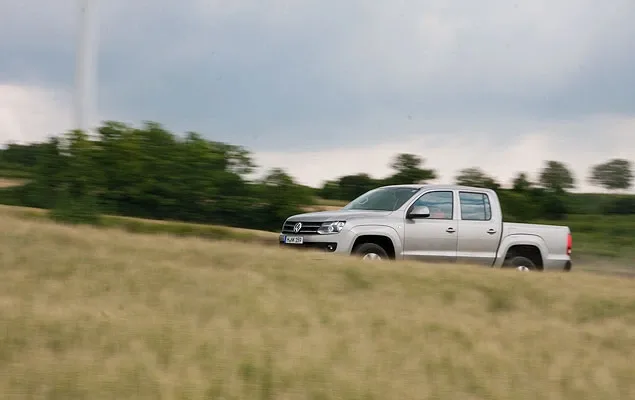
Secondly, at the start of sales we will only have a two-liter bi-turbo diesel available, producing 160 horsepower. The younger version of this engine, detuned to 122 horsepower, will not be brought to Russia yet. However, in Wolfsburg they are considering the possibility of offering a rear-wheel-drive Amarok with a 1.8-liter gasoline turbo engine with 160 horsepower on our market. But the main achievement of the engineers who created this pickup is the soft suspension, which you truly appreciate only when you leave the asphalt. Say, onto a field. The Amarok doesn't "buck" even on serious bumps, although this is exactly what almost all pickups with rear leaf springs are guilty of. Especially when the bed is empty. The Germans prepared two sets of leaf springs for the Amarok: one is designed for a payload of 950 kilograms, and the second, the so-called Heavy Duty option, allows carrying up to 1100 kilograms of cargo. So, even with the Heavy Duty springs, the test pickup demonstrated exemplary ride smoothness. True, I should note right away: during this test we did not get to try the vehicle in real swamp mud. After all, in such conditions, off-road capability depends not only on the vehicle but also on the driver's skill, and among automotive journalists it can vary. After all, even in this profession there are beginners. Therefore, even at the bottom of a large artificial puddle, where the Germans showed how the Amarok fords a half-meter deep wading, specially added gravel crunched under the wheels. But we checked the pickup's geometric off-road capability to the full extent. Thanks to a ground clearance of 240 millimeters, short overhangs (front and rear approach angles are 30 and 17.6 degrees, respectively), and large suspension travel, the Amarok on standard 16-inch all-season tires calmly climbs over obstacles that Austrians attack on weekends in specially prepared off-road vehicles. "Do you hear — the cabin is completely quiet, no squeaks," proudly says the instructor sitting next to me, when the test Amarok in low range makes its way along another "elephant trail." As it turned out, this is not an ordinary event agency employee, but the head of the Volkswagen division responsible for designing the Amarok's frame — Klaus Stenzel.
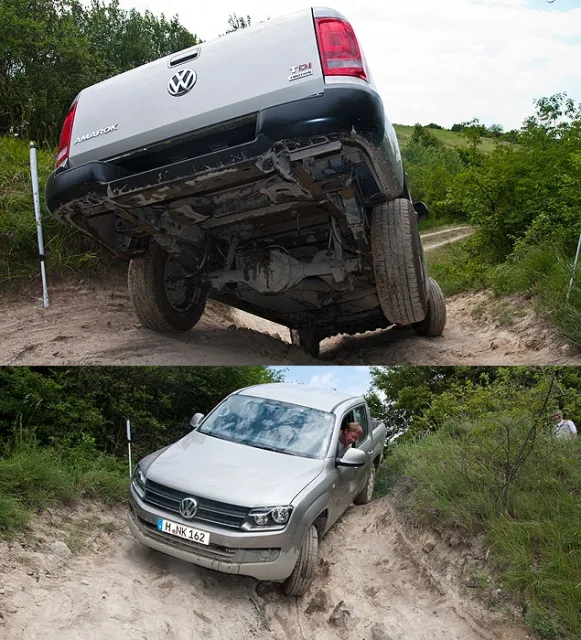
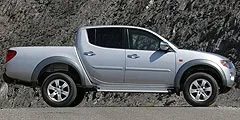
In the bottom photo, Klaus Stenzel, head of the Volkswagen division that worked on the pickup's frame, looks out of the Amarok's window — he demonstrates the vehicle's off-road capabilities to us. In the top photo, the same vehicle in the same place, but taken from behind. Klaus is proud of both the frame his department worked on and the vehicle itself — it is clear that participating in the creation of a real body-on-frame off-roader gives him genuine pleasure. Therefore, he enthusiastically shows various "tricks" prepared specifically to impress journalists. For example, we stall the Amarok's engine on a 30-degree incline, then engage first gear in low range and, releasing the clutch, start the vehicle. Instead of stalling, the pickup starts and begins to slowly crawl upward. Then Klaus clearly explains how the electronic differential lock imitation, which is standard on all versions of the pickup, differs from a real mechanical lock offered as an option. Our test vehicle is equipped with both systems, so first we go to the "diagonal wheel hang" obstacle with the electronics, and on the second round we engage the mechanical lock. The difference is noticeable — with the mechanical lock engaged, the Amarok drives on "two wheels" as easily as on all four. When the electronic system works, the vehicle first "hangs" during diagonal wheel hang and only then, under throttle, begins to move. Another "trick" is a special off-road ABS algorithm, activated by a button on the console above the transmission tunnel. In this mode, the electronics allow brief wheel locking — so that on loose soil they rake small piles in front of themselves, improving braking efficiency. The difference in the operation of the ABS algorithms was demonstrated visually: we had to accelerate on a dirt road to 60 kilometers per hour and sharply press the brake "to the floor" in a "corridor" marked with cones — once in each mode. Using the cones as a guide, we estimated how many meters the special mode saves. In our case, the difference was one and a half Amarok lengths — about seven and a half meters.
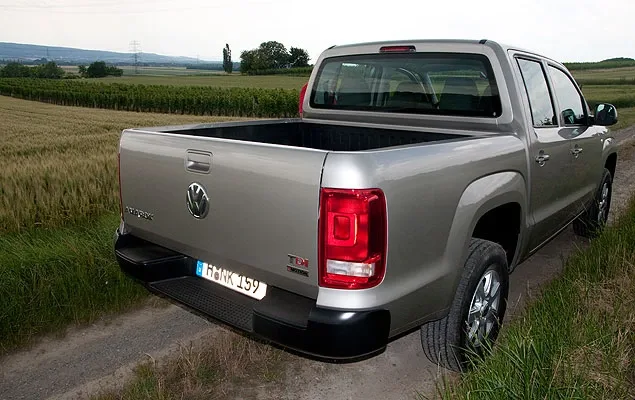
Despite having its own plant in Kaluga, the Amarok is unlikely ever to be assembled in Russia. The official explanation is "low sales volume, long transportation distance for vehicle kits, and too high customs duties on their import." At the end of the off-road test, Klaus was beaming like a polished nickel. And rightly so, he has something to be proud of: the VW Amarok turns off-road driving almost into a circus show. Therefore, the German engineer was genuinely surprised to hear our complaints about the vehicle. However, after listening to the complaints about the long travel of the manual gearshift lever and making sure that the unit's selectivity fully satisfied us, Klaus promised to pass the comment "to the appropriate place." According to him, the technical department pays close attention to any comments, because the vehicle uses many solutions new to the concern. For example, the very "manual" we complained about debuted on the Amarok. It is made in one housing with the transfer case and is intended for the pickup with a pluggable front axle. Other versions — rear-wheel-drive and the modification with permanent all-wheel drive Torsen — are equipped with an already proven unit from other models of the concern.
Tango for romantics
But the "automatic" for the Amarok is not yet available even as an option. For Russian buyers, this is a serious drawback. After all, in Russia, the German pickup is unlikely to take root as a workhorse for small businesses or small farms — things are not going well with them here. Therefore, Volkswagen marketers already predict that in our country, pickups in the bare Conceptline trim will sell noticeably fewer than the relatively expensive Trendline and Highline trims.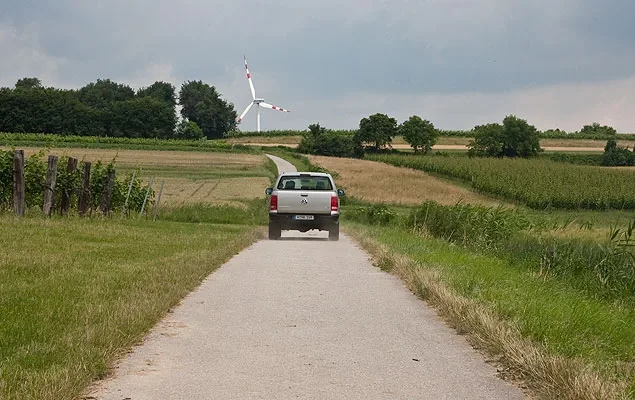
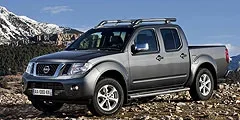
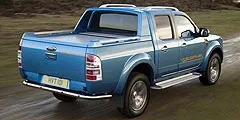
Although the European presentation has already taken place, Russian buyers will have to wait for the Moscow Auto Show to learn the exact start date of sales, prices, and trim levels of the pickup in Russia. So far, it is only known that there will be three trim levels: Conceptline, Trendline, and Highline. The first version is primarily intended for commercial transportation, hence the minimum of decorative elements in the exterior and interior design — no power windows or body-colored bumpers. "Trendline" is richer. This version has a significantly wider list of standard equipment and options. And "Highline" is designed for those who prefer to drive even off-road with comfort — in the cabin of such a vehicle, the seats are upholstered in leather, and the front panel is made of soft plastic. In addition, all versions of the Amarok come standard with ABS and four airbags. The stability control system will most likely be offered only as an option on base models. That is, in our country, the VW Amarok can only count on the role of an image vehicle for wealthy Russians who want to emphasize the "extreme" side of their nature. Such drivers do not like to "wrestle with a poker," and for them, the absence of an automatic transmission in the options list could become a strong argument in favor of competitors. Especially since now on our market, with an "automatic," you can buy not only the expensive Nissan Navara pickup but also the more affordable Ford Ranger (the Germans promise that prices for the Amarok will be in the range between these two models). There is logic in such reasoning, but it misses the essence of the issue — the Russian pickup market, where an "automatic" is needed for successful sales, is too small by Volkswagen's standards. After all, in Wolfsburg they plan to conquer almost half of the Southern Hemisphere with the Amarok. Moreover, credit must be given to the Germans — they turned out to be capable students, and the Amarok produced at the Pacheco plant in Buenos Aires with a manual transmission is in huge demand. According to rumors, all 25 thousand pickups that are to be produced in Argentina by the end of the year have already been sold out.
Alternative
|