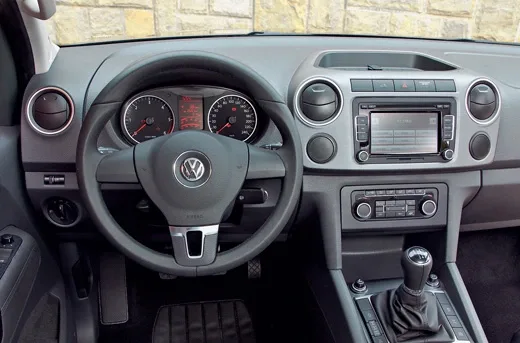
It seems the instrument panel is from the Polo, and the plastics are hard, but still, it feels solid
ROOM FOR ALL FIVE
Honestly, I feel gratitude towards the VW concern for its dislike of experiments. Sitting in the Amarok at the airport of Argentine San Carlos de Bariloche, I was sure I knew what to expect. A comfortable seat that firmly embraces the body. The correct seating position typical of SUVs. Perfect ergonomics. The interior is classic in style, without excessive pomp — it feels like the instrument panel was borrowed from the Polo and the center console from the Golf Plus. The plastic that should be soft to the touch makes a knocking sound. Wait, why knocking? Excuse me, señores, it only looks soft. Okay, that can be tolerated. The cabin is spacious in width, and in the second row there is plenty of room — three men of average build will fit without using profanity. This is significant, because most pickups on the Russian market are only nominally considered five-seaters. Now about the cargo area. Here reigns the philosophy of "square-practical-good." In theory, even an ATV can fit here; in practice, the organizers loaded a Euro pallet into the bed, and it fit perfectly, like a cartridge into a magazine. The gap between the wheel arches is 1222 mm, with pallet dimensions of 1200x1800 mm. Of course, the pallet served only as ballast. The Germans did not hide that its weight is 160 kilograms. A clever trick to improve driving characteristics. I wonder if the two-liter turbo engine will feel this load? I will jump ahead: practically not. However, for a pickup with a payload of 1000 kilograms, this is a mere trifle.
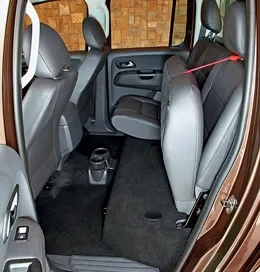
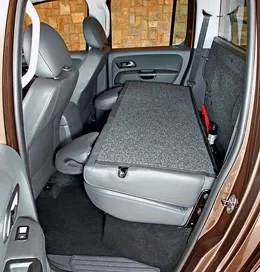
At the back – either three full seats, or a luggage compartment, or both
MODEST APPETITE
The engine with common rail and two turbochargers is surprisingly quiet for a diesel. No rattling or vibrations. Such refinement I have previously encountered only in expensive cars. However, according to Volkswagen, the main trump card of this engine is phenomenal fuel efficiency. So I will immediately answer the question about consumption: along mountain serpentines (250 km) and highways (100 km), with two passengers and cargo in the bed, the computer showed 9.8 liters per hundred. The working range is 1500–2000 rpm, where the peak torque is available. At the same time, the Amarok confidently pulls uphill even from 1200 rpm. But revving the engine to high rpm is pointless. ONE-TWO-THREE
The first thing that caused dissatisfaction was the long travel of the clutch pedal. And also the engagement of third gear: it is somewhat vague, without precision. You engage it and do not feel pleasure. Although, in essence, third gear could have been left engaged altogether: it suited both ascents and descents equally well. Especially since you better forget about engine braking in the new Volkswagen pickup — the effect is zero. Perhaps the reason is that the engine is powerful but light?
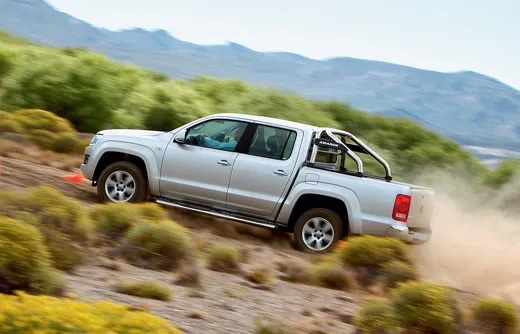
Braking in off-road mode: ABS tries to interfere as little as possible
On the highway, the comfortable cruising speed is 120 km/h. You can accelerate to 160–170, but then the needle of the pleasure gauge starts to drop. Usually it is even funny to talk about this — it is a pickup — but not in the case of our truck, which behaves like a passenger car. It holds the straight line perfectly and confidently takes curves. No rolls, no pitching, no nose dives. If the steering were a bit sharper, it could become quite a hot guy. But that is figurative, of course, the Amarok does not need sharpness. It is simply very close in character to modern unibody SUVs with fully independent suspension. RESPECT FOR LEAF SPRINGS
For off-road, the organizers prepared separate vehicles — without ballast. But to get to the specially built testing ground, we had to drive along a broken dirt road. And if there were a "Suspension of the Year" award, I would without hesitation give it to the VW Amarok engineers. Fine washboard, deep potholes, bumps — everything is handled perfectly: without bottoming out, pitching, or shaking. A German consultant joined us in the cabin, so on the way there I sat in the back, and on the way back — my colleague. The opinion was unanimous: even with an empty bed, the second row is quite comfortable. Those who have ridden as passengers in other pickups will understand me. In short, the suspension left a magnificent impression: it is not stiff, but at the same time absolutely unbreakable. The best I have encountered on pickups.
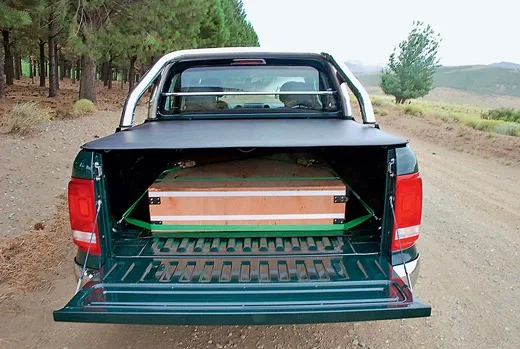
The distance between the arches of 1222 mm allows loading a Euro pallet
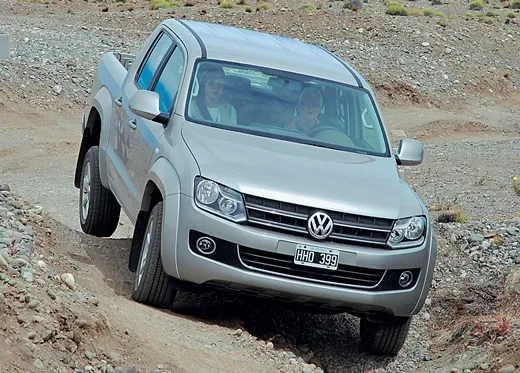
Pay attention to the bumper: they clearly worked on increasing the approach angle
BUTTONS DECIDE EVERYTHING
Off-road, the Amarok frankly disappointed me. I felt like a child whose favorite slingshot had been taken away. I craved adrenaline and drive. And from whom to expect them, if not from a brutal pickup with 265 mm of ground clearance? Without false modesty, I was going to show the Germans how to drive off-road. And as a result, it turned out that even a girl can handle this pickup. It is enough to engage the low range (ratio 2.7:1, idle speed — 2 km/h), lock the rear differential (this, however, is an option), and press the off-road button. It activates hill descent and ascent assist systems, as well as off-road ABS and traction control. After that, you can (and even should) simply release the pedals and work only with the steering wheel. Moreover, on an incline too — hill cruise control. Furthermore, if during a descent you press the clutch out of fear, nothing will happen, the speed will not change. In short, the Amarok itself climbs 100-percent (45 degrees) slopes and descends itself, handles wheel articulation itself, and decides how to brake. Let me explain about braking: off-road ABS allows the wheels to lock slightly so they can build up a ridge of soil in front of them. This is how emergency systems on trains sprinkled sand in front of the locomotive to accelerate stopping. True, as we were explained, off-road ABS is useless on snow and ice. And on clay, it is probably not always effective.
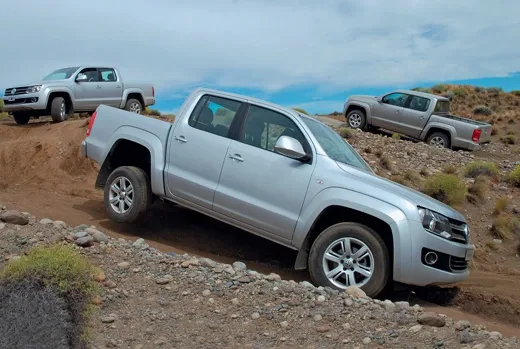
Regular readers may remember that I have long acknowledged the benefits of electronic assistants. For example, the Land Cruiser Prado 150 and Land Rover Discovery IV are so good at automation that one can only admire them. It was just unexpected to find such "artificial intelligence" on a pickup. BETWEEN MITSU AND NISSAN
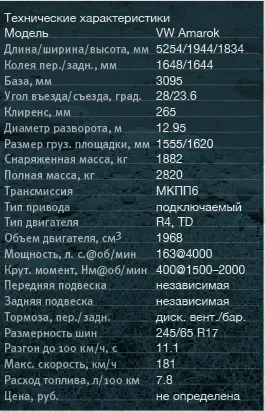
So, we have already figured out the strengths and weaknesses of the Volkswagen Amarok. The only thing that remains a mystery is its price. Officially, the price will be announced only in August, when the pickup is presented at the Moscow Auto Show. Russian sales will start in the fall — a little later than in Latin America (where it is produced), but earlier than in Europe. So far, it is only known that three basic trim levels are planned, including the simplest one — with black bumpers and without power windows. Interestingly, a version with permanent all-wheel drive based on a Torsen differential will also be available.
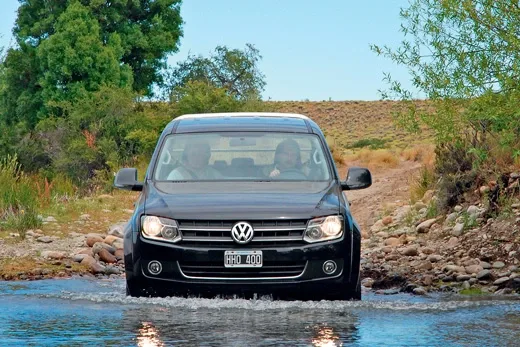
The permitted wading depth is 500 mm. But this is, of course, a safety margin
For Amarok, a lot of accessories of varying usefulness will be offered. For example, a plastic insert for the cargo area is a necessary thing. But you can easily do without a double-DIN touchscreen head unit.
It is already obvious that the only competitor of the Volkswagen pickup on the Russian market is the Nissan Navara. However, the head of the Volkswagen Commercial Vehicles brand, Mikhail Semenikhin, has already stated that the new model will be priced higher than the Mitsubishi L200 but lower than the Nissan Navara. So the price list for the Amarok will clearly start from 1 million rubles.