
Toyota Yaris. The Second Coming. But Will It Be Successful?
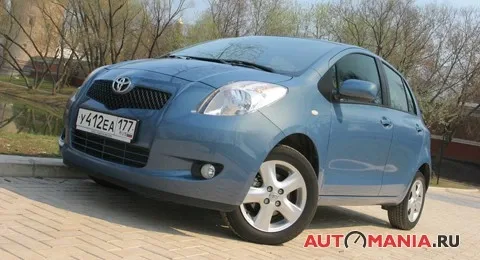
Why "return"? The debut of the first Yaris took place in 1999. In Europe, 1.2 million units were sold, but in Russia — almost zero. In the late nineties, few wanted to pay 14–17 thousand dollars for a car with a one-liter engine. Even the title of "European Car of the Year" for 2000 did not save the situation, and the model disappeared from the post-Soviet market. Now — the second coming. Neither liter nor diesel versions will be brought to us. Only one option: a 1.3-liter "ferret" with 87 horsepower. The gearbox is either manual or the proprietary MultiMode (something like EasyTronic: a manual without a clutch pedal, but without "drive" and "parking" modes). There are three trim levels: Yaris (1), Luna (2), Sol (3). We got the top one — it, like all others, is assembled in France.
Try to Start It
I sit down, press the "engine start" button, familiar from Lexus and more expensive Toyotas. Silence. Damn. I figure out what's wrong. I remember: a similar gearbox was already encountered on the Corolla Verso and Suzuki Swift. There is no "P" or "D" — only "R", "N", and "E" (what this letter means, I never understood, but it replaces "drive"). To start the engine, you first need to put the lever in "N", press the button, then move it to "E" and only then drive off. And don't forget to release the handbrake in "N" position. It's fussy, but you get used to it in a couple of hours. Another question is how this system will behave in our winter conditions, when frost alternates with thaw.
The Slow-Witted "Robot"
I'll reveal one thing right away. When we returned the car after the test, the garage manager at the Toyota representative office was surprised: only 60 kilometers of mileage (usually we rack up 600–700 km in 2–3 days). And it's not that there was nowhere to go. It's just that after a couple of kilometers, this gearbox wears you out. In "pseudo-automatic" mode, the Yaris (like the Corolla Verso with the same transmission) noses down when you press the gas and absolutely doesn't want to accelerate. The robot inside the gearbox, unlike Asimov's creature with instant reaction, is endlessly thoughtful.
Another point — a well-deserved "two" for behavior on an incline. If I hadn't used the handbrake in time, the car behind would have been in trouble, and I'd have to explain myself to the traffic police, and you wouldn't immediately think of how to explain such a situation. Plus, over two days, I never managed to get comfortable in the driver's seat: it's hard and uncomfortable. The seating position is minivan-like, but you still can't feel the front dimensions.
Not only the seats turned out to be hard, but also the suspension. Any pothole or bump responds in the cabin with an unpleasant jolt.
Sound insulation is also not impressive. The engine is audible constantly, and after 60 km/h, external noises add up.
The Main Thing Is Not Driving, but Safety
But there are no complaints about safety. As in the Avensis, there's a knee airbag under the steering wheel, a collapsible steering column, and a folding brake pedal. In total, there are seven airbags, two fewer than in the Avensis. The handling also pleases: the electric power steering works perfectly, the EMPS system is borrowed from the Avensis. The turning radius is only 4.7 meters, which is very handy in the city.
Who Needs It
Now let's try to imagine a buyer willing to pay almost 20 thousand dollars for the top version. In the B-class, competition is fierce. I've driven many rivals. For example, the Nissan Micra with a regular automatic in top trim for 17–18 thousand seemed more comfortable, and there's no less space in the back. The Chevrolet Aveo in luxury trim for 12–14 thousand is also not bad. The Ford Fiesta with a more powerful engine costs about the same as the Yaris, but drives more interestingly and is more pleasant in comfort. Don't forget the Mitsubishi Golf, which wins in urban qualities.
I shared my thoughts about competitors with those who took the car from me. The answer was: "Don't worry, people are ready to pay for the Toyota badge and believe in it."
And I'm worried. I don't yet see great prospects for big sales of the newcomer in the B-class. In 2007, only 4,775 "ferrets" were sold, and in the first quarter of 2008, it didn't even make it into the top twenty.
Dmitry Shavyrin
Brief technical characteristics of the Toyota Yaris:
| Dimensions (mm) | 3750x1695x1530 |
| Wheelbase (mm) | 2460 |
| Engine | 1.3 L, 4-cylinder, inline |
| Displacement (cm3) | 1296 |
| Max power (hp/rpm) | 87 at 6000 |
| Max torque (Nm/rpm) | 121/4200 |
| Curb weight (kg) | 1055 |
| Gross weight (kg) | 1480 |
| Acceleration to 100 km/h (s) | 13.1 |
| Average fuel consumption (l/100 km) | 5.8 – 6.7 |
| Fuel tank capacity (l) | 42 |
| Ground clearance (mm) | 140 |
| Max speed (km/h) | 170 |
| Price (rubles) | from 471,000 to 550,000 (plus 6,500 for "metallic" paint) |
We thank the Toyota representative office in Russia for providing the car for the test.
Source – AUTOMANIA.RU