
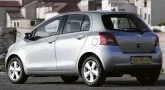
Already in March, Russian Toyota dealers will have another new product — the second-generation Yaris hatchback is entering the domestic market.
The first generation of the Yaris debuted seven years ago. The model, which managed to earn two "Car of the Year" titles — in Japan and Europe — was once sold here too, but only for a few months. Back then, the small car found no demand and quickly disappeared from showrooms. Today, the situation is different: the foreign car market in Russia is growing rapidly, and compact cars are gradually gaining their fans. The new Yaris has grown noticeably, especially in length — the increase is 110 mm. The car's appearance hints at features of the Corolla and even the Avensis, which will undoubtedly please future owners. The front bumper now forms a single unit with the radiator grille — this solution simplifies production and allows only one element to be replaced in a minor accident, reducing repair costs. The hood and headlights are secured in a special way: in a frontal impact, they shift upward, and in a low-speed collision, the optics and hood may remain intact.
The interior greets you with a pleasant design — it's clear that Toyota specialists worked hard. In the central part of the front panel, as in the previous model, there is an electronic "well" of instruments. Thanks to a special lens in front of the display, it creates the impression that the scales are recessed deep into the dashboard. This optical illusion is convenient for the driver: when the gaze shifts from the road to the instruments, eye accommodation hardly changes. The steering column adjusts in two directions, so a person of any height can easily sit behind the wheel. In versions with the Smart-Key system, which recognizes the owner by an electronic key fob in the pocket (range about one meter), the engine is started with a button. Climate is controlled by three identical round knobs located one above the other on the central console — a rare case of a successful combination of originality and convenience.
The front panel resembles a home secretary: there are as many as three glove boxes — one regular at the bottom and two at the top. At the edges of the dashboard, there are fold-out cup holders. Door pockets are designed to hold a water bottle. Small compartments for small items are also on the sides of the central console and under the steering column.
In the back row, you're initially surprised: where does so much space come from in such a compact car? There's no less free space here than in the Corolla — the wheelbase increased by 90 mm has an effect. The rear seat deserves special mention: its unequal parts can not only be folded but also slid forward, increasing the trunk. And the backrests are adjustable for tilt, which will come in handy on a long journey. In Europe, the Yaris will be offered in two body styles — three- and five-door, as well as with three engines: gasoline 1.0 and 1.3, plus a 1.4 turbodiesel. Russian buyers, however, will only get the five-door version with the 1.3 engine. This choice by Toyota Motor marketers is understandable: three-door cars and cars with weak engines are hardly bought here. And the turbodiesel is not supplied to Russia due to doubts about the quality of local fuel, which, according to Toyota, is detrimental to modern direct-injection diesels.
A Russian buyer, thus, is spared the choice of body and engine, but can choose the transmission. In addition to the regular manual gearbox, the new Yaris is available with a MultiMode robotic gearbox equipped with servo drives for the clutch and gear shifting.
Robotic gearboxes have the advantages of an automatic, and they are cheaper to produce, so they are used more and more often. True, not all manufacturers manage to fine-tune the electronics: often "robots" are late with shifts or engage gears too abruptly, causing the car to nose-dive during acceleration. But Toyota has a very smart "robot"! It works no worse than an experienced driver: you can calmly stand in a traffic jam or drive at an aggressive pace. In the latter case, the electronics allow revving the engine almost to the red zone, without interfering with the driver by early upshifts. There is also a sequential mode — then gears are shifted manually by rocking the lever forward and backward. MultiMode not only simplifies control but also saves fuel: according to official data, the version with the "robot" consumes less gasoline than the car with a manual. The main buyer of the Yaris at the Russian Toyota office is considered to be a wealthy resident of a big city who wants a compact but comfortable car. And such a buyer will most likely choose MultiMode: the price difference is only $800, so it can be expected that most sales will come from robotic versions.
+ High safety, spacious interior, interesting appearance, good equipment.
– Russian versions do not have a stability control system.
Trims and prices
In Russia, the Yaris will be sold in three trims. The base version with a manual gearbox costs $17,390 and includes ABS with EBA, four airbags, air conditioning, power windows, as well as heated seats and mirrors. The same car with MultiMode will cost $17,990. The top version of the Yaris with a robotic transmission costs $20,450 — it will additionally get alloy wheels, fog lights, climate control, keyless entry Smart-Key, side curtain airbags, and a driver's knee airbag.
Technical specifications of Toyota Yaris 1.3
Curb weight, kg – 1055
Gross weight, kg – 1480
Dimensions, mm:
- length – 3750
- width – 1695
- height – 1530
Wheelbase, mm – 2460
Trunk volume, l – 272–1086
Maximum speed, km/h – 170
Acceleration time to 100 km/h, s – 11.5 (13.1)*
Fuel consumption, l/100 km:
- city cycle – 7.2 (6.7)
- highway – 5.3 (5.3)
- combined – 6.0 (5.8)
Engine:
- type – gasoline, 4-cyl., 16-valve
- displacement, cm3 – 1296
- power, hp at rpm – 87/6000
- torque, Nm at rpm – 121/4200
Transmission – manual, 5-speed (robotic)
Suspension (front/rear) – independent, McPherson/semi-independent
Brakes (front/rear) – disc, ventilated/drum
Price, $ – from $17,390 (from $17,990)
* — Data for the modification with a robotic transmission are given in parentheses.
© 5 Koleso