
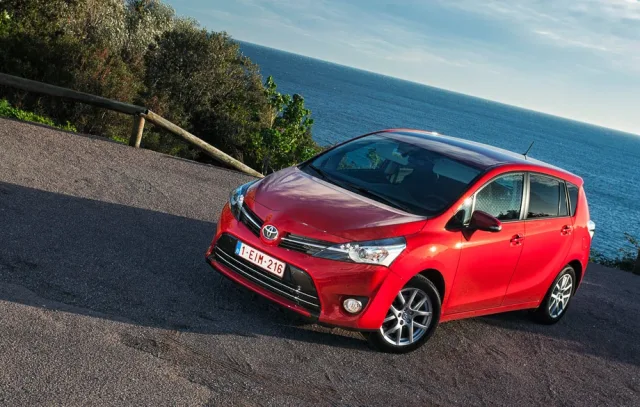
Having received a new corporate face, the Toyota Verso grew by 20 mm in length (to 4460): 15 mm of the increase came from the front bumper, and 5 mm from the rear. Nevertheless, it is still actually the most compact car among those that can be ordered with a seven-seat interior. Although the difference with the closest competitor is now vanishingly small — the Opel Zafira Family is only 7 mm larger.
It should be noted that the appearance in the new corporate style suits the Verso. And that's not a pun — at the rear, there are very few changes. The bumper shape has become slightly sharper, a diffuser has appeared, and that's it. Personally, I have no complaints about the rear lights themselves. It's just that if previously their rounded shape echoed the similar contours of the front optics, now the front is all angular and chiseled, while the rear remains as it was. A hundred percent harmonious image is not achieved.
It's difficult to distinguish the updated car from the pre-facelift one from the rear, but it's possible. The 2013 model has a black diffuser in the rear bumper.
In the interior, there are no architectural or layout innovations. The trim style has changed slightly, and, most importantly, the materials have been radically improved. The plastic is mostly soft, the leather on the steering wheel is not just any kind, but Nappa. Matte silver inserts look appropriate and contrast pleasantly with the dark interior details. Build quality is top-notch. Special thanks should be given to those responsible for the facelift for the white color of the instrument cluster backlighting. It looks noticeably more pleasant compared to the old amber one, and it's also a plus for the readability of the instrument readings.
For the first time, I had the opportunity to drive a car with instruments located in the center of the cabin. I have always been skeptical about this solution, but it turned out to be really convenient. Perhaps in some ways it's even better than projecting data onto the windshield. The information is always quite close, but at the same time it doesn't constantly hover before your eyes.
The interior still has many compartments and pockets for small items, and the upper part of the split glove box is cooled. The proprietary interior transformation system called Easy Flat is truly simple to use and offers more than 30 different combinations. There is plenty of legroom in the second row, and all three individual seats can be independently adjusted in length over a range of 195 mm. However, the third row of seats was somewhat disappointing. To sit there really comfortably, the seat in front must be moved forward as much as possible, leaving very little space. Of course, you can find a compromise position, but that would be an option where everyone is equally uncomfortable.
The front seats are well profiled, and the lateral support can be called sufficient with a slight stretch — on serpentines it was sometimes lacking. Full-fledged individual second-row seats and a flat floor mean that all three passengers will have equally spacious conditions. Those sitting in the gallery almost got no side glazing, and there's also not enough legroom — you have to ask those in front to move up. But there are a couple of large cup holders, and thanks for that.
However, perhaps this is what should be expected from a car with such modest dimensions for its class. Moreover, even with all the backrests raised, the trunk volume can be called useful. At least a couple of suitcases, like those you can take on a plane as hand luggage, fit there without needing to pack them with your feet, and there's even some space left. I think the option with the rear seats shifted all the way back was also considered when creating the Verso, but, firstly, it's unclear what would happen to safety in that case, and secondly, the idea of completely losing the trunk doesn't appeal to me personally.
The central armrest and doors in the top trim are upholstered in leather. The tables in the backrests of the front seats are quite convenient and equipped with cup holders. Given that the table's tilt angle is rigidly linked to the angle of the front seat backrest, this is a very relevant thing; it will be harder to spill tea. As an option, you can also order a panoramic glass roof.
I don't understand the person who placed the USB and AUX connectors on the side of the central tunnel on the passenger side. Firstly, the driver can only use them by touch, and secondly, this location exposes flash drives and wires to a constant risk of mechanical damage from the feet of occupants.
In addition to the practicality of urban use, more compact dimensions allow the car's weight to be kept at an acceptable level, which benefits handling, dynamics, and fuel efficiency. Changes to the front and rear suspension, an increase in the number of welding points, and recalibrated electric power steering and CVT also contribute to this. The only version that could be driven to assess the changes is the Verso with a 1.8 petrol engine paired with a CVT. I liked that the car in this combination drives very honestly.
Under the trunk floor are a space-saver spare wheel and several additional compartments for small items. The space remaining behind the folded third-row backrests is sufficient for small bags or suitcases.
Of course, there are no miracles: 11 seconds to 100 km/h is frankly slow, and the CVT is largely to blame. However, the operation of the continuously variable transmission in automatic mode has been made more pleasant; engine revs now rise more in line with acceleration. The sport and manual modes are fundamentally no different — in both, the range of gear ratios is divided into seven virtual steps, and in both options, the gears are automatically shifted by the computer both down and up when critical revs are reached.
The passport states the figures: 147 hp and 180 N•m, and the real dynamics are felt in these numbers.
If you drive for a long time with the gas pedal floored, the Verso will eventually accelerate to its maximum of 185 km/h. I won't say how long it takes to reach that speed; I didn't have the opportunity to time it, but it's nice that the handling remained transparent throughout the acceleration up to the maximum, with no hints of yawing from side winds or unloading of the axles due to increased lift forces. And you can talk at high speeds without raising your voice much. The blame lies with the reduced rearview mirrors compared to the pre-facelift car, additional sound insulation in the area of the front pillars, and improved seals in the front door openings.
Wind whistle around the mirrors begins to appear above 120 km/h, but with further speed increase, its volume rises insignificantly. Energy-saving tires with low rolling resistance contribute to the noise reduction.
Of course, the Verso is not a driver's car, and it would be strange to expect sporty behavior from a compact MPV. But how responsive the steering turned out to be in practice commands respect. The "action — effect" connection here is immediate. Navigating through narrow European streets, it's easy to imagine how big a plus this is in our evening courtyards, when cars from nearby houses are already parked almost on top of each other. And even the body rolls during active driving on winding roads turned out to be surprisingly insignificant.
Perhaps the only complaint about the car's behavior on the road is the feeling of emptiness in the steering wheel near the center position. When corrective steering is needed on a straight line, there is not enough feedback from the steering wheel, even though the car itself responds willingly to slight steering wheel deviations. The dead zone ends quite quickly, and then there are no complaints about the informativeness of the steering wheel.
If there were plenty of opportunities to get acquainted with the Verso's handling — around Cannes, where the European presentation route of the Verso actually ran, there are plenty of serpentines — then with bad roads, to the great joy of the French, it was very, very tight. I had to use every chance to test the suspension in action. Run a wheel over sewer manholes, overcome a speed bump a little faster than allowed, and listen to the effect. And there was almost none; the tires just slap, and that's it. Moreover, riding in the back is just as comfortable as in the first row. Both the suspension and the sound insulation of the wheel arches were worked on excellently by the ED2 team.
The minimum price for the updated Verso compact van on the Russian market is 820,000 rubles. For this money, the buyer will get a car in the Comfort trim with a 1.6 engine producing 132 hp and a manual transmission. The same trim with a 1.8 engine will cost 890,000. The seven-seat interior is available only in the top Prestige version, for which they ask 1,090,000. The same Zafira Family, by definition, comes with three rows of seats, and prices for it start from 784,000 rubles.
Perhaps this is just a coincidence, but the car, updated under the leadership of an engineer from Turkey, will be produced in that very country. In Europe, Toyota expects to sell enough Verso compact vans to achieve a 5% market share. They say that in Russia the plan is approximately the same, and it seems to me quite achievable. Prices for the thoroughly improved car remained, though not low, but quite acceptable (the base version even became cheaper by 23 thousand rubles), and there are plenty of people who do not want to carry an extra half meter of car behind them every day for the occasional need to seat seven. I, for example, know such people personally.
Specifications
| Toyota Verso | 1.6 Valvematic | 1.8 Valvematic |
|---|---|---|
| Body | ||
| Body type | hatchback | hatchback |
| Number of doors/seats | 5/5 | 5/5–7 |
| Length, mm | 4460 | 4460 |
| Width, mm | 1791 | 1791 |
| Height, mm | 1630 | 1630 |
| Wheelbase, mm | 2780 | 2780 |
| Front/rear track, mm | 1535/1545 | 1535/1545 |
| Curb weight, kg | 1525 | 1525 (1540)* |
| Gross weight, kg | 2125 | 2125 |
| Trunk volume, l | 484–1026 | 155–982** |
| Engine | ||
| Type | petrol | petrol |
| Location | front, transverse | front, transverse |
| Number and arrangement of cylinders | 4, in-line | 4, in-line |
| Number of valves | 16 | 16 |
| Displacement, cm | ||