
Toyota RAV4 has long earned a reputation as one of the most popular SUVs among women. However, the new generation, first shown in Frankfurt in the fall, could change that perception. Thanks to a more assertive design and increased dimensions, the car may well attract the attention of the stronger half of humanity as well.
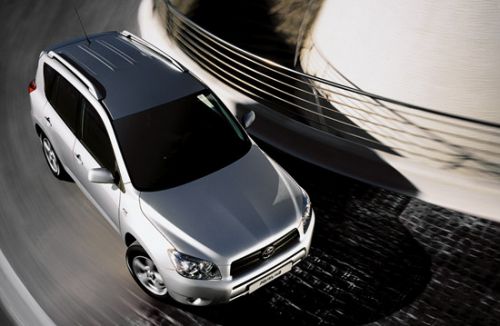
2006 Toyota RAV4
© Photo: Toyota
The design remains true to previous principles: a unibody construction, a transversely mounted engine, and a fully independent suspension. But the dimensions have become more serious. The wheelbase has grown by 70 mm and now stands at 2560 mm, while the overall length has increased by 145 mm to reach 4395 mm. The body has also become wider — expanding from the previous modest 1735 mm to 1815 mm.
The secret of RAV4's popularity among the fairer sex was simple: the high seating position provided excellent visibility, the ground clearance allowed not to fear curbs and light off-road conditions, and all-wheel drive added confidence. A neat, elegant appearance without excessive pretentiousness also played a significant role. Now the exterior has become noticeably more masculine and aggressive, which is clearly aimed at attracting a male audience. In a number of stylistic solutions, the new model has become closer to the older models in the family. It is also worth noting that the three-door version is a thing of the past — now only a five-door body is available to buyers.
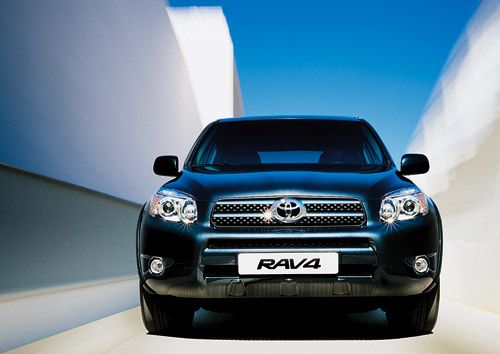
2006 Toyota RAV4
© Photo: Toyota
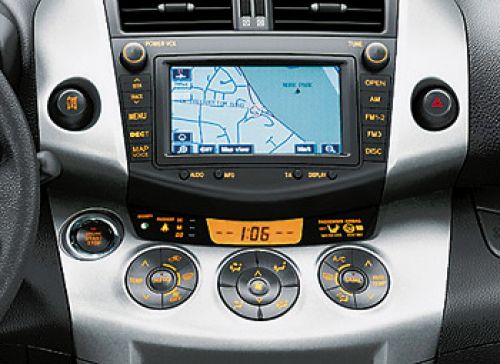
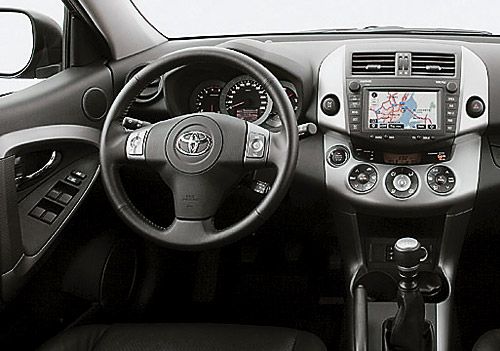
The interior has also undergone significant changes. However, along with the increase in external dimensions, the engineers seem to have decided to save on finishing materials. Visually, the plastic looks quite decent, but upon closer inspection and tapping, you realize it is hard and cheap, which is a bit disappointing.
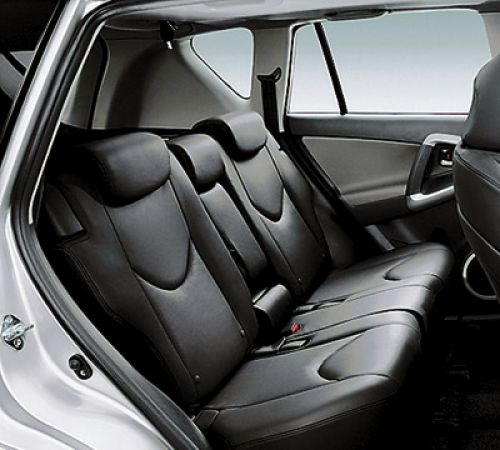
But there are also pleasant innovations. For example, the Easy Flat system, familiar from the Yaris II minicar. It allows the rear seats to be folded flush with the luggage compartment floor, with each part of the seat able to be moved independently of the other.
The suspension at the front and rear has been redesigned. But the main technical innovation is the Active Torque Control 4WD permanent all-wheel drive system. This complex combines ABS, a vehicle stability control system, an electromechanical power steering, and an active traction control system. It works like this: sensors continuously monitor speed, steering wheel position, and throttle input. The electronics, controlling an electromagnetic clutch, distribute torque between the axles in a ratio from 55:45 to 100:0 in favor of the front wheels.
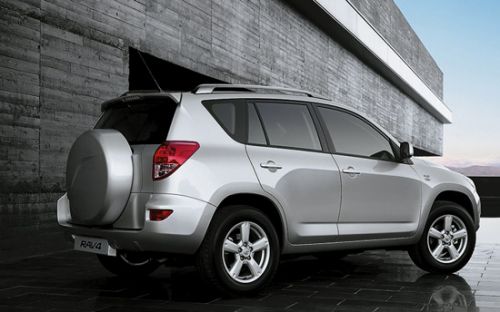
2006 Toyota RAV4
© Photo: Toyota
Assessing the effectiveness of this system in practice turned out to be easy. For this, two cars were needed — the old and the new — to feel the difference. The second condition was a large asphalt area with a section covered in plastic plates that, when watered, become very slippery, almost like ice. Behind the wheel of the old version, we accelerate to 65 km/h, driving the right wheels onto the wet plastic while the left wheels remain on dry surface. Then — sharp braking. The old car holds the straight line, but only if the driver actively turns the steering wheel, despite the chattering of the ABS. We switch to the new RAV4 and repeat the maneuver. The result is the same, but much less effort is required from the driver — the electronics themselves correct the trajectory. This is a definite plus for those who do not have extreme driving skills, and such people are the majority. For experienced drivers accustomed to relying only on themselves, the intervention of Active Torque Control 4WD may seem excessive. But, I think, ordinary car owners will rather be pleased — with an electronic assistant, there is less chance of getting into trouble.
2006 Toyota RAV4
© Photo: Toyota
Now about the engine. For our market, the new model is offered with a single 2.0-liter gasoline engine with 152 horsepower. With such a unit, the car accelerates to 100 km/h in 10.6 seconds. However, it seems that the engine has become noisier than its predecessor. Perhaps this is the price for the increased body dimensions. There are two gearboxes to choose from: the previous 5-speed manual or the same old 4-speed automatic.
2006 Toyota RAV4
© Photo: Toyota
European buyers are luckier in this regard. They have a choice of two 2.2-liter diesel engines with 136 or 176 hp, which are paired with a 6-speed manual gearbox.
The absence of a diesel is, of course, disappointing. But there is good news: for the version with an automatic transmission, a function has appeared that was previously found only on large SUVs. This is the Hill-start Assist Control (HAC) system, which prevents the car from rolling backward. It is complemented by the DAC system, which assists when descending a hill: the car brakes with the engine, and the driver hardly needs to use the brake pedal. Such solutions have long been used on heavy trucks.
The body has become safer. Judging by the equipment, the engineers are aiming for the maximum result in Euro NCAP crash tests. The top version has seven airbags: two front, two side front, two curtain side, and one lower airbag to protect the driver's legs.
2006 Toyota RAV4
© Photo: Toyota
In Russia, buyers will be offered three trim levels. The starting price is $33,000. For this money, the car will have alloy wheels with 225/65R17 tires, a six-disc CD changer, VSC, ABS with EBD, Brake Assist (BA), traction control system TRC, and the already mentioned Hill-start Assist Control (HAC). By paying an additional $1,400, you can add the Downhill Assist Control (DAC) system to this list. And for $37,800, a version with a leather interior, Smart-key keyless entry system, engine start button, cruise control, rain sensor, and automatic headlight activation is available. Sales of the new RAV4 will begin in March.
Technical specifications of Toyota RAV4
Body – wagon
Number of seats – 5
Curb weight, kg – 1185
Gross weight, kg – 1750
Dimensions, mm:
- length – 4395
- width – 1815
- height – 1685
Wheelbase, mm – 2560
Trunk volume, l – 586
Maximum speed, km/h – 185 (175 AT)
Acceleration time to 100 km/h, s – 10.6 (12 AT)
Fuel consumption, l/100 km:
- city cycle – 11
- highway – 7.2
- combined – 8.6
Fuel tank volume, l – 60
Engine:
- type – gasoline, VVT-i
- displacement, cm3 – 1998
- power, hp at rpm – 152/6000
- torque, Nm at rpm – 194/4000
Transmission – manual, 5-speed (automatic, 4-speed)
Tire size – 225/65R17
Suspension:
- front – McPherson
- rear – double wishbone
Brakes:
- front – disc, ventilated
- rear – disc
Steering – electric power steering
Price, $ – 33,000–37,800.
Advantages and disadvantages
+ Increased interior space.
– Insufficient sound insulation.
March 14, 2006
Author: Stanislav Pavlov
© 5 Koleso