If you take a closer look at the new look of the RAV4, it seems the idea has worked. Previously, this Toyota crossover confidently led sales in its segment on the Russian market. However, over time it was pushed aside: first Nissan X-Trail took the top spot, then Hyundai Tucson, and later Honda CR-V. What caused the loss of leadership? Many reasons have accumulated. Of course, the RAV4 scared off part of the male audience with its "feminine" image, but that wasn't the only issue. The inflated price with rather modest dimensions also played a significant role. Competitors one by one approached the 4.5-meter mark in length, and some even exceeded it, while the "Japanese" remained at its 4.3 meters with a short wheelbase. Of course, it's known that women often prefer smaller cars, but for men not burdened with complexes, size still matters.
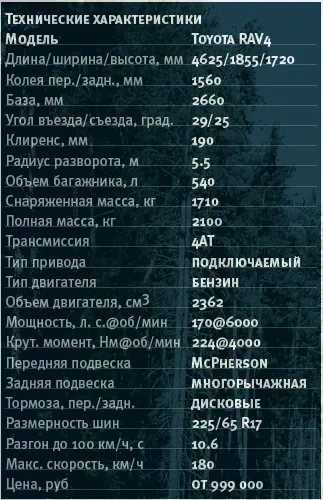
The new RAV4 has tried to correct all previous miscalculations. Now the crossover is also available in an extended version — 4.6 meters, and the wheelbase has grown by 100 millimeters. The trunk volume has increased from 410 to 540 liters, and the cabin has become noticeably more spacious. Notably, with an increase in living space length of 45 millimeters, the distance between the front and rear rows of seats has grown by 65 millimeters. Family buyers should appreciate this. However, the short version of the crossover will also remain on sale — apparently, for those who have difficulty parking.
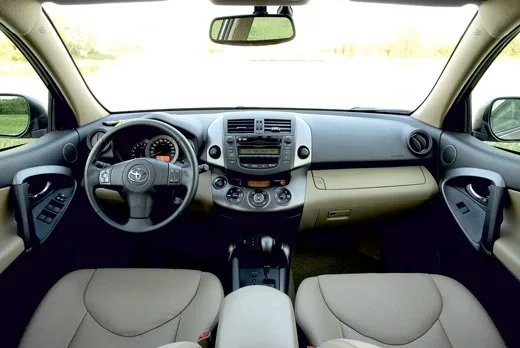
The two-tier layout tries to accommodate the driver's attempts to control the climate while driving
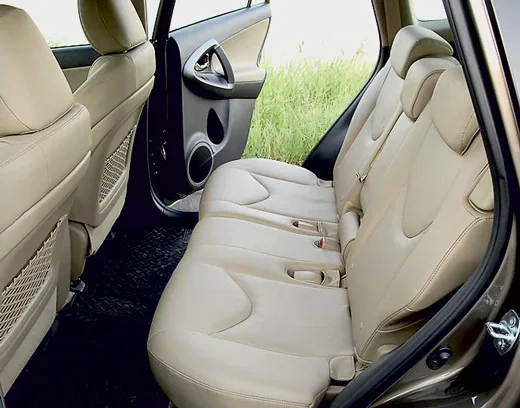
The rear row is now noticeably more spacious than before
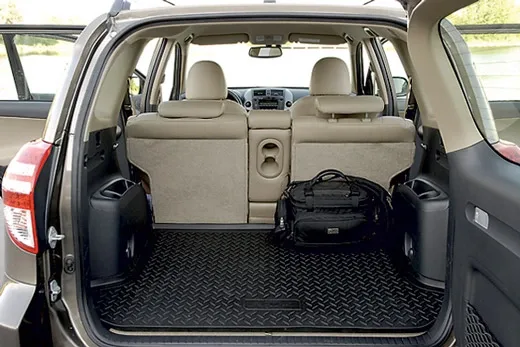
In the trunk, under the false floor, there's a huge niche — it can fit several packs of beer
STOP AND TWIST
The technical content of the RAV4 has not changed. Under the hood are still the same two gasoline engines with volumes of 2.0 and 2.4 liters. Paired with them are a five-speed manual and a four-speed automatic. In the cabin, the design of the climate control unit has been slightly adjusted, although this refinement could have been skipped — there's no benefit from it. And yet, the "Japanese" front panel deserved proper work. There's room for improvement. The clever two-tier layout tries to help the driver adjust the climate while driving, but it's far from ideal. All buttons on the front panel should be at a level where the eyes continue to monitor the road with peripheral vision, or they should be suitable for blind operation. At the very least, something very simple could have been devised — for example, huge knobs with large pictograms. I know I complain about this too often, but, by the way, it's a safety issue. Hardly anyone will stop on the roadside to adjust the climate or switch radio stations.
NEITHER BY WEIGHT NOR BY INTELLECT
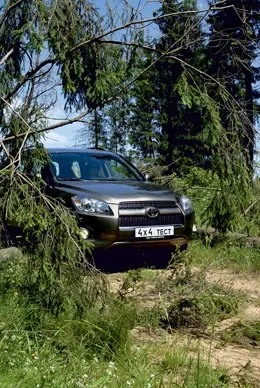
So, the new RAV4 tries to position itself somewhere between the Outlander and the X-Trail, having received a more aggressive face and slightly increased in size. But these are just my assumptions; let's see what Toyota itself says about this. I open the press release and read: "...design changes emphasize strength and athleticism... even more masculine..." Yes, the Japanese are indeed saying goodbye to "feminine toys." We read further: "...the highest class of a sports SUV..." Strange, why don't they replace the word "sports" with "reliable"? And also: "...the enlarged body gives the appearance solidity and status..." At this point, LC200 owners should cry — they paid two and a half times more for the same qualities.
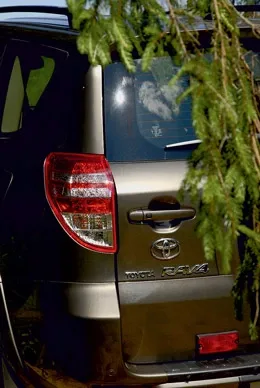

The Toyota press release says nothing about how the new RAV4 behaves on the move. I haven't noticed any changes in the crossover's character. The last time I sat behind the wheel of this car was in March 2008, when we compared it with the Jeep Liberty. Then I remembered the ease with which the "Japanese" performed any maneuvers — acceleration, U-turn, climbing a hill. The new version just as easily doesn't burden the driver with either weight or intellect. It moderately obeys the steering wheel and brakes well. The main thing is that it does everything without visible effort, and that's its main advantage. Overall, it's a fairly easy-to-drive crossover that doesn't suffer from excessive body roll or a stiff suspension. Everything in it is quite harmonious. Except, perhaps, its ability to drive off-road.
SPECS: TOYOTA RAV4
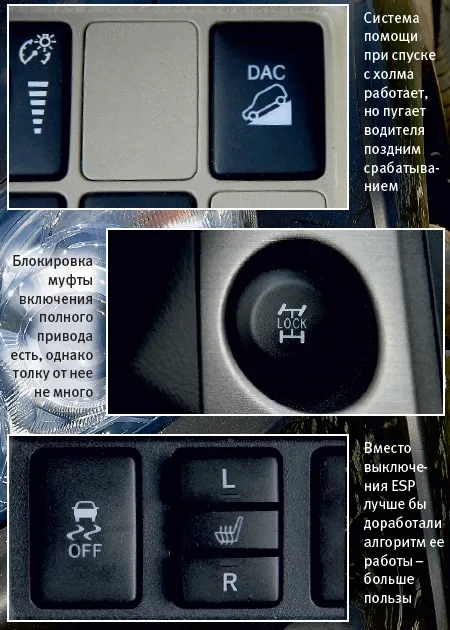
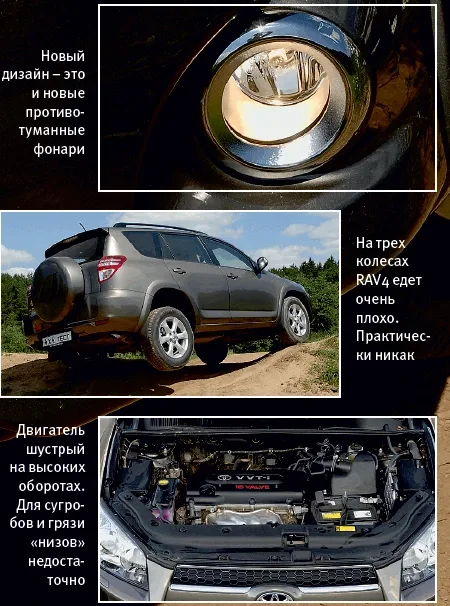
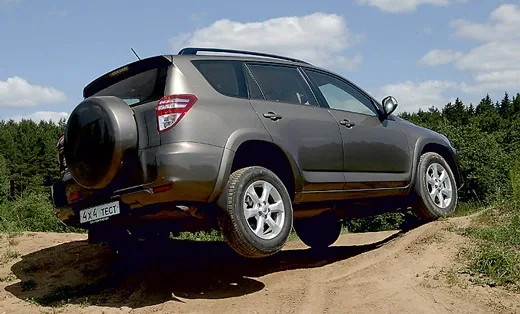
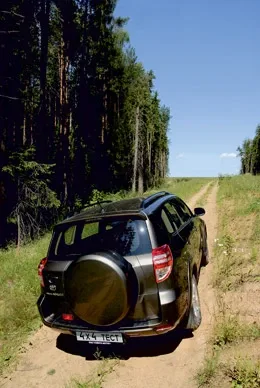
Off-road, it behaves as before — like a large passenger car with a helpless traction control system that resists to the last. It's better to approach obstacles with momentum. Only decent geometry allows overcoming difficult sections — the approach and departure angles of the RAV4 are 29 and 25 degrees, respectively. This, however, doesn't guarantee the integrity of the bumpers, so caution won't hurt. And if the "Japanese" does get stuck with wheels hanging, you'll have to get out and think about how to live on. Unfortunately, there's no "Land Cruiser" wisdom in the electronic algorithms for braking spinning wheels in the new RAV4. You'll have to think for yourself.
However, for a bit of hooliganism, ESP can be turned off, and the rear axle coupling can be locked. With certain experience, the advantages of all-wheel drive will be available. Within reasonable limits. Ideally, a diesel or a lower-geared transmission would be nice here, since they've taken a course toward athleticism. For now, this grown-up crossover simply doesn't bother with extra noise and doesn't scare with its trim. Is that enough to attract more men?