
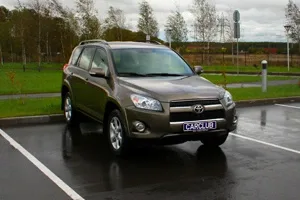
In Russia, the compact crossover segment is in huge demand. The very word "jeep," which we commonly use to refer to any vehicle with elevated ground clearance, has an almost magical effect on car enthusiasts. Even before the crisis, during the automotive boom, this class was rapidly gaining popularity, and one of the main stars here was the Toyota RAV4.
The Toyota brand holds a special place in our country. Take, for instance, the Camry business sedan — it consistently ranks among the top ten best-selling cars, despite being surrounded by budget models. And the Land Cruiser 200 SUV leads its segment by a wide margin.
With the updated version of the "Rafik," Toyota seems to have decided to challenge the stereotype of a "women's car" that has firmly attached itself to this model. The exterior facelift, apparently, should please both loyal fans and a broader audience. There are no radical changes in appearance, but the car has become noticeably fresher: different headlights at the front, a new bumper, fog lights with chrome trim, redesigned taillights, a revised grille, and a fresh design for the alloy wheels.
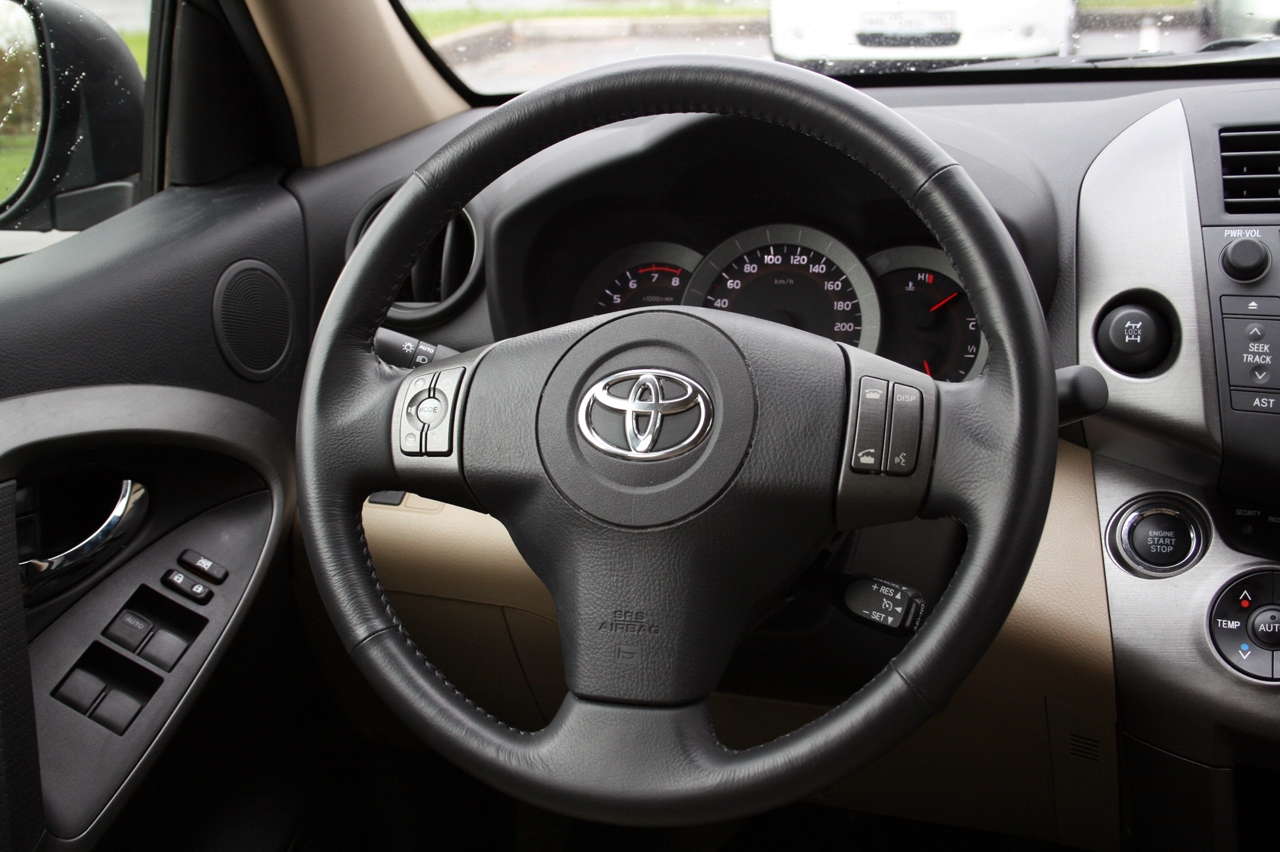
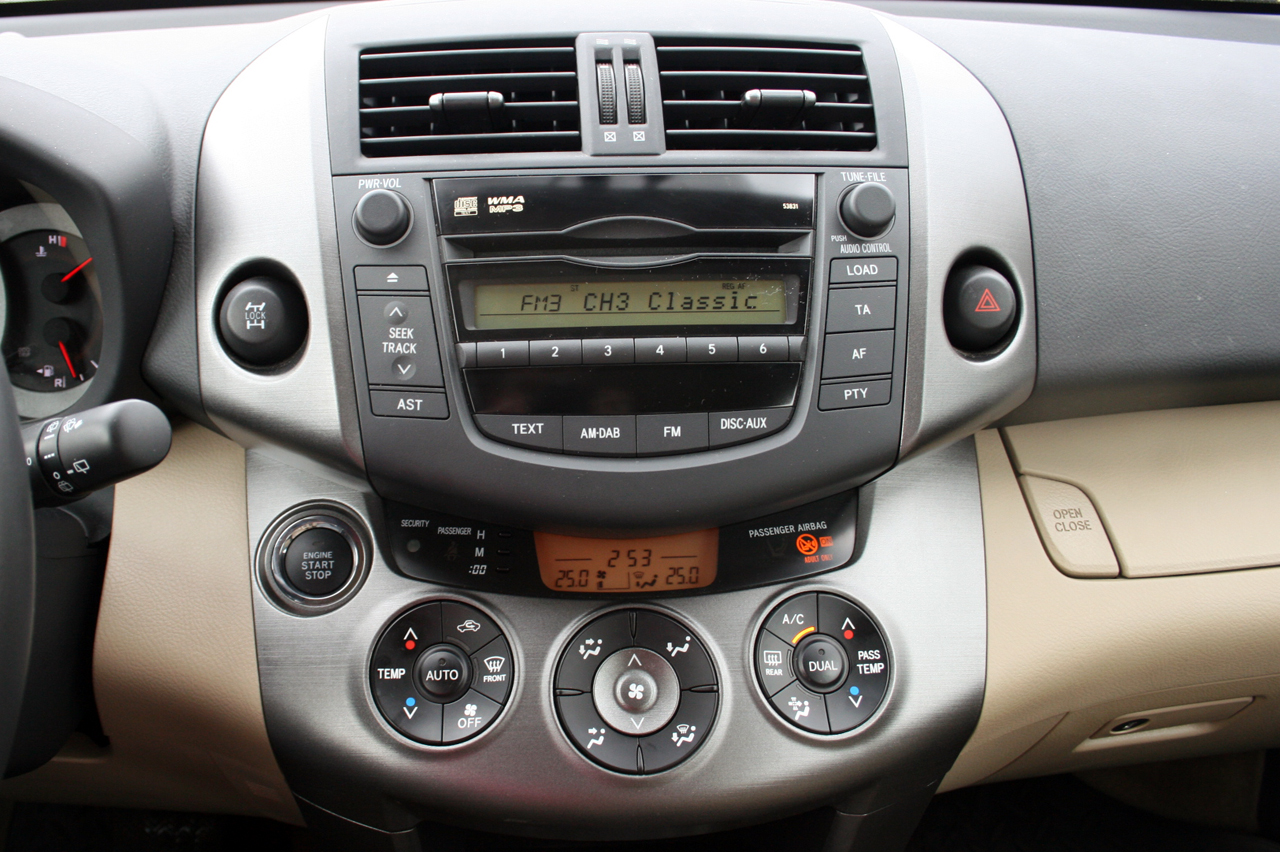
That's about it, perhaps. But it is precisely thanks to such seemingly simple touches that the RAV4 looks both more modern and more solid. Inside, there are even fewer changes — in fact, almost none. A few additional buttons have appeared on the steering wheel: now you can control the trip computer (previously the button was on the instrument cluster), voice commands, and the Bluetooth system for wireless phone connection from the wheel. Also, on the center tunnel, between the front seats, an AUX input for external devices has been added. A useful thing, but why cover it with such an inconvenient and cheap rubber plug?
The main innovation is the introduction of a long-wheelbase version. All crossovers with the 2.4-liter engine are now supplied in this configuration. Moreover, the increase in size was achieved not by simply extending the rear overhang, but by stretching the wheelbase by a full 100 mm. This gave the "Rafik" the much-needed spaciousness: the trunk volume grew from 410 to 540 liters, and the distance between the front and rear seats increased from 800 to 865 mm. If you fold the rear row, a fairly decent cargo area forms at the back. And under the trunk floor, there's another hidden compartment, no less spacious — you can store plenty of things there too.
The technical part remains unchanged. Under the hood is the same 170-horsepower 2.4-liter engine and the already outdated 4-speed automatic transmission. Due to the 100 mm stretch, the car has become 80 kg heavier, and the geometric off-road capability has slightly worsened. However, for a soft-roader, this is quite sufficient — storming serious off-road terrain is not common practice here. And the 190 mm ground clearance is far from the worst among its classmates.
If off-road conditions are unavoidable, there's a large round button on the center console — it activates the electronic locking of the center coupling. In normal mode, the electromagnetic clutch responsible for driving the rear wheels is disengaged, but as soon as the front wheels start to slip, it engages instantly, preventing the crossover from "sitting on its belly."
Despite the archaic four-speed automatic, this gearbox can outpace many modern transmissions in shift speed. The 2.4-liter engine revs briskly up to the peak of 6000 rpm, and controlling acceleration is a pleasure.
The chassis is excellently tuned: slight rocking on a straight line is compensated by clear and precise reactions to steering input. The effort and feedback from the electric power steering are just right. On bends at the limit, the RAV4 confidently holds its line. When understeer is near, the crossover requires a greater steering angle of the front wheels, but if you do manage to break traction, the stability control will reduce excess torque and gently bring the car back onto the correct arc. Very reliable behavior!
Passengers have to pay for such handling with comfort. The suspension meticulously tracks all road imperfections and transmits extra vibrations into the cabin. On large potholes, alarming dull thuds are heard, which the weak underbody insulation lets through, and passengers start to shake even more.
A woman's perspective:
Women adore the RAV4. And this sincere loyalty does not depend on age. Surely everyone can recall among their female acquaintances one who is already on her third car and still chooses a new "RAV4." What's the secret of such fidelity?
Firstly, we love crossovers: you sit high, see far, get in easily, and minor road irregularities are no big deal. Secondly, from the first second, the RAV4's dimensions feel like home! Perhaps there is no other car, especially of such size, where all corners are so mystically well felt from the inside. The new car, fortunately, has not lost these qualities.
But on the outside, the car has become more brutal — apparently, specifically to move away from the image of a women's car. We don't mind; we like it! The "Rafik" has grown, acquired new headlights, a bumper, and a grille — and still remains easily recognizable.
The interior has hardly changed compared to the previous version. The front panel is still two-tiered, with the lower climate control unit slightly raised — everything is visible, everything is at hand, everything is intuitive. The trim pleases with quality, the materials are pleasant, the seats are very comfortable, and the window buttons are positioned so that they are easy to reach. However, there are some flaws: nowhere on the instrument panel does it show which transmission mode is selected — the European version has such an indicator. And another small detail, familiar from the Auris: the audio control buttons on the steering wheel lack a mute button. And sometimes it's absolutely essential! You have to reach all the way to the stereo.
 |
 |
Sound insulation is also not perfect — I'd like it quieter. This crossover can't be called soft and comfortable, but in handling it shines brilliantly: it accelerates easily and briskly (the 170 "horses" make themselves known, and the automatic gearbox, despite its archaic nature, doesn't let you down), confidently holds a straight line, doesn't act up in corners, and brakes clearly and predictably.
Summary:
The Toyota RAV4 has become noticeably more polished, gained a long-wheelbase modification, and has not lost its driving talents. The long-wheelbase version is an option for those who have settled down, started a family, and value cabin spaciousness and practicality. For complete happiness, the new "Rafik" lacks only a third row of seats, which the big Nissan Qashqai+2 and the French "twins" Mitsubishi Outlander XL can boast of.
The starting price of the RAV4 with a two-liter engine is 999 thousand rubles. For an automatic transmission, you'll have to pay another 40 thousand. And the most expensive version — with a 2.4-liter engine, automatic, stretched body, and full options — will cost 1,391,000 rubles.
Ruslan Galimov, Svetlana Aleeva