
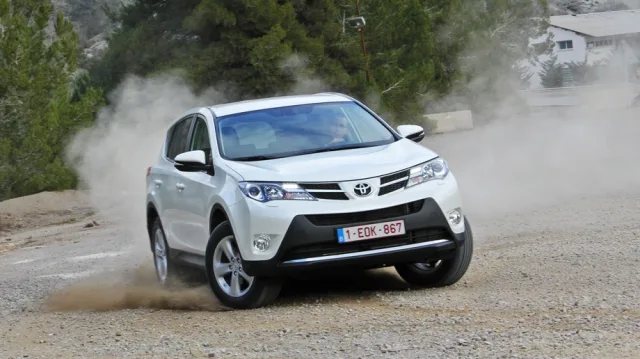
How time flies! It seems like just recently she, still a cheerful girl, was infecting everyone with teenage positivity. Growing up, she turned first into a pretty but slightly insecure young woman, then into a strict, self-assured lady. Heading to Barcelona for the presentation of the new Toyota RAV4 crossover, I was sure I was going to meet a mature lady. However, the Japanese corrected me: it's not she — it's he! Yes, in the fourth generation, they did to the popular Japanese crossover what in human life is called Female to Male: a change of physical gender from "F" to "M". I was in a trance!
The RAV4 crossover became the third company car to try on the new styling. And this is a reason to talk about the brand's corporate style, which Japanese designers had been seeking for so long. The foundation of the new Toyota face is the headlights in the Keen Look style — "Sharp Look"!
The operation went without complications. After all, the new RAV4 is just an evolution of the 2005 design. Under the cover of the new corporate design hides familiar technology. The body is based on the predecessor's platform with the same wheelbase — 2660 mm. The suspension, all-wheel drive transmission, and some engines are from it too. And those that are placed under the hood of the "Ravik" for the first time are well known from other models of the concern. The car has grown by 205 mm in length and 30 mm in width, thanks to which the trunk now holds a record 547 liters. That is, from now on, the Toyota RAV4 is not an overgrown C+ class car, but a full-fledged competitor to D-segment cars like the Nissan X-Trail and Mitsubishi Outlander.
The dynamic design only partially hides the increased dimensions: the rear with broad strokes of taillights looks a bit heavy. Despite the shared platform with the previous generation car, only the rear pillar with its characteristic triangular window reminds of it.
It has become more powerful and economical. Even though the base gasoline engine remains the same (2.0 L, 146 hp), the flagship "four" from the Camry sedan develops 180 hp. And now the RAV4 will also have a diesel! The 2.2 L turbo unit (150 hp) was previously the prerogative of European markets, and the new crossover will be the first Russian Toyota with such an engine. And the new RAV4 has also become closer to the driver. The Japanese modernized the electric power steering and suspension specifically for active drivers. A Sport button even appeared on the center console; pressing it not only switches the automatic transmission to "combat" mode but also commands the multi-disc clutch in the rear wheel drive to a preventive 10% lockup, in case the sensor installed on the steering shaft detects deviation from a straight course.
The front panel retained its two-story architecture and is trimmed with higher-quality materials. However, some buttons are from the last century. The instrument cluster, resembling a prompter's box, looks poor but is quite informative. The microclimate control block located on a sloping protrusion is convenient and simple to use.
This is a shift in priorities! The increased dimensions, the appearance of a diesel engine, and the more driver-oriented character — all this is done for one purpose: to attract a male audience to the RAV4's driver's seat. Toyota is trying with all its might to wash off the label of a ladies' favorite from its most promising model, because it... limits sales. To make it clear: what was previously given only for March 8, now, ideally, should also be bought for February 23. It is also symbolic that sales of the new RAV4 started right on the most masculine day of the year.
In terms of driver seating comfort, the new RAV4 is head and shoulders above the previous generation. Front seats with developed lateral support and optimal cushion length. And the seatback with an increased adjustment range can now be set vertically. The steering column adjusts in two directions, but the limited travel adjustment may still cause inconvenience.
In the back row, there is enough space in all directions, but the most pleasing is the legroom reserve. The seatback adjusts in three positions, and by pulling the lever at the base of the cushion, it can be folded with one hand.
According to Japanese forecasts, the share of male owners among buyers of the new crossover will grow to 65%. To a large extent, this will be facilitated by the appearance of the diesel engine. So far, the stakes on it are low: only 10% of all sales, but it is here that the highest concentration of male audience is expected — 85%. With other engines, it is lower, but even front-wheel-drive crossovers, according to marketers, will more often be bought by men — about 65%.
The full-size spare wheel ate 41 liters of trunk space and increased the loading height. In Russian RAV4s, the compartment holds 506–1605 liters. In the underfloor, there are two niches for small items. A mesh "hammock" for transporting especially valuable cargo is included in the standard equipment of all versions.
It's just that Toyota seems to have forgotten that men, unlike women, are more demanding. And they will certainly frown when they learn that after placing a full-size spare tire in the crossover's trunk, it shrank from 547 to 506 liters. And the declared ground clearance of 197 mm does not correspond to reality for the most powerful 180-hp version: under the exhaust pipe that is visible from under the crossover's bottom, I measured only 170 mm.
The RAV4 is a pure soft-roader! Under the exhaust pipe of the 180-hp version, there is only 170 mm against the declared 197 mm. And the situation is twofold: steel protection will only reduce ground clearance, and its absence can lead to damage to the part. The rear suspension bristles with protruding ends of stabilizer links, which can anchor the car when driving off curbs. Plastic fender liners appeared in the rear wheel arches, but sound insulation was not there and is not there. The engine compartment is protected from dirt by a thick rubber seal laid along the edge of the hood, but the unprotected wiring going to the "brains" of the power unit is a dubious solution.
They will certainly praise the Japanese engineers for not skimping on thick mats in the engine compartment and a special sound-absorbing film for the windshield. And also for the foam filler poured into the sills and body pillars. And yet, in the end, men will be dissatisfied that tire noise still breaks into the cabin, because in the rear arches, as before, there are areas of bare metal. While driving on varied asphalt, the sound background either increases or fades away.
The 2.5 gasoline engine from the Camry sedan is also excellent for the crossover. It is quiet, perfectly balanced, and gives the RAV4 quite convincing dynamics: 9.4 s in acceleration from 0 to 100 km/h. And such an engine will be appreciated by those who are partial to the sound of naturally aspirated engines. When accelerating "to the floor," the "four" fills with such overtones that you don't want to release the accelerator!
However, they will definitely appreciate the potential of the most powerful 180-hp version (such modifications will be offered only with an "automatic" and all-wheel drive). This power unit wins over with its coordinated work: acceleration is easy, gear changes are barely noticeable, and the gearbox also tracks speed drops, promptly downshifting. And here it is already appropriate to talk about driving pleasure. The modernized electric power steering motor provides a quite tolerable steering picture. On a straight line, there is a clear "zero," and in a turn, the effort on the steering wheel increases. True, all this happens rather roughly, one might even say primitively, but progress is evident.
What the new RAV4 disarmed with is the loss of the usual comfort. The crossover drives over small irregularities in a European, collected manner. On medium ones, the suspension, no longer shy, transmits all the road flaws into the cabin, and when hitting large potholes, a mini-explosion occurs.
Body rolls are also small. The Japanese replaced all suspension elastic elements with stiffer ones, and the crossover's handling only benefited from this. But it did not bring much joy, because the ride smoothness remained extreme. Moreover, the loss turned out to be much more noticeable than the gain! What was the previous "Ravik" loved for? For its neutral character, which allowed, among other things, not to worry much about what road was under the wheels. And in the new one, you have to look for potholes and avoid them. The tightened shock absorbers are no longer able to dampen vibrations as skillfully as before. On the compression stroke, there is an unpleasant poke in the lower back, and when the wheel unloads and the rod length is selected, a hard impact is felt, which the Highlander also distinguished itself with in its time. Even on smooth Spanish roads, it comes to discomfort. What will happen on ours?
Despite the stiffening of the suspension elastic elements, the new RAV4 with a gasoline engine behaves in corners much like the previous one: boring but unobtrusive. However, the connection with the road has become more direct thanks to the recalibrated electric power steering.
The diesel modification has the suspension tuned in the same way. Stiff! Moreover, such a car has the front axle weighed down by an extra thirty kilograms. And if in the top model the understeer when entering a turn is noticeable but still within the bounds of decency, then in the diesel it is so pronounced that it already causes concern. Yes, the winding roads near Barcelona seem created for rally stages. Try to resist pressing the accelerator, but then again, the RAV4's status is now different — masculine. And this, in my opinion, implies a more subtle chassis tuning. Finally, we have six months of winter. Are you ready to adapt to (pardon the pun) excessively insufficient understeer of your car with every turn of the steering wheel? I am not!
Noisy, slow, economical. That's how you can describe a ride in a diesel RAV4 in one sentence. Toyota marketers have dubbed potential buyers of such versions "practical folks," hinting that fuel economy will outweigh other drawbacks for this type of buyer.
And in all other respects, the diesel "Ravik" turned out to be a gray mouse. Acceleration is moderate, torque seems sufficient, but the range where you can exhaust all 340 newton-meters is too narrow. Maybe it's good that this modification only comes with a six-speed automatic — it smooths out the imperfections of the turbodiesel. With a manual, the driver would have a tough time. And such a RAV4 can't be called quiet. The mats covering the engine compartment can only contain the engine's clatter at idle and medium revs. Add gas — and decibels pour into the cabin. Fuel consumption — perhaps the only trump card that favorably distinguishes this modification. The turbodiesel car is 3–4 liters more economical than the top gasoline model.
Even with a slight speed excess, the diesel RAV4 slides into understeer on any surface, including dry asphalt. Forced locking of the coupling changes the situation to the opposite: torque on the rear axle endows the crossover with rear-wheel-drive habits. However, the coupling itself quickly overheats.
But if I were choosing a Toyota RAV4 for myself, I'd go for the version with the base 146-horsepower gasoline engine and a manual. The most balanced crossover of all! The suspension here is much softer than in other modifications. Over potholes, such a "Ravik" rides no worse than the previous one, and handles even better. Here, both the drift of high-profile tires less blurs steering precision, and front-axle slides don't interfere. Let the body roll a bit more, but the connection with the steered wheels is more transparent and honest. As a result, the driver makes fewer mistakes, strains less, and gets more driving pleasure. That's what we need!
Depending on the engine and drive type, the new RAV4 will offer three types of transmissions: for diesel and 180-horsepower gasoline versions — a six-speed automatic (left), and for two-liter crossovers — a manual or a CVT.
In the most equipped versions "Prestige" and "Prestige Plus," two new systems enhancing passive safety will be available: blind spot monitoring and lane change alert. If necessary, both functions can be turned off.
Unfortunately, the two-liter engine is still a bit weak for a 1600-kilogram crossover: up to 2000 rpm it doesn't pull at all. When starting from a standstill, it's easy to stall the engine even with a very informative clutch pedal. And for dynamic driving, the tachometer needle needs to be kept closer to the red zone. But the engine doesn't stumble when driving at low revs, and such a precise gearshift mechanism in this class of cars is hard to find. However, the manual is not in favor with us, regardless of the owner's gender, and how this version with a CVT will behave remains a mystery. There were no "Raviks" with a CVT in Spain.
The new RAV4 is offered in eight trim levels at prices from 998,000 rubles for a front-wheel-drive crossover with a manual to 1,543,000 rubles for the most equipped version with a 180-horsepower engine, automatic, and all-wheel drive.
But even with not entirely complete information about the model, conclusions can be drawn: despite the efforts to change gender and technical improvements, the Japanese crossover remained the same ordinary car for everyone and for each, as before. However, if the previous "Ravik" was docile and unobtrusive, like a waitress in an expensive restaurant, the new one seems to have character. The Japanese clarify: masculine!
Specifications
| Toyota RAV4 | 2.0 L FWD | 2.0 L AWD | 2.2 L AWD | 2.5 L AWD |
|---|---|---|---|---|
| Body | ||||
| Body type | wagon | wagon | wagon | wagon |
| Number of doors/seats | 5/5 | 5/5 | 5/5 | 5/5 |
| Length, mm | 4570 | 4570 | 4570 | 4570 |
| Width, mm | 1845 | 1845 | 1845 | 1845 |
| Height, mm | 1670 | 1670 | 1670 | 1715 |
| Wheelbase, mm | 2660 | 2660 | 2660 | 2660 |
| Front/rear track, mm | 1570/1570 | 1570/1570 | 1570/1570 | 1570/1570 |
| Curb weight, kg | 1540 (1575)* | 1610 (1645) | 1715 | 1685 |
| Gross weight, kg | 2000 (2050) | 2080 (2110) | 2190 | 2130 |
| Trunk volume, L | 506–1605 | 506–1605 | 506–1605 | 506–1605 |
| Engine | ||||
| Type | gasoline | gasoline | turbodiesel | gasoline |
| Location | front, transverse | front, transverse | front, transverse | front, transverse |
| Number and arrangement of cylinders | 4, in-line | 4, in-line | 4, in-line | 4, in-line |
| Number of valves | 16 | 16 | 16 | 16 |
| Displacement, cc | 1987 | 1987 | 2231 | 2494 |
| Max power, hp/rpm | 146/6200 | 146/6200 | 150/3600 | 180/6000 |
| Max torque, Nm/rpm | 187/3600 | 187/3600 | 340/2000–2800 | 233/4100 |
| Transmission | ||||
| Gearbox | manual six-speed (CVT) | manual six-speed (CVT) | automatic six-speed | automatic six-speed |
| Drive | front | plug-in all-wheel | plug-in all-wheel | plug-in all-wheel |
| Chassis | ||||
| Front suspension | independent, spring, McPherson | independent, spring, McPherson | independent, spring, McPherson | independent, spring, McPherson |
| Rear suspension | independent, spring, multi-link | independent, spring, multi-link | independent, spring, multi-link | independent, spring, multi-link |
| Front brakes | ventilated disc | ventilated disc | ventilated disc | ventilated disc |
| Rear brakes | disc | disc | disc | disc |
| Tires | 225/65 R17 | 225/65 R17 | 225/65 R17 | 225/65 R17 |
| Ground clearance, mm | 197 | 197 | 197 | 197 |
| Performance characteristics | ||||
| Maximum speed, km/h | 180 | 180 | 185 | 180 |
| Acceleration time 0–100 km/h, s | 10.2 (11.1) | 10.7 (11.3) | 10.0 | 9.4 |
| Fuel consumption, L/100 km | ||||
| — urban cycle | n/a | 10.0 (9.4) | n/a | 11.4 |
| — suburban cycle | n/a | 6.4 (6.3) | n/a | 6.8 |
| — combined cycle | 7.7 (7.4) | 8.0 (7.8) | 6.5 | 8.5 |
| Toxicity standard | Euro-4 | Euro-4 | Euro-4 | Euro-4 |
| Fuel tank capacity, L | 60 | 60 | 60 | 60 |
| Fuel | AI-95–98 | AI-95–98 | diesel | AI-95–98 |
| * In parentheses, data for the version with CVT. | ||||
Technology
The naturally aspirated gasoline "four" 2AR-FE with a displacement of 2.5 L develops 180 hp and 231 Nm. Valve timing is changed on both camshafts (Dual VVT-i). The valve cover is designed to reduce noise from the timing mechanism. The effective length of the intake tract is determined by the position of a valve installed between the halves of the collector. Roller rocker arms, piston rings with improved sliding characteristics, and less viscous 0w-30 oil contribute to fuel economy. The new engine is 24% more economical than the previous 2.4-liter "four."
The diesel turbo unit D-4D with a displacement of 2.2 liters was also installed on the previous generation car. However, such crossovers were not supplied to Russia. And now, with the fourth generation RAV4, the "four" with factory index 2AD-FTV has reached us. Engine features: turbocharger with variable nozzle geometry, Common Rail injection system with operating pressure over 1000 bar, and a 32-bit processor responsible for preparing and injecting the fuel mixture.
The upgraded six-speed automatic, familiar from the previous Camry 3.5, provides sport (activated by a button on the center console) and manual modes. For the sake of economy, the final drive was made longer, the torque converter lock-up range was expanded, and the clutch operates more smoothly and handles loads better. The automatics of diesel versions are supplemented with a full torque converter lock-up system starting from second gear.
The crossover is built on an optimized platform of its predecessor, but with increased dimensions: 4570 x 1845, the wheelbase increased by 10 mm (was 2560). The share of high-strength steel grades in the body structure has increased, and the connection points of the hood, front pillars, and upper rear suspension mounts are additionally reinforced. The number of weld points in door openings has been increased. In addition, the steering column angle is now increased by one degree, which should improve driver seating comfort. The suspension design remains unchanged: MacPherson struts in front — multi-link in the rear. However, engineers revised the stiffness of springs, shock absorbers, and bushings. The front and rear stabilizer bars have become thicker. The all-wheel-drive transmission has undergone more significant changes. Thus, the multi-plate clutch in the rear wheel drive is reinforced, and in the case of forced locking (active up to 40 km/h), the torque is distributed between the axles in a 50:50 ratio. Particularly noteworthy is the new Dynamic Torque Control 4WD system, which works in conjunction with other electronic systems of the vehicle. For example, if sensors detect understeer during steering, up to 50% of traction can be directed to the rear axle. And in Sport mode, an additional 10% of torque is constantly present on the rear wheels.
Safety
As before, even in the base version of the RAV4, there is a full set of passive safety features. This includes seven airbags, including a driver's knee airbag. This was the case before, but the side airbags are now dual-chamber, capable of simultaneously protecting the torso and pelvis of front occupants. The stability control system and traction control are included in the standard equipment list.
History
In 1994, the appearance of this little one caused a sensation! Toyota bosses simply wanted to make a youth car for active leisure (hence the abbreviation — RAV4: Recreational Active Vehicle, the "four" indicated permanent all-wheel drive), for which they used the platform of the all-wheel-drive Celica coupe, but in fact created an entire car class, interest in which has not waned to this day. Initially, the RAV4 was produced in a three-door body, but just a year and a half after its debut, a five-door modification appeared. The only two-liter naturally aspirated gasoline engine, depending on the level of tuning, developed 128, 135, or 178 hp. There were two transmissions: a five-speed manual and a four-speed automatic. Drive: permanent all-wheel or front-wheel. The pioneer of the compact crossover class remained in the production lineup until 2000.
The matured second-generation RAV4 grew in size and comfort, but the car's ideology remained the same: a crossover for active leisure with a three- or five-door body, front- or all-wheel drive. Initially, there were two engines. The gasoline 1.6 (100 hp) was assigned to base three-door models, while more advanced versions were equipped with a new two-liter naturally aspirated engine with variable valve timing, producing 150 hp. A turbodiesel with 113 hp also appeared under the hood of the "Ravik," and the most powerful engine (2.4, 163 hp) was shared with the compact crossover by the flagship sedan Camry already at the end of its career in 2004.
In 2005, the third-generation RAV4 saw the light of day. The crossover lost its three-door versions and permanent all-wheel drive. A multi-plate clutch was responsible for engaging the rear wheels. And overall, it was already a different RAV4. The larger body of 4395 x 1815 x 1685 mm required powerful engines. Thus, in place of the previous turbodiesel, a new D-4D unit with 136 hp appeared. And at the top of the range was a crossover with a V-shaped "six" of 3.5 liters producing 270 hp. Such a diverse engine lineup implied a wide choice of transmissions: there were six types!