
 Technical specifications of Toyota RAV4
198 Nm/4000 rpm.
highway — 6.4 l
combined — 7.5 l
Width — 1 815
Height — 1 685
Tires — 225/65 R17
ESP, ABS, EBD, TRC, HAC, DAC programs, navigation in Russian, dual-zone climate control with cooled glove box, EPS, 4 power windows, front fog lights, heated mirrors, leather multifunction steering wheel, 6 CD, MP3, WVA, 6 speakers, immobilizer, Smart Entry & Push Start, rear parking sensors, rain sensor, cruise control, 7 airbags.
Service 2 — 8 680
Service 3 — 8 020
Service 4 — 13 700
Service 5 — 8 020
Service 6 — 8 680
Service 7 — 8 020
Service 8 — 24 520
Service 9 — 8 020
Service 10 — 11 960
$ 43 977 (351 810 UAH),
base —$ 30 342 (242 731 UAH)
Marat Salimullin, director of the branch of LLC "Italinox Ariel" in the Republic of Tatarstan
When the editors of "Autoclub-Kazan" offered me to test the updated RAV 4, I immediately agreed — after all, I own a car of the previous generation. The question is whether the new model can outdo my old one. I'll analyze this from three positions.


I'll start with the interior, body, and comfort.
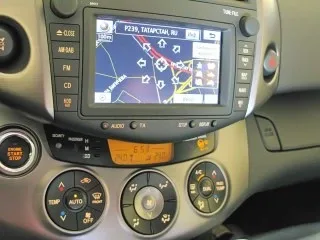
Inside, almost everything is the same: the only noticeable change is that instead of the CD player window on the front panel, there is now a navigation system. It's a useful thing, but ambiguous. The range of steering wheel adjustment for reach and tilt, unfortunately, remains the same — small. But the cabin has become noticeably quieter: if earlier at speeds over a hundred you had to shout to be heard by rear passengers, now you can talk in a normal voice. Owners of the previous RAV 4 will understand what I mean.
Now about the appearance. The front end, in my opinion, has clearly improved: due to the more elongated lines of the bumper and hood, the car looks longer and more dynamic. Beautiful. But a couple of days later I saw the new model on the highway in motion — and the bumper line no longer seemed so successful. The rear remained the same, so I won't describe it.

The second point is dynamics.
Replacing the old 4-speed automatic with a CVT made the car even more responsive, and in "Sport" mode it literally shoots forward. The CVT also helped with fuel consumption — which is not superfluous these days. And note: in manual mode, as many as 7 speeds are available! On my old RAV4 on the highway, I always lacked one more gear, but here — seven whole ones.
The third question is the suspension.
In previous RAV4s, it was somewhat stiff, but sharp in handling, yet a bit uncollected. In the new version, this collectedness has appeared: the suspension has become softer and at the same time does not break through. I drove it both on dirt roads and on the highway — nowhere did it let me down, didn't clang or break through. I really liked that. The only thing is that on large potholes at low speed, the rear suspension "thumps" exactly the same as on my car.
Summing up, I'll say one thing: the new friend is still better than the old two. Even despite controversial interior solutions (that same "beard") and not everyone's comfortable seating, the new RAV 4 turned out great!
before restyling after restyling
Vadim Sadykov, "Autoclub-Kazan"
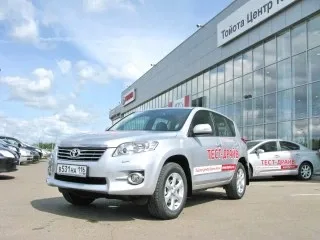
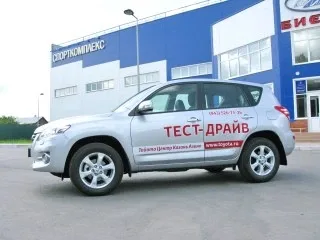
If you don't look closely, the new RAV4 can easily be mistaken for the previous one. The exterior differences are minimal: hood, front headlights, and bumper. Inside, there are even fewer changes. But at the same time, the new RAV4 differs noticeably from the old one.
Everything is subjective, but in my opinion, the main feature of the previous RAV4 was stiffness... no, not that — SUPER stiffness of the suspension. Alfred and I even joked that when crossing tram tracks, you could lose all your fillings. A joke, of course. But that car really shook. The new RAV4 has become not soft, but rather "elastic." On small irregularities, including the same tram rails, passengers won't feel discomfort. But if there are large potholes or bumps, sharp impacts on the rear suspension and shaking are guaranteed. True, we suspect that the tires on the test car were overinflated — perhaps the real car is even softer.

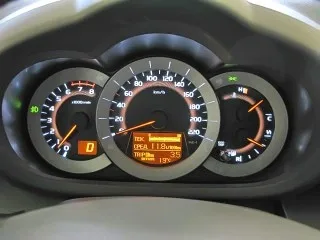
On the highway, there are no complaints about the car. Noise insulation has become better. It holds the road confidently at any permitted speed. Overtaking slow cars is simple: you can press the gas once (normal acceleration) or twice (press, pause, press harder) — in the second case, the car accelerates noticeably faster. I liked that at 100 km/h the engine speed is about 1500. Economical! This is the merit of the CVT. Its gear ratios vary from 2.396 to 0.426 with a final drive of 5.791. If you multiply the minimum gear ratio by the final drive (we get 2.467), this indirectly indicates efficiency at the "top gear." For comparison, in a 6-speed manual, the multiplication result is slightly higher (3.372), meaning at a hundred the revs will be about 2050. Also not bad. But multiplying the maximum gear ratio by the final drive indicates two things: how quickly the car accelerates from a standstill and how capable it is of "churning mud." The larger the result, the faster the start and the more power is transmitted to the wheels for getting "out of the mud," but the wheels turn slower. For a 6-speed manual with 2.0, this is 17.632. For a CVT with 2.0 — 13.875. For the extended RAV4 with 4-speed automatic and 2.4 engine — only 12.13. Everything is clear here: the extended version is not for off-road or "traffic light races." And one more figure: in 2nd gear, the 2.0 transmits 23% more power to the wheels than the 2.4 engine.
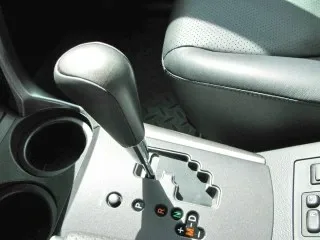
But the CVT, despite the importance of numbers, has the main thing — the algorithm of the control program. The "brains" of the CVT. At the same speed of steady motion and almost the same throttle pressure, the engine speed can be different. The CVT finely adapts to the driving style. More about the behavior of different CVTs can be read at www.autoclub-kazan.ru in the article "Based on our test drives. Part 3: CVT." I liked the CVT in the RAV4 even more than in the Toyota Avensis or Audi A4. Especially since there is a new 2.0 engine (dual VVT-i) with excellent torque — 198 Nm at 4000 rpm. Before the trip, we reset the average fuel consumption, and when I got behind the wheel, the trip computer showed 10 l/100 km. First, I drove in a "jerky" mode: seemingly within the speed limit, but sharp accelerations and braking raised consumption to 10.4 l. I liked the dynamics, although there is a slight delay when starting from a standstill. But pressing the "Sport" button makes the car very lively. After playing "races," I switched to normal mode and drove smoothly. Alfred breathed a sigh of relief — finally the "rocking" ended. When we approached the TTS, the consumption was only 9.8 liters. An excellent result for a heavy crossover with a 2.0 engine!
The new RAV4 is one of the best offers in the "crossover" class. The innovations successfully fixed three main drawbacks of the predecessor: the suspension became more comfortable, noise insulation was improved, and the archaic 4-speed automatic was replaced with an excellent CVT. Let's not forget the new engine — it is more elastic and powerful. Now it's up to the buyers, because their assessment is the most important.
Alfred Mardanov, "Autoclub-Kazan"
The first working day after long holidays was rich in events. The morning began with a test drive of perhaps the most popular crossover here — the Toyota RAV4. This car is so common that everyone probably has an acquaintance or friend who drives a "Rafik." My friend Marat, whom I invited along, recently bought the previous version of this crossover, but he has considerable experience with such cars. According to the plan, we were supposed to stop by his place, and I wanted to definitely take a ride in his car to refresh my memories and compare it with the new model. I was just talking about this on the phone with Vadim on the way to the dealership, which is why I missed the right turn. While making a "penalty" loop, I noticed how many RAV4s there are around — there are a lot of them, driven by young and old, men and women. Truly a people's car.
The showroom turned out to be large and bright. Inside, there are crowds of managers and customers who pace importantly between the cars, everything is proper and noble. Two 'Rav4s' stand side by side, and I, sipping coffee from the second floor, watch as visitors approach the vehicles and, it seems, see no difference between them. Otherwise, it's hard to explain why they are more drawn to the old model standing closer to the exit. However, there's nothing to be surprised about here: only a trained eye will spot the differences right away. Like in the children's magazine 'Murzilka' — two pictures and the task 'find 10 differences'. The new RAV4 has even fewer of them, and they are not so obvious, but they are still there. The first thing that catches the eye is the shape of the headlights, the new radiator grille, and, accordingly, a different hood stamping. Thanks to this, the car looks more aggressive than the previous one. I looked around other Toyota models and realized that the concern is gradually coming to a unified style.

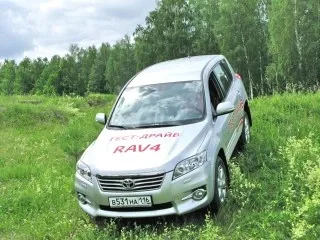
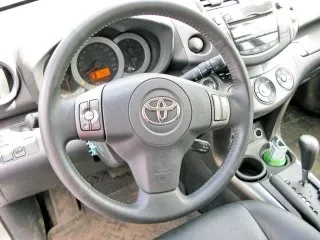
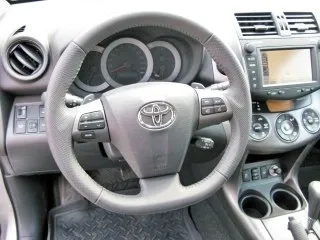
The radiator grilles clearly echo each other across the entire lineup, and only the new restyled Camry with these bulges around the badge stands out from the overall picture. The RAV4's interior also has updates. And I'm not talking about the navigation system, which is now available to new owners (though only in top trims). I mean the steering wheel. It has become truly comfortable: there are recesses for the thumbs, the rim itself has thickened, and it fits perfectly in the hand. In shape, it is now more sporty and not quite round. You'll say it's a trifle? Not at all! The steering wheel is the main tool for communicating with the car; it's through it that we give commands and feel feedback. I'm surprised why many manufacturers don't understand this. I've long noticed that brands with a rich racing history treat the steering wheel very reverently, and it always turns out grippy and comfortable. Okay, let's get back to the topic. So, in the cabin, the changes are the new steering wheel, navigation, and, perhaps, that's all.
before restyling after restyling
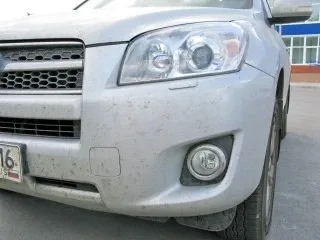
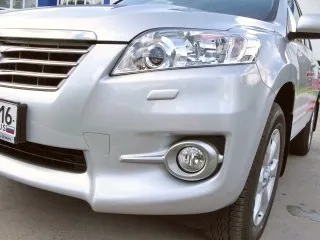
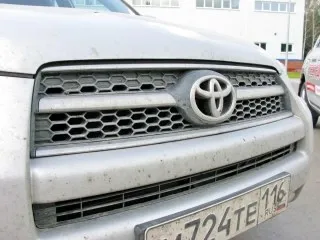
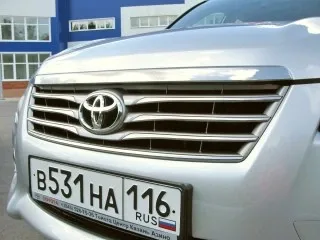
I've already mentioned the exterior changes; it remains to add that, having walked around the car, I found no differences at the rear (we put a cross there). Everything is the same: the shape of the body stampings, the lights, and the color. It seems they saved on... hmm, how to put it... not on the 'stern', though in fact that's exactly what happened. Another important point is the price tag. Two cars in the same trim cost differently. Can you guess which one is more expensive? You've just lost a case of cognac. The editorial address is easy to find, the contact person is Alfred! Just kidding, neither is more expensive — the price is the same! Although formally the 'old' RAV4 was more expensive, but solely due to dealer-installed extras — alloy wheels, alarm, and so on. The manufacturer, apparently, did not intend to raise the price for the restyled version, but since the two-liter engine became more powerful, and instead of the archaic four-speed automatic, a CVT appeared, it turns out that in absolute terms the RAV4 has even become cheaper. And just then Vadim arrived, interrupting my thoughts. This time I decided not to take the car to the test site: it became clear from the first meters that the suspension had not been radically recalibrated, and all those 'moose tests' and 'slaloms' would only confirm this. And what's the point?
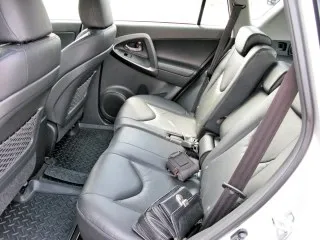
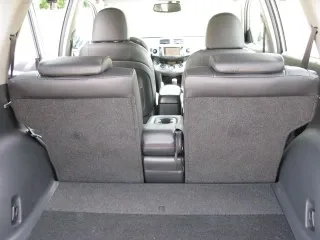
Probably, it's more reasonable to focus on the engine, which now produces six more horsepower, and on the CVT's operation. I get behind the wheel first, and we head to Marat. The CVT is undoubtedly a step forward, but it needs to be trained. Exactly! You have to find a common language with this beast from half-pressing the pedal, and I managed to do it. The secret lies precisely in HALF-pressing (meaning 'half', not 'floor'). If you press to the floor (even twice, as in the well-known trick with an automatic), it doesn't have time to digest the power from the 158-horsepower engine, growls solidly (the sound, by the way, is very pleasant) and only then delivers acceleration. But if you press smoothly, without jerks, even all the way, the car responds with gratitude and accelerates excellently! And all this under approving hoots from somewhere behind — ooh... ooh... oohhhhh. We finally got to Marat, drove around looking for a place to shoot, and I, of course, didn't miss the chance to switch to his car. The main difference between the old and new versions of the 'Rav4' is precisely the automatic and the CVT. You immediately feel the sharp start of the automatic and a certain 'softness' at the start of the CVT. With active pedal work, the CVT is noticeably noisier than the automatic, but at some point on the pickup it becomes even more fun. The conclusion is simple: the automatic starts more briskly but loses in acceleration... Although Marat immediately disputed this. He found the 'Sport' mode on the CVT, and everything evened out. The new RAV4 pulls very confidently to the finish line and at the same time drinks... that is, eats quite moderately. When I was already leaving the showroom after the test, I met a friend on a Mazda MX5 along the way. That convertible really needs stiffness, and it's perceived as a given. But you need to get used to the RAV4. And so I think, what would I choose as an owner of such a car? Probably, what's important for any owner of a 'crossover-tractor-lunar rover'?
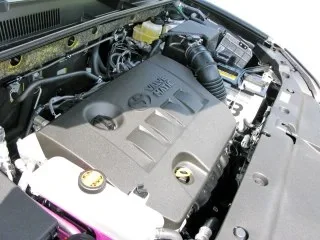
That it both drives and doesn't ask to eat, right? The RAV4 does this excellently: it both hauls and doesn't eat? How so? Well, just like that! The car, yes, is stiff, but it has become more resilient. Imagine: if a ball was overinflated, then by letting out a little air, it becomes elastic. You know what I mean? Roughly speaking, the suspension has become denser and more composed, plus sound insulation has noticeably improved.