
Through Thorns to "Green"
There are plenty of environmental problems in the modern world. In megacities, transport is the main air pollutant. Therefore, in developed countries, emission standards are constantly tightened, especially regarding carbon dioxide.
Russia is not lucky in this regard: local automotive ecology lags behind the West by about ten years. We still produce cars with engines that barely meet the "Euro-3" standard, introduced back in 2000 (referring to the Togliatti "classic"). Meanwhile, almost all major global manufacturers have already switched to "Euro-5".
The result is that Russian cities are choking on exhaust fumes, and "green" technologies reach us more despite than thanks to. This is exactly how the Toyota Prius hybrid made its way to the country. The journey took almost 12 years, during which three generations of the hatchback managed to change in Japan.
It could have...
not made it at all
Greenhouse Effect
Residents of large cities, however, are not surprised by the "Prius". Even before official sales, our drivers mastered gray schemes for importing such cars from North America, Europe, and Japan. True, when buying a used hybrid, caring about the environment is rarely a priority.
Russians buy "Priuses" because of rich equipment and benefits on insurance, transport tax, and "customs clearance" — fiscal authorities calculate payments only based on the characteristics of the gasoline engine. And it is like a small car's: the first generation's 1.5-liter unit produced 70 horsepower, the second — 76. The new model got a 1.8-liter engine with 98 horsepower, but that's also not much.
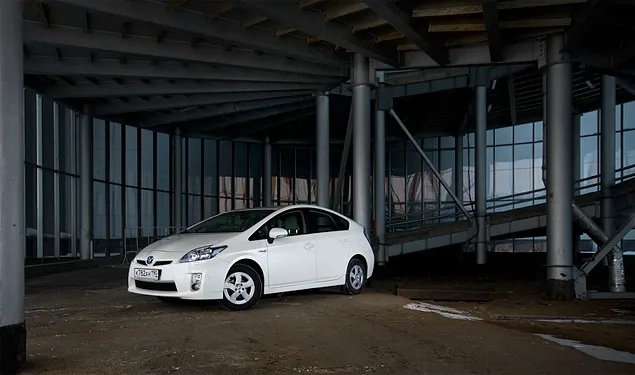
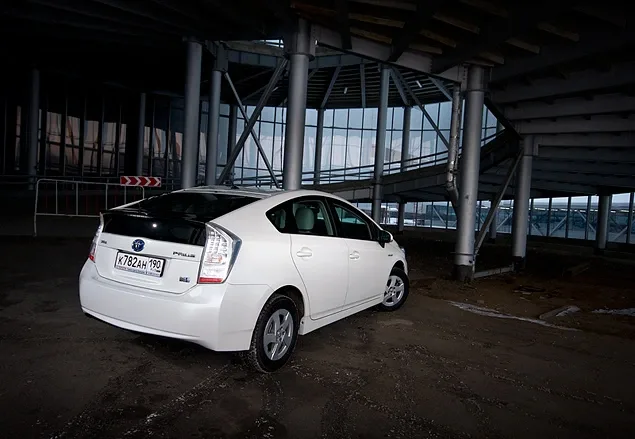
The third generation looks little different from the second, so there won't be a sensation on the streets. Especially since the exterior can't be called outstanding. From an aesthetic point of view, the high "humped" roof made of two perpendicular planes, the trunk lid in the spirit of a Soviet country greenhouse, and the bumpy hood are clear misses. However, the five-door hatch can boast excellent aerodynamics: a drag coefficient of 0.25, less than many sports cars.
In the cabin, aerodynamics are not so important, and Japanese designers took advantage of the freedom that the "hybrid" layout provides. The "Prius" has neither a transmission tunnel nor a gearbox as such, so the lever for the electronically controlled transmission modes can be placed almost anywhere. In the first generation, the lever lived on the steering column, in the second — on the front panel to the right of the steering wheel, and in the third, it moved to a specially molded plastic arc resembling a "pseudopod": it comes out of the front console and rests on the armrest.
Interior
|


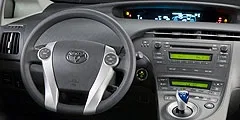
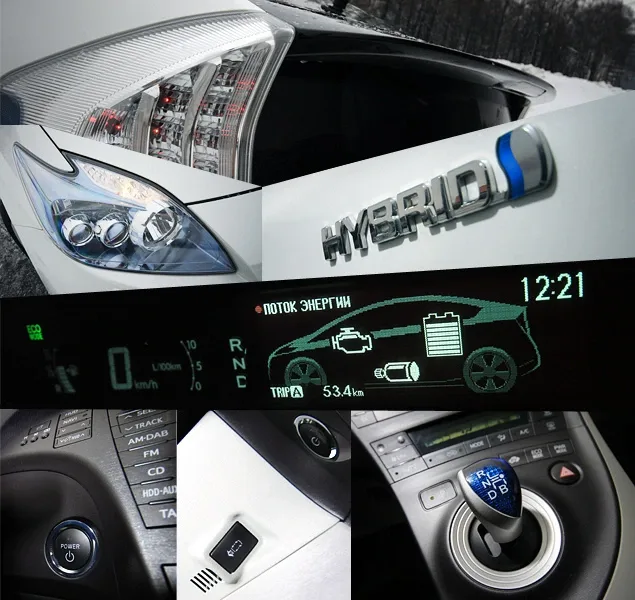
The instrument panel is absent from its usual place. Instead, there are three liquid crystal screens for indicating the operation of the hybrid system and a digital speedometer. They are hidden under the windshield in the fold of the "sculptural" front panel. In general, Salvador Dali. The plastic quality is quite European, and the comfortable seats in the only configuration supplied to Russia are upholstered in pleasant-to-touch non-slip leather.
Thanks to the high roof, the "Prius" is spacious both in front and in the back. Moreover, the designers successfully selected the angle of the front pillar to the hood — forward visibility is excellent. But in the interior rearview mirror, you can only watch the traffic on the highway: due to the complex trunk lid, reversing will have to be done solely by the image from the rear parking camera. It, by the way, is included in the base equipment. And that's good — the image from the "Prius" parking sensor is much more informative than any mirror.
There are many buttons on the central console, and upon closer inspection, you realize that half of them even an experienced motorist sees for the first time. There are three switches for hybrid drive modes, and a button for the automatic parking system. To the right of the signature "Prius" oval steering wheel are keys for adjusting the speedometer readings, navigation, and hybrid system indicator projected onto the windshield.
The projector readings can not only be turned on and off but also "moved" up and down on the glass. A bit much for the golf class? Yes, but don't forget: the "Prius" for "Toyota" is like VDNKh for the former USSR, a showcase of the latest technical achievements.
On the Edge of Fantasy
The technology of the Toyota Prius is truly outstanding. The gadgets in the cabin are just the tip of the iceberg. The most advanced "know-how" is hidden under the hood. For example, an internal combustion engine operating on the Atkinson cycle: compared to a conventional Otto cycle engine, it has an increased duration of intake valve opening on the third, power stroke. This reduces "pumping" losses and increases the compression ratio. In practice, this gives an increase in efficiency, but at the same time significantly reduces torque at low speeds.
However, in the "Prius", the gasoline engine works most of the time at optimal average speeds for fuel economy. For this, the Japanese created the Hybrid Synergy Drive powertrain — that's what "Toyota" calls its hybrid drive since 2003, earlier it was called Toyota Hybrid System. In addition to the internal combustion engine, HSD includes an 80-horsepower electric motor and a generator. The hatchback has no gearbox in the usual sense: HSD itself generates torque and decides how many Newton-meters to transmit to the wheels. The redistribution of energy flows goes through a planetary gear.
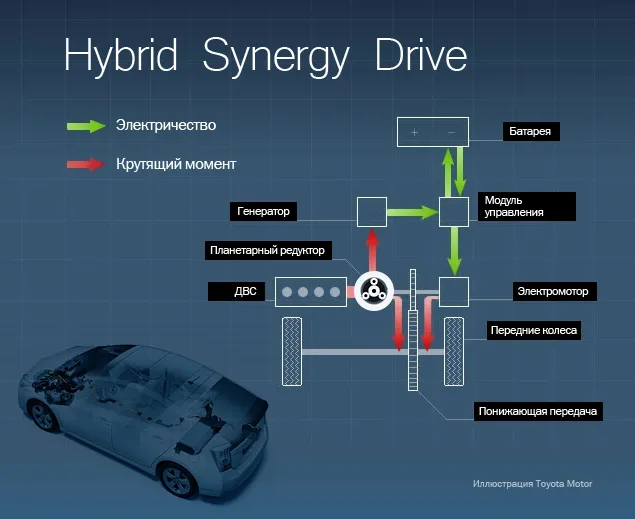
The trajectory of the gears in the planetary gear resembles the movement of celestial bodies around a star, and it's hard to imagine the principle without animation. But the owner of a "Prius" doesn't need to train spatial thinking. It's enough to know: when driving at low speeds (up to 45 km/h) with a fully charged battery, the hybrid car can travel almost three kilometers on the electric motor alone, which delivers 207 Newton-meters of torque. When the battery discharges and the electric motor's power becomes insufficient, the gasoline engine will kick in. In this mode, part of the engine's rotational energy goes through the planetary mechanism to the wheels, and part to the generator to power the electric motor, which helps rotate the drive shaft. This is how "Toyota" engineers overcame the main drawback of the "Prius" engine — lack of power at low speeds.
At high speeds, the electric motor also helps the internal combustion engine stay in the optimal speed range — up to 4000, where the traditional engine delivers its maximum 142 Newton-meters. So even with sharp accelerations, you won't be able to rev the engine "to the redline".
The Toyota Prius also has no traditional reverse gear. Instead, when engaging reverse, the driver changes the polarity of the power supply to the traction electric motor, and it starts rotating the wheels in the opposite direction. In addition, the hybrid drive can convert part of the energy spent during braking into electricity.
However, from this attachment of the "Prius" to electricity comes the main drawback of the hybrid scheme — during prolonged driving at high speeds or uphill (when the generator is turned off, since all the power of the gasoline engine is used to move the car), the nickel-metal hydride battery can run out, and then the driver is left alone with the 98-horsepower internal combustion engine. To replenish the energy reserve, you'll have to switch to "city rhythm", that is, reduce speed or even stop.
Economy in Numbers
But this is all theory, but in practice, over two days of our test on the capital's roads, we never managed to fully discharge the Prius batteries — in traffic jams, the engine (when needed) worked exclusively on the generator, and at traffic lights, if you didn't press the gas, almost all braking energy was transformed into electricity, which went to recharge.
Moreover, engine braking is perfectly refined — you just slightly press the pedal, and the car slows down with its whole body. The feeling is pleasant, especially on icy surfaces. If you press harder, the standard braking system comes into play, and in case of emergency, the standard ABS.
But driving silently — purely on the electric motor — worked out only for a few minutes. In twenty-degree frost, the Prius electronics are in no hurry to turn off the internal combustion engine when moving at low speed and at stops — Japanese technology saves the "start-stop" algorithm for warm weather, when battery energy is not spent on heating the cabin. Therefore, the average consumption is higher than stated: according to the test results, the onboard computer recorded 6.8 liters per "hundred", although the documentation stated 3.9 liters per 100 km in the urban cycle.
But even 3.9 and 6.8 liters of 95-octane in the city for a car weighing 1400 kilograms is not much. Especially since the hybrid system provides decent dynamics — the hatchback accelerates to a hundred in 10.4 seconds. Although from a car with a 98-horsepower engine and an 80-horsepower electric motor, one could expect more — together both units produce 178 horsepower. But Toyota Prius has its own arithmetic: since the electric motor helps the gasoline engine maintain average revs, not allowing it to reach peak power, the official output of HSD is a "modest" 136 horsepower.
And in Power Mode, when the electronics, on the contrary, actively support the internal combustion engine with the electric motor, these "horses" are quite enough. Moreover, on slippery winter asphalt, due to the high torque of the electric motor when pressing the gas to the floor, the wheels easily break into wheelspin even at 40–50 km/h. But it is instantly suppressed by the stability control system, which, like ABS, is included in the basic equipment. By the way, with a sharp driving style, the behavior of the electronic variator (as Toyota calls the Prius transmission) resembles a good adaptive "automatic" — with intense pressing on the accelerator, the electronics almost instantly seem to shift a couple of gears in the virtual gearbox, and the car is noticeably thrown forward.
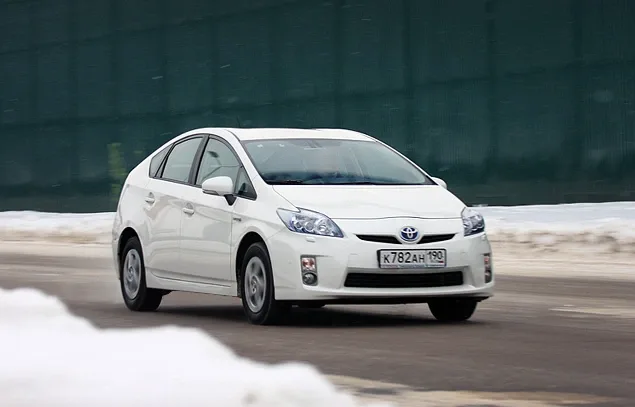
If you activate Eco Mode, where all Prius systems are tuned for maximum fuel and electricity economy, the response to the gas becomes sluggish. Here, there is no talk of ten and a half seconds. But if in this mode you suddenly need a sharp acceleration, it is enough to press the pedal to the floor, and the car will use the full potential of the gasoline and electric engines. This "surge of energy" can not only be felt, but also seen in real time — you just need to display on one of the instrument panel screens an animated diagram showing the power flows in the hybrid system.
Technologies of the future
However, the main thing in the Prius is not advanced graphics or hybrid technologies (at the mention of which, in the Togliatti scientific center, they probably clutch at heart drops), but the feeling that the future has already happened, and it literally catches up with you behind the wheel of this car. At first, it seems that nothing special is happening — the Prius honestly and predictably responds to the gas, and the suspension (which, by the way, has not yet found a place for sensors and servos — it is a regular McPherson in front and a torsion beam in the rear) conscientiously shakes on small surface defects.
But then, turning 90 degrees, you suddenly notice how persistently, with the mechanical persistence of the electric motor built into the rack, the steering wheel returns to "zero", and you realize that literally everything around is entangled with wires, through which signals from your axons through the gas pedal go directly to the "brains" of the power plant. In short, goosebumps are guaranteed, and I would buy this car just for them.
Although, maybe it's my professional impressionability. Russian drivers with a more stable psyche will most likely perceive the Prius as a fashionable and smart accessory, like an expensive smartphone. True, at a price of 1 million 177 thousand rubles, there will not be many such people, but they will be. Otherwise, we would hardly have been brought the most valuable thing that the Japanese manufacturer has — its tomorrow. After all, Toyota still subsidizes the production of this model.
Technical characteristics of Toyota Prius
| Length, mm | 4460 |
| Width, mm | 1745 |
| Height, mm | 1500 |
| Wheelbase, mm | 2700 |
| Curb weight, kg | 1445 |
| Engine displacement, cm3 | 1798 |
| Power, hp/rpm | 99/5200 |
| Torque, Nm/rpm | 142/4000 |
| Acceleration time from 0 to 100 km/h, s | 10.4 |
| Maximum speed, km/h | 180 |
| Fuel consumption in combined cycle, l/100 km | 3.9 |
| DISCUSS | [ comments: NONE ] |