
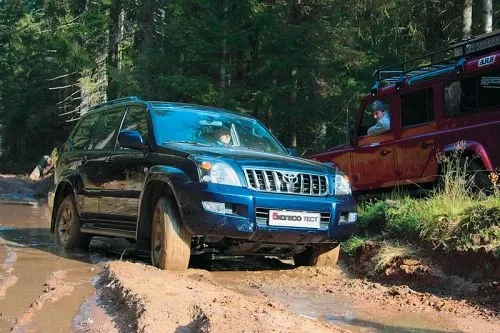
Often, SUV owners don't even realize what their car is truly capable of, besides its impressive looks and confident curb climbing. Our reader shares his impressions of a real master class arranged for him by an experienced off-roader.
Viktor Puzyrev, 27 years old, entrepreneur, 8 years of driving experience, drives a Toyota Land Cruiser Prado
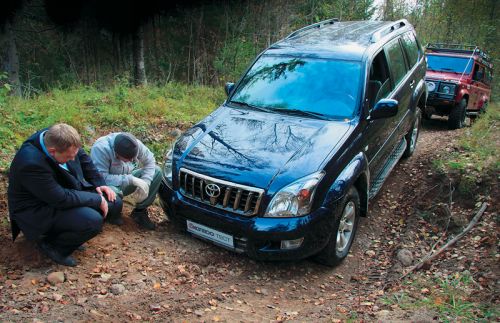
2003 Toyota Land Cruiser Prado
© Photo: Igor Kuznetsov, 5 Koleso
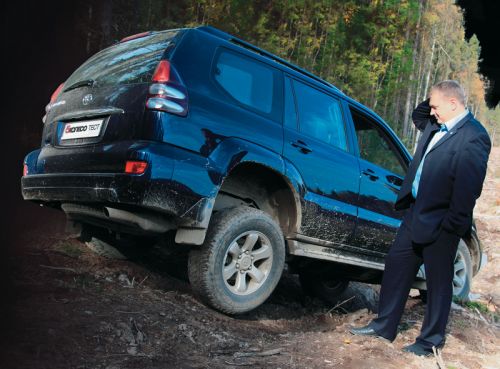
2003 Toyota Land Cruiser Prado
© Photo: Igor Kuznetsov, 5 Koleso
The main reason for buying an SUV was, of course, its prestige. But the desire to look solid is not the only motive. I am more attracted by the opportunity to keep the situation under control. Previously, dense city traffic annoyed me, but now it doesn't cause much trouble. The high seating position allows me to see the road many cars ahead, and all-wheel drive and ground clearance give me a chance to bypass traffic jams where I would have been afraid to go before.
At the same time, I am aware that I won't use many of the car's functions in everyday life. I'm not talking about cruise control or heated seats, which people call a "sterilizer." I mean systems that allow driving where there are no roads or they are in terrible condition. Honestly, I've always wanted to test what my SUV is capable of. And then such an offer — to check the car and get advice from a real off-roader! I agreed without hesitation.
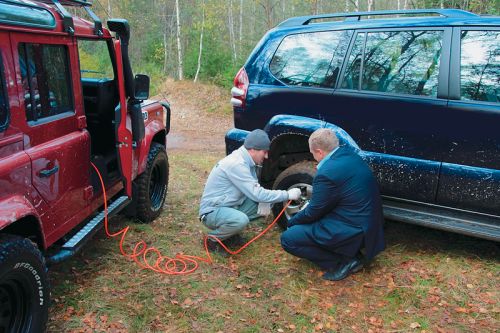
2003 Toyota Land Cruiser Prado
© Photo: Igor Kuznetsov, 5 Koleso
2003 Toyota Land Cruiser Prado
© Photo: Igor Kuznetsov, 5 Koleso
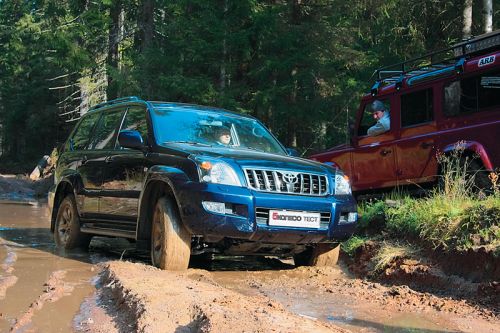
At the meeting point, I met journalists from the "5 Koleso" test group and Sergey, a veteran of the off-road movement. The first thing I learned: a real SUV, in addition to all-wheel drive, low-range gearing, and a powerful engine, also needs good geometric cross-country capability. This means a short wheelbase, small overhangs, and high ground clearance. These parameters, along with long-travel suspension, allow the car to confidently grip the surface. And this contact is the basis for overcoming obstacles. My car is fine in this regard. I easily drove where I previously thought I would definitely leave a bumper or rocker panels.
But diagonal wheel articulation became a real test for my nerves. When the car started swaying from side to side on one of the bends, I almost lost my pulse. The feeling is unpleasant. But Sergey explained that this is a test of the car's ability to continue moving, relying on only two wheels (in the cabin it seemed to me even on one). This checks the operation of the center and cross-axle differentials. My car handled this exercise without a single mistake, which made me very happy. The most serious test was the ford.
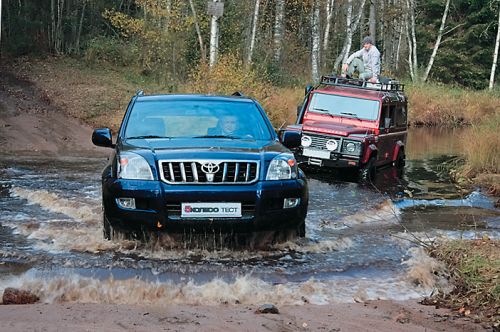
Before sending me into the water, Sergey spent a long time looking at something under the hood, and then said that if I had a snorkel, there would be no problems, but as it is, I'd have to be careful. I asked why he didn't take this person with him. It turned out that a snorkel is not a specialist's surname, but a special pipe that prevents the engine from drowning and getting water hammer. Nevertheless, I got the command to cross. The sensations, I'll tell you, are not pleasant. Entering the water, you instinctively want to get out quickly, but you can't do that. A slight wave coming with the car is a sign that everything is being done correctly.
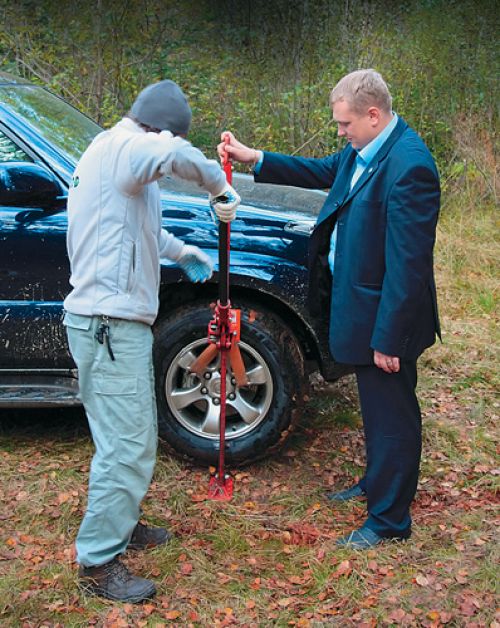
I also learned from the veteran that by changing tire pressure, you can significantly improve cross-country capability on sand or snow. And a "hi-lift jack" is not a greeting among off-roaders, but a device for lifting the car to a great height to pull it out of captivity or carry out repairs.
Communicating with a person for whom an SUV is not a status but a way of life was very informative. The most pleasant thing is that I tried some techniques myself that are unlikely to be useful in everyday life. But now, if anything, I can use them. And I was very pleased that my car is capable of a lot without special preparation. I won't go on a trophy raid in it, of course, but I will now make trips away from asphalt more often.
Instructor's opinion
Sergey Lebedev, 40 years old, veteran of the off-road movement, 20 years of driving experience, drives a Ford Ranger, Land Rover Defender 110
2003 Toyota Land Cruiser Prado
© Photo: Igor Kuznetsov, 5 Koleso
2003 Toyota Land Cruiser Prado
© Photo: Igor Kuznetsov, 5 Koleso
I am amused by how many SUVs drive on our streets. Most of their owners have no idea what their cars are capable of. A stern look, a powerful engine, all-wheel drive, and ground clearance are not all that is needed to go into the wilderness, have fun there, and get out without problems. First of all, you need to at least theoretically know what and why is in the car. And secondly, you need to go out into nature at least sometimes. Only then do skills and confidence appear. If you don't do this seriously, then there's not much point in buying such a "weight." Those who are just planning to purchase such a car should think carefully about whether it's worth overpaying for all the systems that you'll use once or twice during the entire ownership. Maybe it's better to take a regular crossover? They also allow you to go on light off-road. And you don't need to think about what and why to turn on — they know everything themselves.
2003 Toyota Land Cruiser Prado
© Photo: Igor Kuznetsov, 5 Koleso
Driving
The car impresses with its capabilities both on asphalt and off-road. Driving it is a pleasure, but don't forget that the center of gravity is higher than in a passenger car, so you need to be more careful in corners.
Interior
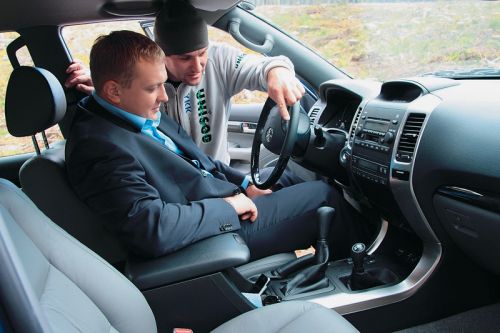
Spacious and comfortable, and the additional seats in the trunk noticeably expand its functionality.
Comfort
Equally good on asphalt and on dirt roads. Adjustable stiffness only helps with this.
Safety
At a high level.
Price
A bit high.
Advantages and disadvantages
2003 Toyota Land Cruiser Prado
© Photo: Igor Kuznetsov, 5 Koleso
+ Spacious and comfortable interior, excellent dynamics, serious off-road capabilities, a large number of truly useful options.
- High price.
Specifications
Make and model — Toyota Land Cruiser Prado
Dimensions — 4660x1790x1835 mm
Engine — petrol, 6-cylinder, 3956 cm³, 249 hp/5200 rpm
Transmission — automatic, 4-speed
Dynamics — 175 km/h, acceleration to 100 km/h in 9.5 seconds. Main rivals — Nissan Pathfinder and Land Rover Discovery.
2003 Toyota Land Cruiser Prado
© Photo: Igor Kuznetsov, 5 Koleso
I'm glad that I became the owner of a truly serious SUV, but I'm even more glad that I now understand how to drive it not only on smooth asphalt. On top of everything else, after this trip, I think I won't be able to calmly drive past a decent puddle anymore. A childish pastime? Perhaps, but what a charge of emotions!
© 5 Koleso