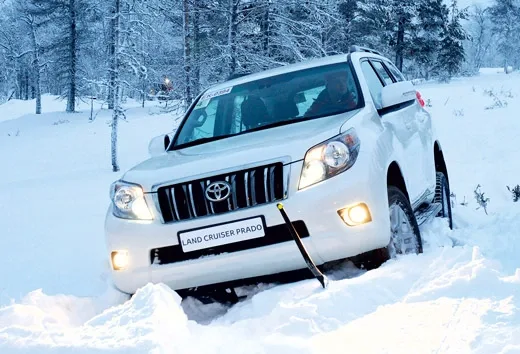
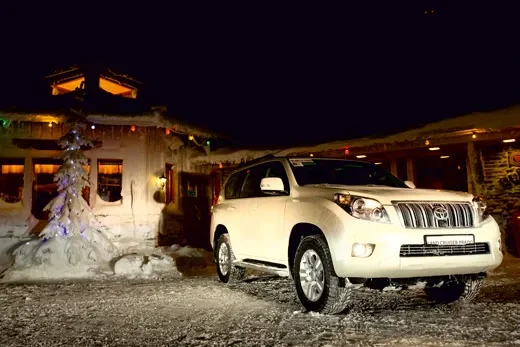
"Why Lapland?" — I asked myself, hastily tucking my ears into a warm baseball cap in twenty-degree frost. The first test of the Prado, organized three hundred kilometers north of the Arctic Circle, could have only two explanations. First, in December, darkness reigns for twenty hours a day, and the remaining four are just light twilight. Perhaps someone is shy about showing off their grown body in the headlights? Besides, almost all Prados were white, like polar bears. "Cover your nose with your paw, Umka, so the journalist doesn't notice you..."
The second reason is snow and ice in abundance. A winter track is exactly what you'd pay money for permanent all-wheel drive for. We didn't drive a single meter on asphalt — in winter in northern Finland, it simply doesn't exist. Roads aren't sanded — only snow is packed down, and that's it.
**LOYALTY TO PRINCIPLES**
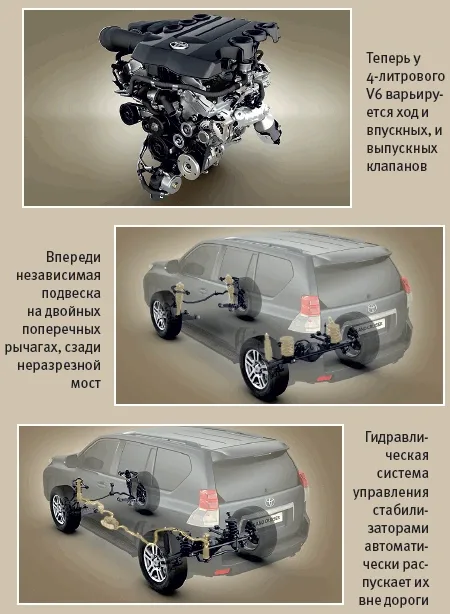
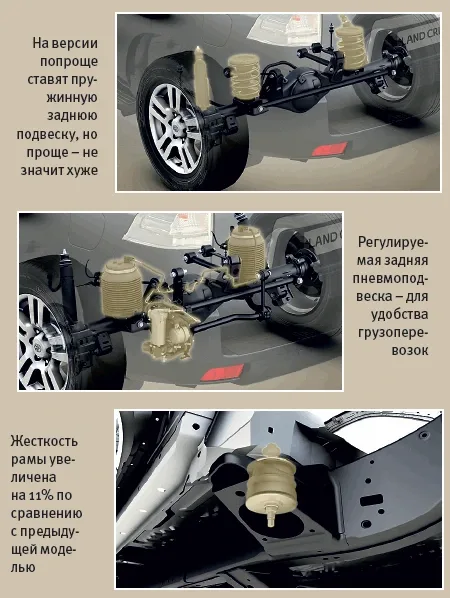
What attracts me to the Land Cruiser Prado is its devotion to tradition. Look at the competitors: Mitsubishi Pajero, Nissan Pathfinder, VW Touareg, LR Discovery. All have torsionally rigid unibody bodies and independent suspensions. That's a sensible approach. Today, universal SUVs spend about 90% of their time on asphalt, and durability isn't that necessary. But the Prado, contrary to trends, has kept a frame — though a new, stronger one, with crossmembers specifically designed for painless contact with the ground. At the rear — a solid axle with a reinforced differential. At the front, of course, independent suspension, but that's been the case for a long time.
As I noted, permanent all-wheel drive hasn't gone anywhere either. Here it's, so to speak, real, since it works through a mechanical Torsen limited-slip differential. And since such a scheme doesn't allow fully locking a spinning wheel off-road, the base trim includes locks for the center and rear differentials. But let's return to the live impressions from the test.
**IT'S JUST WORK**
So, first the proving ground. Very slippery: snow and bare ice. Tires — Nokian Hakkapeliitta R SUV without studs (by the way, there's a separate article about them in this issue). I do the lane change and slalom — it doesn't look very pretty. In the sense — uninteresting. We're at the limit, but very clean. You don't have to fight the car, catch it, and tuck it into a turn — we're not playing with it; we're just working according to the scheme. A sharp dip before entering a turn, steering input, acceleration, another dip to load the front wheels. And all this — under the constant squeal of electronics actively participating in the process. The stability system noticeably helps — it slightly chokes the engine, slightly brakes the wheels, and as a result, the Prado holds its trajectory. It's just that this damn squeal is clearly unnecessary, smacking of panic on board.
Computer stabilization, however, can now be turned off — halfway, so it only activates in a truly critical situation when the rear starts swinging, or completely. I tried both ways — still, guys, on bare ice, it's better with it.
Access to the trunk is also possible through the window — a solution quite common in the US. But the side-hinged door is almost exotic.
The third-row seats fold down to form a flat floor, not hang on the walls taking up half the trunk like before.
The center console, growing right through the dashboard, looks like a gift from Aliens.
The Multi-terrain monitor system shows not only zones invisible from the driver's seat but also the trajectory of wheel movement.
However, the laws of physics can't be canceled even by computers. If you release the accelerator pedal in a turn, on ice the Prado is irresistibly pushed outward with all four wheels. So — "don't slow down on bends." Though that's trivial; it was the same before. What's curious is something else — the new Prado has almost no body roll. Well, by the standards of mid-size universal SUVs. And without any discounts for the frame. This magical effect is provided by a new, clever hydraulic anti-roll system. It also allows increasing suspension travel off-road, and it does it itself, without any button manipulations. I won't bombard you with technical details; if interested, look up at the "Fluid Against Rolls" block.
The armrest fits four half-liter water bottles. It even seems to be cooled.
On the right of the steering wheel is a joystick for controlling the Multi-terrain system. Its menu is displayed on the LCD screen between the instruments.
**ALL LIFE, BUT NOT ALWAYS**
How is the Prado on a regular road? Boring to the point of indecency. Everything is very good: it's smooth, fast, obedient, adequate. I'd like to live with such a car all my life and die with it on the same day — but only if I can occasionally cheat on it with hotter cars.
So, regarding road qualities, I hope I've spoken quite clearly. I can only add that the cars we tested had a 4-liter gasoline engine, V6. The same as before, but slightly modernized for Euro 5 and at the same time — as Toyota claims — a bit more powerful, torquier, and economical. Probably so. At least we didn't lack torque even when climbing out of a ford onto a steep bank, with chunks of thick ice rumbling under the floor. This, as you've already understood, is us elegantly transitioning to the off-road part of the test. Specific, snowy-forest, but still having taken place.
Actually, this mirror is meant for watching children, not for flirting.
**HEMISPHERE CONFLICTS**
Besides differential locks and a low range in the transfer case, the new Prado is loaded with so much off-road intelligence that the right hemisphere of its electronic brain conflicts with the left. Perhaps this long sentence doesn't seem too funny, but I'm not joking. Look what happens. There's an excellent Crowl Control function — a kind of cruise control for slow, 5–7 km/h, movement. It doesn't just fix fuel supply; it automatically maintains the set speed. If you suddenly need to speed up, please — press the gas. I really liked Crowl Control, especially on a steep climb. It's also effective on descents. True, for descents, the Prado has had its own special system since the previous generation. But that's not a problem. The bad thing is that Crowl Control can't be used simultaneously with the Multi-terrain system. Which also seems quite useful — like Terrain-Response in Land Rover. Only here you need to choose the type of surface under the wheels, not the old-fashioned way — with a rotary knob, but through a computer menu. Navigation through it is done with a small joystick on the steering wheel. You need to stroke it up and down or vice versa, and to make a decision, subject it to light pressure. After which, by the way, the car may well report via the display — "Cannot engage Multi-terrain while Crowl Control is active." Interesting, why, if the first is responsible for the permissible degree of wheel slip, and the second for speed. And in general, which one to use if both are recommended for difficult situations?
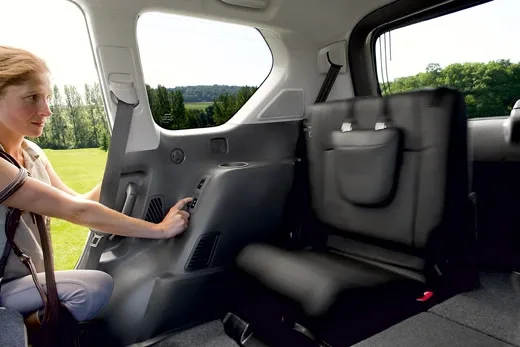
In top trims, the last-row seats hide into the floor at the press of a button — the electric drive does everything itself
WE'LL FIGURE IT OUT AT HOME
I honestly admit: I never managed to thoroughly study the Multi-terrain capabilities. I only had dry snow about thirty centimeters thick. In addition, while I was clicking the shutter, photographing a Prado thoroughly buried in a snowdrift, Boreslav Kazankin, a Camel Trophy veteran, got behind the wheel and drove the car onto the track. True, I suspect that before that, he turned off all the electronics...
However, the Multi-terrain arsenal has another function — the Multi-terrain monitor surround-view system, and it works flawlessly. The screen shows both what's happening on the sides and what's right in front of the bumper. On descents and ascents, it's a lifesaver. Moreover, the camera image is supplemented with lines showing the trajectory of the wheels. All that's required from the driver is to learn to trust these lines unconditionally. When I drove onto the ramps thrown over a stream, I couldn't resist and asked a colleague to get out and back me up.
It remains to add one more important piece of news: finally, a diesel version of the Prado will appear in Russia. Under the hood — a three-liter engine, and, according to marketers' forecasts, this modification will account for more than 60% of all model sales in our country. It's just a pity that this option wasn't brought to Lapland.
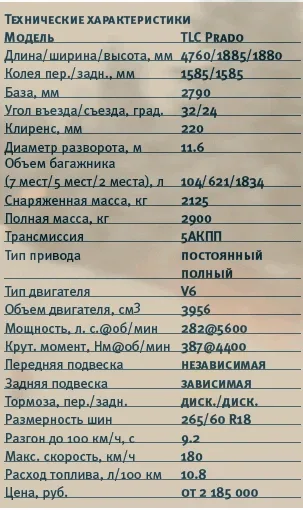
SPECS: TOYOTA LAND CRUISER PRADO
LUXURY OR PRESTIGE
Prices for the gasoline Toyota Land Cruiser Prado start from 2,185,000 rubles for the "prestige" trim, while the top "luxury" version will cost 2,615,000 rubles. I think such figures won't scare off the model's fans. Nor, for that matter, will the appearance, which aesthetes are still actively discussing.
FLUID AGAINST ROLLS
Engineers call this the kinetic dynamic suspension system (KDSS). It improves suspension performance both on asphalt and off-road, and it does so simply and effectively.
The design of the front and rear stabilizers incorporates separate hydraulic cylinders connected to each other. Each of them has upper and lower chambers. The upper chambers of the front and rear cylinders are connected through a receiver, and the lower chambers are connected in the same way. When turning, equal forces act on the outer wheels, the cylinder pistons remain in place, and the suspension travel is reduced. However, on rough terrain, when the vertical travels of the front and rear wheels on each side are in opposite directions, the pistons in the cylinders begin to move freely, and the suspension essentially loosens.