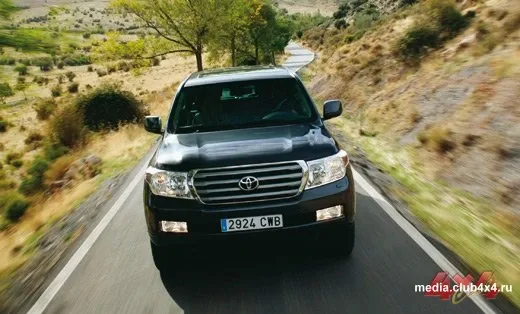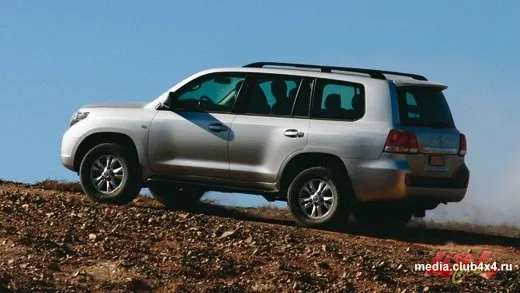
The lifespan of the previous generation Land Cruiser turned out to be quite decent by modern standards. It has been replaced by a completely new "two hundred" model, which shares not only recognizable design in the corporate style with its predecessor. Contrary to the expectations of skeptics, the flagship "cruiser" did not abandon the frame and retained the dependent rear suspension. The frame received zones of programmed deformation to improve passive safety, and torsional and bending rigidity indicators became noticeably higher. The body dimensions have hardly changed — the length of the SUV still does not exceed five meters.
EIGHT CYLINDERS
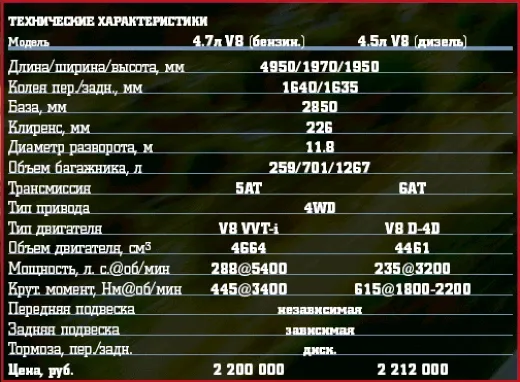
In marketing materials, the new product is positioned as the new Land Cruiser V8 — and for good reason. Under the hood, only eight-cylinder units can now be installed. Two options are provided for the European market. The gasoline one is a refined version of the 2UZ-FE engine familiar from the "hundredth" model, with a volume of 4.7 liters. Its output has increased to 288 horsepower, and now it meets the Euro-4 environmental standard.
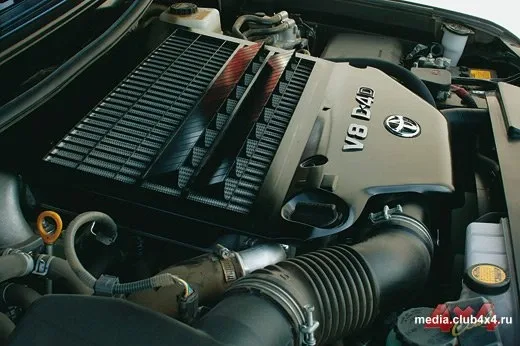
The second engine is a completely new development. We are talking about a 4.5-liter turbo diesel V8 with direct injection, designated by the index 1VD-FTV. Its power varies depending on the sales market. For the Russian version, which complies with Euro-3 standards, 235 hp is stated. In Scandinavia and Turkey, the engine develops 265 hp. But in other markets, the diesel produces 286 hp, which is almost comparable to the gasoline unit.
The buyer will not be given a choice of gearbox. The gasoline engine works exclusively with a five-speed automatic transmission, and the diesel with a six-speed one. Both gearboxes are equipped with a manual shift mode.
LSD, NOT TO BE CONFUSED WITH LSD
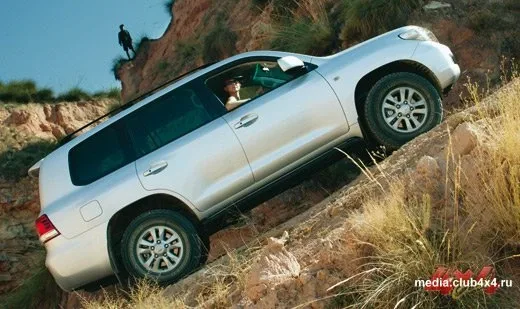
The drive scheme has not changed. It is a permanent all-wheel drive, supplemented by the possibility of manual locking of the center differential. Moreover, the differential itself is now not free, but of the Torsen LSD type (limited slip). Torque between the axles is distributed without the participation of electronics, depending on the surface and load, but this ratio is limited to between 30:70 and 70:30. The low range in the transmission, of course, remains. And to get ahead of competitors, Toyota engineers were the first in the world to introduce the Crawl Control system. A three-position switch (available only on gasoline versions) allows you to move at a snail's pace: 1, 3, or 5 km/h. Off-road, this is very helpful.
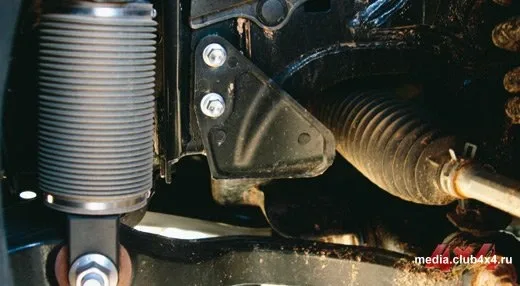
On the left, in a corrugated cover, hides the strut of the KDSS stabilizer stiffness control system
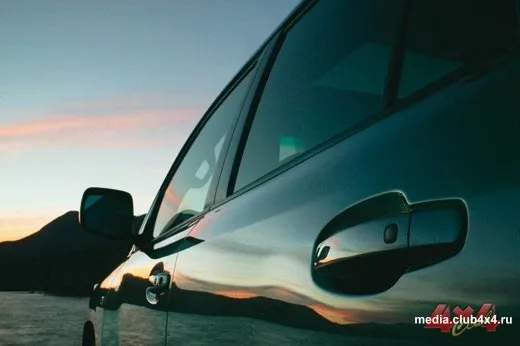
Just in case, door opening cylinders are hidden in the handles. Their key lives inside the key fob
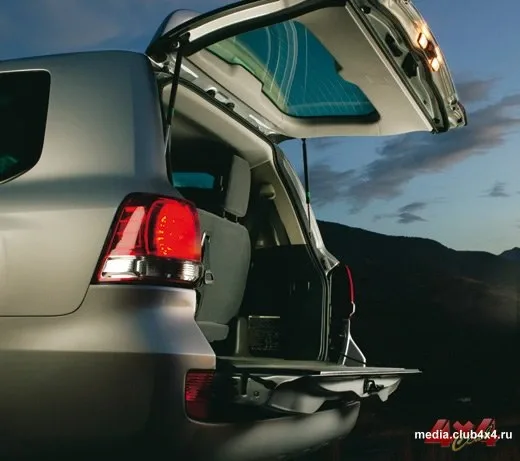
Just in case, door opening cylinders are hidden in the handles. Their key lives inside the key fob
The arsenal of electronic assistants has also expanded. There is a VSC stability control system, A-TRC traction control, DAC downhill and HAC uphill assist. It is noteworthy that when the center differential lock is activated, the electronic stability systems are turned off. Among other assistants, it is worth highlighting the advanced ABS Multi-Terrain. It adequately responds to the situation under the wheels and does not allow errors like braking the unloaded wheel.
OFF-ROAD RELAXED
The chassis, at first glance, has not changed much. Except that springs appeared at the front instead of torsion bars. However, the main innovation is electronically controlled anti-roll bars, which for Russia are now included in the basic equipment. This hydraulic system is called KDSS. The electronics itself decides what to do with the stabilizers at a particular moment. On asphalt, they are clamped, and off-road they are relaxed. Thanks to KDSS, the new Land Cruiser has retained impressive suspension travel, like the previous model. But this is not the only plus: on asphalt, body rolls are much less than you would expect from a heavy frame SUV with a high center of gravity. In other markets, the 4W AHS@AVS system is offered, which adjusts the ground clearance. There are also simplified suspension options without any systems. By the way, the Land Cruiser has noticeably "matured": versions with solid axles and simple inline engines have disappeared completely. And it's a pity...
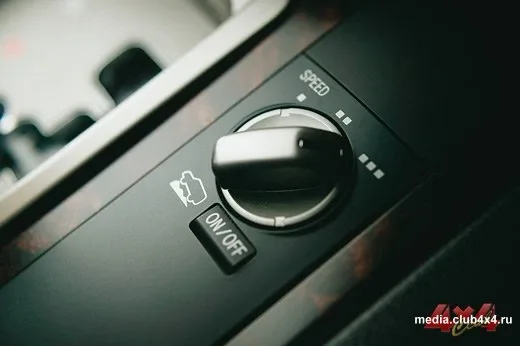
The Crawl Control system allows you to crawl at a speed of 1.3 or 5 km/h without touching the pedals
EVERYTHING FOR THE HUMAN
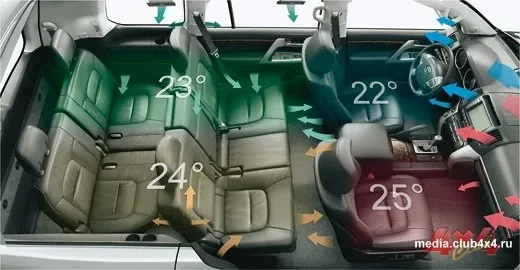
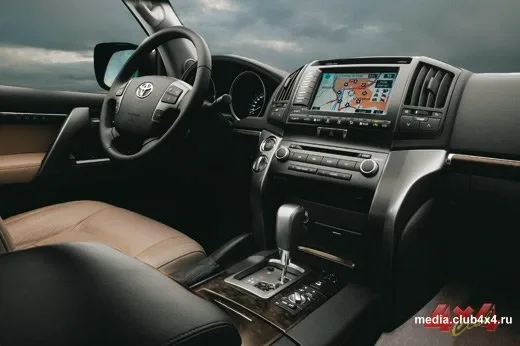
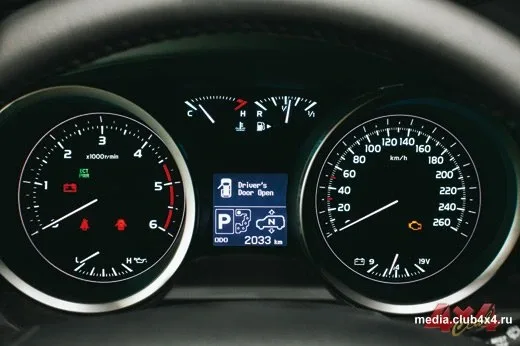
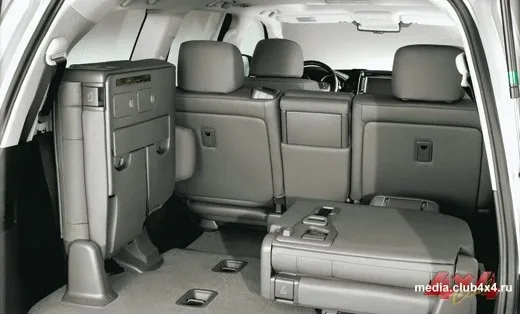
Inside the car, many new details have appeared. The engine is started with a button, and the key hidden in the key fob will only be useful for mechanically opening the doors if the battery dies. Four-zone climate control will allow each passenger to arrange a personal Tashkent or, conversely, Magadan. Air ducts are also connected to the third row of seats — all versions, by the way, are seven-seater. Ten airbags are responsible for safety, including knee airbags and curtains for all three rows. The driver's seat is electrically adjustable in many directions and remembers settings for three profiles. There is a navigation system with a touch screen (works in Russia too), DVD, and a parking assistant using a rear-view camera. The steering column is electronically adjustable for reach and tilt. In the central armrest there is a cooled box that can hold a dozen 0.33-liter cans. The only surprising thing is the absence of xenon headlights with such rich equipment.