
How does the diesel Land Cruiser 200 differ from the petrol one
How the diesel Land Cruiser 200 differs from the petrol one, how not to doze off at the wheel of both versions, and something about a very important button. Before heading out in the new Land Cruiser 200 on an extreme trip to the mountains or over the roofs of shells in your own yard, be sure to use the RSCA OFF button.
It disables the side curtain airbags and seatbelt pretensioners. The manual says: this button should be pressed when there is a risk of rollover. True, it's better to immediately buy a spare LC 200 — after activating this mode, the first one is unlikely to be restored. And even if it survives, you'll still want to check if the "two-hundredth" can handle the claimed 700 mm of wading depth. This applies to both versions — petrol and diesel, but we started our comparative test with the latter.
WHY DOES IT RATTLE?
The diesel Land Cruiser 200 gives itself away from the first seconds: a characteristic tractor-like hum, weak brakes, and acceleration that runs out of breath after 140 km/h. Where does this rattling sound come from? I haven't heard such a wild roar under the hood since the inline six-cylinder diesels in the old "hundreds." The Discovery TDV6 sounds similar when, after a long drive, the Finnish diesel in its tank runs out and our sludge is poured in.
Having accelerated, I noticed a queue of cars ahead stuck before a speed bump and began to brake, leaving what I thought was a decent margin. Ugh! How wrong I was! The red Peugeot 207, which had been getting underfoot before, seeing my rapid approach in the mirror, suddenly came alive and cleared the obstacle. Snorting in surprise (why do the Japanese brake like Americans?), I stopped to catch my breath and adjust the seat.
The seatback, or rather its electric adjustment, turned out to be broken. This simply cannot happen with a new Toyota... Just now I was pressing the brake pedal, pushing with all my weight against the seatback, so others before me must have abused it the same way. What servo drive can withstand that?
Trying not to touch the brake anymore, I got onto the Novorizhskoye highway, and up to 110–120 km/h everything went as usual. Another overtake required accelerating to 130–140 km/h, and then the revs dropped from 3500 to 3000 — the next gear engaged. The thrust disappeared right in the middle of the maneuver. After that, I had to switch to manual mode on the automatic transmission. But even that didn't help much. This diesel runs briskly only at low revs — such a character suits the city and dirt roads, but not the highway.
DON'T SLEEP!
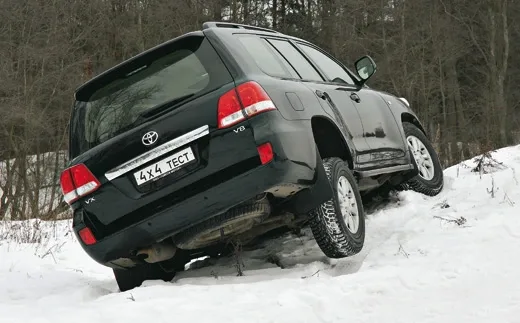
Next, we headed to the Zvenigorod quarry. To be safe, we brought a Land Rover Defender 110 to pull the "two-hundredth" out of an off-road trap if needed. Confidence didn't leave us as we drove through ravines, studying the off-road capabilities of the Toyota LC 200, and then the Defender itself got stuck in a gully.
A photo of the "two-hundredth" pulling the "one-tenth" on a tow rope would look great on the wall of Toyota's Moscow office, but we won't give it to them for anything. We'll hang it in our editorial office.
How unbearably boring the Toyota is compared to other SUVs! It just drives along the road, then goes onto the snow, then climbs a hill... and that's it. I'd hang a huge flashing sign with a buzzer in it: "DON'T SLEEP!" Because after just ten minutes behind the wheel of the "two-hundredth," the driver risks falling asleep. I started yawning after about five minutes. It's too correct — and completely emotionless.
Fighting sleep, we continued the test on snow and ice. The Toyota diesel with 615 Nm of torque in the 1800–2200 rpm range drove the car through the snow equally confidently with the traction control system both on and off. The active stabilizer contributed to off-road capability and comfortable driving over rough terrain. It maximized axle articulation without losing wheel contact with the road. Only an icy incline of about 30 degrees caused hesitation in the diesel LC 200. But with a good run-up, it conquered that too.
In the end, having received the highest score for off-road and the lowest for highway driving, the "two-hundredth" headed to the Toyota dealership's garage. And we, rubbing our stuck-together eyelids and fighting elephantine yawns, went for a bucket of eleutherococcus.
CRAWL FASTER
The next day, I was already behind the wheel of the petrol Land Cruiser 200 to compare both versions with fresh impressions. And the difference isn't just in the engines. The petrol version, unlike the diesel, is equipped with "crawl control." This system automatically maintains a set speed off-road and has three modes: 1 km/h, 3 km/h, and 5 km/h. Moreover, crawl control includes an electronic descent assist.
Is it really that simple? Turn the lever and you go without touching the pedals? Having engaged the slowest mode — 1 km/h, I moved over icy undulations, trying to look relaxed. But it didn't work: the soft and comfortable Land Cruiser vibrated heavily under the chattering of brake pads. Then I switched to 3 km/h — our off-road isn't that extreme. But the most suitable for civilian conditions turned out to be the fastest crawl control mode — 5 km/h. Most likely, that's what owners of petrol Land Cruiser 200s use.
The off-road cruise control allows you to focus only on steering, without being distracted by the gas pedal, and already saves a lot of physical and moral strength for the driver, who is trying with all his might not to scratch the bumpers and sides of the car, for which the queue is longer than for benefits at the social security office.
But in comparison with the diesel off-road, the petrol version still seemed weaker, despite the trendy crawl control. The diesel easily overcomes undulations and pulls more confidently on long climbs, and — most importantly — you don't need to be distracted by crawl control switches and calculate the required speed. The torquey diesel will pull you out anyway.
SPECS: TOYOTA LAND CRUISER 200
FEAR THE "KAMAZ"
According to the specs, the diesel version (eight cylinders, 4.5 liters) accelerates to 100 km/h in 8.6 seconds, while the petrol version (eight cylinders, 4.7 liters) does it in 9.2 seconds. Driving on Moscow region highways in the diesel, I never managed to reach 180 km/h, but in the petrol one, I did it easily, without the slightest effort. In a sprint to 100 km/h, the diesel wins, but beyond that, no. After 3200 rpm, the diesel runs out of steam, while the petrol engine is just waking up. Conclusion: the diesel version isn't versatile, but the petrol one with crawl control is.
It's a pity. The diesel consumes almost half as much as the petrol and behaves excellently off-road. But 90% of our country roads are two-lane dark proving grounds for half-dead "KAMAZ" trucks, and the topic of extreme overtaking is too relevant to ignore.
A SOLID FOUR-PLUS
The Land Cruiser is a calm family car, averaged in all parameters from birth. Not only in acceleration but also in suspension. There seem to be body rolls in corners and longitudinal pitching, but they don't interfere with driving. Ride smoothness is combined with excellent energy intensity, making any speed bumps not scary. Directional stability is far from the best in its class, and the steering wheel indulges weak and dystrophic office rats too much.
Some call it "cruiser," others "cruzer." There's also "cruiser." Yakut policemen say "crawzer." Now a gloomy nickname "two-hundredth" has appeared. In any case, it's noticeably worse than the Range Rover and better than the Nissan Pathfinder Armada. It gets solid four-pluses in all subjects, and therefore it's extremely boring. It was so and will be so unless, having had your fill of ordinariness, you get to the RSCA OFF button. Since you'll do it anyway, I remind you: the TLC 200 according to the specs overcomes a 100% incline (45 degrees), but the approach angle is 32 degrees, so after such a climb, the front bumper will have to be thrown away. But one of your "Toyotas" is destined for the scrap heap anyway...
Test drive photos
Comments
No comments yet. Say the first word.