
Eye-stopper
What parallel can be drawn for the microcar Toyota iQ? What can this car be compared to so that the image is clear to every resident of Russia? Perhaps, with standard housing? Quite a suitable option — after all, most city dwellers in our country live in standard high-rise buildings.
Let me explain more simply: for small cars, it is easy to find an analogy with "one-room apartments." Then budget economy-class models are "Khrushchyovkas," and compact cars that are more expensive, with options usually found in larger siblings, are one-room apartments in panel cooperatives or new buildings of increased comfort.
Continuing this line: golf class — two-room apartments, family sedans — "three-room apartments," minivans — multi-room apartments, minibuses — communal apartments, and trams, trolleybuses, and buses with metro and commuter trains — of course, "dormitories."
but at least three people can fit in these "squares"
There is also a place for exotic in this classification. For instance, premium limousines and bespoke sports cars beg to be compared to expensive private cottages in the suburbs, while Soviet automotive rarities like the "eared" "Zaporozhets" or "Moskvich-401" can be equated to "wrecks" that miraculously survived within the city limits.
And what about the "iQ"? It does not fit into either Soviet or post-Soviet standard housing, nor does it qualify as an individual project by a Russian architect — too modest. But for this car, there is a vivid "compact" image at the intersection of two cultures — the microcar resembles a Michurin hybrid between a "Soviet-style" hotel-type apartment and a "single" room in one of the ultramodern hotels in Tokyo's skyscraper district of Shinjuku. From the first, the Japanese microcar got the feeling of a small but still personal space, and from the second — a creative approach to layout, modern "renovation," and gadgets.
Without Illusions
The total area of the "iQ" is five square meters (2985 millimeters in length by 1680 millimeters in width), living area — 2.2 "squares" (iQ interior: 1435 millimeters in length and 1515 millimeters in width). This is six times less than what a person was entitled to under the Soviet housing code. But in the automotive industry, different standards apply, especially when the car is designed by Toyota engineers: in their two "squares," three adults can fit (two in front and one in the back), plus in the place behind the driver — a child, a pet, or a bag. At least, that is what the press release claims.
And indeed: on the right in the iQ, both the front and rear passengers are comfortable — to free up space, Japanese designers "removed" the glove box from the front panel. But behind the driver "under 190 cm tall," even a preschooler cannot sit, as the fully reclined front seat rests against the lower cushion of the rear bench. Therefore, regarding the child, Toyota's PR people were hasty — this place is only suitable for a small dog, a cat, or a couple of bags from the supermarket.
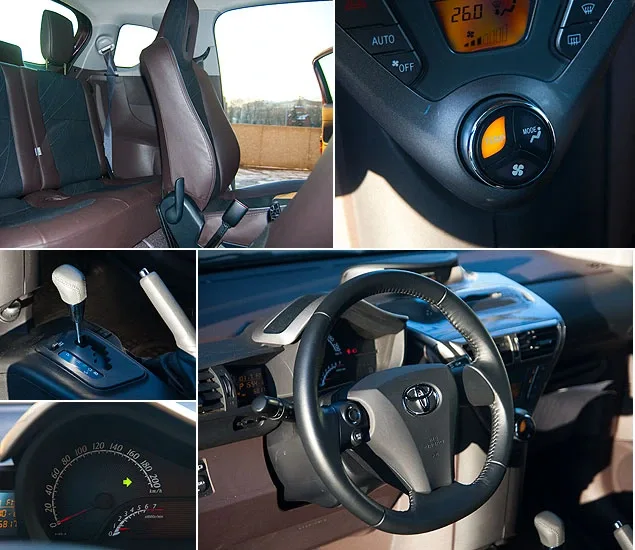
The downside is that learning to use the music system with just one tiny joystick on the steering wheel by trial and error is practically impossible — you cannot do without the instructions.
But still, the efforts that the Japanese made to ensure that the three-meter "iQ" has a full-fledged three-seat interior deserve respect. Take, for example, the asymmetric front panel, for which they had to not only abandon the glove box but also devise a new scheme for routing climate control air ducts and wiring harnesses. In addition, Toyota engineers created a unique climate unit for the iQ, which is 20 percent more compact than those in "classmates."
All Grown-Up
Naturally, space in the cabin had to be saved not only by optimizing the interior — the Toyota iQ is almost entirely woven from unusual technical ideas and solutions that are rarely found on compact cars. And if you do find them, not in such quantities. For example, the steering rack of the "iQ" is raised in height, so the gearbox and engine are actually located under it.
And the gearbox itself, the Japanese turned with the differential forward, thanks to which the front axle was moved a few more centimeters closer to the front bumper. Also worth mentioning here is the flat fuel tank with a thickness of 120 millimeters (half an A4 sheet), located under the front left seat.
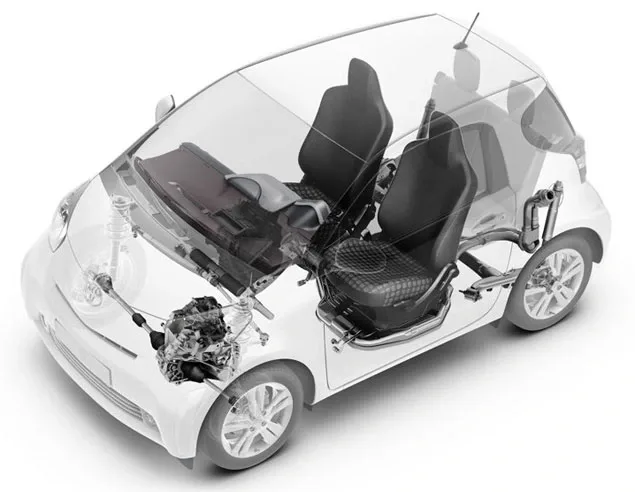
As a result, even despite the tiny — two-meter — wheelbase, the iQ gives the impression of a spacious car. And if you do not look back from the driver's seat, you get the feeling that there is a full-fledged interior of a five-door hatchback behind you.
This illusion is supported not only by spatial "know-how": Toyota designers also "played" with the dimensions of the iQ. For example, the microcar has a fairly high ceiling (1500 millimeters). Moreover, the "iQ" is wide — it is only two millimeters narrower than the "senior" Volkswagen Polo (1682 millimeters). The cabin seems spacious also because of the windshield, which, thanks to the pillars pushed almost beyond the front axle, is perceived as huge.
True, for the rejection of the usual proportions, they had to pay with a somewhat utilitarian appearance — it is difficult to call the beautiful three-meter box-shaped body. In addition, the microcar has "adult" alloy wheels with a dimension of 175/60R16, which, despite their obvious aesthetic merits, do not add harmony to the "iQ" appearance due to their impressive size.
Wheels Knock
Large and heavy wheels are also the main cause of all inconveniences when driving the iQ. Shaking and loud knocks under the floor are common when overcoming even relatively small obstacles such as bridge joints or deeply recessed manhole covers. The source of this "accompaniment" is the large unsprung masses, as well as the close proximity of these masses to the driver. In fact, he sits almost above the rear axle, and his heels are just a few centimeters from the left front wheel arch.
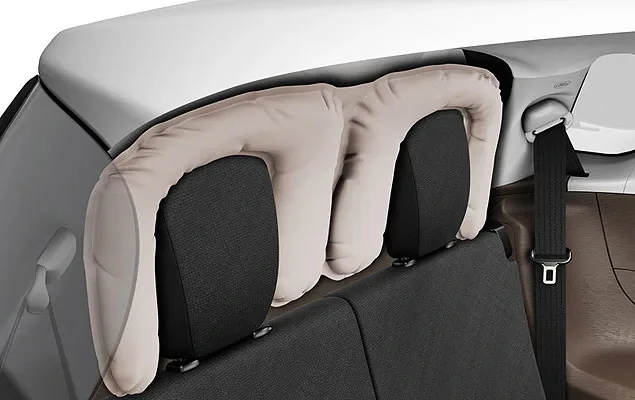
Third, the Japanese microcar has a solid list of electronic active safety systems, which includes ABS, stability control, and traction control. Moreover, the high safety level of the iQ is confirmed by crash tests: in EuroNCAP tests, the hatchback earned five stars.
Otherwise, there are no particular complaints about the "iQ" behavior on the road (of course, taking into account the caveats regarding the short wheelbase and high center of gravity of this car). On the contrary, the iQ can bring its owner many joyful moments on a winding country road. And in city traffic, the light weight, stiff suspension, and informative steering provoke the driver to "feats."
Moreover, the 100-horsepower gasoline "four" with a displacement of 1.3 liters and a CVT with six "virtual" gears eagerly accelerate the microcar at city speeds. But at cruising speeds, the "iQ" accelerates with difficulty. And according to the official data, the microcar is far from sports records — acceleration to "hundred" takes more than 11 seconds.
Other engines and transmission options for the "iQ" exist, but not in Russia. Here, the three-seat (in fact) car without a trunk is offered only in one — top — trim level and, it seems, is positioned as exotic mixed with premium. Otherwise, it is impossible to explain the price at which this car is offered to domestic buyers — for 777 thousand 777 rubles, you can now buy a European golf-class hatchback in good trim.
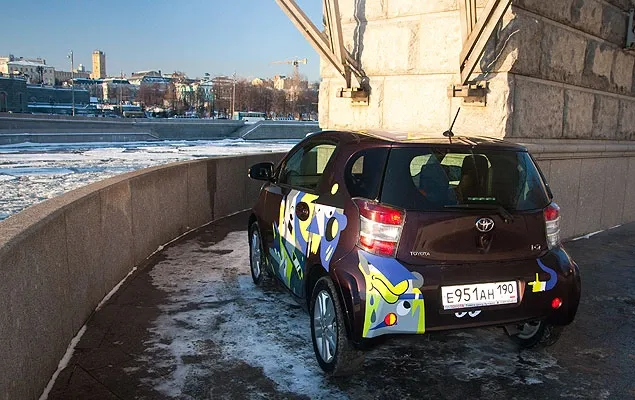
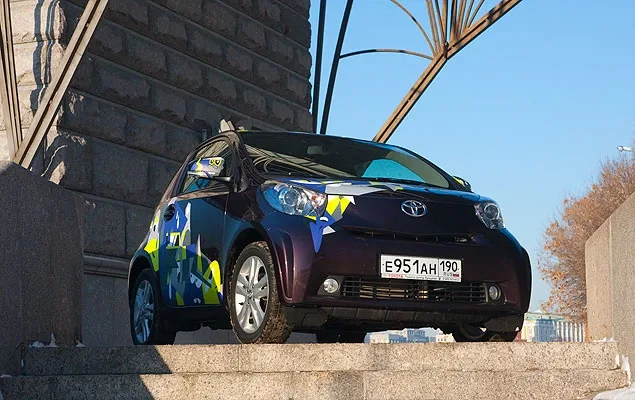
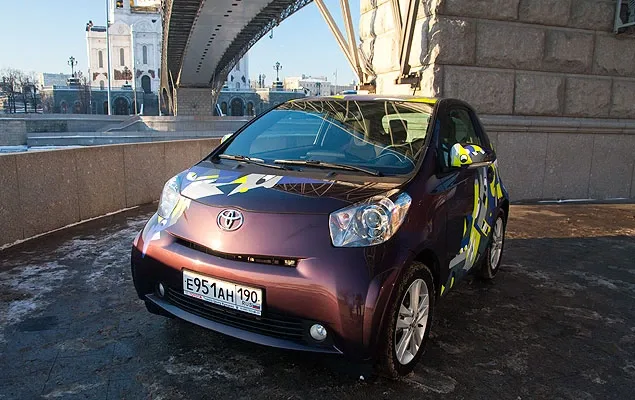
For those who want to stand out, "IQ" has an option — one of eight sets of body stickers. These designs for the "Toyota" were created by eight Russian design bureaus. Our test car, for example, was decorated in the style of Mainstreamers. The full list of "tattoos" for the iQ can be found on the official website.
On the one hand, it's a bit of a pity. After all, in Europe this little one can be bought with two other engines: a 1-liter gasoline "three-cylinder" (70 hp) or a 90-horsepower 1.4-liter diesel. Plus, a six-speed "manual" or a simple CVT with simulated five gears is available there. With such engines and a manual gearbox, the iQ would have been noticeably cheaper and would have consumed less. In our test, the most powerful 100-horsepower unit consumed about 9 liters per 100 km during active city driving.
But on the other hand, they did the right thing by bringing only the version with the 1.3-liter engine to Russia. With the 70-horsepower engine from the Japanese version, there would have been much less emotion from this car.
Elite mobility
If you count the price per square meter, the iQ is still lower than in elite Moscow apartments. But premium (or almost premium) small cars are not the most profitable investment object for us: maintaining such a compact costs almost the same as caring for a full-size sedan or crossover. And the car's dimensions are not yet a decisive factor when finding a parking spot even in large Russian cities. After all, we have significantly fewer cars per capita than in Western Europe (Moscow is probably an exception). Therefore, for global automakers, Russia is a "market with great potential," nothing more.
Plus, due to the virtually absent trunk, the practicality of such a car tends to zero. Young families who want to buy a compact and unusual car will find it difficult to take such a step. So as a first and only car, the iQ is unlikely to be considered by anyone.
the Toyota iQ gives the impression of a handcrafted car
It turns out that the iQ has few real buyers in Russia. Most likely, it will be a second or third car in a wealthy family. In Moscow, such cars could be purchased for rental — Europeans accustomed to compact cars would enjoy driving them.
And in the most extreme case, the Japanese baby could become a promo car covered with bright advertising, say, for an energy drink. In marketing, such cars are called "eye-stoppers" — that is, "bait for the eyes." Therefore, the intellectual potential embedded in a car with the telling name iQ is unlikely to be appreciated on the Russian market in the near future.
Technical characteristics of Toyota iQ
| Length, mm | 2985 |
| Width, mm | 1680 |
| Height, mm | 1500 |
| Wheelbase, mm | 2000 |
| Curb weight, kg | 1030 |
| Engine displacement, cm3 | 1329 |
| Power, hp/rpm | 98/6000 |
| Torque, Nm/rpm | 123/4400 |
| Acceleration time from 0 to 100 km/h, s | 11.6 |
| Maximum speed, km/h | 170 |
| Fuel consumption in combined cycle, l/100 km | 5.1 |
| DISCUSS | [ comments: NONE ] |