
Toyota IQ. A mind-boggler
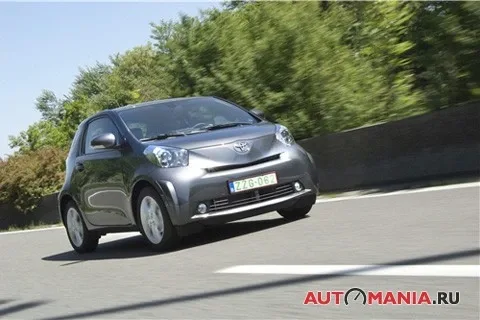
Familiar saying: “Easier to jump over than to walk around”? Usually said about overweight people. But the new Toyota IQ can be described the same way. The width of this car exceeds its height.
The car's appearance is, to put it mildly, unusual. As unusual as a car can be. And is it even a car? From a certain distance, the IQ could easily be mistaken for an oversized doghouse, a futuristic ice cream kiosk, or even a toy ambulance. And the key word here is “toy.” How else to react to a car less than three meters long? Among modern four-wheeled vehicles, only the Smart ForTwo is shorter. Surprisingly, though, the IQ is far from being the most affordable model in Toyota's lineup. Yes, our little one is not as cheap as it seems at first glance. To understand this paradox, we need to figure out: “What was the Toyota IQ even invented for?”.
An unknown little creature
Indeed, if the role of an affordable city car, a kind of pass into the world of Toyota, in the European lineup of the Japanese is played by the Aygo (a sibling of the familiar Peugeot 107), and the stylish and practical Yaris successfully competes with the best German and French superminis, then who should the IQ fight? The Smart ForTwo? But its sales are too modest to worry the marketers of the world's largest automaker. In reality, the Japanese have much more serious ambitions. They specifically designed a new type of city car for cramped Europe—compact but excellently packaged. Moreover, Toyota intends to sell 100,000 of these little ones a year. Smart dealers could only dream of such volumes!
The engineers were given a seemingly impossible task: with A-class dimensions, the IQ should not yield to B-segment models in dynamics, and in safety and interior space it must match the “golf class”!.. But let's not jump to conclusions; maybe the Japanese really managed to turn the impossible into reality…
Something that cannot be
Looking at this Japanese puppy—the upturned nose of the brand emblem and the good-natured headlight-eyes hint at a cute dog—I can't hold back my affection. It really is very cute! And, by the way, it doesn't look flimsy, cramped, or too small at all, which is quite surprising given a body length of 2 m 99 cm. The IQ gains solidity from the wide massive front bumper, developed wheel arches, and powerful rear roof pillars. No, this is not a God-offended Chihuahua or Pekingese, but rather a fighting dog, albeit still a puppy. It seems that time will pass, the Toyota IQ will grow up and become, if not a Land Cruiser 200, then at least a RAV4.
But we got distracted. Despite all the charm, I'm not ready to believe that I can fit inside this little box without harming my health.
I open the IQ's door. Well, well… At first glance, the seats look quite adult. But that's in the front. The same Smart, at 2 m 70 cm long, offers two quite comfortable chairs. The trick is that the ForTwo has no rear row at all, while the IQ does. Moreover, that's where I'll try to get in.
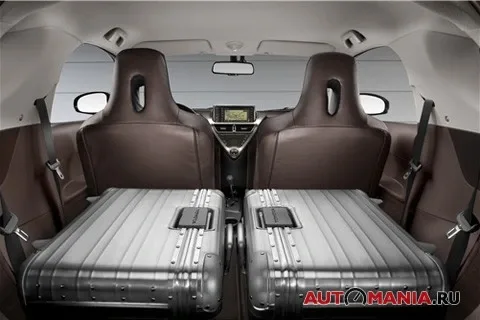
And what do you know, it seems to work… The driver's seat backrest tilts far forward, and I climb onto the sofa. No, rather, onto the little sofa. Surprisingly, one can exist here. Yes, the roof presses a bit, but my head doesn't touch the ceiling. You can't cross your legs, of course, but your knees aren't acting as spacers between the sofa and the front seatbacks. And in width, the IQ feels like a full-fledged car! Where does it all come from?!
Reason suggests: “You can't set up a football field on a stairwell!” So how does the tiny IQ manage to be a four-seater? Oh, this is incredibly interesting! The construction of the smallest Toyota has so many unique solutions, innovations, and fresh ideas that if there were a Nobel Prize for automotive engineering, it would definitely go to Tokyo.
A masterpiece of cabin layout
You don't even know where to start. You could, for example, start with the ultra-thin seats. Notice: the thickness of the backrest is at least half that of regular models. The asymmetric approach to cabin layout is evident in the abandonment of the usual glove box. Instead, the IQ has an elegant flat thing—either a folder or a briefcase—attached to the dashboard with Velcro. The capacity and convenience of such a device are debatable, but it allowed saving a few precious millimeters for the front passenger's legs.
In the pursuit of “golf-class” spaciousness, Toyota engineers not only shrank familiar things but also rethought their placement. For instance, the heater and air conditioner fan is usually located in the lower right part of the cabin, i.e., at the right passenger's feet. In the IQ, it moved up, where it doesn't bother anyone. Other unique features of the car, hidden from view, include a flat fuel tank placed under the driver's seat, a special steering rack design, and a gearbox differential moved ahead of the front axle.
The Japanese accomplished their task: the IQ is undoubtedly the most spacious car in the world in its weight class. There aren't even any worthy competitors nearby. Against this achievement, it's easier to forgive the little one for the lack of a trunk. No, formally, it exists, of course. But note that the minimum volume of the Toyota's “hold” is 32 liters. Three buckets of water! That's a lot when you carry them up the stairs to the 12th floor, but for a trunk, these numbers are a real joke. Even a lady's handbag won't fit into the narrow slit, like an embrasure of a long-term firing point, between the rear door and the sofa backrest. At most, a flat diplomat case. True, the rear seatbacks can be folded with one motion, and, to spite all skeptics, you can go shopping. If not to IKEA, then at least to Auchan.
The IQ's interior is not only thoughtfully designed and calculated with cosmic precision, but it also looks quite attractive. According to the creators themselves, their muse was marine flora and fauna. Indeed, if you use your imagination, in the simple jumble of unusual lines and shapes in the cabin, you can see seashells, starfish, and even the profile of an electric ray. Beautiful and high-quality. The seats delight with striking brown leatherette, and the plastic panels have a textured surface reminiscent of more expensive models. The engine start button also migrated here from higher-class cars. Everything like the “big ones.”
You can drive, but carefully
I press the button, and in the depths of the modest hood, the engine wakes up. In Europe, the IQ can be bought with the base 1.0-liter engine, but our little one comes only with the top inline “four” with a displacement of 1.3 liters and 99 hp. The same power unit works under the hood of the Yaris and the facelifted Auris, which means that for the little one with a curb weight significantly less than a ton, its capabilities should be more than enough.
And indeed, the IQ takes off very briskly. The continuously variable transmission quickly shifts through virtual gears, and the car, before you know it, reaches “a hundred.” It might seem that accelerating to 100 km/h in 11.8 seconds is not a great achievement, but it's long been noted: the smaller the car, the sharper the sensation of speed. Indeed, in city traffic, the IQ gives no reason for sadness. It easily pulls away from traffic lights, effortlessly fits into gaps in dense traffic, and allows overtaking without strain. And what it does in the parking lot!!! The little Toyota seems to be able to fit into an area slightly larger than a large man's handkerchief. In a word—beau-ti-ful!
Problems arise only of a psychological nature: I can't shake the feeling that the glances of those around are fixed on my person. After all, a face overgrown with stubble doesn't quite match the IQ's caramel appearance. I think that's roughly how Vladimir Turchinsky would look with a pink handbag in his hands and a Pekingese on a leash. Not an “achtung,” of course, but close.
However, the IQ's road manners also have objective drawbacks. Thanks to the stiff suspension and large 16-inch wheels, the car handles the steering well at speeds up to 120 km/h. But as soon as you hit the highway, it seems as if gusts of side wind play with the Toyota like a toy. And in corners, the ultra-short wheelbase calls for extreme caution. After all, a skid with such modest dimensions can start very abruptly, and “catching” it, on the contrary, is difficult. Before you can gasp, the rear will overtake the front… However, that's why the dynamic stability system is standard on the IQ. Here, electronics are always on guard.
Just in case, the smallest Toyota is quite well equipped. Believe it or not, this little one has 9 airbags. One of the airbags is truly unique. To protect rear passengers, the Japanese developed the world's first rear head airbags.
Ours and not ours
The IQ is, in a sense, a very Russian car. Toyota engineers seem to have deliberately created difficulties for themselves in order to then enjoy overcoming them. Take, for example, the dimensions: the car is tiny, but inside—please, quite spacious. The short wheelbase, which can cause the car to skid sharply—well, there's the stability system for that. And so that even the most inveterate skeptics believe in safety, the car is stuffed with nine airbags and five EuroNCAP stars. Everything seems thought out, but there's one thing.
The price is confusing. In Russia, the IQ is sold in only one, but very well-equipped version, and even that does not justify 777,777 rubles. This is a disastrous price! Take, for example, the new Avensis — a car three classes higher, with a 1.8-liter engine producing 147 horsepower and in a decent Comfort Plus trim. It is 16,000 rubles cheaper. It is interesting how Toyota plans to solve this problem.
Dmitry Anatolyev
Technical specifications of Toyota IQ 1.3 Multidrive
| Length, mm | 2990 | |||
| Width, mm | 1680 | |||
| Height, mm | 1500 | |||
| Wheelbase, mm | 2000 | |||
| Curb weight, kg | 855 | |||
| Engine displacement, cm³ | 1329 | |||
| Max. power, hp | 99/6000 | |||
| Max. torque, Nm | 125/4400 | |||
| Max. speed, km/h | 180 | |||
| Acceleration time (0-100 km/h) s | 11.8 | |||
| Average consumption (l) | 4.8 | |||
| Price, rub. | 777,777 | |||
Source – AUTOMANIA.RU