
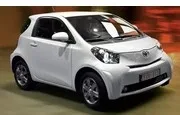
Toyota's engineers and designers were themselves delighted with the result when creating the iQ and vied with each other to call it a breakthrough. They reconsidered established notions about the automobile and abandoned old idealistic approaches. As a result, their creation became one of the most unusual developments of Toyota's research center.
UNUSUAL ENGINEERING
All the unconventionality lies in the concept. As for design, the iQ remains a typical Japanese car. A comparison with the founder of this class, the Smart, which has already lived to its second generation, suggests itself.
The Smart is a bright and lively car, but not without flaws. The brilliant idea, unfortunately, received not the best implementation. The virtues for which the Smart is loved are balanced by its shortcomings.
Against the background of the Smart, the Toyota iQ looks completely ordinary. It is a regular car placed in a body less than three meters long. Creating such a car is a complex and costly task, but Toyota handled it competently, without sacrificing consumer qualities.
Of course, expecting the iQ to have the spaciousness of a station wagon or the transformation of a minivan would be silly. But in everyday driving, few can compare with this Japanese baby. Ease of finding a parking spot, convenience of maneuvering on narrow congested streets — all this is its element. The iQ also suits those who commute daily to the office from the suburbs alone or with a passenger. It does not force you to give up luggage, and if there is none, you can take two more passengers in the back seats. True, then you will have to choose: travel four people light or two, but with things. However, this is not such a big problem — it is rare when you need to fill the cabin with people and luggage at the same time.
Judging by the number of Smarts on European roads, small sizes are now in demand. Many are willing to overpay for a truly compact city car. After all, no one is surprised that an ultra-thin phone or a light laptop costs more than ordinary ones. Why should cars follow a different logic?
REFERENCE METER
When an unfamiliar car appears in our test center, it is always an event. And if it is a pre-production example, assembled almost by hand, even more so. This was the case with the Toyota iQ.
Admittedly, we had to make efforts to negotiate with the Toyota representative office to be the first to receive the iQ for comprehensive testing. And we succeeded!
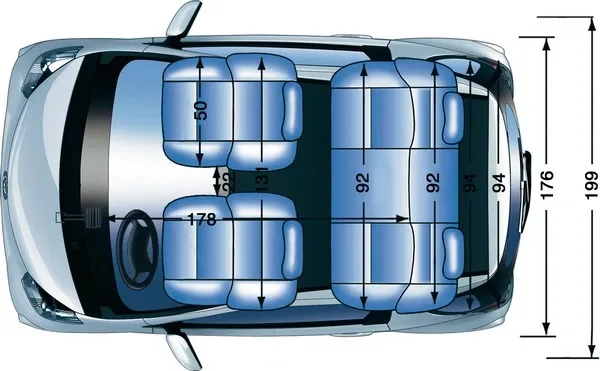
It is curious: what at first glance unites the Toyota iQ and Smart fortwo is also their main difference. We gave the highest scores for the interior and trunk to the iQ. The fortwo also distinguished itself once. But how so, because the iQ's trunk is just a mockery, and the back row is cramped? We answer: we considered the new Toyota as a two-seater car. With this approach, the iQ turns out to be more spacious than the Smart, especially in width. If in the German city car you constantly feel "elbows," then the "Japanese" allows you to sit as in a regular car.
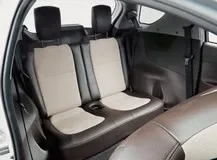
In terms of space in the front seats, the iQ is very similar to the Yaris. The trunk behind the front passengers is significantly larger than that of the fortwo, mainly due to the fact that the "Japanese" does not have an engine there. Therefore, it received five stars for capacity. Plus — a pair of "emergency" seats. Of course, they are far from the seats of a luxury sedan, but they exist, and that is enough. If we considered the iQ a four-seater, the rear seats would receive not the most flattering reviews.
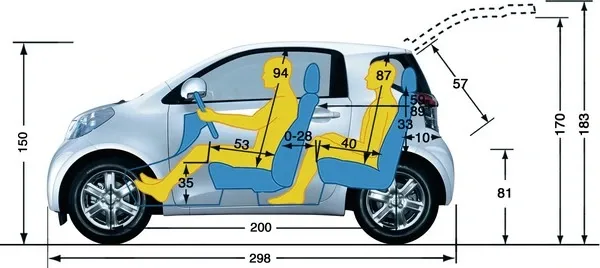
The Japanese used many solutions for the rational use of every millimeter of the cabin. The dashboard is made with a recess on the front passenger side so as not to crowd the person sitting behind. The latter, by the way, will experience no more discomfort than in a MINI, where the distance from the rear seat cushion to the front seat back is almost the same. And no worse than in the FIAT 500, with which the "Japanese" is comparable in distance from the seat cushion to the ceiling.
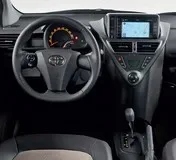 |
ALMOST LIKE HOME The "nightstand" of the central console looks original, crowned by the "TV" of the navigation system (option) | ||||
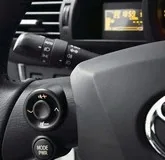 | |||||
|
STARTING CONDITIONS On the instrument panel — all the necessary information. The engine is started by a button on the steering column | |||||
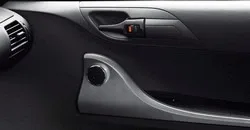 |
FINISHING ELEMENT A tweeter — a high-frequency audio system speaker — is built into the door handle | ||||
|
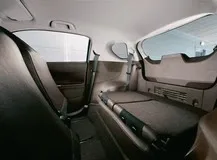
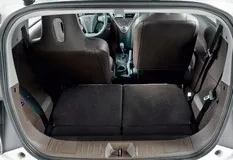
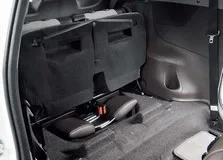
PEOPLE AND THINGS Three seats and a small trunk — a good compromise allowing rational use of interior space. Two-tone combined seat upholstery is an option not for all markets | 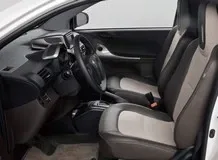 | ||||
PLEASURE GUARANTEED
Instead of discussing the test results, which turned out to be more than positive, let's better talk about the sensations on public roads, in real conditions.
Driving the iQ is very pleasant. Behind the wheel, it seems like a Yaris with shortened front and rear parts. The driver feels no inferiority. Why? For example, because of the steering wheel, which demonstrates quick reactions and sufficient informativeness. There is always a pleasant effort on the rim, ensuring reliable control in any situation. The small Toyota holds the road tenaciously, the stability system always corrects driver errors in time, even on very slippery surfaces. Lifting off the throttle in a corner almost does not affect the trajectory — to provoke the car, you need to sharply jerk the steering wheel at the same time. Then the iQ will transition from mild understeer to increasing oversteer, which, however, is instantly suppressed by the stability system.
Reliable behavior is combined with the suspension's ability to effectively swallow bumps, despite the car's small mass (1017 kg according to weighing results). Broken sections of city roads can be overcome with quite good comfort, largely thanks to narrow and tall tires. The transmission also makes a significant contribution to comfort — the iQ rolls softly, smoothly, but at the same time allows you to "fool around" a bit if desired. Moreover, there is reason to trust the brakes: although the distance to a full stop turned out to be not the shortest (considering this is a pre-production example), the system seemed balanced and resistant to overload. There were no questions about the elastic brake pedal, which allows precise dosing of deceleration. In general, the Toyota iQ demonstrated a number of advantages previously unseen in microcars.
MEETING REQUIREMENTS
Fitting four people in a three-meter car is a task that MINI and FIAT 500 solved half a century ago. But it is much more difficult to make such a car meet modern safety standards. European requirements for frontal and side impacts, if applied to a classic city car, would literally turn it into a crushed tin can. Therefore, manufacturers seek a compromise that does not force passengers to sacrifice comfort, does not take away free space, and allows not to limit the buyer in the choice of options.
It is precisely because of the constant tightening of safety standards that small cars have grown to four meters in length. And the width has increased to such an extent that many of them can hardly be called "city" cars. The reason is simple: you need to look decent in EuroNCAP crash tests, including one of the most severe — the pole impact. Unsurprisingly, cars with engines of 660 cubic centimeters and a body width of 148 centimeters are sold only in Japan: in other countries, they simply will not pass safety standards.
PHYSICS PROBLEM
However, even excellent crash test results do not guarantee safety in real life — the very concept of a protected car is rather conditional. You cannot fool the laws of physics: if a car weighing 1000 kg collides head-on with a car of 2000 kg, moving at a speed of 50 km/h, passengers in the light car will experience overloads as in a wall impact at 75 km/h. But those sitting in the heavy car will get off with consequences comparable to an impact at a speed of only 25 km/h.
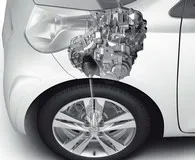
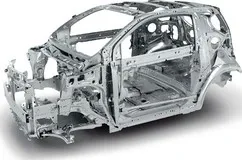
This example proves once again: creating a mini-car that truly protects people in an accident, not just in a laboratory where it collides with its own kind (iQ vs iQ, Land Cruiser vs Land Cruiser), is a colossal challenge. This requires an ultra-strong frame, modern seat belts, many airbags, and a well-thought-out layout of components so that they don't wedge into the cabin during body deformation. Toyota engineers coped with this task, and for the iQ they had to seriously refine the differential, steering, climate system, and fuel tank. This exclusivity partly explains the price difference with the Aygo and Yaris models, with which the new model is unified in many components.
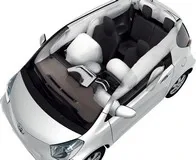
SAFETY ENGINEERING
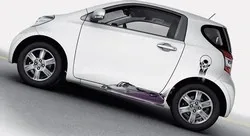
Inside, the iQ is quite spacious, and the level of protection here is very high. This was achieved through several solutions: the differential is shifted forward so that the wheels are further from the cabin; the tank is hidden deep in the platform, saving space and improving protection; numerous airbags, one of which deploys between the second row of seats and the third door, protecting the heads of rear passengers. The iQ's safety cage compares favorably with the Smart's capsule: the low sill simplifies entry, and there was no need to widen the body for reliable side protection.
SAFE FROM ALL SIDES
The creators of the Smart also did a huge amount of work but chose a different path: their engine is at the rear, and they abandoned the two rear seats to free up space for programmed deformation at the front. Contrary to popular belief, a rigid body resembling a steel barrel does not guarantee the driver and passengers survival. On the contrary, the overloads, especially for the brain, would be extreme. Without body deformation, it is impossible to absorb the impact and keep deceleration at a safe level for humans.
However, the cabin frame, on the contrary, must remain intact—deformation zones should only be around it. Toyota solved this problem by installing special airbags behind the rear headrests to reduce loads in a rear-end collision. It is important to note that in Europe there are currently no regulations governing protection in rear impacts. This is explained by statistics: in such a scenario, the risk of death is only 3%, and severe injuries—5%. For comparison, in a side impact these figures are 42% and 30%, and in a frontal impact—50% and 55%, respectively. This variation may also be due to the fact that rear seats are used much less frequently than front ones. And the problem of protecting the "rear" concerns not only city cars—it is no less relevant for minivans and crossovers with a third row of seats, which are located close to the rear door.
In the 50s, developers of the FIAT 500 and MINI didn't even think about such issues. However, back then, buyers weren't concerned about them either.
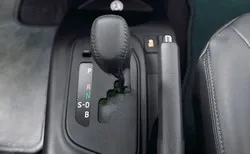
LIKES
Finally, a car has appeared that comes standard with an automatic transmission, and the "manual" is only available on order! We hope that in the near future the Toyota iQ will not remain a pleasant exception.
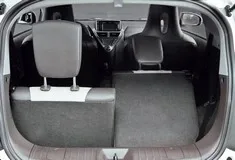
DISLIKES
To fold the seatbacks, you first need to remove the headrests. In practice, it will likely end with the owner removing them and not putting them back even when passengers sit in the back.
In the four-seat configuration, you can forget about the trunk: the compartment length is only 10 cm, and the volume is 27 liters. The situation improves if you fold the rear seats. But for that, you first need to remove the headrests and store them in the niche under the seats.
Technical specifications provided by the manufacturer
Toyota iQ 1.0 Multidrive 68 CV
- Engine: inline, front transverse, 3 cylinders, cylinder bore — 71.0 mm, piston stroke — 83.9 mm, displacement — 998 cm³, compression ratio — 10.5:1, maximum power — 68 hp at 6000 rpm, max torque — 91.0 Nm at 4800 rpm, specific power — 79 hp/t, cast iron cylinder block, light alloy cylinder head, 4 valves per cylinder, two overhead camshafts, chain, multi-point injection
- Transmission: front-wheel drive, CVT, gear ratio range — from 2.386:1 to 0.426:1; final drive — 5.403:1
- Tires: 175/65 R 15 74S (on the test car — Bridgestone B250), repair kit, alloy wheels 5J
- Body: 3 doors, 4 seats, steel unibody
• Chassis: front — independent MacPherson strut suspension with transverse arms, springs, and telescopic shock absorbers; rear — semi-independent design with coil springs and hydraulic shock absorbers.
• Brake system: ventilated discs all around, supplemented with ABS and electronic stability control.
• Steering: rack-and-pinion with electric power assist.
• Dimensions and weights: wheelbase — 2000 mm, front and rear track — 1480 and 1460 mm respectively, body length — 2985 mm, width — 1680 mm, height — 1500 mm, turning radius — 7.8 m, curb weight — 860 kg, maximum permissible — 1210 kg, trunk — from 32 to 360 liters, fuel tank — 32 liters.
• Assembly: Takaoka plant, Japan.