
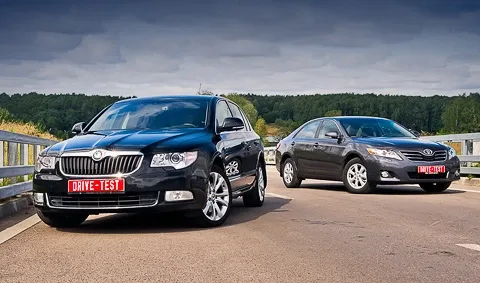
One quick glance at this pair is enough to understand who is closer to whom. Even such a restrained design says a lot. The Japanese car, despite being shorter than the Skoda, impresses with its massiveness and the feeling of solid body panels. But if you sense the spirit of the times in the Superb, the Camry will seem like an overfed domestic horse that the owners haven't exercised in a long time and don't intend to.
In the Superb's door opening, the head of the Czech Republic could probably walk in side by side with his assistant: the wide opening opens almost at a right angle. Wheel arches don't hinder entry or dirty clothes, and the top edge of the opening doesn't try to hit your forehead.
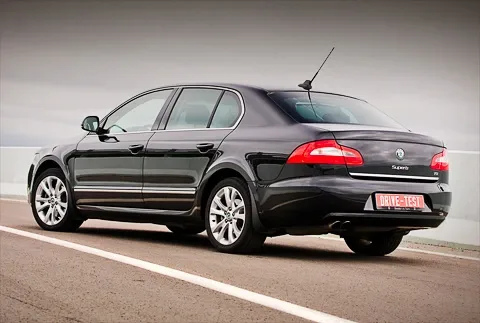
And how much space there is in the second row of the Skoda! Both in width and length. The vertical body pillars gave passengers extra centimeters above their heads. But there is a serious complaint about the almost ideal "office" interior: the rear sofa in the Czech car is flat and hard. You might as well attach chrome handrails and hang metro maps around the cabin.
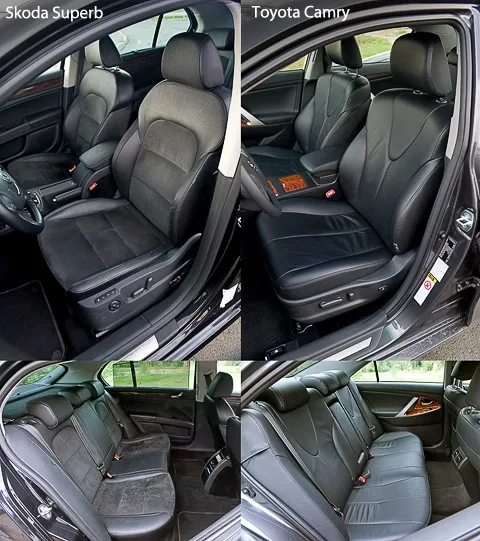
The front is more comfortable in the Superb — a firm seat with a clear profile. But the rear sofa clearly lacks softness — like the Toyota's, for example.
But the Toyota is attentiveness itself, especially for rear passengers. The backrest may be slightly more reclined than desired, but on the soft and formless sofa you relax and enjoy the unobtrusive support of the side bolsters. Legroom and headroom in the Camry are exactly what is expected in this class. No more, no less. Just like in Lufthansa business class.
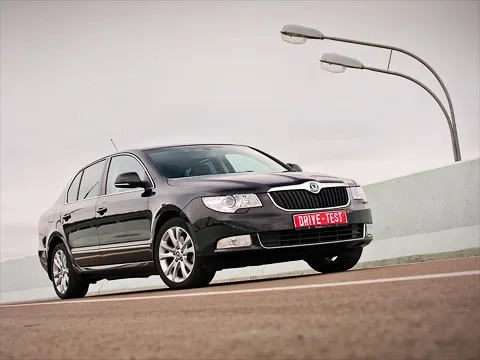
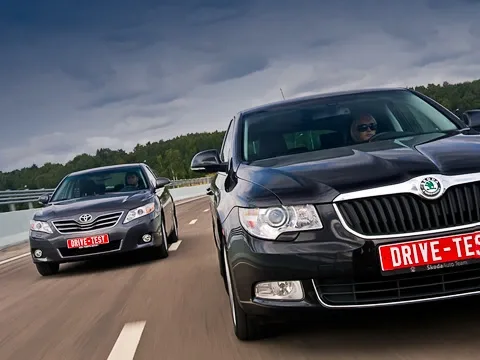
The sharp edges of the headlights with washer "caps", the sculpted hood, the chrome air intake trim in the bumper — the Superb looks more expressive and distinctive than the Camry.
Both cars are equipped with the most popular engines in Russia. The Czech has a turbocharged 1.8 TSI four-cylinder with direct injection and a DSG robot. Real high-tech. The Toyota, on the other hand, is content with a much more familiar unit — a naturally aspirated 2.4, developed back in 2001, paired with a classic automatic.
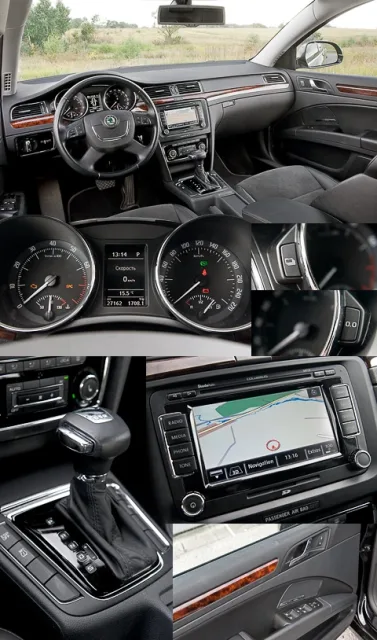
- The interior looks solid and strict... But after 27 thousand kilometers, the leather on the steering wheel turned into greasy polyurethane, and near the DSG lever, an extremely intrusive "metallic" cricket started.
- The navigation in the Columbus system left mixed feelings. On one hand, pleasant graphics and logical control, on the other — unclear rendering of intersections, system sluggishness, and lack of voice prompts in Russian.
Sitting behind the wheel of the Superb, you don't feel that you lack engine displacement, but you also don't feel obvious technological superiority. The Skoda's engine is good: 250 N•m of turbocharged thrust — smooth and confident acceleration up to 160 km/h. Moreover, the engine willingly revs to the redline: its 160 horsepower could be called sanguine... If they were human, not equine.
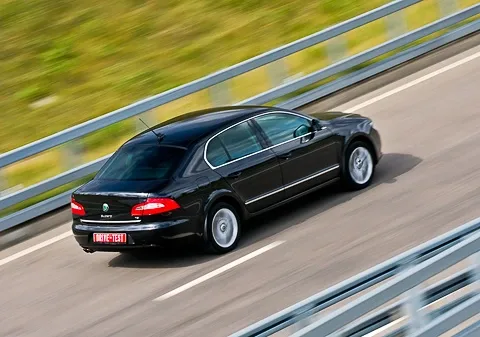
But the DSG "robot", unlike us, only likes the torque of this engine. Drive and high revs don't suit the gearbox. A couple of full-throttle launches from a standstill — and the DSG starts twitching in convulsions, signaling overheating. The gearbox shudders and goes into emergency mode, refusing to accelerate faster than 60 km/h.
The DSG also dislikes traffic jams. When moving at a crawl, the transmission seems unable to choose a gear. It darts between gears, shifting torque on the clutches. But it does this not smoothly, but with jerks that would wake a passenger even after a sleepless night. Although in calm driving, the "robot" shifts its seven gears almost imperceptibly, and in sport mode it even helps the engine deftly.
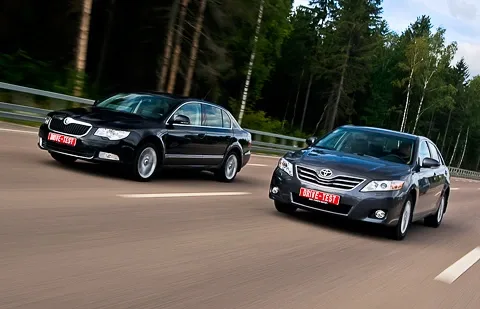
If Toyota could be psychotyped, it would be a phlegmatic. Strong, balanced, inert — that's all about the St. Petersburg sedan. The Camry's engine, producing 167 hp and 224 N•m, is boring, like a silent woman, sounds bland and louder than the Skoda's. But its capabilities are quite enough for city bustle and high-speed runs on the ring road. The main problem with the Toyota's four-cylinder is the gearbox.
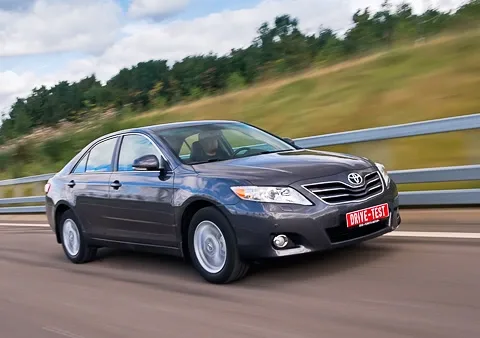
The recent facelift did the Toyota good: larger optics, an imposing chrome grille, and a new bumper made the Camry even more solid.
The five-speed automatic brakes with everything except the engine. In dense traffic, you constantly have to work the gas pedal in advance. Otherwise, in the couple of seconds it takes the gearbox to think, the gap you were aiming for will definitely close. But this general sluggishness of the Toyota has a plus: in calm driving and in traffic jams, gear changes are smoother than in the Superb.
Maybe it's for the best that the Toyota's engine doesn't excite: the suspension matches. Simple and tuned in an American way: you don't drive, you float, swaying in all directions and bowing to invisible waves. But why do we call these American settings? A Russian person likes this too — it's in our road traditions.
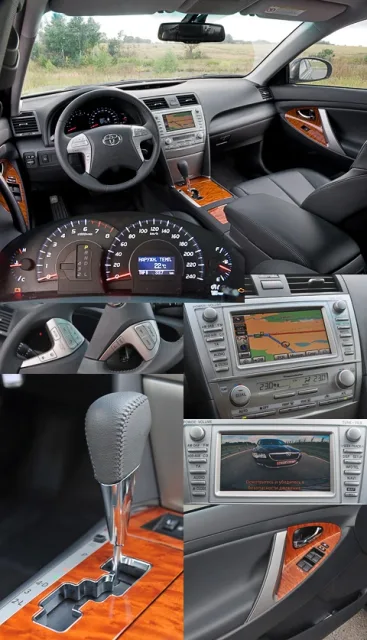
- Large steering wheel with a thin rim, wide formless seat, huge instrument dials, solid steering column stalks — American scale! Too bad a long trip in the driver's seat causes terrible discomfort.
- The same navigation is in the new Avensis: the picture is primitive, the route doesn't recalculate when deviating, but there are voice prompts in Russian.
- The Camry's parking sonar is complemented by a rearview camera.
Moreover, the Camry will quickly teach you not to drive fast in corners. On a straight road, the steering wheel is light but with a clear "zero". However, as soon as you turn the wheel, the effort sharply disappears: you have to enter the arc by feel, and the roll builds up like an avalanche. Before you know it, you'll be smeared against the door. And the most temperamental will be disciplined by the non-switchable stability control system, which crudely and primitively returns the sedan to the trajectory. That's for sure.
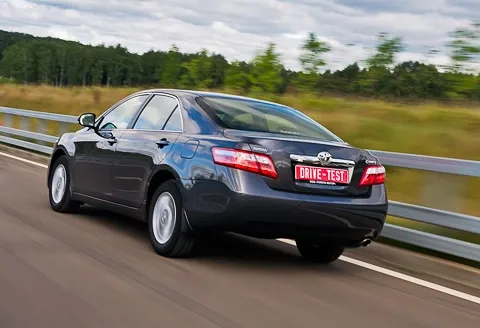
Indifference to road imperfections at high speeds makes the Camry an excellent highway stayer. Only the weightless steering wheel and rocking on waves are concerning.
The Czech car plays for Europe. The informative steering wheel pleasantly weights up in corners, rolls remain moderate, and ESP acts extremely delicately. Clear and reliable behavior: the Superb is the unambiguous choice for those who are closer in spirit to biathlon rather than the women's ski relay.
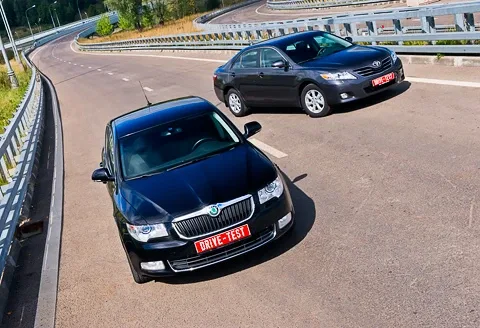
When it comes to winding highways, let alone country two-lane roads, the Skoda and Toyota have their own attitudes. The Superb loves the road, the Camry doesn't care about it.
The price for the Skoda's pinpoint accuracy is mediocre comfort. Before speed bumps, you need to significantly slow down in the Superb; the Czech car takes potholes and scars of the road surface to heart, disturbing occupants with unpleasant jolts and body shuddering. And deep cuts in the asphalt left shamelessly unattended by road workers are fraught with damage.
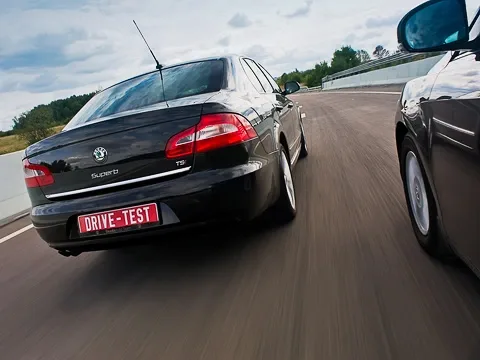
In a parallel start, the Superb easily dispatches the Toyota. It doesn't matter whether the DSG robot works in normal or sport mode. The main thing is not to play drag racing to the point of gearbox overheating.
And the Superb is also noisy. There's an annoying background from tires, and at speed, a whisper of airflow cut by the large side mirrors adds. The Camry's "burdocks" are also like African elephant ears, but their shape seems better refined: there are fewer characteristic aerodynamic noises. And the sound insulation of the floor and wheel arches is better in the Japanese car. Which for Toyota is generally more the exception than the rule.
The exception is also the reasonable price of the Toyota. The nature of this phenomenon is well understood: Russian assembly gave the assimilated sedan its main competitive advantage. For the same money as an Auris, you get a solid, spacious, moderately dynamic and economical (average fuel consumption during the test — 11.6 l per 100 km) car with Japanese lineage. And Russian heroes and Nightingales the Robbers have long valued the Far Eastern breed.

Comparing trunks favors the Skoda, and not only in numbers. Its cargo area is flat, walls are even, there are nets, and the opening is huge — thanks to the two-section door. The loading height is also low.
Just as the factory in Shushary, where Toyotas are assembled, is rarely remembered, so the buyer, inspired by a pleasant price tag, is unlikely to notice the Asian pretentiousness of the interior, budget trim materials, and front seats that are merciless to the lower back. But even we, accustomed to nitpicking, admit: despite all these flaws, the Toyota Camry is a solid car and, more importantly, truly balanced.
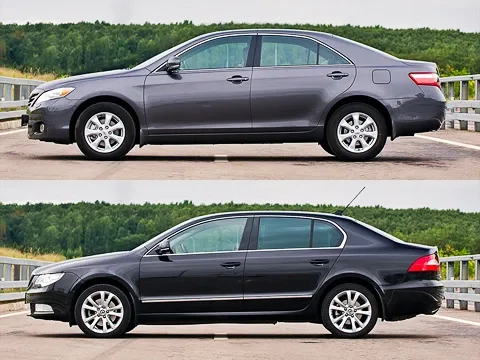
"Liposuction": a visual aid "before and after".
But Skoda is exactly what lacks this very harmony. Who was this liftback made for? It seems obvious — for the passenger on the right in the back. But why then does the car please more behind the wheel? Why was the suspension made so stiff? And why wasn't more attention paid to sound insulation? Against the background of the emphatically comfortable Toyota, the Skoda, which looked great on its own, turned out to be a car that is hard to live up to expectations.
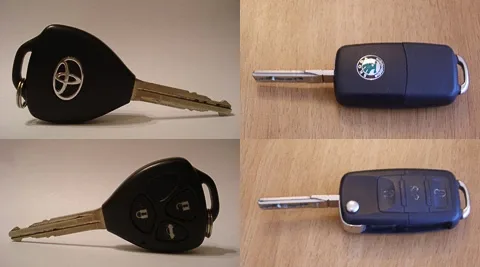
And yet, we, the DRIVE.RU editorial team, give the victory in this comparison to the Superb. Nothing can be done — we are partial to technical highlights like the original fifth door. A sedan-liftback is great! But seriously, our choice is dictated by the feeling of a more expensive and higher-quality thing that Skoda gives. Look into the cabin, run your hand over the soft plastic of the front panel, close the glove box and the door, listen to the sound. Look at the graphics of the central display. And finally, compare the keys of the Camry and the Superb — and you will understand what I am talking about.
Technical specifications
| Model | Skoda Superb 1.8 TSI | Toyota Camry 2.4 |
|---|---|---|
| Body | ||
| Number of doors/seats | 5/5 | 4/5 |
| Length, mm | 4838 | 4815 |
| Width, mm | 1817 | 1820 |
| Height, mm | 1462 | 1480 |
| Wheelbase, mm | 2761 | 2775 |
| Track front/rear, mm | 1545/1518 | 1580/1575 |
| Curb weight, kg | 1471 | 1540 |
| Gross weight, kg | 2091 | 1985 |
| Trunk volume, l | 565–1670 | 535 |
| Engine | ||
| Type | petrol, with direct injection and turbocharging | petrol |
| Location | front, transverse | front, transverse |
| Number and arrangement of cylinders | 4, in-line | 4, in-line |
| Number of valves | 16 | 16 |
| Displacement, cm3 | 1798 | 2362 |
| Max power, hp/rpm | 160/5000–6200 | 167/6000 |
| Max torque, N•m/rpm | 250/1500–4200 | 224/4000 |
| Transmission | ||
| Gearbox | robotic, seven-speed | automatic, five-speed |
| Drive | front | front |
| Chassis | ||
| Front suspension | independent, spring, McPherson | independent, spring, McPherson |
| Rear suspension | independent, spring, multi-link | independent, spring, McPherson |
| Front brakes | disc, ventilated | disc, ventilated |
| Rear brakes | disc | disc |
| Ground clearance, mm | 158 | 160 |
| Performance characteristics | ||
| Maximum speed, km/h | 220 | 205 |
| Acceleration time 0-100 km/h, s | 8.5 | 9.3 |
| Fuel consumption, l/100 km | ||
| — urban cycle | 10 | 13.6 |
| — suburban cycle | 6.1 | 7.8 |
| — combined cycle | 7.6 | 9.9 |
| Toxicity standard | Euro-4 | Euro-4 |
| Fuel tank capacity, l | 60 | 70 |
| Fuel | AI-95 | AI-95 |
Equipment of tested cars
Designations: + — included in base trim; - — not available; o — option installed on the tested car.
| Model | Skoda Superb | Toyota Camry |
|---|---|---|
| Trim level | Elegance | Prestige |
| Front airbags | + | + |
| Front side airbags | + | + |
| Knee airbag | O | - |
| Inflatable "curtains" | + | + |
| Bi-xenon headlights | + | - |
| Xenon headlights | - | + |
| Dynamic stability system | + | + |
| Tire pressure sensor | + | - |
| Keyless entry | - | - |
| Immobilizer | + | + |
| Anti-theft system | + | + |
| Central locking | + | + |
| On-board computer | + | + |
| Dual-zone climate control | + | + |
| Heated front seats | + | + |
| Heated rear seats | + | - |
| Leather interior | O | + |
| Leather and alcantara interior | O | - |
| Audio system with MP3 support | + | + |
| CD changer | + | + |
| Navigation system | O | + |
| TV tuner | O | - |
| Parking assistant | O | - |
| Rear view camera | - | + |
| Cruise control | + | + |
| Rain and light sensors | + | + |
| Alloy wheels | + | + |
| Sun blinds for rear passengers | + | - |
| Wood trim | + | + |
| Metallic paint | O | O |
| Price of base trim | 1,084,000 rubles | 1,105,000 rubles |
| Price of tested car | 1,277,000 rubles | 1,119,000 rubles |
Technology
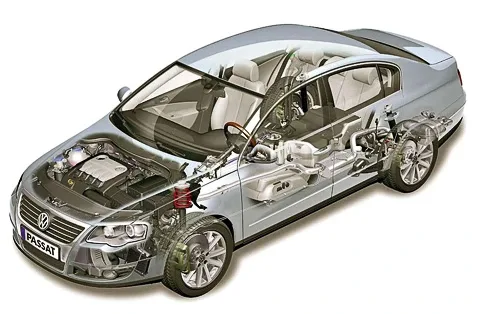
The Skoda Superb is based on the extended front-wheel-drive platform of the sixth-generation Passat, but the engine here is mounted transversely, not longitudinally as before. The units are petrol and diesel, the gearboxes are a six-speed manual and a DSG robot, as well as all-wheel drive with a fourth-generation Haldex coupling. All this is familiar from other Volkswagen Group models. By the way, the torsional rigidity of the Superb body increased by only 10–15%.
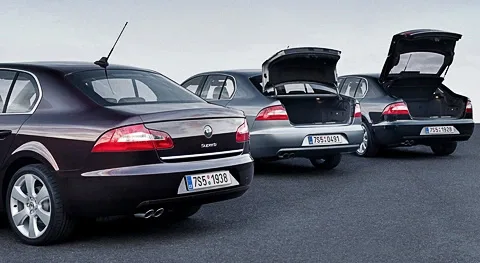
The main feature of the Czech car is the patented two-section Twindoor tailgate. In normal mode, only the lower part rises, like in a sedan. But when you press the right of the two buttons on the edge, the electric drives connect both halves into one large door — then the Superb opens the trunk completely, with a volume of 565 liters. A closer helps when closing. And for those who find this insufficient, there is a wagon version.
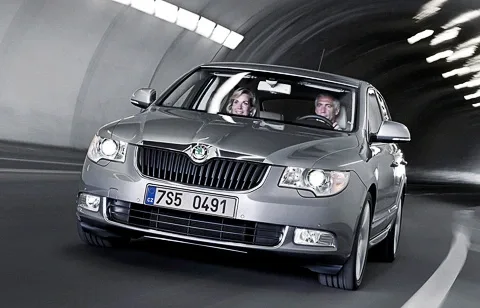
It was the Superb that was the first among Volkswagen Group models to receive the intelligent adaptive light system AFS — similar ones are installed on the Opel Insignia and Mercedes-Benz E-Class. At speeds of 15–60 km/h, the low beam is slightly widened to better illuminate the roadside. When the car accelerates beyond 90 km/h, the beam rises. There is also a "rain" mode that works up to 70 km/h: to avoid dazzling the driver with reflections from drops, the beam is lowered and widened.
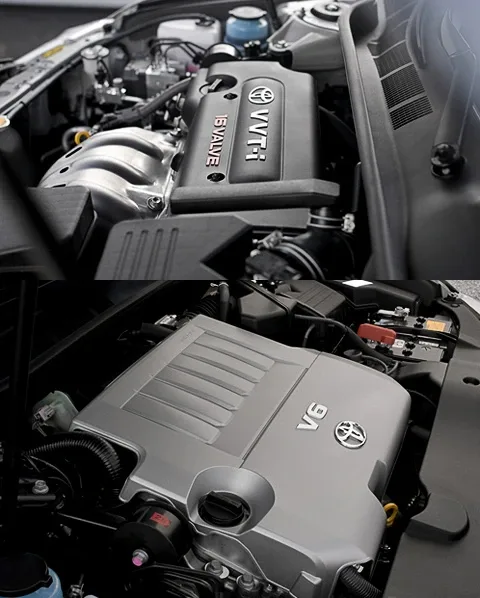
For the Russian market, the Camry is offered with two engines — a four-cylinder 2.4 VVT-i (167 hp, 224 N•m) and a V6 3.5 Dual VVT-i (277 hp, 346 N•m). The first is from the 2AZ-FE family, which debuted in 2001 on the Toyota Highlander SUV. The six-cylinder 2GR-FE is younger: it has a variable valve timing system on intake and exhaust and first appeared in 2005 on the Toyota Avalon sedan. Both engines meet Euro-4 standards.
It's no secret that you can't buy a hybrid Camry in Russia — about fifteen percent of such cars are sold in the US. In combined cycle, this version consumes about seven liters per hundred. Such modest appetite is the merit of the power plant, where the familiar 2.4 gasoline unit (147 hp, 187 N•m) was converted to the Atkinson cycle, adding to it an electric motor with 40 horsepower and nickel-metal hydride batteries. The total output of 187 "horses" goes to the CVT. True, in the States the hybrid asks for $5705 ($26 150) more than the starting gasoline modification with the "four" (2.5 L, 169 hp) and "automatic".
History
The Superb in the Škoda model range did not appear in our days — its lineage goes back to pre-war times. From 1934 to 1942, the Czechs assembled six different versions of the executive car, including the Superb Type 902 and Superb 3000 Type 952.
The first of the current Superbs was initially made for China. Later, what became the European Škoda was sold in the Middle Kingdom as the Volkswagen Passat Lingyu. The Chinese differed from the standard Passat B5 by a wheelbase stretched by 10 cm (2803 mm). The engine range was rich, with engines mounted longitudinally: "fours" 1.8 T, 1.9 TDI, 2.0, 2.0 TDI, as well as V6 2.8 and V6 2.5 TDI. There were also plenty of gearboxes — five- and six-speed "manual" plus a five-speed ZF "automatic". But the body was only one — sedan. Until March 2008, first-generation cars were assembled in China, India, and here in Ukraine.
The Toyota Camry, aimed primarily at North America, has a much richer biography. The model has six generations. The first (index V10), known at home as the Toyota Vista, debuted in 1982. A fresh front-wheel-drive platform was made for the Camry: length reached 4440 mm, wheelbase — 2600 mm. Sedans and hatchbacks with three gasoline engines (1.8–2.0 L) and a two-liter turbodiesel rolled off the assembly line in Toyota City. The engines worked in pairs with a five-speed "manual" or a four-speed "automatic". Production was discontinued in 1986.
Cars of the next generation, which appeared in 1987, were produced not only in Japan (Vista) but also in the USA (Camry) and Australia (Holden Apollo). The platform remained the same, but the length grew to 4520 mm, and the weight increased by 195 kg (to 1240). The engine range slimmed down to three gasoline ones: "fours" 1.8 and 2.0 and a "six" 2.5 L, delivering from 86 to 160 horsepower. Depending on the market and engine, sedans and station wagons could be all-wheel drive (only with V6 2.5), received four variants of the five-speed "manual" and three versions of the four-speed "automatic". In Japan, production of the Camry V20 ended in 1990, in the USA — in 1991, in Australia — in 1993.
The third generation (1992–1996) grew in all dimensions and looked like a real "Yankee". Only powerful engines were provided. The base was a four-cylinder 2.2 with 130 hp, and the flagship was a V6 3.0 (185 hp, 264 N•m), with which the sedan reached a hundred in less than eight seconds. The five-speed "manual" was installed only on two of the four modifications — the base DX and the sporty SE. The latter stood out with a stiffer suspension, different power steering settings, and original alloy wheels with wider tires. In 1995, the Camry was slightly refreshed: a new radiator grille, different optics, and ABS became standard in the rich XLE trim. In addition, the third generation had a Camry Coupe, produced from 1994 to 1997.
From 1997 to 2001, the fourth-generation Camry was made in Georgetown (Kentucky). The American dream stretched to 4821 mm in length and 1781 mm in width. At the same time, the wheelbase grew by only 70 mm (to 2670). The change of generations benefited the model: the exterior became more interesting (without the former biomotifs), and the previous gasoline engines gained power. The "four" 2.2 produced 133 horsepower, the "six" 3.0 — already 194. The gearboxes remained the same. The suspensions were not radically changed either: MacPherson struts in front and a multi-link in the rear were only retuned in a sporty direction. But the trim levels were revised: ABS became standard for all versions, optional side airbags appeared, and an immobilizer was added to the anti-theft system. Due to weak demand in the USA, the station wagon had to be abandoned (it was made for Japan, where it was called Camry Gracia and Mark II Qualis), but in 1999 the Camry Solara coupe was launched.
In September 2001, the fifth-generation Camry began to be assembled. Completely new design, fully redesigned interior — even higher quality and more expensive looking. The length decreased to 4805 mm, and the wheelbase grew to 2720. The old "four" 2.2 was replaced by a new one, 2.4 liters with VVT-i (152 hp, 218 N•m), and the previous three-liter "six" was boosted to 210 hp (for Europe and Russia — 186 horsepower). Later, the V6 gave way to a new V6 3.3 engine (225 hp). At first, the gearboxes remained old, but then the four-speed "automatic" was replaced by a five-speed one. The Camry got a stability control system and side curtain airbags. All this could not but affect sales: Toyota became a bestseller in the USA and a leader in Russia. In 2005, the last year of sales, Russians bought 12,860 Camry sedans — a huge gap from the silver medalist Audi A6 (2,357 units). And the next generation even became the best-selling car in America — that says it all.
Behind the scenes
Here in the editorial office, no one struggles with the choice of a business sedan. But some gladly used this test as an excuse to spend a day outdoors. The get-together turned out to be much more fun than the subject of the test itself. The most unexpected thing is that we really liked the Toyota. It seemed its time had passed, but it, like sunny autumn, is still able to please. Now we better understand Camry buyers.