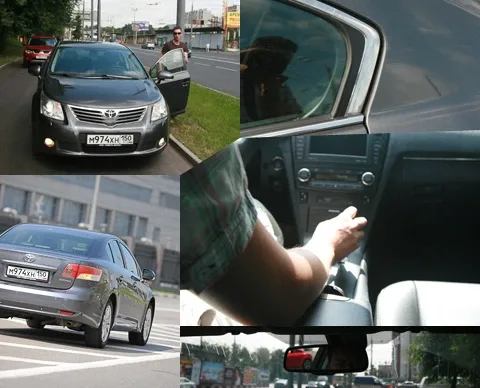
The story began unremarkably, like dust on a windowsill. The bank where I work replaced old Toyotas, which had served their time in terms of mileage and age, with a new batch of cars. And among them was an Avensis of the third generation, which had just entered the Russian market. But it crept into my life unnoticed, becoming another item on the usual list of office accessories: a strict suit, a communicator with a day scheduled by the minute, and this car.
If you believe the manual, under the 17-inch alloy wheels are hidden brake mechanisms: 320 mm at the front and 290 mm at the rear. They work perfectly, but there is a complaint about the pedal—when pressed sharply, it becomes as if made of stone.
If this continues, all I can say about this Avensis is "I sit fine, I drive fine." But I'm not an ordinary person: I read car magazines, know all the terms, and am interested in technology! I'm an attentive person—why not describe the Avensis with soul? Or at least with expertise. In the worst case, it will become a reason to write an article if I get tired of dealing with numbers and reports. Look, there are plenty of such examples in the DRIVE.RU editorial office.
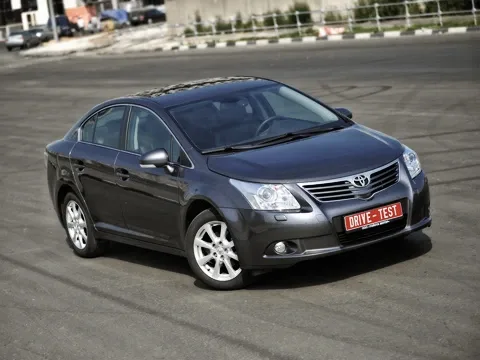
Externally, the new Avensis looks restrained and composed. Like me in a business suit. The Japanese car's image exudes harmony, and the most interesting details are concentrated at the front.
The main thing is that the new Avensis no longer resembles that "Passat-like fish," which made the last six years seem like an endless series of identical days. Now its appearance hints at unexpected motifs: the hood, for example, brings to mind the updated Saab 9-3. The unusual optics and original stampings on the lower part of the doors make passersby linger for a couple of seconds—for Toyota, that's already an achievement. If our head of the analytical department didn't have exactly the same car, this guy would surely have turned to follow mine.
The sides are adorned with "shoulders," like the Volvo S60. True, these elements constantly loom in the side mirrors, blocking the view of what's happening at the sills.
The interior is a space without risks. The wide door opening allows a person of any build to settle in comfortably. The interior lacks a zest, but it looks solid. The ratio of soft and hard plastic is calibrated like the balance in an accounting report before an audit. Not Brioni, of course, but it could pass for Feraud. Although even with a suit of that brand, I wouldn't wear plastic Casio watches—and that's exactly what comes to mind when you look at the climate control unit.
During active driving, it turns out that the lateral support of the front seats is nonexistent, but the leather upholstery saves the day—friction keeps the body in place. True, you have to pay for such a pace: the CVT, along with the central tunnel, heats up so much that you could boil water in the cup holder.
The touchscreen display could use a higher resolution—it noticeably fades in the sun. But figuring out the multimedia menu is easy, as is using the navigation with its detailed map. True, sometimes a pleasant female voice (exactly like my assistant's) suggests turning under a "brick" sign.
After a couple of hours behind the wheel, you get used to switching the Multidrive S CVT modes by touch. The large Sport button is also easy to find blindly. But keep in mind: if you constantly drive in sport mode around the city, fuel consumption will be 14–15 liters per hundred kilometers.
In the Avensis, you can sit comfortably and, turning serious, praise the wide adjustment ranges: there's enough space for both arms and legs. But after a long day full of negotiations and reports, you want to sink into a soft seat. It's rather firm, and the backrest stubbornly pushes the tired body out. However, the side mirrors are excellent, and the bright instrument lighting can be dimmed in the evening. The multimedia system is also convenient: the buttons are large, and even the virtual keys on the touchscreen don't require squinting like Tom Berenger's character in "Sniper."
Rear passengers in the new Avensis are not to be envied: they don't get air vents. But there is a massive armrest, which is tilted too far forward, and the headrests are hard as stone. And passengers taller than 185 cm will periodically touch their heads against the ceiling.
On the move, the Avensis is hard to call "official." It's resilient and quite soft: small and medium irregularities don't cause discomfort to occupants. And there's no rocking like on a ship. On large potholes, which I, of course, don't deliberately seek out, the Toyota seems a bit firm. But what annoys me most is the sound: the front suspension loudly and metallically "curses" at potholes, cracks, and rails. Perhaps only the Mazda6, which I almost bought for my wife, cursed that loudly.
I obviously can't professionally assess handling—my "non-deformable barrier" of experience prevents that. The car turns, doesn't roll much—and that's fine. But something else is telling: the Avensis makes me hold the chunky three-spoke steering wheel with interest and even change my usual routes. Rogachevskoye Highway either winds or runs off into the distance. A couple of fast turns—and I don't feel that the electric power steering is hiding anything.
With sound insulation, it's a strange story. If you sit on the rear sofa, the Japanese car seems quite quiet. But from the driver's seat, you can hear both the singing of the front wheel arches and the howling of the wind at the windshield pillars.
And the main thing—it's a Toyota. When I start to think that I'm about to understand what "precise but soft reactions" mean, the delicate stability control system already extinguishes the understeer of the front wheels and takes control of the subsequent sliding.
The two-liter "four" is a true economist. On the highway, you can fit into 6.2 liters per hundred, and in the city with calm driving—into ten.
I'm not a racer. So the normal CVT mode and the thoughtful responses of the 152-horsepower 2.0 engine suit me just fine. The tachometer needle barely moves. But let's not pretend that the Sport button on the central tunnel doesn't exist. As soon as the letter S lights up on the panel, it's as if the spirit of my assistant possesses the engine—she also does everything before you have time to ask. True, if she were as responsive as the Avensis in sport mode, I'd have problems at home. The engine easily revs up to 5000 rpm, obediently following the pedal. Even beyond 120 km/h, the Avensis retains a reserve of thrust. Neither the Mondeo with 145 horsepower nor the Mazda6 2.0 AT, which I know, accelerates like that.
Competitors came to mind for a reason. In my opinion, the new Avensis has become a collective image: it resembles almost all of its classmates. Handling—almost Mondeo, suspension composure—just short of Insignia (and it's noisy), ergonomics—almost Volkswagen. And what about the notion that its mood is boring and lifeless? Believe a person who has driven various Toyotas for many years: the more boring a Toyota seems at a short acquaintance, the more pleasant it is in everyday life when your head is full of work problems. The Avensis is like a sanatorium voucher.
But there's one "but." Everything said above holds true if the car is provided at work. But if you're planning to shell out 1,387,000 rubles (your own or, God forbid, taken on credit from my bank) for an Avensis in the top "Lux" trim, you should think hard. I have exactly such a car, and neither I nor my colleagues who are entitled to an Avensis see any point in paying that kind of money. Unless our bank's fleet manager would think about it—but he's primarily interested in operating costs. At least officially.
The trunk with a volume of 509 liters can be increased by folding the rear seatback in a 60:40 ratio. Pros—a wide opening and a convenient handle on the inner side of the lid, which is upholstered in fabric. Cons—the high loading height and the eagerness with which the lid shoots upward. That's somehow not respectable.
The situation is completely different with the 1.8 version. The less powerful unit, developing 147 horsepower, along with a modest list of equipment, does not deprive the Avensis of its respectable "corporate" appearance and does not turn it into a less solid car. At the same time, you no longer have to constantly listen to the annoying question of why the choice fell on the Avensis and not on the 200-horsepower Volkswagen Passat Highline with a six-speed automatic gearbox, which costs 1,382,235 rubles.
Technical specifications
| Model | Toyota Avensis |
|---|
| Body |
|---|
| Number of doors/seats | 4/5 |
| Length, mm | 4695 |
| Width, mm | 1810 |
| Height, mm | 1480 |
| Wheelbase, mm | 2700 |
| Track front/rear, mm | 1550/1550 |
| Curb weight, kg | 1440–1580 |
| Gross weight, kg | 1950–2050 |
| Trunk volume, l | 509 |
| Engine |
|---|
| Type | petrol |
| Location | front, transverse |
| Number and arrangement of cylinders | 4, in-line |
| Number of valves | 16 |
| Displacement, cm³ | 1987 |
| Max power, hp/rpm | 152/6200 |
| Max torque, N•m/rpm | 196/4000 |
| Transmission |
|---|
| Gearbox | CVT |
| Drive | front |
| Chassis |
|---|
| Front suspension | independent, coil spring, McPherson |
| Rear suspension | independent, coil spring, multi-link |
| Front brakes | disc, ventilated |
| Rear brakes | disc |
| Ground clearance, mm | 150 |
| Performance characteristics |
|---|
| Maximum speed, km/h | 205 |
| Acceleration time 0-100 km/h, s | 10 |
| Fuel consumption, l/100 km |
| — urban cycle | 9.2 |
| — suburban cycle | 5.7 |
| — combined cycle | 7 |
| Emission standard | Euro-4 |
| Fuel tank capacity, l | 60 |
| Fuel | AI-95 |
Trim levels and prices
Standard equipment
- Front airbags
- Side airbags and inflatable curtains
- Driver knee airbag
- Active headrests
- ABS
- Multifunction steering wheel
- Power-adjustable and heated rearview mirrors
- Central locking
- On-board computer
- Steering column with tilt and reach adjustment
- Electric power steering
- Heated front seats
- Audio system with MP3 support
Additional equipment
- Vehicle stability control system
- Bi-xenon headlights
- Leather-wrapped steering wheel
- Dual-zone climate control
- Front fog lights
- Light and rain sensors
- Leather seat upholstery
- Navigation system
- Rearview camera
- Rear parking sensors
- Metallic paint
- Alloy wheels R17
- Power-adjustable driver seat with memory function
- Power-adjustable passenger seat
- Power-adjustable steering column
Price of base trim — 819,500 rubles
Price of tested car — 1,401,000 rubles
Technology
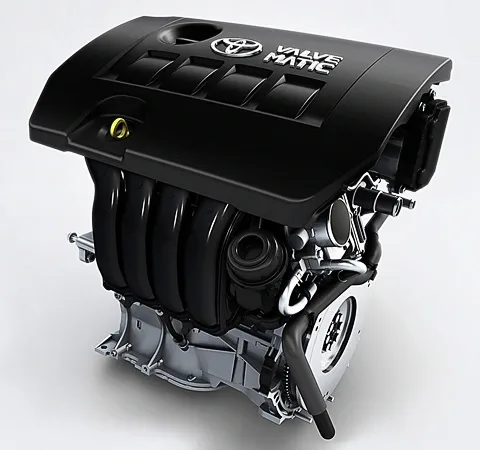
In addition to the 152-horsepower two-liter engine (196 N•m), under the hood of the third-generation Avensis there can also be two more petrol four-cylinder engines: 1.6 (132 hp, 160 N•m) and 1.8 (147 hp, 180 N•m). All three units are equipped with distributed injection, Valvematic variable valve timing system, and comply with Euro-4 standards. These power units belong to the ZR family, which appeared in 2007.
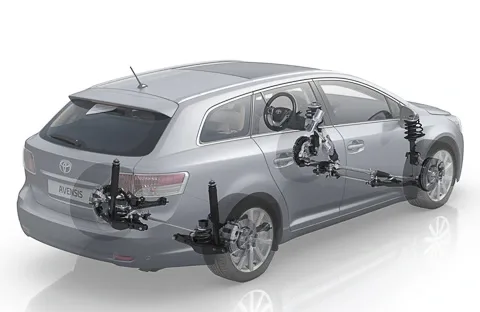
The developers of the Avensis claim that the third-generation Toyota is based on a new platform. However, in reality this is not entirely true. Compared to the previous generation car, the torsional and bending rigidity of the body remained the same, the wheelbase (2700 mm) did not change, and at the front and rear, as before, McPherson struts and a multi-link design work. Among the innovations are re-tuned suspension geometry and increased angular rigidity.
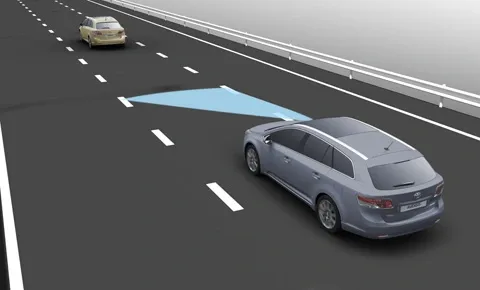
If top modifications with the 2.2 D-4D turbodiesel (150 and 180 hp) were offered in Russia, our safety would be protected in advance by the Pre-Crash Safety system. The radar monitors the situation in front of the car, and in the event of a collision threat, the electronics independently initiate braking while simultaneously turning on the hazard warning lights. At the same time, seatbelt pretensioners and active headrests go into a state of readiness.
History
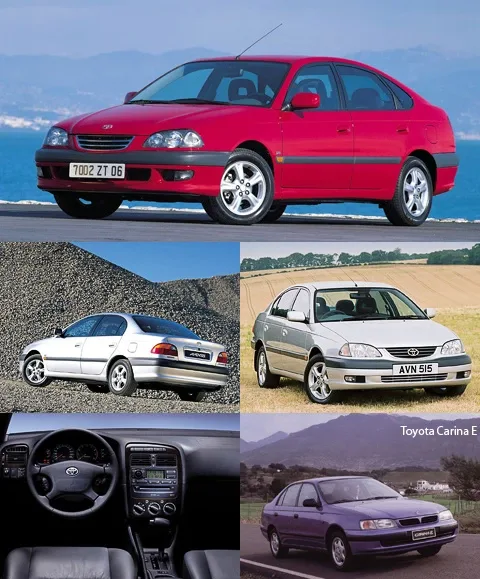
In 1998, the Toyota Carina E model was replaced by the Avensis family. The new model was created specifically for the European market, and production was established exclusively at Toyota's British plant in Derbyshire. Despite the new body and interior, as well as a base that grew by 50 mm (to 2630), the technical content of the Avensis largely repeated its predecessor: the same petrol engines 1.6, 1.8 and 2.0 and McPherson struts on both axles. The body lineup included a sedan, a five-door hatchback and a station wagon. In 2000, the Japanese carried out a restyling: the headlights and radiator grille changed slightly, two-liter petrol engines were switched to direct injection, and a two-liter turbodiesel was added to the range. The power of the units varied from 99 to 147 hp.
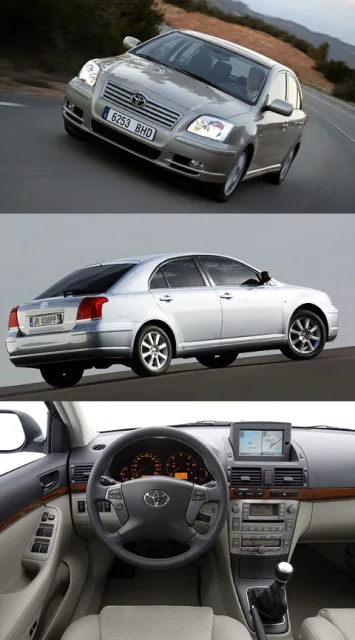
The second generation Avensis appeared in 2003. As before, buyers were offered three body types: sedan, liftback and station wagon. At the same time, the car stretched by 125 mm (to 4645), became wider by 50 mm (1760), and the base grew to 2700 mm. At the front, McPherson struts remained, but at the rear they were replaced by a multi-link with a self-steering effect. Engines from the first generation were transferred to the new model after modernization, plus new units appeared. The flagship was the 2.4 four-cylinder (163 hp), and the 2.0 D-4D diesel (115) was replaced by the 2.2 D-4D engine (150 or 177 hp). In 2006, the family was slightly updated: the exterior was refreshed and the interior trim was reworked. Technically, a 124-horsepower version of the D-4D turbodiesel was introduced.
Behind the scenes
While this material was being prepared, about twenty people got acquainted with the car — our friends and acquaintances, the entire DRIVE.RU team... And no one, as they say, was hooked by the car. Toyota's laws work!