
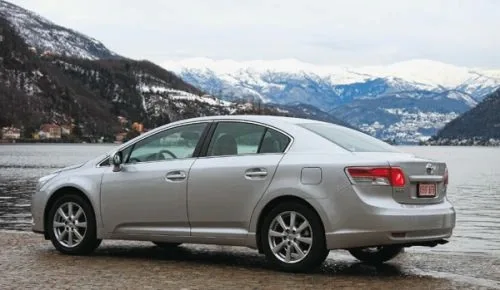
When you ask acquaintances what they think about the Avensis, the most common short answer you hear is: “What can you say — it's a Toyota.” This phrase encapsulates a whole stereotype that applies to some extent to any passenger car of the Japanese brand. Usually, such an assessment implies impeccable reliability, decent driving qualities, a well-thought-out interior, and a rather ordinary appearance. The third-generation Avensis is made on the same principle. Although the new styling has made the model's appearance more lively and expressive, it is unlikely that the car will be called a handsome one. But tastes differ, and perhaps someone will like the J-factor — that very Japanese originality, which, as the head of the Toyota design center Wahei Hirai believes, deserves a positive response everywhere.
The new Avensis, as is customary, has grown slightly in dimensions, but only a little. However, the interior has become more spacious, and there is enough room even for demanding passengers. The seats greet you warmly, and even after long hours behind the wheel, your back will not remind you of itself. True, when getting into the front seats, you should be careful — due to the sloping roofline, you can easily hit your head on the door opening.
The interior is executed in a laconic and strict style: everything is thought out, neatly assembled, and pleasant materials are used. It looks quite conservative, but for a solid D-class car, this is quite appropriate. The only thing that seems a bit outdated is the dim LCD display of the climate control system on the center console, especially against the background of the luxurious optitronic instrument panel with orange-white backlighting. There is no familiar handbrake lever here — it has been replaced by a button for the electric parking brake. This is convenient, but you will have to forget about sporty cornering.
The chief project engineer Takashi Yamamoto claims that in terms of equipment level, the new model is ahead of competitors. A bold statement, but even the base version “Comfort,” of which there are six in total, already has air conditioning, an audio system with CD/MP3/AUX, a stability control system, seven airbags, and other useful options. And then there is more. The top trim “Lux” is impressive: leather interior, Bluetooth, cruise control, adaptive bi-xenon, rain sensor, dual-zone climate control, keyless entry, and navigation with Russian language. A special reason for pride for the Japanese in this version is the center console trim, inspired by traditional “takesumi” — bamboo charcoal. As for cargo transportation, the sedan's 500-liter trunk can easily accommodate suitcases, and the station wagon is generally capable of swallowing a huge amount of things.
On the road, the Avensis with a 1.8 petrol engine and automatic transmission (in Russia, versions with 1.6 and 2.0 engines and a six-speed manual will also be offered) behaves restrainedly and docilely. Even despite the modest displacement, the power is enough for any dynamic driving. The secret lies in Valvematic technology, which allows control not only of valve timing but also of the intake valve lift height. As a result, there is more power than its predecessor and better fuel efficiency and environmental performance. Toyota engineers finally decided on a CVT, and the combination of the new engine with this gearbox turned out to be successful: acceleration is smooth but confident, and at speeds over a hundred, there remains a reserve of traction for overtaking.
Manual and sport modes are provided: the first is activated by the CVT selector, the second by a button. Both make the car a bit more responsive, but no miracle happens. The characteristic CVT engine noise during sharp acceleration is present, although it has been thoroughly muffled. The suspension is stiff, but this is rather a plus for handling, and it has enough elasticity to cope with uneven surfaces. The steering wheel also pleased: despite the electric power steering (modernized from the Auris), there is no lack of information. True, there are no familiar recesses for thumbs on the rim. The brakes and stabilizing systems work as standard, passive safety is at a proper level, and visibility is good both through the windows and in the mirrors. In short, a Toyota is a Toyota.
Technical characteristics of Toyota Avensis sedan (station wagon)
- Dimensions – 4695x1810x1480 mm (4765x1810x1480)
- Engine – petrol, 1798 cm³, 147 hp/6400 rpm
- Transmission – continuously variable transmission
- Dynamics – max 200 km/h; 9.4 s to 100 km/h (9.7 s to 100 km/h)
- Competitors – Ford Mondeo, VW Passat
Advantages and disadvantages
Pros: spacious interior, excellent driving characteristics, reliability.
Cons: inconvenient entry into front seats, poor sound insulation of rear wheel arches.
Like — don't like
Pleasant: the CVT shifts smoothly, optimally distributing torque and saving fuel.
Spacious: the body pillars have been moved apart — front by 100 mm, rear by 50 mm.
Driving: the car accelerates confidently, brakes excellently, and is obedient to the steering wheel.
Interior: roomy, well-thought-out, comfortable — five adults can fit comfortably.
Comfort: even the base version has everything necessary, and the top version is equipped to the maximum.
Safety: a full set of active and passive protection systems.
Price: not yet announced, presumably at the level of its predecessor.
Our opinion
Having made another evolutionary step, Toyota will surely strengthen the Avensis's position in the D-segment. The new model has many advantages that will attract its fans, and the reputation of an ultra-reliable car will become an additional trump card in the fight against competitors.