
Suzuki SX4. Japanese triple
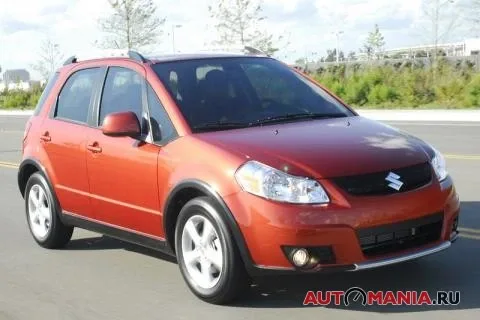
Japanese engineers are famous for their love of versatile cars where opposites coexist. Take, for instance, their habit of turning mid-size station wagons into something sporty or fitting two turbochargers into the one-liter engines of little cars like the Daihatsu Move. Everything is subject to modification. However, experiments with existing production models are not the end of it. Designers at car factories also like to play around. It was they who came up with the idea of mixing a minivan with an SUV, and turning a compact hatchback into a spacious mini-van, all seasoned with all-wheel drive.
To sum up, in the Japanese understanding, a flawless car should be all-season, unafraid of any weather, have a sporty character, and remain compact. Almost every local brand has its own variations on this theme, but most of these models never leave Japan. Not to mention Europe. Although, as it turned out, interest in such cars there is no less. You don't have to look far: at Suzuki, a brand well-known and in demand here, they consider their SX4 hatchback almost a benchmark.
And, apparently, Europeans agree with the engineers, including Russian buyers. For the five-door SX4, our compatriots queue up for six months or even longer. The waiting time for a specific car is directly tied to its color and trim, with the body shade playing almost a primary role. At first glance, this seems strange. What's the secret? The thing is, the hatchback is assembled at two plants — in Japan and Hungary. From the Land of the Rising Sun, we get front-wheel-drive versions with a manual gearbox, and from Hungary, all-wheel-drive ones with an automatic. All else being equal, a Japanese car takes longer in transit. But then the color queue comes into play. And so, for a sought-after configuration with an automatic transmission in the most popular orange color, a customer has to wait seven to eight months. The same car, but with a manual, will arrive a month later. But a white car in a similar configuration from Japan will arrive in six months, and from Hungary — in about three months. Such is the entertaining arithmetic.
True, practice shows that our motorists are willing to patiently wait even a year and a half — that was the case when the model first appeared on the market. And for what? Because of all-wheel drive? Not at all. According to statistics, Russians most often order city front-wheel-drive versions. Because of phenomenal driving qualities? Again, no. Under the hood of the hatchback, there is only one available gasoline engine with a displacement of 1.6 liters, and such a car clearly doesn't qualify as a supercar. Maybe it's about the price? And again, no. This model can't be called cheap: the base version costs almost half a million rubles, and the top version even reaches an indecent 603,400 rubles for the B-class. So what attracts our compatriots to the Suzuki? Most likely, the appearance, which, by the way, directly depends on the wishes of the future owner.
The creators of the SX4 claim that its versatility is embedded in the very name: S stands for sport, X is a symbol of off-road conquerors, and the number hints at all-season capability. Nevertheless, the buyer is offered two options: Urban Line and Outdoor Line. The first is a front-wheel-drive family compact van designed for the city, smooth asphalt, or, at most, light country roads. The second is for those who love active outdoor recreation. It looks noticeably more brutal than its "civilian" counterpart and is also larger by 4, 2.5, and 5.5 cm in length, width, and height, respectively. Almost all of this increase went into ground clearance, in which the Outdoor Line is only slightly inferior to the mid-size crossover Suzuki Grand Vitara. Additionally, the SX4 driver can activate all-wheel drive by pressing a button on the front panel.
But let's look inside. The interior largely echoes the cabin of another compact Suzuki hatchback — the Swift. The same architecture, the same black plastic combined with red instrument lighting, and the dashboard itself is easily recognizable. The main difference is the center console. Apparently, considering the SX4 a competitor to the now-fashionable crossovers, the Japanese styled it in the spirit of SUVs: a monumental vertical composition framed with metal inserts. The quality of trim materials overall raises no questions, although, honestly, for that money, the plastic could have been better.
The ergonomics, in my opinion, are also in the "jeep" style. Simply put, you sit almost upright behind the wheel, which is quite tiring on long trips. However, you can save yourself by slightly changing your posture or reclining the seat back. True, the steering column adjusts only for height, so you won't find the ideal driving position right away. Otherwise, there are almost no complaints. The seats are comfortable, and the adjustment ranges are sufficient in most cases to get settled behind the wheel properly. The steering wheel has a pleasant shape, with audio system control buttons on it. The instruments are easy to read, and all controls are at hand.
Rear passengers won't have to complain either — provided there are two of them and the front seat isn't occupied by someone of basketball height. Three on the sofa is a bit cramped: the cabin is narrow. The feeling of spaciousness is created only by the headroom, but there's nowhere to put your legs — the transmission tunnel is too high and massive.
A similar story with the trunk. On one hand, it's quite roomy; on the other, large items like a big travel suitcase, alas, won't fit. The transformation of the rear sofa helps, which can be partial — the standard 40:60 split. The folding process itself is extremely simple: press a button on the backrest, pull the cord from the trunk, and the folded seats stand upright, turning the hatchback into a cargo-passenger van. The only snag is the high loading height, but solving it without serious structural intervention won't work, so you'll have to struggle with heavy bags.
In Europe, the SX4 is offered with two gasoline engines (1.5 and 1.6 liters) and a 1.9-liter 120-horsepower turbodiesel, which, following good European tradition, is not supplied to us. The same fate befell the younger gasoline unit with 99 hp and the optional six-speed manual for the European market. So, as I already said, Russian buyers have only one option — a 107-horsepower engine, which can be paired with either a five-speed manual or a four-speed automatic.
In our test, we had an all-wheel-drive Outdoor Line with a manual. Thanks to decent torque (145 Nm at 4000 rpm), the car accelerates to 100 km/h in just over 11 seconds and averages about 7 liters per 100 km. Overall, it drives well; the main thing is not to be afraid to rev the engine to high RPMs, otherwise, it won't show anything outstanding.
Otherwise, the hatchback doesn't particularly stand out among its classmates. Although wait — it has all-wheel drive! It engages via a button on the center console. In auto mode, as expected, at the first signs of wheel slip, up to 50% of torque goes to the rear axle. As soon as traction is restored, the electronics quickly put everything back. But that's not all. The SX4 can also work in 4WD Lock mode, a kind of pseudo-lock that allows you to get out of mud on medium off-road — especially since the 190 mm ground clearance and metal underbody protection are conducive to this. True, there's a limitation: the speed must not exceed 60 km/h, otherwise, the electronics will switch the system back to auto.
In short, you shouldn't drive the SX4 recklessly — it's easy to overdo it. And you shouldn't consider it a full replacement for a crossover: their weight categories are still different.
Technical specifications of Suzuki SX4
| Length (mm) | 4115 |
| Width (mm) | 1730 |
| Height (mm) | 1585 |
| Wheelbase (mm) | 2500 |
| Ground clearance (mm) | 175 |
| Weight (kg) | 1130 |
When I first saw this car, I immediately noted its proportions. The compact station wagon looks composed and slightly aggressive, although in fact, it's an absolutely city car. Inside, everything is modest but functional: the plastic is hard, but there are no gaps or squeaks, and the seating is comfortable even for a tall driver.
Under the hood is a 1.6-liter gasoline engine producing 107 horsepower at 5600 rpm. Torque of 145 Nm is available from 4000 rpm, making the engine quite flexible in city traffic. Acceleration to 100 km/h takes 11.5 seconds, and the top speed is limited to 170 kilometers per hour. According to the specs, average fuel consumption is 7.1 liters per 100 km, but in real rhythm with traffic jams and traffic lights, it comes out to about eight — also not bad.
On the move, the car feels light and maneuverable. The steering is informative but not sharp — for everyday driving this is more of a plus than a minus. The suspension is elastic, it gathers the road on small bumps, but on serious joints and speed bumps it noticeably shakes. A calm pace is its element, but quick lane changes are given with a slight delay, which is expected for such a body.
The trunk pleases: 270 liters in the normal state and 625 — with the rear row folded. For trips to the countryside or transporting large purchases, this is enough, although the loading height could be lower. The rear seats fold almost into a flat floor, which adds versatility.
As for the price — from 481,700 rubles. For this money, the buyer gets a practical car with honest characteristics, without excesses and marketing tricks. This is not the case when you want to fall in love at first sight, but if you need a reliable working tool for every day — it's worth taking a closer look.