One of them is equipped with a 1.7-liter engine, the second with a 1.3-liter motor. But both are true off-roaders, which is what attracts attention. Moreover, among compact SUVs on the Russian market, they are as close as possible in characteristics and price. Yes, formally they belong to different segments. Yes, the head of the family is unlikely to consider buying a Suzuki Jimny. But young people quite often consider it as a replacement for the Chevrolet Niva. Therefore, our task is to arrange a friendly duel between them.
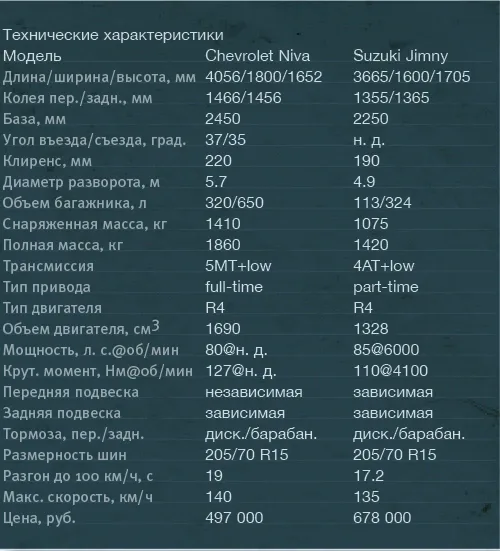
The most affordable version of the Jimny costs 641,000 rubles. This amount includes a manual transmission, air conditioning, CD player, roof rails, and front airbags. A fully equipped Chevrolet Niva (air conditioning, roof rails, audio preparation) will cost 497,000 rubles. The difference is noticeable, but as already mentioned, the Jimny is the closest competitor to the Niva in price.
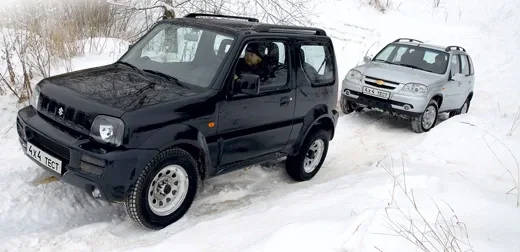
I'll note right away: we got the top version of the "Japanese" — with leather interior and automatic transmission, for 678,000 rubles. There was no other car in the press fleet. Comparing cars with different transmissions is not entirely correct, but there is no choice — we'll just make an adjustment for this fact.
SWALLOWS ROUGH ROADS
The main conclusion can be made in advance: the Niva is inferior to the Jimny in almost everything, but in one thing it surpasses it — in the suspension. If you live outside the city and constantly drive on broken roads, potholes, and bumps, there is no alternative. Only the Niva. Its suspension is a benchmark. It is both soft and energy-intensive. You can not slow down before a pothole or a speed bump, but on the contrary, even add gas — and not be afraid of hitting your head on the ceiling. The Jimny has no suspension as such. Due to solid axles, stiff springs, and a short wheelbase, it does not absorb bumps. The car bounces over them, and passengers in the cramped cabin rattle around like balls in a lottery drum. This is exhausting.
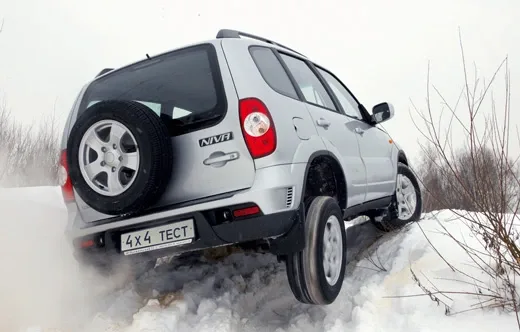
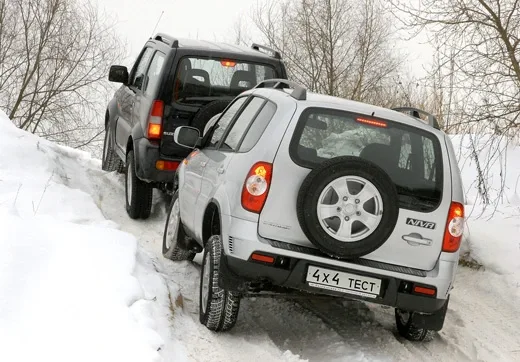
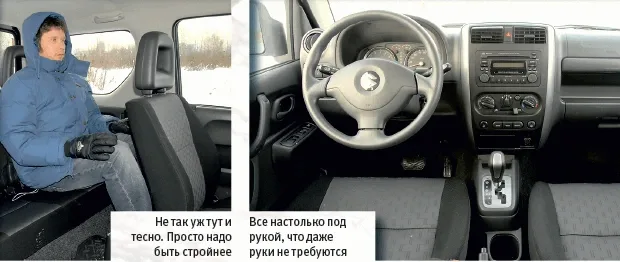
The Niva absorbs bumps like a loaded pickup truck on leaf springs. For the sake of a clean experiment, I sat next to a Jimny owner, and we drove along his usual dacha route — through the forest on concrete slabs. The poor fellow squinted and reflexively covered his head with his hands before every pothole — he had no idea what the Togliatti chassis was capable of!
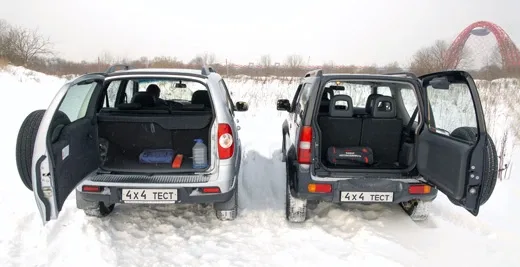
The other advantages of the Chevy are related to its dimensions. Here the trunk is larger and the rear row is more spacious. That's all. If you want to buy a Chevrolet, you can stop reading and just be happy.
A LOG UNDER THE PEDAL
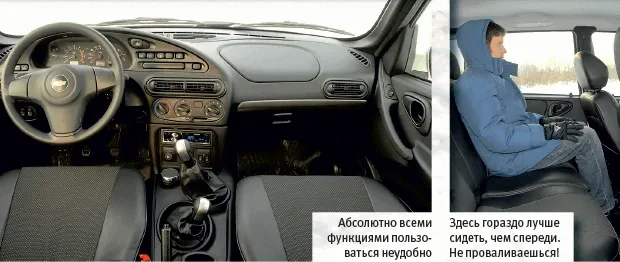
First, I got behind the wheel of the "Japanese," then switched to the Niva — and immediately realized that it has neither seats, nor a dashboard, nor brakes. The instrument panel seems to be assembled from used fender liners, with buttons just thrown on. The seats sink under you like an old sofa with foam rubber. Under the brake pedal — a log. At the extreme steering wheel position, the power steering vibrates from overstrain. The sunglasses holder on the ceiling with a micro-lift opens only with a screwdriver. The knob of the transfer case lever rotates freely around its axis.
The fuel sensor lies like a weather forecast. The felt on the trunk floor was never secured. Surprisingly, after a few days of driving, you forget about all the shortcomings — habit kicks in. So let's continue comparing the rivals by characteristics. Ergonomics and quality can wait.
RIGID VS PERMANENT
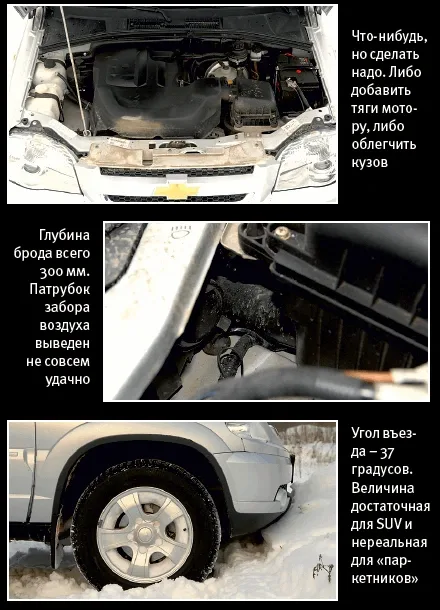
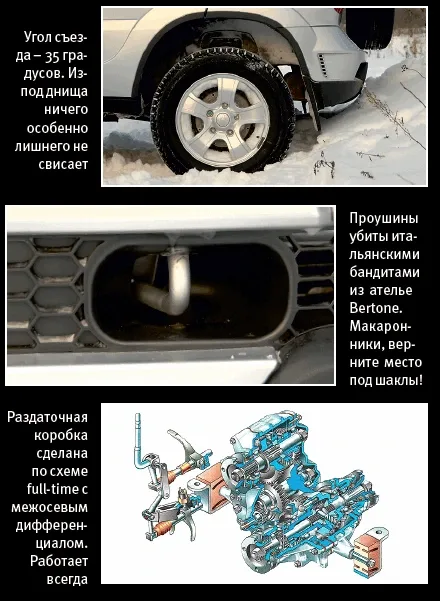
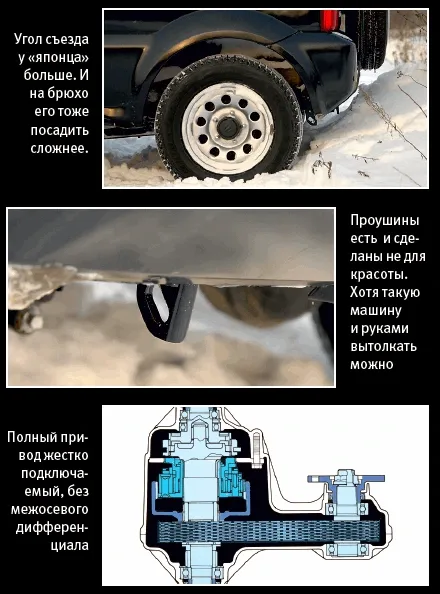
By design, the Suzuki Jimny is a 100% off-roader. It has a frame, axles front and rear, and a low range in the transfer case. Plus, a rigidly engaged all-wheel drive without a center differential. The Chevrolet Niva is more civil: a unibody, independent front suspension, and a solid rear axle. There is a low range. The drive is permanent, all-wheel, with a center differential.
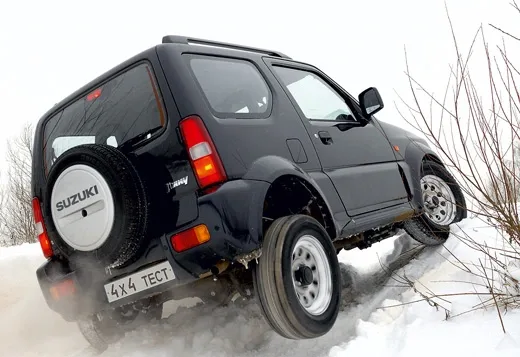
Comparing the off-road capability of the Chevrolet Niva and Suzuki Jimny can take a long time — too many details. The Jimny has a stronger reduction in the transfer case, plus there is a version with an automatic. This gives a serious advantage off-road in terms of traction. But the fact that the Suzuki engine produces 110 Nm, and the Chevrolet engine has 17 more, means nothing. After all, the Niva is four hundred kilos heavier. But it has wheels that hang out much less often — better suspension articulation. Moreover, it is more stable: the center of gravity is lower.
Geometric cross-country ability is roughly comparable. The Niva is slightly better in approach angle, but slightly worse in departure and ramp angles. The difference is insignificant. And the traditional competition "who will climb the highest hill" ended in a draw — both cars took the summit with a run-up.
WATCH THE ROAD
On asphalt, the Niva smooths out bumps better but holds a straight line worse. Reach for a button on the panel while driving — and you can accidentally drift into the next lane. The "Japanese" is tuned more precisely and is noticeably more agile. Its power is 85 hp, the "Russo-American" has 80. The Jimny accelerates to 100 km/h faster, and we've already talked about torque and weight difference.
If we talk about consumer qualities, the Niva is good to sit in only in the back, and the Jimny has just air instead of a trunk. But the "Japanese" has an airbag and ABS already in the base, while the Niva can't get them even for an extra charge. The new modular headlights of the Chevy are not inferior to the Japanese ones, but there are no fog lights in the base configuration. The transfer case engagement mechanism on both cars sometimes makes you turn the steering wheel and drive back and forth until it deigns to engage.
SPECS: CHEVROLET NIVA
SPECS: SUZUKI JIMNY
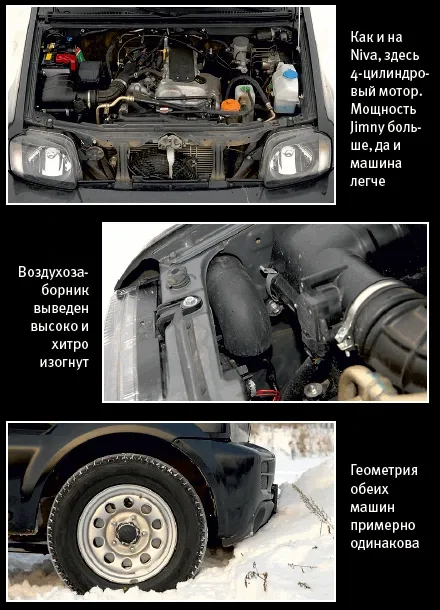
Before Volkswagen bought part of Suzuki's shares, both cars were produced under the supervision of GM. But the future of cooperation between the Togliatti plant and General Motors is also foggy. It's nice that under the hood of the Niva there is a plate: made under license from OAO AVTOVAZ. Cool! We actually outsmarted "gangster motors" with our intellectual property.
Approaching the finale, I repeat: the Chevrolet Niva loses in many parameters — quality, ergonomics, traction. Even in maintenance costs. The first maintenance for the Chevrolet Niva in Moscow costs $325 (2,592 UAH), the second — 9,300, the third — 17,400. For the Suzuki Jimny — 4,800, 7,600, 8,600 respectively. But if your roads are bad, you need the Niva, and the Jimny is good in every way, but it's too bouncy.