
Suzuki Grand Vitara
POWER
Engine - 3.2 L VVT
Max power -
233 hp/6200 rpm
Max torque - 291 Nm/3200 rpm
Max speed (km/h) - 200
Acceleration 0-100 km/h - 9.3
Fuel consumption:
city - 14.4
highway - 8.3
combined - 10.6
5-speed automatic
Curb weight - 1677 kg
Length - 4300 mm
Width - 1810 mm
Height - 1695 mm
Ground clearance - 200 mm
Tires 225/65R17
Price $ 43,943 (351,540 UAH)
Equipment:
Permanent all-wheel drive with locking center differential and low range, ESP, ABS, hill descent control, leather interior, leather steering wheel, cruise control, climate control, A/T power
Service interval:
15,000 km
Break-in service - 1,000-2,000 km - $169 (1,350 UAH)
Service 1 - 15,000 km - $237 (1,891 UAH)
Service 2 - 30,000 km - $372 (2,970 UAH)
Service 3 - 45,000 km - $338 (2,700 UAH)
Service 4 - 60,000 km - $608 (4,860 UAH)
Service 5 - 75,000 km - $237 (1,891 UAH)
Service 6 - 90,000 km - $743 (5,940 UAH)
Competitors:
Chevrolet Captiva
Opel Antara
Nissan X-trail
Renault Koleos
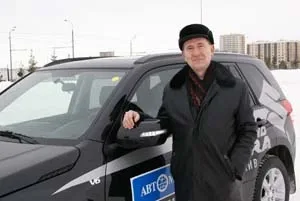
Marat Makhmutov, "Kazan School of Higher Driving Skills"
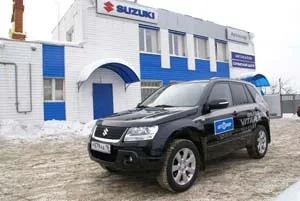
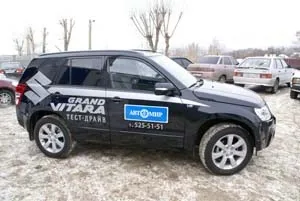
Winter imposes specific requirements on the choice of a candidate for the next test drive, since various SUVs, as well as crossovers and ordinary passenger cars with all-wheel drive transmission, best suit this event. Therefore, it is not surprising that this time we had at our disposal the current generation "Suzuki Grand Vitara", which has been on sale for quite a long time, including on the Russian car market. What is the point of testing this particular SUV, which is not a novelty by and large? The reason for our interest was not so much the car itself as such, but the new 6-cylinder engine with a volume of 3.2 liters and a power of 233 hp, which began to be installed on this model. Owners of "Grand Vitara" 2nd generation of the first years of production purchased them only with 4-cylinder engines of 1.6 L (106 hp) and 2.0 L (140 hp), and even the largest of them did not have enough power for dynamic driving. It must be admitted that in addition to the new line of engines (in addition to the mentioned newcomer, an engine with a volume of 2.4 liters and a power of 169 hp, also with four cylinders, was added), the car itself underwent a light restyling, which consists of an updated radiator grille, bumpers of a slightly different shape, and turn signal repeaters on the housings of the exterior mirrors.
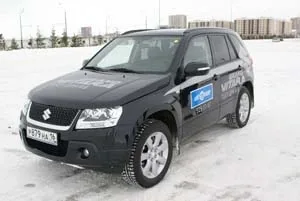
For the test drive, a black car in the maximum configuration was provided, which is also the only one for the top model. It includes almost everything that can be on this Japanese SUV, namely: six airbags with curtains, a five-speed automatic transmission, leather interior, an audio system with steering wheel controls, climate control, cruise control, xenon headlights, a sunroof, 18-inch wheels, a hill descent control system, and much more.
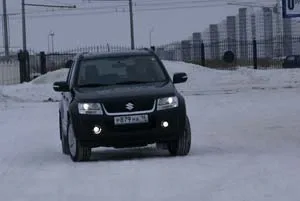
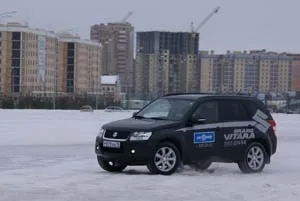
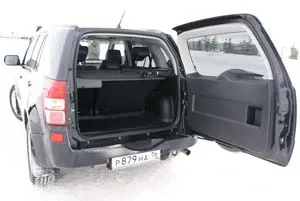
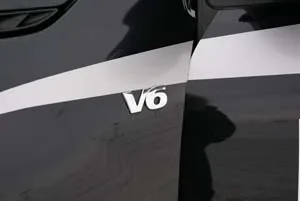
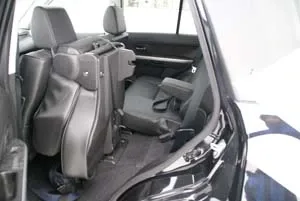
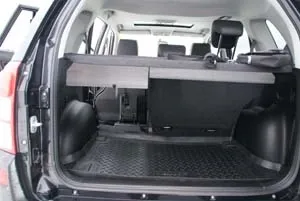
By and large, to the uninitiated eye, the car has practically not changed externally since 2006, and only the "V6" badge on the rear (fifth) door convinces us that this is a 2009 model year version. High-quality Japanese assembly manifests itself in literally everything, from minimal gaps at the joints of body parts, to the interior of the cabin. The finishing materials and plastic used in its decoration are of good quality, and when driving on uneven roads, they did not make the slightest sound. The cabin has enough space for five not very large passengers, and for four there is more than enough space. In the back seat, the legroom for passengers is such that they can sit without any problems. Progress compared to the 1st generation "Vitara" is evident, since the previous model frankly cramped those sitting in the back, including in terms of distance to the front seat backs. The trunk with its 400 liters of volume is not very large, but when folding the rear seats, it increases to 1385 liters, which is sufficient for such a car. This is a brief general description of the car, and now I will move directly to what this test was actually conceived for: to assess the driving qualities of the updated "SUZUKI". Settling comfortably behind the wheel, I noted that, despite the maximum configuration, the "Vitara" lacks electric adjustment of the driver's seat. A trifle, of course, but for the top version, this option could still be included as an element of the basic configuration.
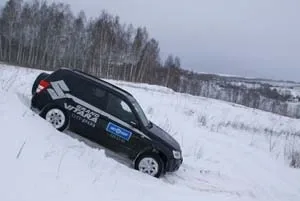
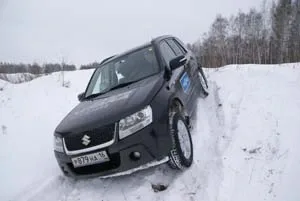
Moving the automatic transmission lever along a winding trajectory to the "D" position and lightly pressing the gas pedal to drive out onto the test site gave an initial positive impression of the car's dynamics: the engine is lively. But the subsequent trip showed that the cheerful nature of the engine is tamed by a not quite nimble, albeit five-speed, gearbox. The engine asks to add gas, it already sings at high revs, but the car does not go. Rather, it goes, of course, but not on 233 horsepower. Subsequent observations of the automatic transmission's operation led to thoughts that the creators of this car were guided primarily by its efficiency, not dynamic performance. The ESP system present in the base (disabled by a separate button) operates at speeds up to 40 km/h, and when this limit is exceeded, it reactivates itself, which does not allow you to effectively pass a high-speed slalom on ice (one of the elements of our test). By the way, the self-activation of ESP did us a disservice during the subsequent off-road test, but more on that later. Driving on a rough road revealed a drawback of the suspension, which consists in too detailed transmission of information about road irregularities to passengers; personally, I did not like it. When driving on the highway, the thoughtfulness of the automatic transmission was still felt, while everyone noted that the car's sound insulation has taken a step forward compared to the pre-restyling model, and the cabin has become much quieter.
Our test would be incomplete without the off-road stage, so driving off the highway towards a snowy testing ground is perceived as a mandatory and necessary element of our test. Among compact SUVs and crossovers, it is the "Grand Vitara" that has all the attributes of a real SUV: a frame, albeit integrated into the body, an impressive ground clearance, a locking center differential, and a low range. Engaging and disengaging the latter two is done not by a lever or buttons, but using a multi-position rotary switch located on the dashboard to the right of the driver. The first obstacle in the form of a fairly steep incline covered with freshly fallen snow, we decide to tackle with the switch in the 4H position (four-wheel drive without low range). From the get-go, we failed to overcome the obstacle - the unpacked snow and the non-straightforward entry onto the hill interfered. The second attempt was made already in the 4L position of the switch (four-wheel drive with low range engaged). And again failure. The fact is that the snow is very soft, and therefore the wheels lacked traction to overcome the treacherous incline. We decide to drive along other sections of the route. And it should be noted that the rest of our off-road segment was covered by the car without any serious complaints. Only once, when driving out of a snow-filled ravine at a speed of over 40 km/h, ESP activated, and at the very top, the car, instantly losing speed, immediately stopped. Here it is, the inconvenience! But this happened with the switch in the 4H position, but in 4L mode everything went without a hitch, as befits a real SUV. Having tasted the taste of victories over snowy off-road, we decide to overcome the ill-fated incline a third time, having previously checked the operation of the hill descent control system on it (it works!). The third time fortune favored us, and the treacherous hill, albeit not quite easily, was overcome. The car rehabilitated itself, and I suspect that this is also the merit of the powerful engine, which allowed the car to be pulled out in tension at low revs.
Summing up briefly, I will express my opinion about this car: solid, high-quality, practically having no competitors-analogues in price in its class, good for everyday driving on moderate off-road.
Vadim Sadykov, "Autoclub-Kazan"
This is already the 3rd Grand Vitara we've been driving: before that, there was a 1.6-liter 3-door and a 2.0 5-door. The first thing you notice is that the car has become more solid, in particular, the sound insulation has improved. But almost immediately a drawback of the R17 alloy wheels was revealed. Firstly, with 225/60R17 the car is excessively stiff. The other recommended size, 225/65R16, is much better here. Secondly, the alloy wheels have a wide platform parallel to the ground that gets packed with snow, causing wheel vibration. After a short run around the city, we tested the car on an ice rink. It should be noted that the Grand Vitara 3.2 is primarily focused on safety. The ESP cannot be completely turned off, and the traction control only turns off after locking the center differential. By the way, the traction control automatically turns on at 40 km/h. You can't fool around in this car; safety is paramount.
But even with this approach, the car has some nuances that are better to get acquainted with in advance, not on public roads. I enter a turn on ice, the ESP starts to activate, I release the gas – and the car goes along the previous trajectory, absolutely not reacting to the steering wheel. I observed the same situation from the side when Alfred was driving: the wheels turned left, but the car was pulled straight. Now let's try increasing the gas during a skid. This is probably the safest option for an inexperienced driver. The brakes (automatic ESP operation) engage harshly, the engine is choked (I had the feeling it was about to stall), and the car stops very quickly. It remains to try the third option: careful work with the gas pedal. Here it seems something starts to work out, but you have to dose the pedal effort very carefully: if you don't press enough – we fly along the old trajectory, if you press too much – we stop.
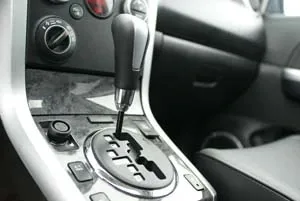
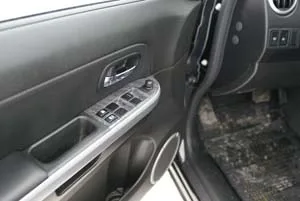
A few words about the 5-speed automatic transmission. We have already encountered the fact that for engines over 3.0, a 5-speed gearbox is not enough (for example, on the Honda Pilot 3.5). Here the 5-speed automatic has 2 more drawbacks: excessive thoughtfulness during shifts and an ancient algorithm for the "manual" mode (this is when mode "3" does not mean 3rd gear, but only a prohibition on using gears above 3rd). At the same time, the settings of the 5-speed automatic are so unusual that it's worth spending time on. The gear ratio at the output of the gearbox after 4th gear is 3.58! This almost coincides with 5th gear on many 5-speed gearboxes! I specifically checked on the highway: 4th gear, speed 90, revs less than 3000. And the Grand Vitara also has a 5th gear, which in its characteristics corresponds to 6th on 6-speed gearboxes. These settings of the 5-speed automatic allow you to move at good speed at relatively low engine revs, providing good fuel economy. After entering the city, the trip computer showed 16.4, and after a while – 16.0, and this is on an unrun car with only 300 km on the odometer. It's unlikely you'll be able to achieve the claimed 14.4 liters, but the fuel economy is evident. Since the 5-speed automatic tries to mimic a 6-speed, on lower gears you have to look for a compromise. For example, the gear ratio at the output of the gearbox after 1st gear is only 12.6, which is very low (typical figures on most gearboxes are from 16 to 17). Figuratively speaking, the car starts as if not from 1st, but from a "one-and-a-half" gear. By the way, the Grand Vitara 2.4 with a manual has exactly 17.
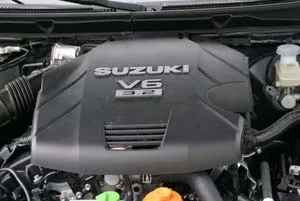
What does this figure mean? It means that the torque at the output of the gearbox is 17 times greater than at the engine. In "our" car, the torque increase is much more modest – only 12.6 times, but we are saved by the excellent characteristics of the 3.2 engine. The maximum traction here is at low revs, at 3200 rpm. "Two in one" – if you briefly state the essence of the car. You can move at low revs (with good traction and at the same time economically), or you can "floor it" to feel all the power of the 3.2.
This is not just an engine change (2.0 to 3.2), it's practically a completely different car. And many will like it.
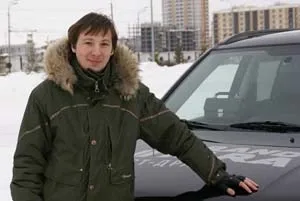
Alfred Mardanov, "Autoclub-Kazan"
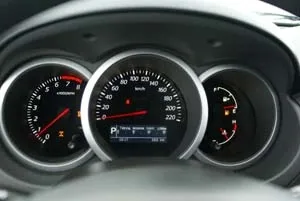
This car can hardly be called new; they changed, or rather, increased the engine displacement to a formidable 3.2 liters, and it would seem that's all. Oh, yes, the digital indicator disappeared from the dashboard and instead a speaker appeared, and the indication is now on the instrument panel itself, which is much more convenient. But this is only at first glance there are no changes, in fact they are there, but more on that later. Sitting behind the wheel and trying to find the electric adjustment lever with my left hand, I was very surprised not to find it. The trim seems to be top-end, but such a small thing is missing. Although, glancing at the instruments, I involuntarily noticed that the climate control is single-zone and, as it turned out later, it is not fully automatic. I mean that it does not regulate the air flows in automatic mode, which most likely was the reason for frequent fogging of the rear windows in the cabin. This moment had to be compensated by manually increasing the fan speed and setting the "glass-feet" mode. Something is starting out sadly, the mood is completely different, I would say, fighting, and I have nothing but nitpicks. Well, it's time to go to our favorite hippodrome, fortunately, a break in driving school classes is about to begin there, and we can slide around on the ice rink to our heart's content. Having adjusted the seat position in manual mode (I didn't find the electric lever), I cheerfully slam the door and forward!!! A-ha, and the car, which is very noticeable even from the first meters of the road, behaves completely differently than its brother with a less powerful engine.
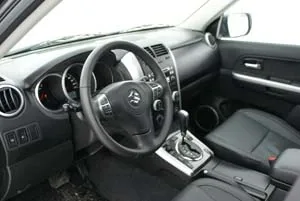
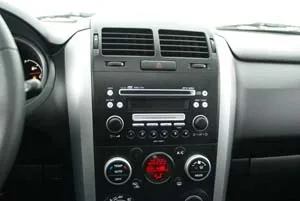
This one is denser, sharper, and less noisy. Well, in one phrase I've laid out all the differences. Now let me try in more detail. That "Vitara" we had the pleasure of testing before was distinguished by some, excuse me, "bucket-like" quality. It thumped loudly even on not very serious bumps and didn't want to protect the peace and comfort of passengers at all. In our case, you can feel that the shock absorbers have undergone changes, at least it's felt in how the Vitara handles the road – reliably, elastically. It's more stiff than soft, especially noticeable on a fine "washboard" road, where passengers feel every bump. But in return, the car got sharp steering, it's not prone to body roll, even if you sharply turn the wheel into a corner. Although due to the uncompromising work of the ESP, any driver initiative is choked, but nevertheless, some composure of the car is noticeable, and the sound insulation is noticeably better, due to which the car seems denser and more protected. But the ESP, since I touched on it, works very cunningly. Vadim has already described the nuances of interacting with this system, I won't be clever or speak ill, but I'll just give advice to those who will have to drive this car. Be gentle and courteous with the gas pedal and accustom yourself to the idea of not pressing it "to the floor" in critical cases and not releasing it in cases of skidding. Roughly speaking, the car should always feel traction, otherwise it "may get lost".
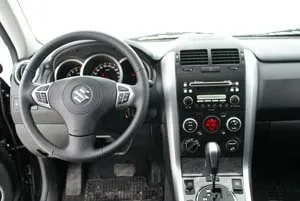
If you suddenly go into a slight skid and release the gas out of fear, the car moves by inertia, paying no attention to you at all (this effect was observed by Vadim from the side). If, on the contrary, you press the gas "to the floor", while correctly turning the wheels, the car still "stalls" and only after thinking, begins to "pull out", although in a real situation you might already end up in a ditch. The most correct thing is to properly position the front wheels and carefully dose the gas pedal, and then the car obediently straightens any skid curve and doesn't let you go into the zone of alienation. In fact, a simple training session on some site – and you'll feel the temper and character of the car, which you can easily control in the future and enjoy it. But off-road, even a child can handle this car. The main thing is to choose a direction and just drive. We didn't even turn off the "drive" mode and calmly drove along a snow-covered road. We switched to "L" mode with simultaneous disengagement of the center differential more out of pure curiosity; the car turns into a small tank, and you get the impression that it can also pull 2 more tons behind it. It's no wonder Americans like to tow and launch boats on such cars. The special "A/T Power" button exists precisely to switch the car's operation mode for long climbs and descents (we read this later in the instructions). It couldn't be otherwise, having "Jeep-like" features in its combat arsenal, it's not just a crossover, but a crossover with increased off-road capability. This is what made the Vitara popular in its time, and to this day it remains true to off-road traditions.