
“Wagon arguments are the last thing…” In hindsight, I, of course, understood that Andrei Makarevich’s words rang true, but when a whole carriage of the Petrozavodsk — Moscow express train is packed with journalists, racing drivers, and Subaru enthusiasts… it’s so tempting to talk. “And the two met not out of fear, but out of conscience. The wheels chased away sleep. One spoke…” We argued about which type of all-wheel drive is better: permanent or on-demand. Gradually, the discussion turned into a dispute, words into hoarseness, and gestures into self-defense. “When there’s nothing more to drink…” But we had something, and perhaps that’s why everyone eventually parted ways peacefully to their compartments. And the unspoken provocateur of this squabble, as I see it, was the updated Subaru Outback crossover, presented in Petrozavodsk — a car that, despite its almost symmetrical torque distribution between the axles, evokes mixed feelings.
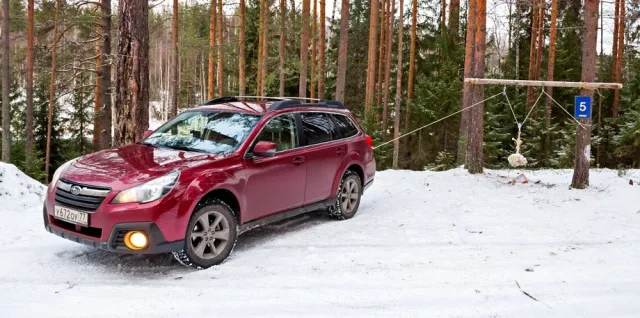
Distinctive features of the 2014 Outback: plastic roof rails, new sill covers and alloy wheels, as well as blackened headlights and a radiator grille.
Once again, I’m convinced that Subaru has the most loyal fans! The rally program has been shut down for five years now, phrases like “permanent all-wheel drive” and “boxer engine” no longer stir the blood, and comparative tests show that today’s Pleiades are finding it harder to compete. But these guys, left without factory support yet confident in their rightness, don’t care! They sincerely believe that only the stars on the Subaru logo can be cooler than the stars. I respect their loyalty! But behind their backs, I call them the “opposition” (derived from “opposite”). Because, clinging tightly to the brand’s history and technical features, Subaru fans stop perceiving the present and future objectively.
LED taillights could have emphasized the updated appearance of the Outback. But Subaru fans remained true to traditional light sources. A car worth one and a half million rubles doesn’t even have such sought-after elements as daytime running lights.
Meanwhile, the requirements for cars are completely different now. It’s no longer so important what technical filling lies at its core; the main thing is how it behaves on the road. So when Subaru engineers start talking about the advantages of the boxer engine or the features of the proprietary Symmetrical AWD all-wheel-drive transmission of the updated Subaru Outback crossover, I start to doze off. What’s the use of a “flat” boxer if the crossover’s ground clearance is 50 mm higher than that of the original — the Legacy wagon? And is there any point in building a technically more complex permanent all-wheel drive if the non-switchable and strict stability control system still negates its advantages? As a result, those who choose the Outback for excitement will be left disappointed. The rest of the buyers don’t care about technical refinements at all; what matters more to them is a low price. So it turns out that while winning in technical disciplines, Subaru ultimately loses the customer!
Subaru fans will hardly have to get used to the Outback’s instrumentation. Everything is in its place, including the narrow display strip on top of the dashboard, which, frankly, could be done without. A successful designer find is the dark fluted aluminum trim on the dashboard. But the panel itself is entirely cast from hard plastic, although on the door sides, pliable leather is combined with soft polyurethane.
However, there are some shifts in this direction. After the current update, the Subaru Outback 2.5 has become cheaper by 60 thousand rubles (from 1,455,000 rubles). And that’s without seasonal and dealer discounts. As they say, it’s a small thing, but nice! But more importantly, the Outback is now 24 thousand cheaper than its main competitor — the all-wheel-drive Volvo XC70 (from 1,479,000 rubles). What’s strange is something else. Both the update itself and the accompanying price reduction apply only to the version with the boxer “four.” Neither applies to the 3.6-liter modification. In the Russian Subaru office, this fact is explained simply: the main focus is on the 2.5 version. At the same time, Outbacks with six-cylinder engines and the old appearance will remain in service, although even under equal conditions their sales did not exceed 5%. What will happen now?
Disadvantages of the front seats: a somewhat short cushion and a pushing backrest. Moreover, the latter cannot be fixed even by completely removing the lumbar support bolster. But once you get used to it, you stop noticing these features. There’s more than enough space in the back row, and the widely adjustable seatback will help you find a comfortable position. However, the third passenger will have to put up with the high transmission tunnel. Loading things into the trunk is marred by the high edge of the rear bumper. But the compartment itself will hardly disappoint: 526–1690 liters.
The Outback itself is generally good. The cabin is spacious, the quality of part fit is with minimal tolerances, and the steering column adjusts over wide ranges. And I sit comfortably, although many colleagues complain about the somewhat short seat cushion. However, a modern crossover shouldn’t have a dashboard entirely made of hard plastics. And a single power window with auto mode is also not proper. Nor is the trio of differently sized displays that only duplicate each other’s readings to varying degrees. But how do you find out the average fuel consumption? I found out by accident: while trying to reset the odometer, I pressed an inconspicuous pin in the instrument cluster. Many will say it’s a matter of habit. But why get used to complexities when there are simple solutions? By the way, the Outback doesn’t suffer from increased appetite: a crossover driven for two days with the gas pedal floored consumed less than 15 liters per hundred. An excellent result!
The Outback’s suspension is quite capable of smoothing out the rough Karelian winter road (left photo). Moreover, the worse the road surface, the more delight the driver experiences. On asphalt, the situation is completely opposite: the deeper the potholes, the more complaints about the suspension’s work.
But the Outback is contradictory not only in the organization of the driver’s workplace. This car is a contradiction itself! You take the wheel and rejoice at the clear fixation of the steering wheel near the zero zone. And the car holds a straight line perfectly: no problems even on broken road sections. But as soon as you enter a turn, the former solidity crumbles. In a corner, I acutely lack feedback. The same can be said about the suspension. On a rough dirt road, it’s just a holiday! Whether it’s a wave, a pothole, or a ramp under the wheels, it doesn’t matter at all. The Outback plows along Karelian winter roads without pitching or impacts. The energy intensity is amazing! But on asphalt, the suspension works as if the shock absorbers are half empty. Even on small bumps, there’s no trace of the former elasticity. And on large and medium ones, impacts pass into the cabin. Moreover, their force hardly depends on the depth of the pothole. It’s stiff and uncomfortable in any case. Although there are still no bottoming-outs.
The rear suspension travel is small. However, the Outback isn’t afraid of diagonal wheel hanging — the VDC system helps, simulating the operation of inter-wheel locks.
But perhaps the most questions arise about the tuning of the electronic systems. That the Outback continues to move forward with wheels hanging is good. But why does the non-switchable stability control system most resemble a prison guard? You stumble a little — and immediately you’re shot with a machine-gun burst of braking wheels. And if the traction control isn’t deactivated either, the electronics also strangle the engine, depriving you of the ability to pull the car out of a slide. You might say, with such a strict “collar,” you needn’t fear rear-axle slides? I thought so too at first. But it turned out that pushing through the system’s barriers isn’t that hard; you just need to make a slight mistake with the entry speed into a turn and turn the steering wheel more briskly.
Despite the fact that the Outback’s chassis is tuned with spirit, sweeping driving with slides is immediately suppressed by the non-switchable stability control system. As soon as you deviate the steering wheel a few degrees toward the slide (and with a lack of feedback, this often happens spontaneously), you’re instantly taken under control.
Or maybe such a strict rein is a forced measure, provoked by coarser errors in the chassis settings? I can’t give a definite answer to this question. I’ll only add that on slippery surfaces, sending the Outback into a slide can be done without much effort. And if at that moment you leave the car without power, it hangs as if in a vacuum, completely depriving the driver of information about wheel load. And then… again the familiar rattle of the stability control system.
Getting up a hill in the Outback is sometimes easier than getting down. When stopping on an incline, the HHC (Hill Hold Control) system keeps the car from rolling backward. True, it doesn’t work by default; to activate it, you need to press the corresponding button. But on a descent, electronic assistance isn’t provided at all.
No questions arise about the engine-CVT combination. Yes, sometimes the naturally aspirated flat-four lacks low-end torque. But the almost perfectly tuned continuously variable transmission saves the day. Subaru can rightfully be proud of the Lineartronic CVT with a torque converter, like conventional automatics. This is exactly the case where a technically more complex design justifies the investment. It's not a big deal that there are sometimes noticeable delays in response to the accelerator, but unlike expensive and finicky preselective gearboxes, this transmission eliminates jerks and always works smoothly. And even the fact that the flat-four delivers its maximum 229 N•m only near the 5000 rpm mark doesn't bother me. In my personal ranking, the voice of a high-revving boxer engine loses only to old-school V8s. In short, there's something to listen to!
Test drive in quest style?! I must admit — it's a fun thing! You drive along various roads, completing tasks. The goal is to gather the necessary tools for the final exercise: lifting a three-pood stone under which memorable souvenirs are hidden. Our crew turned out to be either the most resourceful or the laziest — we used the Subaru Outback to lift the boulder.
As for the wagon disputes... Everything was resolved by a quite banal truce: journalists, racing drivers, and brand enthusiasts came to the logical conclusion that the type of all-wheel drive isn't that important; the main thing is that the driver doesn't experience problems while driving. However, you can't erase words from a song. "And both got off somewhere near Taganrog, among endless fields..." Over the past three years, Subaru car sales in Russia have consistently held second-to-last place among Japanese manufacturers. Only Infiniti sold worse! Reasons? I won't claim that Subaru's departure from big-time motorsport is to blame. But 19 years of experience in the WRC was precisely the gold reserve that ensured the Pleiades special authority among automakers. And without it, the same Outback is just another crossover wagon with the Japanese penchant for penny-pinching and an inflated price tag. So it turned out that Subaru went its own way, and the buyer went theirs.
Specifications
| Subaru Outback | 2.5i-X |
|---|---|
| Body | |
| Body type | wagon |
| Number of doors/seats | 5/5 |
| Length, mm | 4790 |
| Width, mm | 1820 |
| Height, mm | 1665 |
| Wheelbase, mm | 2745 |
| Track front/rear, mm | 1535/1535 |
| Curb weight, kg | 1555 |
| Gross weight, kg | 2040 |
| Trunk volume, l | 526–1690 |
| Engine | |
| Type | petrol |
| Location | front, longitudinal |
| Number and arrangement of cylinders | 4, opposed |
| Number of valves | 16 |
| Displacement, cm³ | 2457 |
| Max power, hp/rpm | 167/5600 |
| Max torque, N•m/rpm | 229/4000 |
| Transmission | |
| Gearbox | CVT |
| Drive | permanent all-wheel |
| Chassis | |
| Front suspension | independent, coil spring, McPherson |
| Rear suspension | independent, coil spring, double wishbone |
| Front brakes | ventilated disc |
| Rear brakes | disc |
| Tires | 225/60 R17 |
| Ground clearance, mm | 213 |
| Performance | |
| Max speed, km/h | 198 |
| Acceleration 0-100 km/h, s | 10.4 |
| Fuel consumption, l/100 km | |
| — urban cycle | 12.0 |
| — extra-urban cycle | 7.4 |
| — combined cycle | 9.1 |
| Emission standard | Euro-4 |
| Fuel tank capacity, l | 65 |
| Fuel | AI-95 |
Technology
The all-aluminum opposed four-cylinder EJ25 with a pair of camshafts in each cylinder head is equipped with multi-point fuel injection and variable valve timing on the intake (AVCS).
Subaru's Lineartronic CVT with a chain from Luk (like the Audi Multitronic gearbox) is currently the only continuously variable transmission capable of working when installed longitudinally in conjunction with all-wheel drive. The function of the friction packs usual for CVTs here is performed by a traditional torque converter. That is, the Japanese created a hybrid of a CVT and an automatic. From our experience with the Subaru Legacy, we know that this combination is not particularly quick. But the Japanese assure that thanks to the torque converter lockup at speeds above 8 km/h, fuel is saved. Also, Lineartronic features short shift times in the pseudo-manual mode: virtual gears change in just 0.1 seconds.
The all-wheel drive system of the Subaru Outback with the 2.5-liter engine and Lineartronic CVT uses an electronically controlled multi-plate hydraulic clutch. In normal driving modes, torque is split between the axles in a 60:40 ratio, and in case of wheel slip, up to half of the torque can be sent to the rear axle. The reliability and performance of the friction clutch during prolonged slipping (risk of overheating) is ensured by its location — in the gearbox housing. In this case, both the CVT and the clutch itself operate in a single hydraulic circuit, the volume of which is several times larger than that of gearboxes with a separate housing.
History
The first Subarus with the Outback suffix (sparsely populated area, wilderness) appeared in the lineup of the Japanese company in 1995. And although in essence it was just an off-road modification of the Legacy model, the Outbacks differed from the original only in additional plastic cladding and increased ground clearance to 185 mm (later the clearance grew to 200 mm), the Outback marked the birth of a new class of cars — the crossover wagon! However, besides the wagon, the Outback could also be a four-door sedan, which was in demand overseas. Engines — opposed four-cylinders of 2.0 and 2.5 liters (135 and 165 hp) — were paired with a five-speed manual or a four-speed automatic. The all-wheel drive scheme depended on the type of gearbox: permanent all-wheel drive with a viscous coupling as the center differential and a reduction gear for versions with a manual, as well as with an electronically controlled multi-plate clutch for cars with automatics. In addition, interesting options were available for the domestic market, such as a rear differential lock and adaptive air suspension, which, however, was quickly abandoned: the system turned out to be complex and unreliable.
The second generation of the crossover, which appeared in 2000, was created on the same simple principle as the first. But now the Outback became an independent model, getting rid of the Legacy prefix, and under its hood, along with the previous four-cylinders, could be an opposed six-cylinder engine with a displacement of 3.0 liters (209 hp). Production of sedan versions also continued. And also, specifically for American buyers, based on the Outback from 2002 to 2006, a four-door pickup truck was produced under its own name Baja. Interestingly, along with the racing Imprezas, the Outback also made a very successful appearance in rallying. In 2002, starting from Seattle (Washington state) as part of the Alcan Rally marathon, the crossover with a crew of three drove to the Arctic Circle and was the first to return. In 2006, the new generation Outback was able to repeat the same success.
The third-generation Subaru Outback appeared in the fall of 2003. Deliberate off-road styling in the design gave way to conciseness: there was less unpainted plastic on the body. The power of the opposed four-cylinders 2.0 and 2.5 became higher (140 and 165 hp, respectively). And on the local market, the Outback also acquired a turbo version with an output of 250 hp. The flagship six-cylinder was radically updated back in 2000 on the previous generation car — its power increased to 245 hp. The choice of hydromechanical transmissions also expanded: a five-speed automatic appeared. But perhaps the main technical news of the "third" Outback was the appearance in March 2008 of a two-liter opposed turbo diesel with an output of 148 hp, which was equipped only with a manual gearbox. Initially a five-speed, and a year later — a completely new six-speed manual.
Behind the scenes
Over the two days spent in Karelia, we racked up about 500 kilometers on the driveshafts of the updated Outbacks. But the main thing — we tasted both regular asphalt roads and three-dimensional winter roads. And between changes of surfaces, we practiced improving driving skills on the site of a reserve airfield. Want to see how it was? Hit Play!