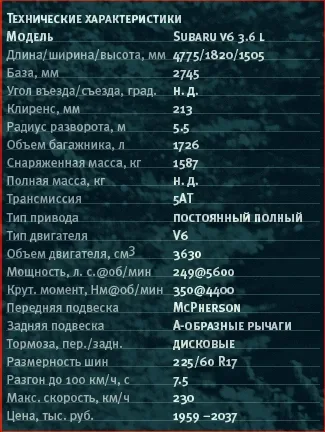
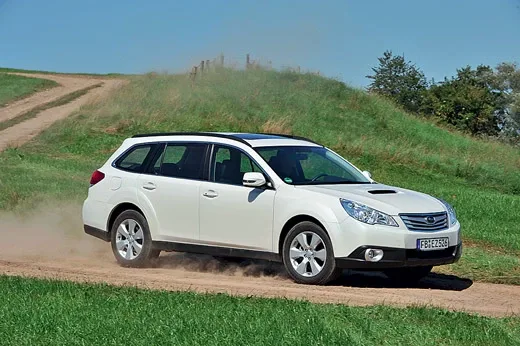
The new Subaru Outback, apparently, has decided not to rest on its laurels. It turns out that it is quite possible to do without the former zest, without the spark, and even without a low-range gear.
LOST IN A GLOOMY FOREST
Why bring journalists to Germany at all? Narrow winding roads outside the city give way to straight autobahns, where you can't feel all the advantages of an all-wheel-drive station wagon. Here it loses to any VW. The real place for a Subaru test is sandy or gravel roads somewhere near Seliger or Ladoga. That's where you can get the most out of this loud all-wheel-drive brand. Instead, we are driving around the German countryside, annoying local drivers. They are no slouches either, especially truckers who pull out onto serpentines in their rigs. You can only pass them by reversing to the nearest turnaround spot.
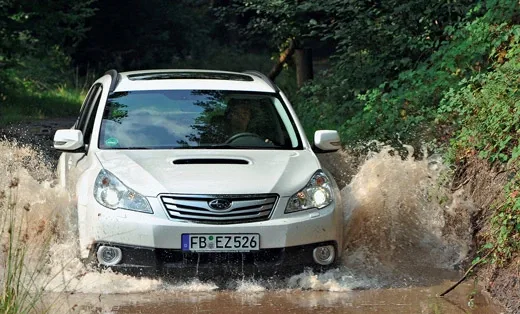
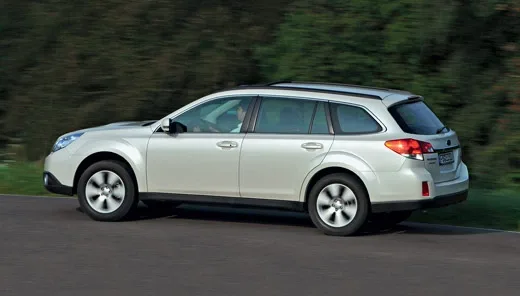
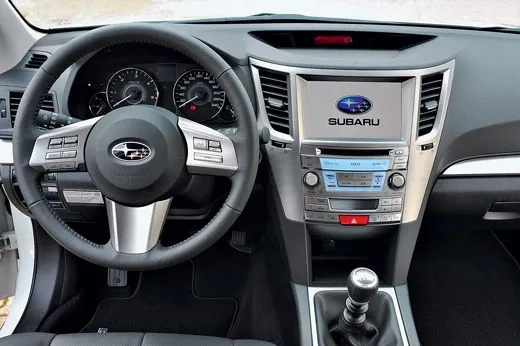
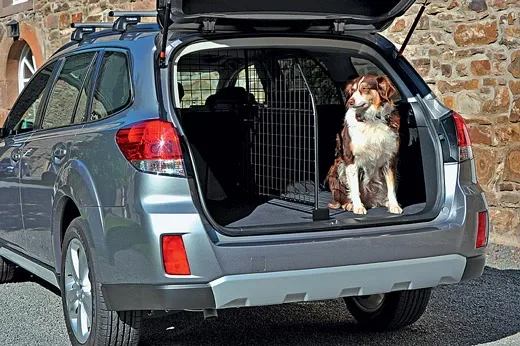
At first, I got the most expensive modification of the Subaru Outback — with a six-cylinder 3.6-liter engine producing 249 horsepower. Alas, despite such power, it's just a family station wagon with 213 mm of ground clearance, nothing more. The interior is no longer as Spartan as the Forester's: there are soft plastic inserts, and the air ducts are neatly spread along the sides of the center console and don't catch the eye. Compared to the previous model, the Outback has become more spacious: the trunk is taller and wider, the cabin is roomier, the distance between seats has increased, and the seats themselves are larger and more comfortable. Subaru also developed a new compact and lightweight CVT and finally used a subframe that reduced vibrations on the body. There's not much more to say. Except that a half-liter plastic bottle fits easily into the pocket of any door...
While other automakers desperately seek their individuality and gimmicks, Subaru in recent years seems to have tried to hide in a gloomy forest, becoming indistinguishable from other Japanese brands. Say, a person was heading to a Nissan dealership but stopped by Subaru on the way. What difference does it make to him? A clever trick to boost sales.
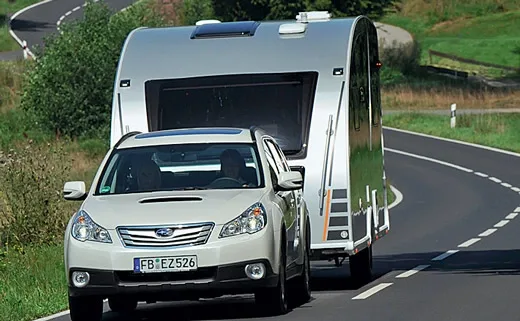
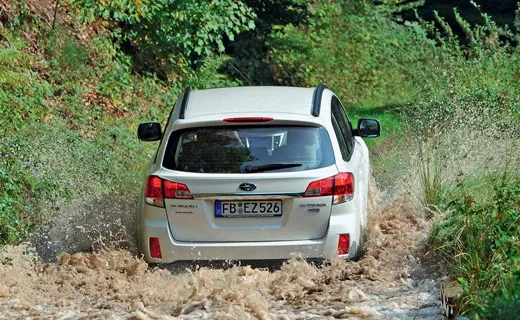
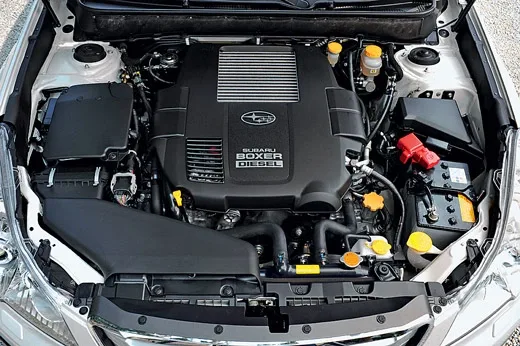
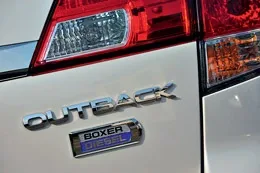
Here they clearly overdid it. Now they have another headache: how to conduct presentations? A test drive is about emotions (otherwise you could just hand out press releases), and after driving on European roads in the current, hopelessly family-oriented Outback, nothing invigorating comes to mind. Except that in Sport mode it flies pretty well, but for racing there's the Legacy or Impreza. And in general, for us, the Outback is interesting precisely for its off-road qualities. So I was eagerly waiting for the version with the two-liter four-cylinder boxer diesel, which produces 350 Nm of torque. "This should be very interesting," Savva Safonov told me in Moscow, "be sure to take it for a spin!" And finally, we have the keys to the diesel boxer in our hands. A colleague from a car magazine takes the wheel first. I settled into the passenger seat and within a minute I'm bombarding him with questions. "Well, how is it? What do you say?" — "You know, the steering isn't as empty as on the 3.6L version." — "That's all?" — "It picks up well from the bottom, but higher up it doesn't pull anymore, you constantly have to shift to second." Twenty kilometers later, I get behind the wheel myself, and everything is confirmed. There are no miracles. The two-liter diesel is a bit weak for the Outback. On a winding road with elevation changes, constantly working the manual gearbox, you feel this especially acutely. By the way, the manufacturer doesn't offer a diesel-automatic combination — such an Outback would probably be too sluggish. Perhaps the diesel boxer can rehabilitate itself off-road, but for now, I only have these impressions.
CVT VIGOR
The diesel version won't be brought to Russia yet: the Japanese are currently testing our fuel. We are only entitled to two versions — 3.6L and 2.5L. The first comes with a five-speed automatic, the second with a CVT or a six-speed manual. The CVT, by the way, gets along well with the high-revving engine, which develops 167 hp at 5600 rpm. Switching to such a car after the diesel, I felt much better: with the characteristic CVT whine, we drove more cheerfully and even, according to the regulations, briefly turned onto a section of German off-road. It turned out that the ground clearance is sufficient, and the electronic assistants work and successfully combat wheel spin.
Subaru traditionally installs several types of all-wheel drive. On models 2.5 and 2.0 D with a 6-speed manual, there is a mechanical center differential with bevel gears with a base torque distribution of 50:50. It is supplemented by a viscous coupling that adjusts power distribution if necessary. On the 2.5 version with a CVT, the role of the center differential is played by an electronically controlled multi-plate clutch. And on the most powerful 3.6L modification with a 5-speed automatic, there is a mechanical planetary center differential (base distribution of 45:55). And most importantly — now the manual transmission no longer comes with a low-range gear. True, it was only 1:1.5 before, but still. At least there is partial deactivation of the stability control system and a hill-hold brake that helps start on an incline.
The powertrains are clear. But what about the chassis impressions? How does the suspension behave? Here I'll have to remain silent. Specifically for Russia, taking into account the condition of our roads, Subaru came up with special suspension settings, which we... were not allowed to try. We drove European versions. They behave quite composedly, roll little, react somewhat stiffly to bumps, but the steering is rather empty, especially on the 3.6L version, most likely due to the new electric power steering.
SWAPPING FOR A CROSSOVER
Today in Russia, the Subaru Outback sells worse than another high-clearance station wagon — the Volvo XC70. And this despite the fact that the Swede is noticeably more expensive. However, for the new Outback with the 2.5L engine, they ask from 1,363,500 rubles, and with the 3.6L engine — already two million. If you abandon the idea of a station wagon with its increased rear overhang and look at regular crossovers, then in this price niche there are plenty of offers. Not to mention special offers on last year's leftovers, which, judging by the volume of advertising, are still plentiful. Moreover, a crossover has an advantage — it is more capable in terms of geometric parameters, and to buy an all-wheel-drive with a cargo compartment, you need to find compelling reasons.

I hope we will meet the new Outback again in the Moscow region and try out the specific settings chosen for Russia. Perhaps on our vast expanses, the Subaru will show itself more spiritedly than in Germany, where every turn hints: maybe it's better to get a VW or BMW?